
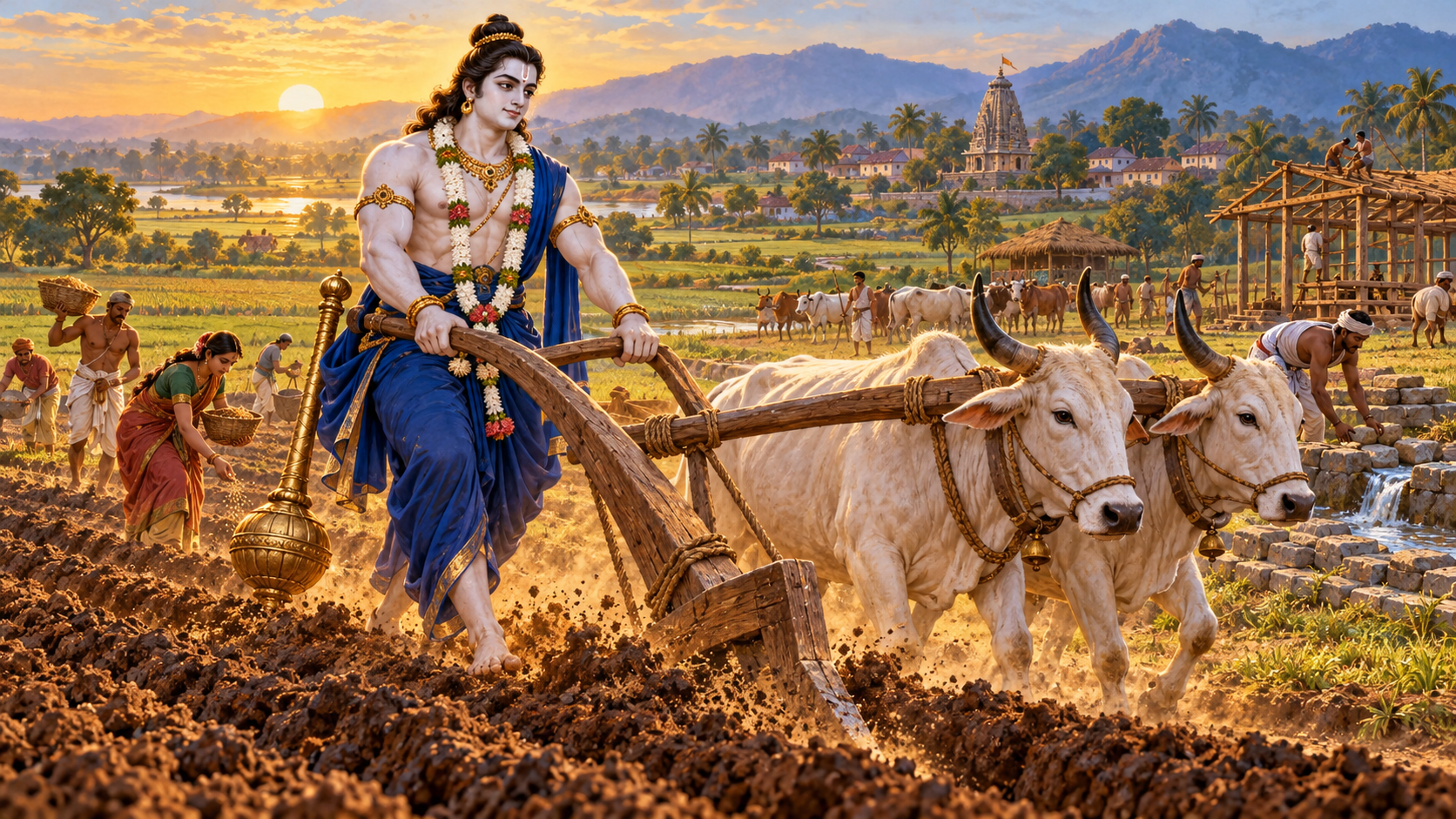
You can recognize force quickly. It defeats an opponent, compels obedience, or breaks an obstacle. The harder question is whether that force leaves anything worth inheriting. That question matters when you judge a leader, defend a tradition, organize a community, or decide what to do with your own anger.
Balarama offers a practical test. In the Dashavatar interpretation that associates him with the plough, he represents the conversion of physical strength into constructive action. The real measure of power is not whether it can strike. It is whether people can live, work, learn, worship, and hand something on after that power has been used.
The plough changes the meaning of power
A plough is not a ceremonial symbol of vague prosperity. It is a working instrument. It cuts the earth, but the cut has a purpose: to prepare a field for growth. It applies force in measured lines. Its value appears later, in what the prepared ground can sustain.
That distinction is central to Balarama’s symbolism. Raw strength asks, “What can I move?” Constructive strength asks, “What should be made possible by moving it?” The first question is about capacity. The second brings capacity under dharma.
Here, civilization need not mean a large state, an impressive building, or material abundance alone. It means durable conditions in which a people can cultivate food, character, knowledge, memory, worship, skill, and mutual obligation. A civilization is strong when these goods can survive the passing of a single powerful person.
- Power becomes responsibility: ability creates an obligation to use it well.
- Possession becomes stewardship: land, wealth, office, knowledge, and influence must be tended, not merely claimed.
- Victory becomes continuity: success is incomplete until the good it secured can be maintained and transmitted.
This is why the plough is a demanding emblem. A weapon can be praised after one dramatic act. Cultivation exposes your discipline season after season. You must return, repair, remove what chokes growth, and accept that worthwhile results may not appear immediately.
Use the plough test before calling something strong
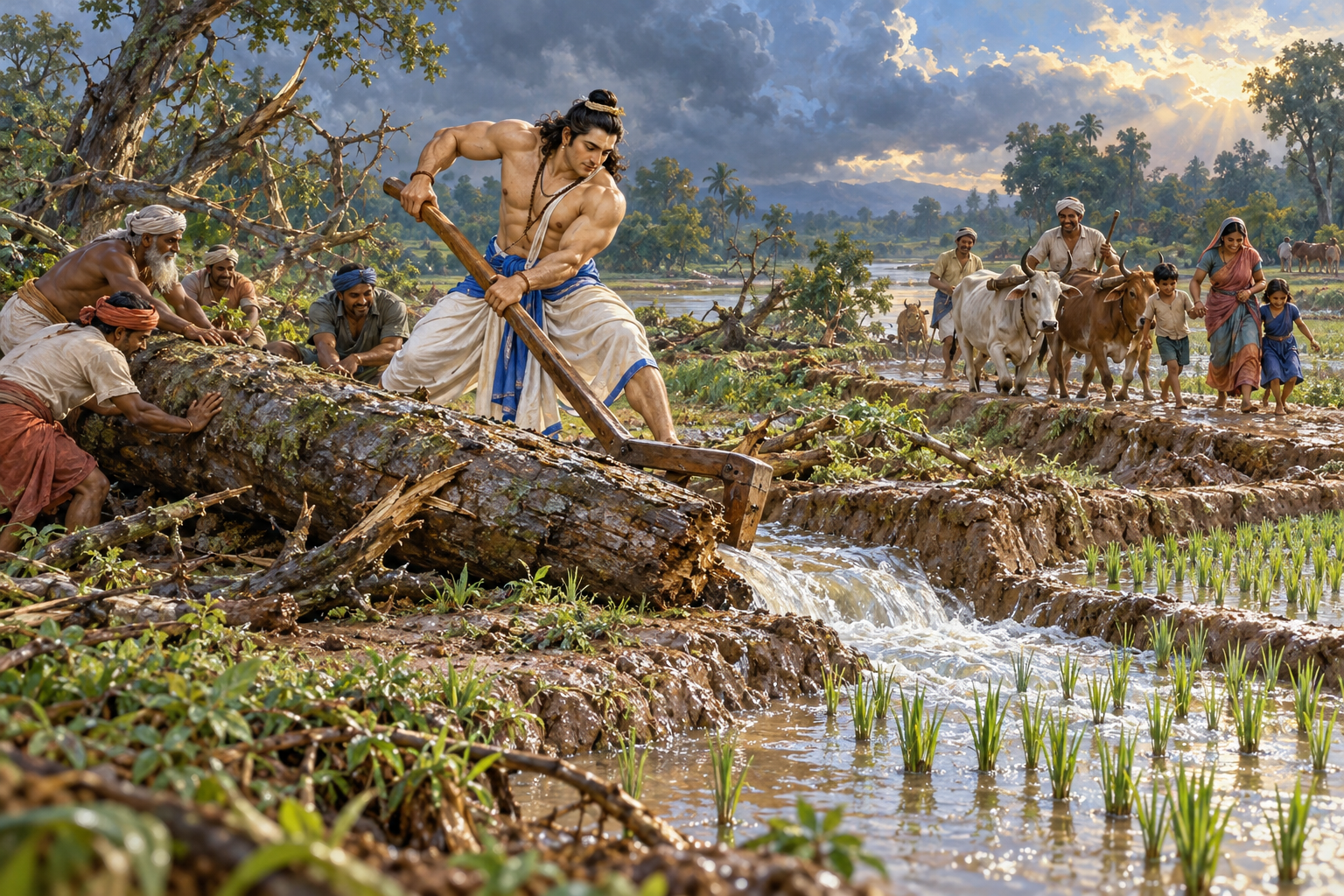
When a person, movement, or institution presents itself as powerful, do not stop at its confidence, reach, or ability to punish. Apply five questions. They turn Balarama’s symbolism into a usable test rather than a decorative ideal.
- What field is being cultivated? Name the concrete disorder being addressed. “Saving society” is too vague. Teaching children a neglected language, restoring reliable temple records, protecting a threatened practice, or helping families perform a duty are identifiable fields.
- What is meant to grow? State the positive good that should exist afterward. If the only answer is that an opponent will be humiliated, the action may express force without producing order.
- Where is the furrow? Constructive strength works within limits. Decide in advance what methods are unacceptable, which people must not be harmed, and when the intervention should end.
- What living ground is already present? A field is not empty merely because it is untidy. Before imposing a solution, notice the relationships, customs, local knowledge, and quiet service already sustaining it.
- Who will tend the result? If everything depends on one energetic organizer, the work is still fragile. Assign responsibility, record the process, teach another person, and create a rhythm that can continue without constant rescue.
Suppose Dharma is attacked online. A firm correction may be necessary, but the plough test asks what your response cultivates. Does it give readers accurate language with which to answer the claim? Does it protect someone being targeted? Does it direct attention toward a text, institution, teacher, or practice that deserves support? Or does it merely convert justified anger into another day of attention for the attacker?
The same test applies inside a cultural organization. A stirring event can awaken interest, but continuity requires contact lists, accounts, schedules, teaching material, assigned roles, and a date for the next gathering. The unglamorous work is not separate from civilizational renewal. It is the furrow in which renewal takes root.
Civilization begins where force accepts duty

Destruction concentrates power into a moment. Construction distributes responsibility across time. That is why civilizational strength often looks less dramatic than confrontation. It appears in the person who keeps a promise, the family that transmits a practice, the teacher who prepares another teacher, and the institution that remains trustworthy after its founder leaves.
This does not make defence unimportant. A field that cannot be protected cannot be cultivated. But protection has a destination. It must open space for ordinary life and higher aspiration: study, worship, livelihood, care, artistic creation, disciplined debate, and the formation of character.
A useful order of action is:
- Protect what is under immediate threat.
- Prepare the conditions in which good work can resume.
- Produce something of lasting value.
- Transmit the knowledge and responsibility required to continue it.
Many efforts stop after the first stage because resistance creates a clear opponent and an immediate feeling of solidarity. Balarama’s plough directs your attention to the morning after the defence succeeds. What will now be taught? Who will be trained? Which neglected duty will be resumed? What will be built that makes the next attack less damaging?
This also clarifies the relationship between physical and moral strength. Physical capacity is not rejected. It is disciplined. Moral intention is not left as a private sentiment. It takes material form in protected places, completed duties, dependable institutions, cultivated land, preserved memory, and people capable of carrying the work forward.
Four distortions can imitate constructive strength
Brute force mistakes resistance for an enemy
A plough must overcome resistance in the soil, but uncontrolled force can destroy the very ground it is meant to prepare. In human affairs, impatience can flatten legitimate disagreement, local knowledge, and personal dignity. Before escalating, identify whether the resistance comes from malice, fear, confusion, exhaustion, or a reasonable concern. Different causes require different tools.
Passivity disguises itself as peace
Constructive action is not the avoidance of conflict. A plough does not preserve the field exactly as it found it. There are times when disorder must be interrupted, a boundary enforced, or a neglected duty reassigned. The practical question is whether the firmness is proportionate and directed toward restoration. Refusing every difficult intervention does not protect harmony; it can leave the responsible person carrying an unfair burden.
Productivity detaches itself from dharma
More output is not automatically better cultivation. An organization can publish constantly while teaching little, hold crowded events while forming no successors, or demand so much from volunteers that service becomes unsustainable. Measure the good actually being produced. If the work weakens families, exhausts dependable people, or lowers standards merely to remain busy, change the method rather than praising the volume.
Nostalgia praises fields no one is tending
Admiration for inherited civilization becomes sterile when it produces no present duty. If a text matters, arrange a reading circle or support careful teaching. If a temple tradition matters, learn what maintenance it requires. If family memory matters, record names, practices, and accounts while elders can still explain them. Reverence becomes constructive when it accepts a task.
Key takeaways: cultivate one field within your reach

- Choose one field: a family obligation, study practice, local institution, cultural archive, neglected relationship, or place of worship. Do not begin with “civilization” as an unlimited project.
- Name one visible result: a completed record, a cleaned and usable space, a scheduled class, a resolved responsibility, or a procedure another person can follow.
- Set a dharmic boundary: write down what you will not sacrifice to obtain the result, including truthfulness, dignity, financial honesty, or the health of the people doing the work.
- Perform the obstructed step first: make the call, open the account book, gather the material, ask for the missing instruction, or assign the unclaimed duty.
- Leave a furrow for the next person: document what you did, identify the next action, and give someone else enough knowledge to continue.
Begin within the next day, but begin at the right scale. Select one area where your strength can create order without requiring applause. Complete the first difficult step, then make continuation easier than neglect. That is how Balarama’s plough moves from sacred image to lived civilizational practice.
References

Leave a Reply
You must be logged in to post a comment.