
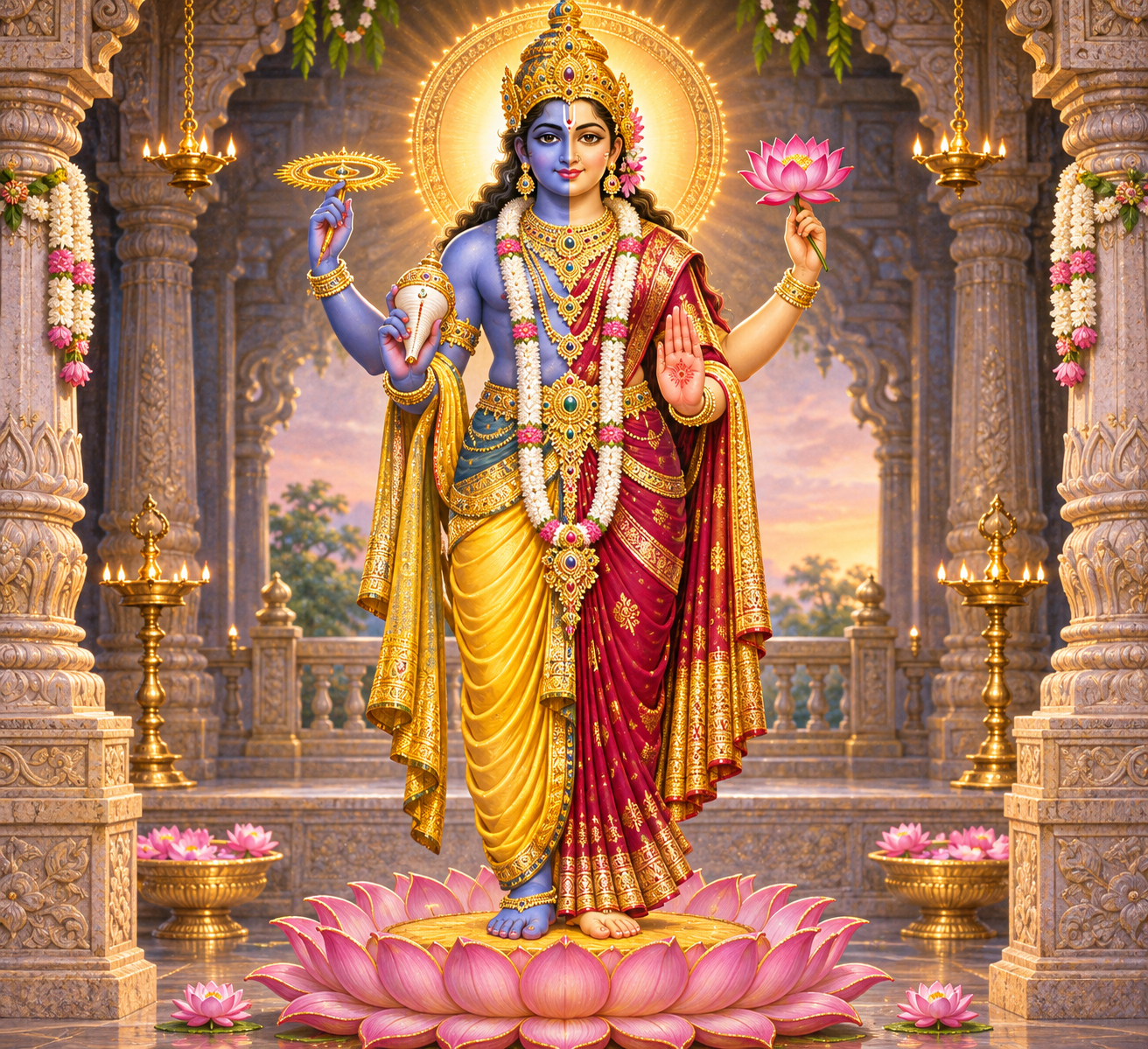
You may have encountered a sacred image that appears divided between Vishnu and Lakshmi and wondered whether it is a Vaishnava version of Ardhanarishvara. The identification matters. This is not merely a portrait of a divine couple standing unusually close together. It is Ardha Lakshmihari: Vishnu and Lakshmi made visible in one composite body.
Once you recognize the form, the more useful question is not simply, “Who is this?” It is, “Why must these two be shown as one?” The answer opens a practical way of thinking about dharma, prosperity, responsibility, and the relationships we too easily separate.
The name tells you what kind of image you are seeing
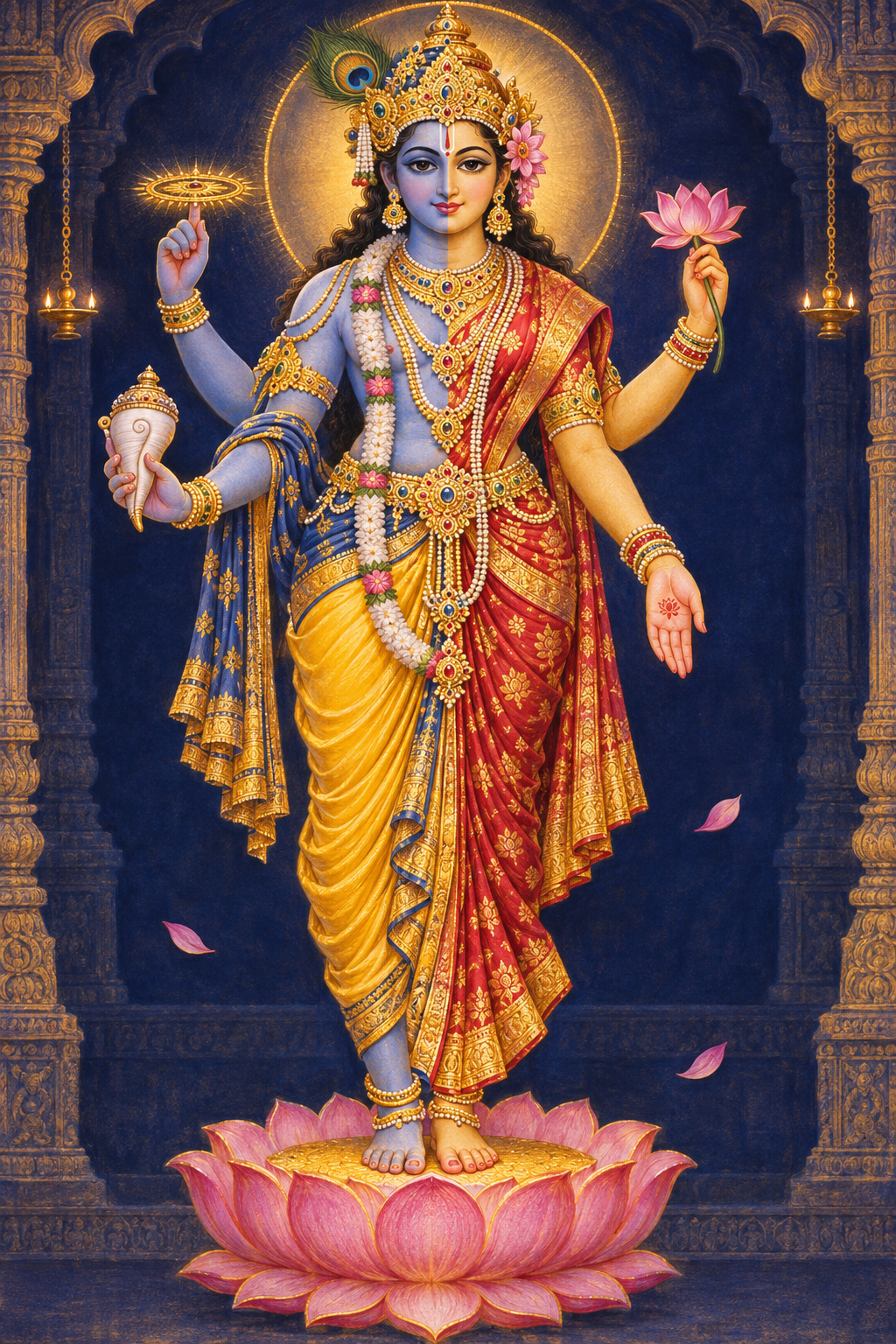
Ardha Lakshmihari is a unified form of Lakshmi and Hari, a familiar name of Vishnu. The word ardha means half, but the sculpture should not be read as two incomplete deities mechanically joined at the centre. Each identifiable half reveals one presence within a single sacred form.
The same composite is also known as Vaikuntha-Kamalaja, Ardhanari Narayana, and Vasudeva Kamalaja. These names can look like a list of separate deities when you first meet them. In this context, however, they identify the same central theological vision: Bhagavan Vishnu and Devi Lakshmi are represented together in one body.
If you are identifying an unfamiliar sculpture, do not rely on the divided body alone. Record the name on the temple, museum, catalogue, or photograph; note any stated provenance; and look for an explicit identification of both Lakshmi and Vishnu. When the object is unlabelled and its context is missing, describe it as a possible identification rather than presenting a guess as certainty. Composite iconography is meaningful precisely because the identity of each participating form matters.
Read the form as a relationship, not a visual puzzle
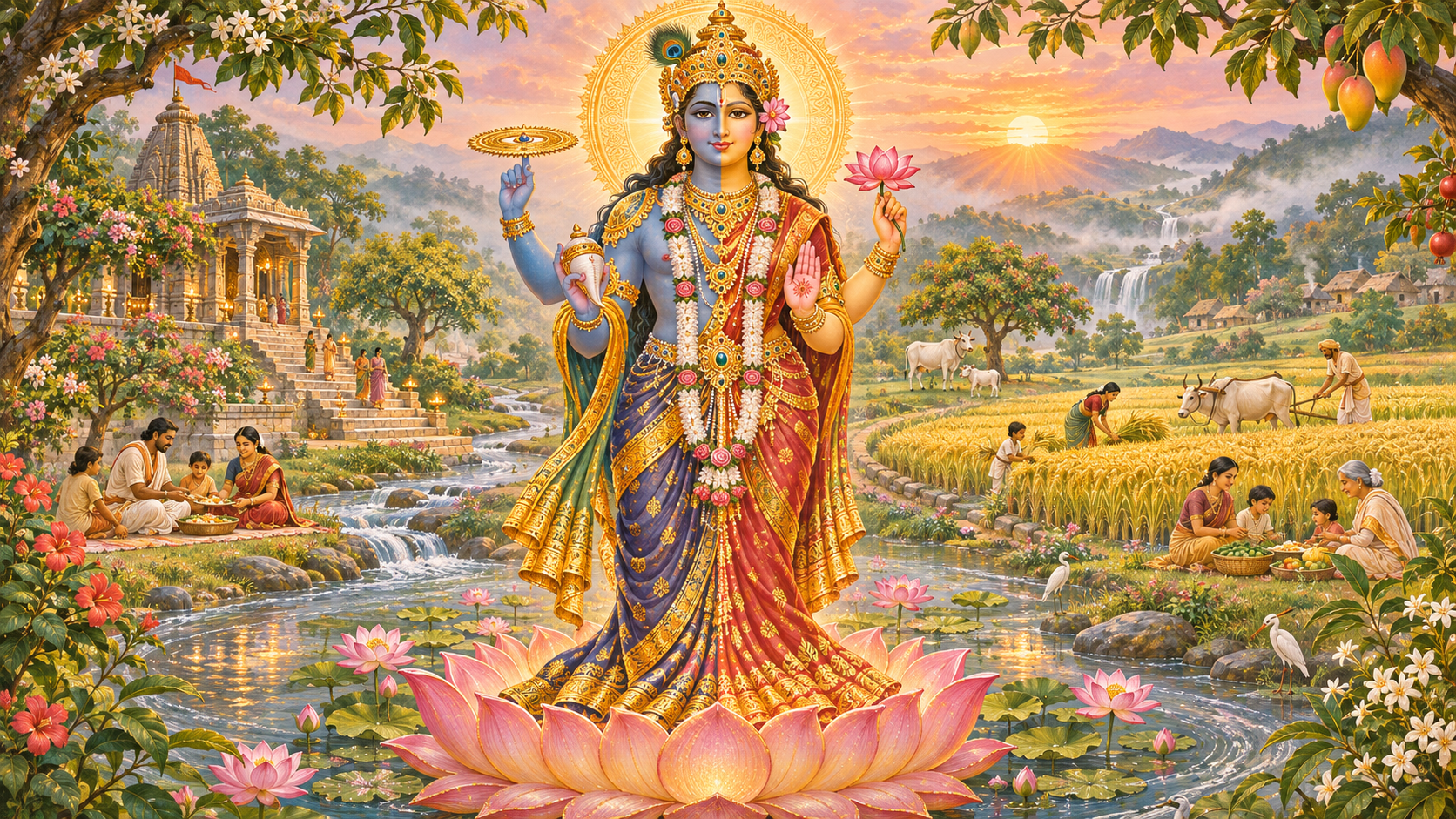
The central fact is visible before any philosophical explanation begins: neither Vishnu nor Lakshmi has been placed outside the other. Lakshmi is not a small attendant at Vishnu’s feet, and Vishnu is not merely standing beside his consort. Their relationship determines the structure of the image itself.
This changes how you should look. Do not search for the “main” half and treat the other as decoration. Start with the entire figure. Then notice how the two identities remain distinguishable without becoming separable. Difference has not been erased, yet unity has not been postponed until the differences disappear.
That visual grammar gives the form its force. Vishnu is associated with the sustaining of cosmic order and dharma. Lakshmi signifies auspiciousness, plenitude, beauty, and well-being; reducing her to money alone misses much of her significance. Their union therefore permits a disciplined reflection: order must support flourishing, while prosperity must remain aligned with dharma.
This is not a licence to turn the murti into a slogan. It is a way to let the icon correct two common errors. The first is to pursue wealth as though its mere accumulation makes it auspicious. The second is to praise stability while ignoring whether anyone can flourish within it. Ardha Lakshmihari holds the two tests together.
You can apply that test to ordinary decisions. Before calling a financial choice successful, ask whether it preserves trust, family duties, and honest conduct. Before defending a rule in the name of order, ask whether it protects the well-being that order is meant to sustain. The form does not supply an automatic answer, but it gives you a better question.
Ardha Lakshmihari is not Ardhanarishvara
The resemblance between the names can cause confusion, especially when Ardha Lakshmihari is called Ardhanari Narayana. Both forms use a composite body to express divine unity, but they do not unite the same deities.
| Point of identification | Ardha Lakshmihari | Ardhanarishvara |
|---|---|---|
| Divine union | Vishnu and Lakshmi | Shiva and Parvati |
| Vaishnava names you may encounter | Vaikuntha-Kamalaja, Ardhanari Narayana, Vasudeva Kamalaja | Not applicable |
| First interpretive question | Why are Vishnu and Lakshmi inseparable? | Why are Shiva and Shakti inseparable? |
This distinction is not sectarian bookkeeping. Replacing one pair with another changes the theological relationship being contemplated. If a label clearly identifies Lakshmi and Vishnu, calling the image Ardhanarishvara because that name is more familiar obscures what the image is actually saying.
The description “androgynous” can be useful at the level of visible form, but it is not a complete interpretation. Ardha Lakshmihari joins masculine and feminine divine identities, yet its meaning cannot be exhausted by a modern category of biological sex or personal gender identity. A contemporary viewer may find additional meaning through those questions. The responsible approach is to distinguish that personal or modern reflection from the tradition-specific identification of Lakshmi and Vishnu.
Nor should the image be made to prove every claim we might wish to make about social relations. Its strongest statement is already substantial: distinction does not require separation, and unity need not destroy distinction. Begin there before attaching a larger political or social argument to it.
A practical way to contemplate Ardha Lakshmihari
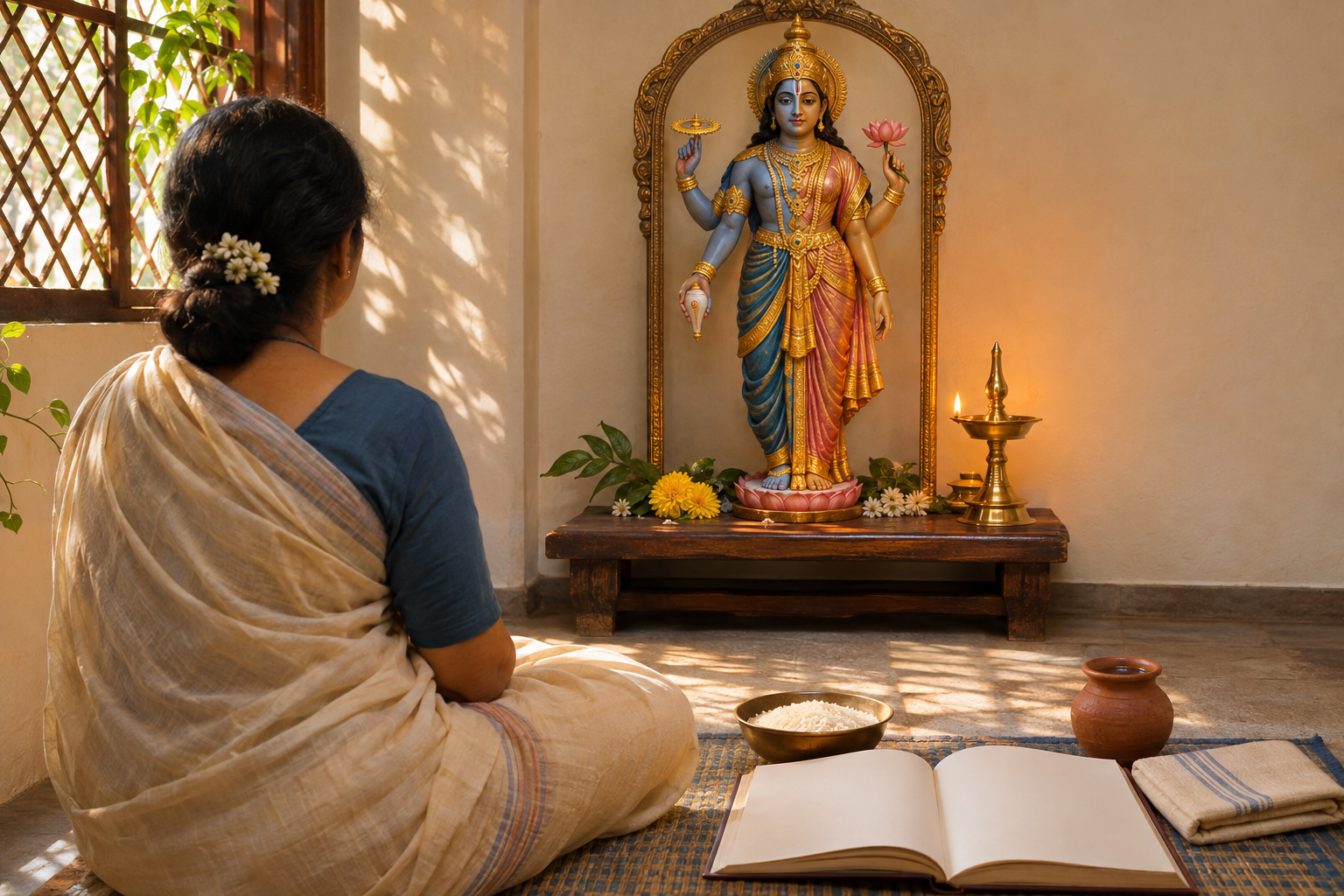
You do not need to invent a ritual, mantra, or claim of scriptural authority to learn from this form. If you want formal worship, follow the practice of the relevant temple, sampradaya, or qualified teacher. For personal contemplation, use the image more simply:
- Name both presences. Look at the complete form and consciously identify Vishnu and Lakshmi. This prevents the familiar deity from pushing the less familiar half into the background.
- Notice unity before opposition. Observe that the image permits distinction without portraying competition. Do not begin by asking which side dominates.
- Bring one real decision before the form. Choose a decision involving livelihood, family responsibility, institutional order, or the use of resources. Avoid contemplating “life” in the abstract.
- Apply both tests. Ask whether the choice sustains dharma and whether it enables rightful flourishing. If it satisfies only one test, identify what has been excluded.
- Make one correction. Change the decision, repair a neglected duty, reconsider the use of money, or acknowledge the person whose contribution you treated as secondary.
This exercise is especially useful for householders because spiritual responsibility and material life cannot be sealed into separate rooms. Earning, spending, maintaining a home, caring for dependants, and supporting sacred or community institutions all join questions of order with questions of abundance. Ardha Lakshmihari asks you to examine that joining consciously.
The form can also correct how we speak about Lakshmi. If prosperity is discussed only as acquisition, Lakshmi becomes a symbol for getting more. If Vishnu’s sustaining role is discussed only as authority, preservation becomes mere control. Their single body encourages a fuller standard: resources should serve a life worth sustaining, and order should protect conditions in which auspiciousness can arise.
Questions readers commonly bring to the form
Is Ardha Lakshmihari simply another name for Ardhanarishvara?
No. The compositional idea is comparable, but the divine pair is different. Ardha Lakshmihari unites Lakshmi and Vishnu. Ardhanarishvara unites Parvati and Shiva. Use the specific name when identifying the image.
Are Vaikuntha-Kamalaja and Vasudeva Kamalaja separate forms?
In the context of Ardha Lakshmihari, Vaikuntha-Kamalaja, Vasudeva Kamalaja, and Ardhanari Narayana are alternative names for the composite union of Vishnu and Lakshmi. Do not assume that a change of name automatically means a different deity. Check the context in which the name is being used.
Does the unified body make Lakshmi subordinate to Vishnu?
The visual structure points in the opposite direction: Lakshmi is integral to the manifested form rather than added as an external accessory. That does not settle every theological question across every Vaishnava school, but it does mean you should not begin your reading by treating her half as ornamental.
What should you remember when viewing the sculpture?
Look at the whole before examining the halves. Identify the divine pair accurately. Then ask what changes when preservation and prosperity, dharma and flourishing, are understood as mutually connected rather than as separate pursuits.
Let the unified form change one divided decision

The next time you encounter Ardha Lakshmihari, pause before moving on to the more familiar images nearby. Name Lakshmi and Vishnu, look again at the single body, and bring one unresolved decision into that field of vision. If your idea of prosperity damages what you are responsible for sustaining, or your idea of order leaves no room for rightful flourishing, the image has shown you exactly where to begin the correction.
References

Leave a Reply
You must be logged in to post a comment.