
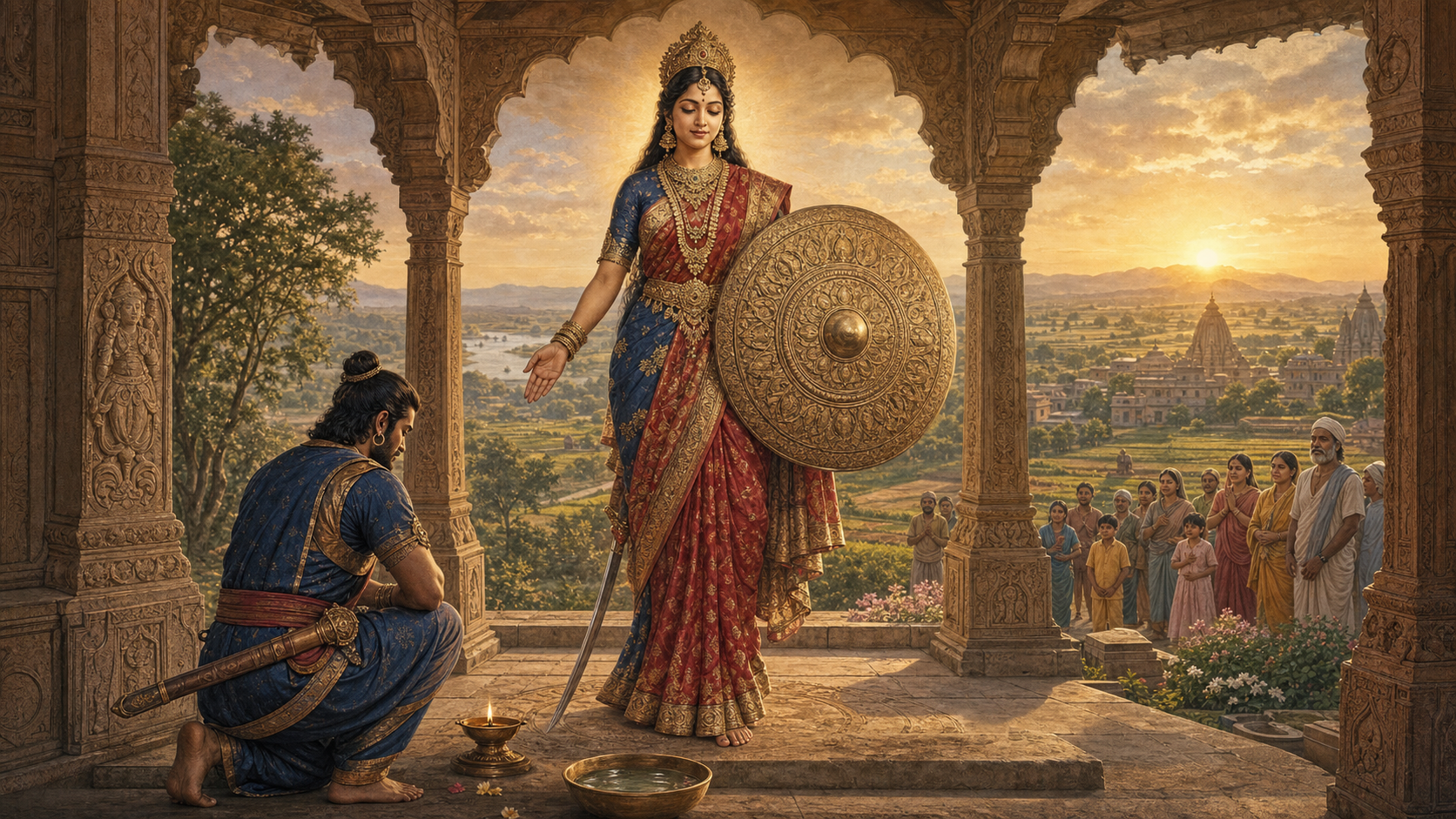
If you have wondered whether worship of Aparajita glorifies battle, do not begin with the sword in her hand. Begin with the obligations placed on the person who would use one. The central question is not whether force appears in the tradition, but whether force remains answerable to protection, restraint, and a just end.
This distinction helps you make sense of victory rites, Ayudha-puja, warrior hymns, and protective deities without romanticizing violence. It also prevents the opposite mistake: treating every Dharmic call to courage as an embarrassment that must be explained away. Aparajita offers a harder standard. You must be capable of confronting adharma, yet unconquered by fear, anger, cruelty, or the intoxication of victory.
What Aparajita actually makes invincible
Aparajita means the unconquered or invincible. Within the broad Shakta tradition, the name functions both as an epithet and as a devotional form closely associated with Durga and Mahishasuramardini. Her multiple arms and astras express sovereign power, while her gestures of abhaya and varada communicate fearlessness, protection, and beneficence. You misread the image if you isolate the weapons from those open hands.
The combination matters. A weapon can stop a threat, but it cannot decide what deserves protection. Strength can win an encounter, but it cannot make its purpose righteous. By placing arms, fearlessness, and protection in one sacred image, Aparajita joins the capacity to fight with the duty to preserve order.
This produces two meanings of victory. The outward meaning is the defeat of a danger that threatens a polity or community. The inward meaning is mastery over the impulses that corrupt a defender: panic, hatred, vanity, vengeance, and the desire to dominate. The two cannot be separated safely. A person defeated inwardly may possess superior arms and still turn a legitimate responsibility into adharma.
When you encounter an image or rite of Aparajita, therefore, ask four practical questions:
- Who or what is being protected?
- What limits are imposed on the exercise of power?
- What inner disorder must the defender master before acting?
- What condition will count as the restoration of order, allowing force to end?
If those questions disappear, invincibility has been reduced to domination. Aparajita is more demanding than that. Her victory must leave the protector morally capable of putting the weapon down.
The rite turns victory into a chain of accountability
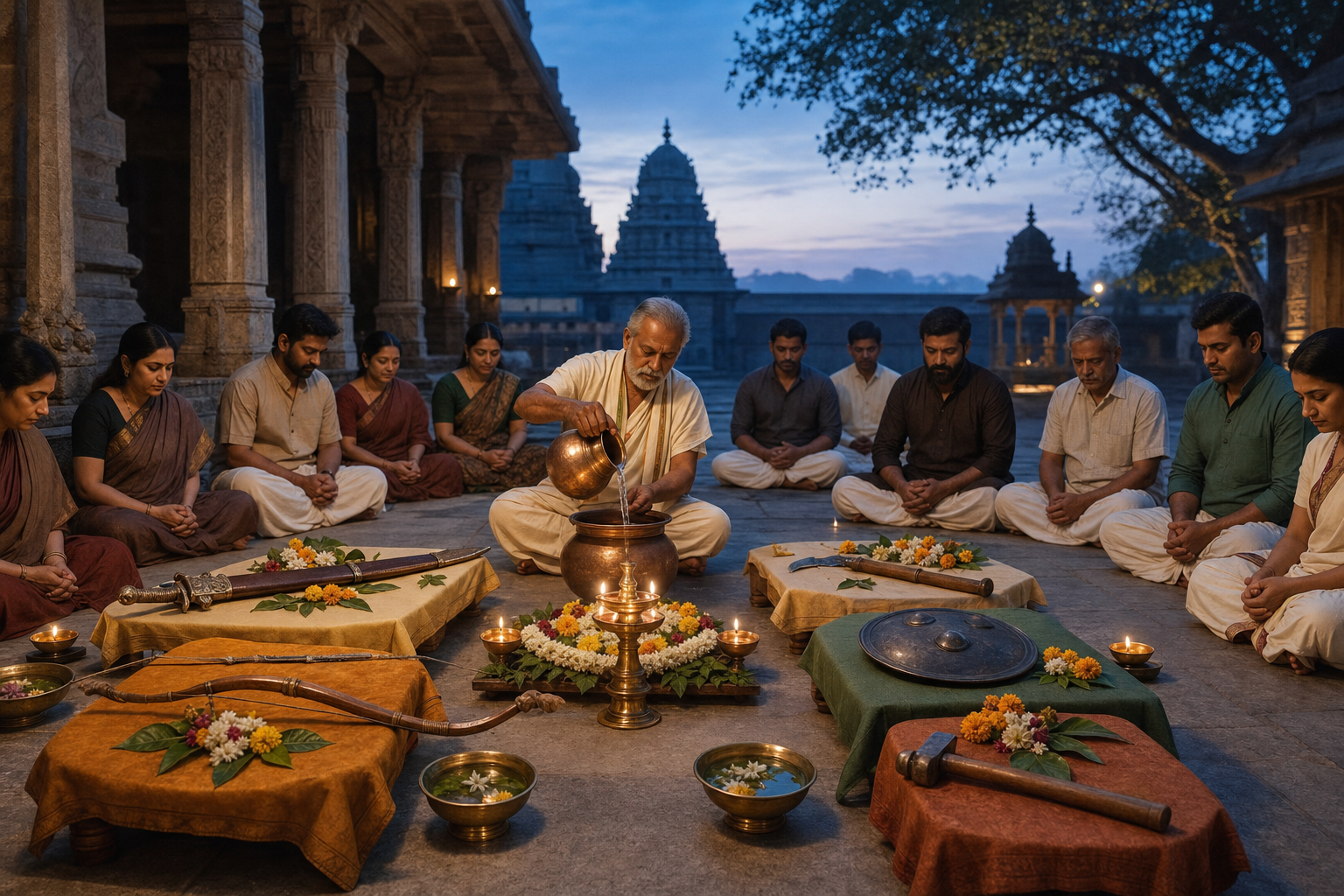
Aparajita-puja was not one uniform ceremony followed identically in every region. Smarta and Shakta paddhatis, royal practice, family custom, and local lineages preserved different forms. The recurring structure is nevertheless clear: purpose, person, instrument, timing, action, and return were brought under discipline.
That structure can be read as a sequence of moral checks:
- Choose the moment deliberately. Campaign preparations could involve a muhurta such as Abhijit or Vijaya, considered alongside tara-balam, chandra-balam, and regional Choghadiya calculations. Whatever view you take of jyotisha, the practical effect was to interrupt impulsive action and synchronize a collective undertaking.
- Set apart a disciplined space. The ritual ground was delimited, and a consecrated kalasha represented the presence of Devi. The commander did not approach war as a purely private act of appetite.
- State the purpose. The sankalpa named aims such as loka-samgraha, social stability; raksha, protection; and vijaya, righteous triumph. This made the declared end part of the rite rather than an excuse supplied after the fact.
- Order the person who will act. Purification, acamana, prana-pratistha, and nyasa aligned body, mantra, and intention. Recitations associated with the Devi Mahatmya and victory stutis directed attention toward disciplined courage rather than uncontrolled aggression.
- Consecrate the means. In astra-puja, swords, bows, standards, armor, and other implements could be cleaned, anointed, garlanded, and blessed. A brief homa for protection sometimes accompanied the rite. The implement was treated as a trust, not as an independent source of glory.
- Cross the threshold consciously. Navaratri and Vijaya Dashami observances could include Ayudha-puja, Shami worship, Aparajita-puja, and simollanghana, the symbolic crossing of a boundary. The crossing represented resolved courage, not the erasure of every moral boundary.
- Close the cycle. Thanksgiving after safe return redirected attention from triumphal display to restored daily life. Victory remained incomplete until the disruption of mobilization gave way to social stability.
The sequence contains a useful insight for your own reading of sacred warfare: ritual timing was not a substitute for ethical judgment, and weapon worship was not a magical permission slip. A favorable muhurta could not make an unjust objective just. A garlanded sword could not purify cruelty. The point was to place both commander and instrument inside a larger order of responsibility.
You can see the same principle in household Ayudha-puja. Families clean and honor the implements through which they work and serve. A tool placed before Devi is no longer merely something you control; it becomes something whose use you must justify. The more power an instrument gives you over another person, the more concrete that obligation should become.
If you want to observe this meaning at home, do not treat a short description as a universal liturgical manual. Mantra, nyasa, and other specialized elements belong to particular paddhatis and lineages. Follow your family custom or guidance from a qualified temple or teacher. The accessible core is simpler: clean the tools of your duty, place them respectfully, offer the customary lamp and flowers, and state plainly how their use will protect rather than exploit.
Dharma-yuddha is a test of legitimacy, not a label
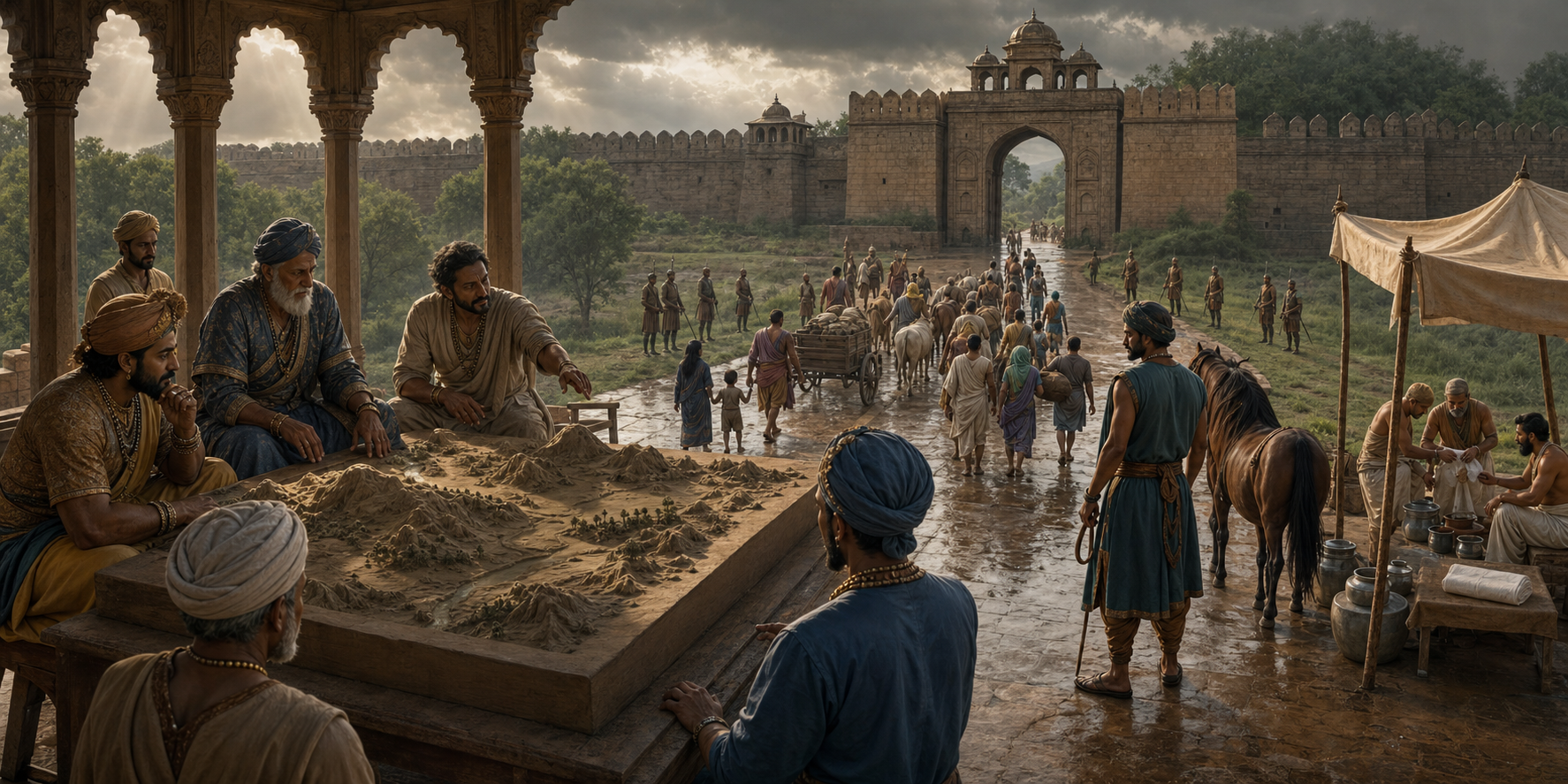
Calling a conflict dharma-yuddha does not make it one. The label has moral content only when it restricts conduct. Rules associated with epic and dharmashastra memory include protection of noncombatants, prohibitions on attacking an unarmed person, and objections to night combat without a declared cause. These norms do not prove that every historical ruler obeyed them. They show the standard against which the use of force was meant to be judged.
That difference between an ideal and actual conduct is essential. Sacred language can discipline power, but it can also be misused to disguise ambition. You should therefore test the action itself rather than accepting the vocabulary surrounding it.
The Arthashastra’s familiar sequence of sama, dana, bheda, and danda supplies another useful lens. Peaceful persuasion and diplomacy, accommodation or calibrated inducement, strategic division, and finally coercive force form a ladder in which danda is not the first reflex. The framework does not turn statecraft into sentimental pacifism. It demands that leaders understand force as one instrument within a wider strategy for securing order.
Before describing any exercise of power as Dharmic, run it through this five-part test:
- Protective end: Is the declared aim the defense of people and social order, or the expansion of prestige, revenge, or appetite?
- Last-resort discipline: Have nonviolent and non-military measures been seriously considered, or was danda chosen because it was emotionally satisfying?
- Limits on conduct: Do restraints survive after the conflict begins, especially toward the unarmed and those outside the fight?
- Defined stopping point: Is there a recognizable condition in which protection has been restored, or does the objective expand whenever success approaches?
- Accountable return: Will those who exercised power answer for their methods, repair avoidable damage, and return authority to ordinary civic life?
No puja can convert predation into protection. No invocation can absolve a leader who deliberately removes every limit. Aparajita-puja gives force religious gravity precisely because the wielder stands under judgment. The warrior asks for fearlessness, but also accepts that courage without self-command is dangerous.
This is why victory cannot mean limitless humiliation of a defeated opponent. Within the Aparajita ethos, vijaya points toward the restoration of a sustainable order. Thanksgiving and return are not decorative endings; they reveal the purpose of the campaign. If ordinary life cannot resume, the moral task remains unfinished.
Dharmic traditions meet on discipline, not identical doctrine
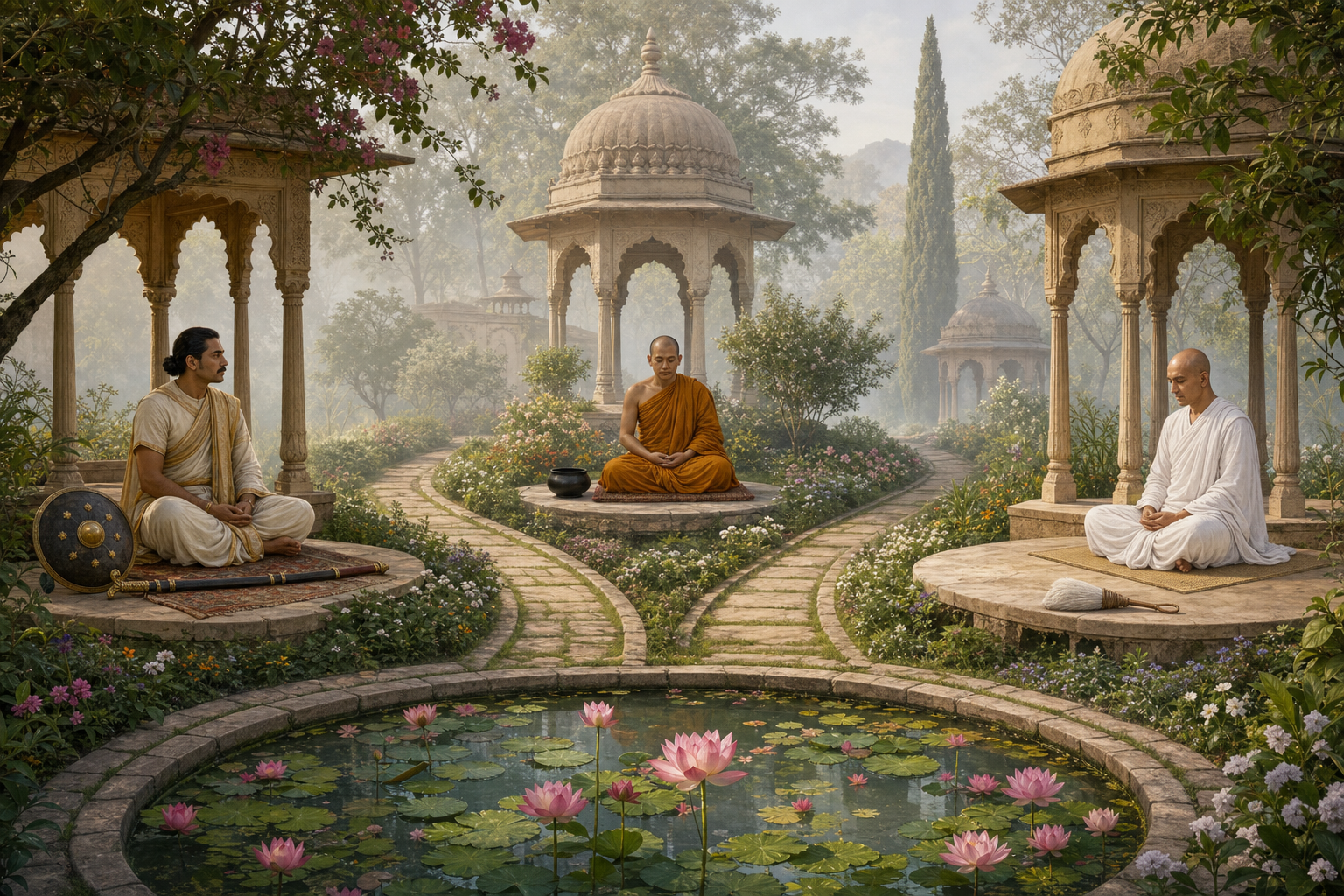
Hindu, Sikh, Buddhist, and Jain traditions all contain resources for thinking about courage, protection, restraint, and self-mastery. That family resemblance should not be turned into a claim that the traditions teach the same theology or authorize force in the same way.
- In the Aparajita-centered Hindu frame, Shakti supplies the power to confront chaos while dharma governs its purpose. Kshatra Dharma concerns the responsibility to protect, and the inner conquest of fear and passion qualifies the outward pursuit of victory.
- In Sikh heritage, compositions such as Chandi di Var give forceful expression to righteous courage under divine will. This belongs within Sikh religious memory and should not be casually recast as an extension of Shakta ritual merely because martial imagery appears in both.
- In Buddhist practice, protective invocations associated with Tara and other guardians join fearlessness to compassion. Protection cannot be understood responsibly if compassion is treated as an optional sentiment added after danger has passed.
- In Jain teaching, ahimsa and the conquest of the self challenge any easy identification of victory with defeating another person. The enduring adversaries are the passions that keep violence reproducing itself.
The shared ground is therefore not a single theory of war. It is a civilizational refusal to let raw power define its own moral purpose. Hindu Kshatra Dharma, Sikh righteous courage, Buddhist compassionate fearlessness, and Jain self-conquest place different emphases on the problem. Each asks, in its own vocabulary, whether the acting person has mastered the forces within that make external power destructive.
This distinction gives you a reliable way to read Dharmic martial language. First identify the tradition speaking. Then ask what the ultimate authority is, what counts as the true enemy, which restraints govern action, and what kind of victory is considered final. Similar symbols may carry different doctrinal weight. Respect begins by allowing those differences to remain visible.
The Jain reminder is especially useful when interpreting Aparajita. It does not erase the Hindu obligation to protect, but it sharpens the inward half of invincibility. A person who wins territory while remaining ruled by rage is not unconquered. The Buddhist joining of fearlessness and compassion tests the emotional quality of protection. The Sikh subordination of courage to divine will tests personal ego. These are not interchangeable teachings, but they can expose the same recurring danger: the defender beginning to resemble the disorder being resisted.
Carry the Aparajita discipline into public and personal life

You do not need to command an army to face the ethical problem represented by Aparajita. Political authority, community leadership, institutional power, professional tools, and public speech all give one person the capacity to affect others. The form changes; the need to bind power to a declared purpose does not.
Before entering a serious conflict, write a plain-language sankalpa. Do not settle for a slogan such as defeating evil. Complete these statements instead:
- We are acting to protect __________.
- We will not use __________, even if it offers an advantage.
- We will stop when __________ has been restored.
- We will answer to __________ for our conduct.
The blanks expose weak motives quickly. If you cannot name the people being protected, the action may be about status rather than service. If no method is off-limits, dharma has already been displaced by expediency. If there is no stopping condition, victory has become an appetite. If nobody can demand an account afterward, the claimed protector has placed himself above the order he invokes.
During the conflict, use the logic of astra-puja as a restraint. Ask what the instrument was entrusted to you to do. A public office is not a trophy. A professional tool is not a license for carelessness. Speech that mobilizes a community is also a form of power; dedicating it to protection is meaningless if you use it to spread falsehood, collective blame, or dehumanization.
Where an actual security threat or possible physical violence is involved, historical ritual is not operational guidance. Follow applicable law, established safety procedures, and trained authorities. Aparajita’s value in that situation is ethical orientation: clarity of protective purpose, control of fear and anger, restraint toward those outside the threat, and accountability for what follows.
After a conflict, create a real return ritual. Express gratitude, account for what was done, repair what can be repaired, and release emergency habits that no longer serve. This mirrors the traditional movement from mobilization to thanksgiving. Without that closure, a person or institution can remain psychologically mobilized long after the danger has ended, continually searching for another enemy.
Navaratri, Ayudha-puja, and Vijaya Dashami provide a natural annual occasion for this examination. When you clean and honor the tools of your work, tell younger family members not only what each tool does but whom its proper use serves. That turns a household custom into ethical education. The lesson is memorable because it is concrete: strength is kept clean, placed before a higher authority, and returned to service.
Key takeaways
- Aparajita represents outward protection joined to inward mastery; invincibility without self-command is not her full meaning.
- Aparajita-puja binds purpose, practitioner, instrument, timing, and return into one chain of accountability.
- Dharma-yuddha is measured by protective aims, attempted alternatives, limits on conduct, a defined stopping point, and responsibility afterward.
- Hindu, Sikh, Buddhist, and Jain traditions share concerns about disciplined power without teaching an identical doctrine of warfare.
- Ayudha-puja remains useful when the honored tool is accompanied by a specific vow about service, restraint, and accountability.
At your next Ayudha-puja, pause before lighting the lamp and write one sentence naming whom your work protects, what you refuse to do with its power, and how you will put matters right if you misuse it. That sentence is where the ancient discipline of Aparajita becomes a living one.