

If you feel drawn to Shiva while your family worships Vishnu, or you revere Devi but enter a temple dedicated to Ganesha, you may wonder whether spiritual integrity requires you to choose one form and quietly downgrade the rest. The question becomes sharper when Advaita tells you that reality is ultimately non-dual.
Adi Shankaracharya offers a demanding alternative to both sectarian rivalry and vague universalism: worship a particular deity wholeheartedly, but do not turn that relationship into a claim that the limitless reality belongs exclusively to your preferred form.
The apparent contradiction is the heart of the teaching
Advaita Vedanta locates final reality in Brahman and denies any ultimate separation between the individual self and that reality. Yet Shankaracharya is also associated with devotional hymns to Ganesha, Murugan, Shiva, Vishnu and Devi. He did not treat devotion or murti worship as an embarrassing concession that serious seekers should outgrow as quickly as possible.
The tension eases once you notice that metaphysical inquiry and devotional practice answer different questions. Metaphysical inquiry asks: What is ultimately real? Devotion asks: How should this embodied person direct attention, love, gratitude and surrender?
- At the level of ultimate truth, reality cannot be divided into rival absolutes competing for territory.
- At the level of spiritual practice, a name, form and relationship give your scattered mind a definite direction.
- At the level of community, distinct forms preserve inherited modes of worship rather than dissolving every tradition into an abstract formula.
Confusion begins when a statement from one level is used to cancel another. Saying that Brahman is non-dual does not mean that a Shiva murti, a Vishnu hymn and devotion to Devi must feel identical. Conversely, experiencing a deep bond with one deity does not establish a second, competing ultimate reality.
Unity does not make the divine forms disposable

A common misuse of non-duality is the sentence, “They are all the same,” delivered as if names, forms and traditions were superficial clutter. That sounds inclusive, but it can become dismissive. The devotee does not ordinarily love an interchangeable theological category. The devotee loves Shiva as Shiva, Krishna as Krishna, Devi as Devi or Ganesha as Ganesha.
Form gives devotion its grammar. It allows praise to become specific, ritual attention to become steady and surrender to become personal. Non-duality places that specificity within an unlimited horizon; it does not erase it.
This is why devotional pluralism is not the claim that every doctrine says exactly the same thing. Shaiva, Vaishnava and Shakta traditions can describe the divine, liberation and worship differently. Respect does not require pretending those differences are imaginary. It requires refusing to convert difference into contempt.
You can therefore say, “This is the form through which I worship most deeply,” without adding, “Every other form is false, inferior or merely symbolic.” The first sentence establishes commitment. The second turns commitment into possession.
Use three tests to distinguish pluralism from confusion
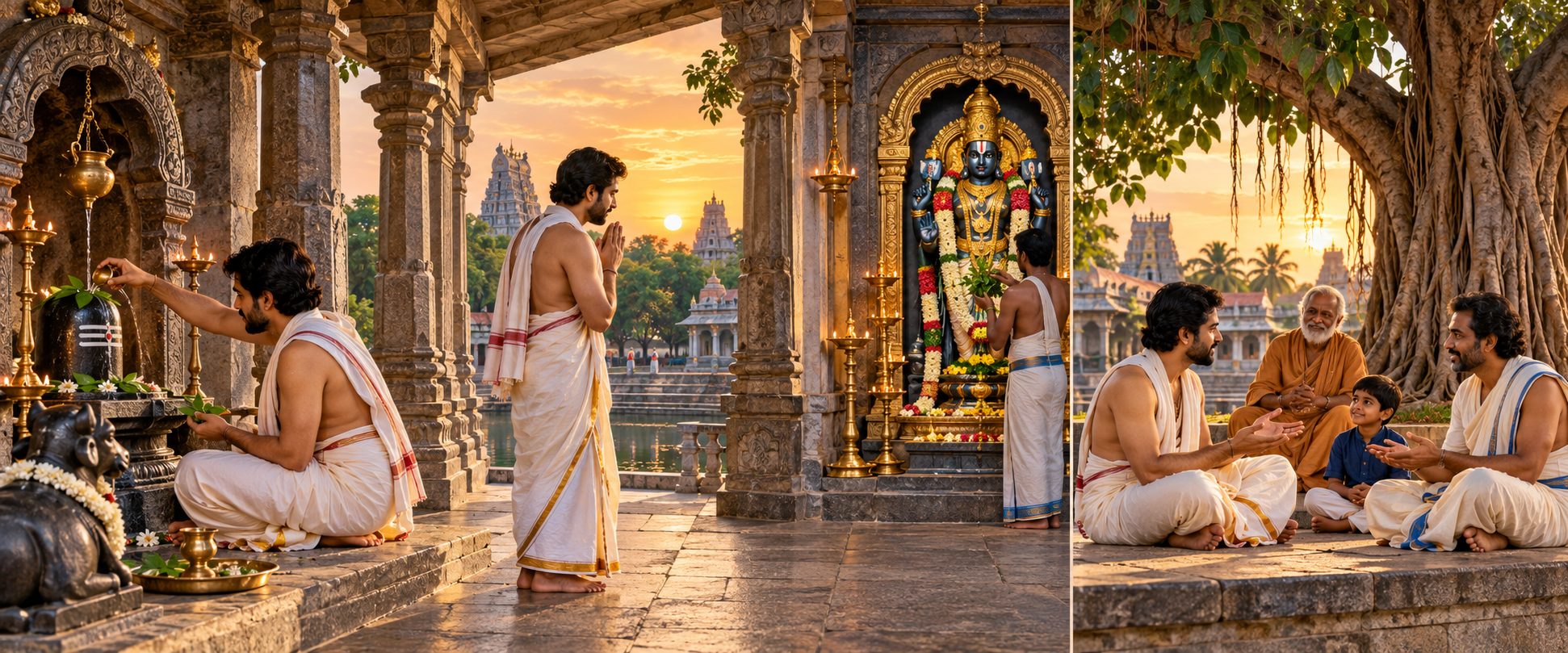
Devotional breadth can become shallow if it is reduced to collecting images, sampling rituals or avoiding every theological commitment. Before calling a practice pluralistic, test it in three ways.
- The commitment test: Can you remain attentive to one form long enough for worship to discipline you? Constantly changing the object of devotion whenever novelty fades may be restlessness, not openness.
- The hospitality test: Can you enter another deity’s temple or join a family observance without silently ranking the worshippers beneath you? You do not have to abandon your own orientation. You do have to leave contempt outside.
- The ego test: Does your devotion loosen self-importance, or does it give the ego a sacred uniform? If the chief result of worship is pride in possessing the highest deity, mantra, lineage or philosophy, the language of devotion is concealing rivalry.
These tests prevent two opposite failures. The first is sectarianism: loyalty becomes a reason to demean others. The second is spiritual consumerism: variety replaces depth. Shankaracharya’s example points toward committed breadth—enough focus for practice to transform you, and enough metaphysical humility to honour forms beyond your own.
Put the principle to work at home, in temples and in debate

At your home shrine
Give your central practice a clear focus. If one deity is the established centre of your household worship, let that form organise the daily rhythm rather than treating the shrine as a ballot among competing gods. Other forms can be honoured without making every act of worship equally elaborate.
When family members have different devotions, ask each person to state what they positively practise rather than what they reject. “I worship Devi in this way” opens a conversation. “Your form is only a lower version of mine” closes it. A shared shrine does not require identical inner relationships; it requires conduct that protects everyone’s capacity to worship sincerely.
When visiting another temple
Do not spend the darshan mentally converting the presiding deity into your preferred form. Attend to the deity actually before you. Notice the name, iconography and devotional mood through which that community approaches the sacred. Participation becomes an exercise in reverence rather than an occasion for comparison.
This does not demand theatrical enthusiasm or a false claim that every form evokes the same response in you. A respectful bow can be honest even when your deepest devotional bond lies elsewhere.
During a sectarian disagreement
First identify what is actually being disputed. Ask: Are we discussing the ultimate nature of reality, the theological status of a deity, or the most suitable practice for a particular devotee? Arguments become needlessly hostile when one person is speaking about final reality and another is defending a lived relationship of worship.
Then separate precision from humiliation. It is legitimate to explain why one school rejects another school’s proposition. It is not necessary to ridicule the other person’s deity, murti, lineage or inherited observance. Devotional pluralism protects disagreement from becoming desecration.
Four distortions to avoid
- “All forms are one, so details do not matter.” Ultimate unity does not make concrete traditions meaningless. Learn the practice you are entering instead of replacing it with a slogan.
- “My deity is real; yours is merely symbolic.” This grants fullness to your own relationship while interpreting everyone else’s from above. State your conviction without claiming ownership of the divine.
- “More forms automatically mean more spiritual maturity.” The number of deities you acknowledge proves little. Look instead for steadiness, humility and freedom from contempt.
- “If reality is non-dual, worship is pointless.” Intellectual agreement with non-duality is not the same as freedom from ego, distraction or aversion. Devotion addresses the person you presently are, not the liberated identity you can describe in words.
The last distortion is especially tempting. A person can use the highest metaphysical vocabulary to avoid the ordinary disciplines of attention and humility. In that case, “oneness” has become another possession of the ego. Shankaracharya’s devotional inheritance refuses that shortcut.
Key takeaways
- Advaita’s non-duality and devotion to particular deities answer different but compatible spiritual questions.
- Deep attachment to one form does not require hostility toward other forms.
- Pluralism preserves real theological differences; it does not pretend that every tradition makes identical claims.
- A sound devotional practice should deepen attention and humility rather than sectarian pride.
- You can honour another deity fully without abandoning the form through which you worship most naturally.
At your next act of worship, try a simple discipline. Give the deity before you undivided attention. Do not compare that form with another while praying. When the worship ends, notice whether it has made you more possessive or more capable of reverence. That movement—from exclusive possession toward wholehearted reverence—is where devotional pluralism becomes practice rather than theory.
References

Leave a Reply
You must be logged in to post a comment.