

You may chant Sri Rama’s name in the morning and still find impatience, avoidance, or disorder returning by afternoon. The Samarth tradition gives you a demanding but useful test: if remembrance never reaches conduct, your practice is not yet complete.
Samarth Ramdas offers a practical way forward. Rama-nama gathers the mind. Manache Shlok confronts its habits. Dasbodh brings discernment into work and relationships. Hanuman reminds you that strength becomes sacred when it serves. Put these together and bhakti stops being an occasional feeling; it becomes a method for shaping character.
Rama-bhakti has to govern your next choice
Samarth Ramdas lived from approximately 1608 to 1681 in seventeenth-century Maharashtra. Traditional accounts identify Jamb as his birthplace, Narayan Suryaji Thosar as his earlier name, and Ram Navami as the sacred day of his birth. His tapas in the Panchavati-Trimbakeshwar region developed into a public mission concerned not only with personal liberation but also with disciplined people, ethical leadership, and collective strength.
Traditional narratives place his moral counsel beside the statecraft of Chhatrapati Shivaji Maharaj. The point is not that spiritual authority should capture political power. It is that power itself must answer to rajadharma: duty, restraint, justice, and the welfare of those affected by a ruler’s decisions. The same principle applies on a smaller scale whenever you lead a family, team, institution, or community.
Four movements make this devotional discipline complete:
- Bhakti: Return attention to Sri Rama instead of letting every mood become your master.
- Viveka: Distinguish duty from preference, truth from flattery, and necessary action from restless activity.
- Vairagya: Release the demand for comfort, recognition, and control. Dispassion does not mean neglecting your responsibilities.
- Seva: Convert clarity into an act that benefits someone beyond your own ego.
This is also the proper frame for kshatra. Courage is not uncontrolled aggression, loudness, or permanent outrage. In the Samarth ideal, strength is governed by dharma and exercised with restraint. If anger can command you at will, anger is strong; you are not. Begin there when examining your own conduct.
Build a daily practice that survives an ordinary day
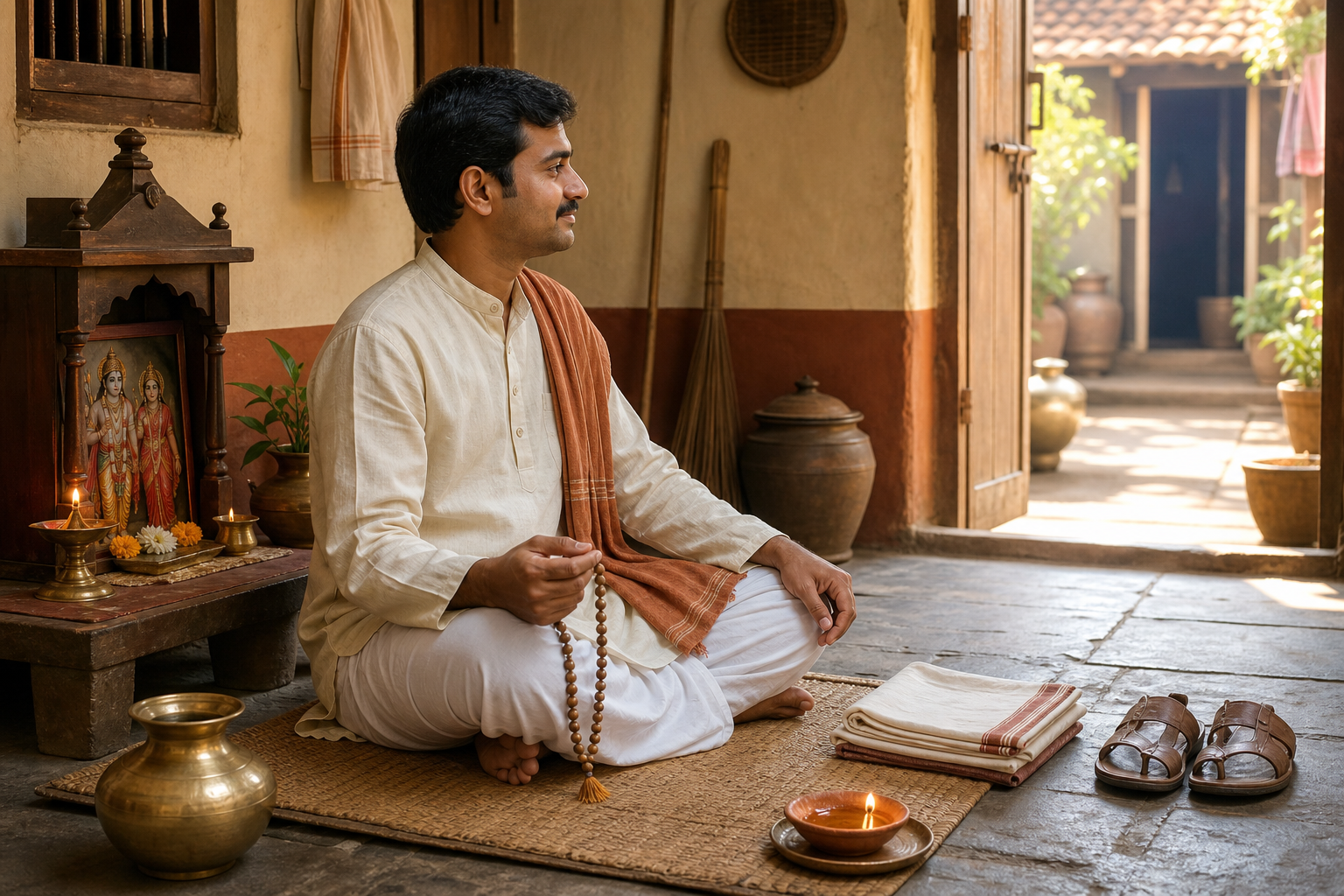
A sustainable practice needs a fixed anchor. Attach it to something that already happens every day: after your morning bath, before breakfast, or immediately after returning from work. Avoid waiting for a devotional mood. Mood follows its own weather; a chosen time gives your practice a home.
The following twenty-minute form is a modern working template, not a claim about a prescribed historical liturgy. Adjust the duration to your household duties, but preserve the sequence: recollect, examine, understand, and act.
- Settle for two minutes. Sit before Sri Rama and Sita, with Hanuman if that is part of your shrine. Light a deepa where it is safe and practical. Name the main disturbance you are bringing into the practice: anger, indecision, pride, fear of a task, or simple distraction.
- Chant for five minutes. Repeat Sri Ram Jai Ram Jai Jai Ram at a steady pace. A fixed period or previously chosen count is more useful than chasing an intense experience. When attention wanders, return without turning the lapse into a second distraction.
- Train the mind for five minutes. Recite a few verses from Manache Shlok in Marathi or in a translation you understand. Select a verse that touches the disturbance you named. Do not race through pages merely to accumulate a recitation total.
- Clarify duty for five minutes. Read one short passage from Dasbodh. Write its practical demand in one plain sentence, such as: finish the avoided task, speak truth without contempt, verify before reacting, or keep the promise already made.
- Make a three-minute sankalpa. Choose one observable action to complete before the next practice. Give it a time and setting. Replace a vague promise such as be patient with a concrete one such as hear the other person fully before answering at tonight’s family discussion.
On a crowded day, keep the chain intact in a shorter form: chant Rama-nama, recall one verse, and fulfil one chosen duty. Do not punish a missed day with an exhausting session that makes the next lapse more likely. Resume at the next fixed anchor. Steadiness matters more than a dramatic recovery.
Give Manache Shlok and Dasbodh different jobs

These texts overlap in purpose, but they do not need to play identical roles in your sadhana. Manache Shlok is the mirror. Its approximately 205 verses address the mind directly, pressing it toward humility, vigilance, steadfastness, and remembrance of Sri Rama. Use it when your main obstacle is an inner habit that keeps repeating even though you know better.
Dasbodh is the map from understanding to conduct. It joins atma-jnana with practical attention to duty, leadership, commerce, friendship, social order, and liberation. It is commonly arranged in twenty dashakas, although editions can differ in how they count and group the material. Choose one edition, learn its structure, and read a section in sequence rather than opening the book at random and treating an isolated line as fortune-telling.
Use this diagnostic when deciding where to begin:
| Your present friction | Use first | Concrete test for today |
|---|---|---|
| The mind is reactive, proud, discouraged, or replaying an insult | Manache Shlok | Name the impulse before acting and return to Rama-nama before speaking |
| A decision about work, friendship, leadership, or resources is unclear | Dasbodh | Separate your duty, personal preference, and the effect on others |
| You know the right action but keep postponing it | Both texts | Recite one relevant verse, state the next physical action, and begin it |
| You consume many teachings but your conduct remains unchanged | Pause new reading | Repeat one teaching until it alters one recurring behaviour |
Keep a small practice notebook, but do not turn it into a second scripture. Four lines are enough: the disturbance, the verse or passage, the duty it revealed, and whether you completed it. After several weeks, recurring entries will show you where your actual sadhana lies. The pattern you keep meeting is more instructive than the inspiration you keep collecting.
Let Hanuman correct passive or self-centred devotion

Samarth Ramdas placed Rama-bhakti beside Maruti worship and physical discipline. He is remembered for encouraging numerous Hanuman temples across Maharashtra; popular enumerations differ between eleven and twelve shrines. The disputed count need not distract you from their living lesson: strength is to be yoked to alertness, humility, and service.
Give that lesson three visible forms each week:
- Discipline the body. Choose a regular form of walking, yoga, mobility work, or strength practice appropriate to your ability. Its devotional value lies in consistency and self-command, not display.
- Restrain speech. Select one recurring weakness such as gossip, exaggeration, sarcastic contempt, or replying before you understand. Observe it closely for the week. Speech is often where an impressive spiritual identity meets its first honest test.
- Schedule seva. Give one task a real time and recipient: help with temple upkeep, distribute food, support an educational session, assist an elderly relative, or join an eligible community donation effort. If nobody knows what you promised or when you will do it, good intentions can remain conveniently unfinished.
Seva also guards against the ego of discipline. A strong routine can make you proud of being more serious than other devotees. Service reverses that gaze. It asks whether your increased capacity has made another person’s burden lighter.
Ram Navami provides an annual opportunity to examine the whole pattern. Because Samarth Ramdas Jayanti coincides with the festival, you can move through a complete cycle in one day: early Rama-nama and a deepa, Sri Rama puja around the local Madhyahna window, selected recitation from Manache Shlok and Dasbodh, an evening Hanuman aarti, and a charitable act. Upavasa or phalahara may support restraint, but food restriction is not a substitute for disciplined conduct.
For much of India, Ram Navami and Samarth Ramdas Jayanti in 2026 fall on March 26. The observance follows Chaitra Shukla Navami tithi rather than the civil date, so check a trusted local Panchang for the tithi span and Madhyahna puja interval, especially outside India.
If you visit Sajjangad, where his samadhi is venerated, or the Rama temple at Chaphal, make the pilgrimage itself part of the discipline. Carry water, preserve quiet in the sanctum, remove your waste, and support local service where possible. A sacred journey that leaves disorder for others has missed its own teaching.
FAQ: keeping disciplined Rama-bhakti honest
Do I need to feel devotion every day?
No. Disciplined bhakti gives you a way to return when feeling is weak, distracted, or absent. That does not justify mechanical chanting. Speak the mantra attentively, acknowledge the mind’s condition honestly, and keep the duty you place before Sri Rama. Fidelity during an ordinary day is itself part of devotion.
Should I begin with Manache Shlok or Dasbodh?
Begin with Manache Shlok when reactivity, pride, discouragement, or wavering attention is the immediate problem. Begin with Dasbodh when you need practical discernment about responsibility, leadership, work, friendship, or action. Many people can use a short passage from each: one to steady the instrument, the other to direct it.
Does physical training automatically become bhakti?
No. Physical capacity can serve vanity, intimidation, or restless competition just as easily as dharma. It enters the Samarth discipline when strength is joined to self-command and made available for duty. Ask a simple question: what can you now carry, endure, protect, or complete for others that you previously avoided?
How can I tell whether the practice is changing me?
Look first at conduct, not extraordinary experiences. You should notice that you return more quickly after distraction, delay fewer known duties, react less impulsively, need less praise for useful work, and serve more reliably. Choose one of these behaviours and review it each week. If nothing changes, reduce the amount you are reading and apply one teaching more closely.
Set out your text tonight and choose tomorrow’s fixed time. Chant the Rama mantra, take one instruction from Manache Shlok or Dasbodh, name one duty, and complete it before looking for more inspiration. That small circuit of remembrance, discernment, restraint, and action is where disciplined Rama-bhakti begins to become character.
References
