
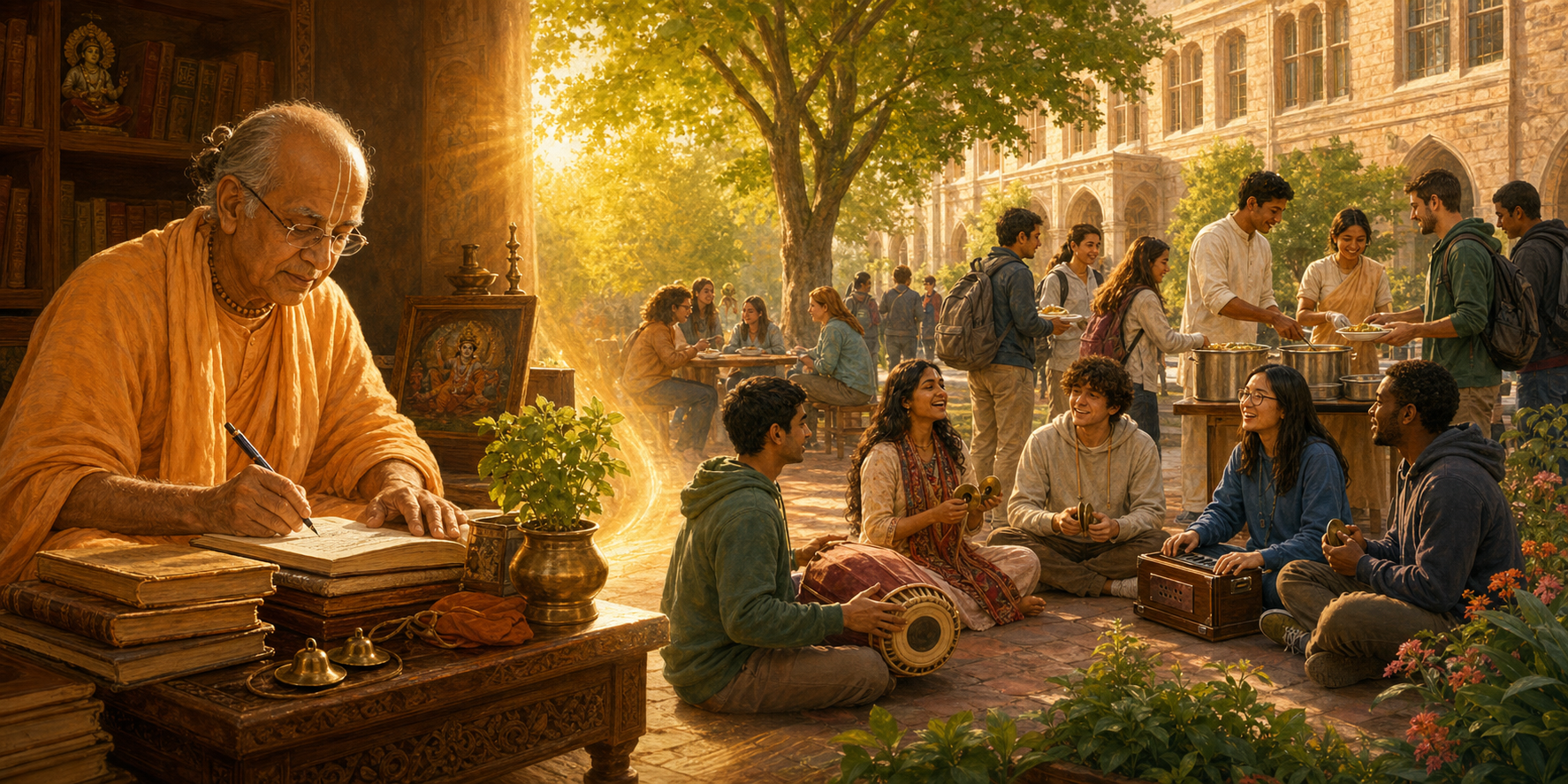
If you are trying to understand why Srila Prabhupada’s work still reaches students, do not choose between the extraordinary life and the ordinary lunch queue. Read them at two scales. His life reveals the convictions, disciplines, and institutional decisions behind a global bhakti mission; campus outreach reveals how those convictions become a dependable meal, a welcoming kirtan, and a conversation someone can enter without pressure.
That connection gives you a practical test for legacy. Do people merely admire the founder, or can they carry his principles into repeatable service? Whether you are reading about Prabhupada, leading a study circle, or planning a university program, the answer lies in the movement from memory to method.
Read the life for decisions, not just memorable episodes

Begin with a clear chronological spine. Without it, famous moments can float free of the preparation, delay, and perseverance that made them possible. Six anchors keep the mission in view:
- Abhay Charan De was born in Calcutta in 1896.
- In 1922, he met Srila Bhaktisiddhanta Sarasvati and received the mandate to communicate Krishna-bhakti in English.
- Decades of writing and outreach followed before the best-known international phase of his service.
- He accepted sannyasa in 1959 and pursued concentrated literary work in Vrindavan, including translation of Srimad Bhagavatam.
- In 1965, he crossed the ocean aboard the Jaladuta and expressed his dependence on Krishna in Markine Bhagavata-dharma.
- In 1966, ISKCON was formally incorporated in New York, giving an institutional form to a mission centered on kirtan, prasadam, scriptural study, and trained community.
Chronology is only the first pass. Approach Srila Prabhupada Lilamrita with two commitments at once. Honor the Vaishnava understanding of lila, guru-tattva, and divine purpose. Also notice the diaries, letters, interviews, archival records, and early publications that provide historical structure. You do not have to choose between devotional meaning and historical seriousness.
For each major episode, write down four things:
- What difficulty or uncertainty had to be faced?
- What authority guided the decision: guru, sadhu, shastra, or a convergence of all three?
- What daily practice sustained the response?
- What structure allowed another person to continue the work?
This method prevents two common misreadings. The first turns an acharya into an unreachable figure whose life inspires reverence but no action. The second reduces him to an organizational case study and filters out the surrender that gave the organization its purpose. A serious dharmic reading holds inner dependence and outward competence together.
When an important historical claim matters to your teaching, compare the narrated episode with available letters, lectures, diaries, and early periodicals. When the question is spiritual formation, ask what the episode demands of your own hearing, chanting, study, and seva. You will then receive more than a collection of heroic moments: you will learn how conviction becomes disciplined action.
See Krishna Lunch as transmitted method, not a side project
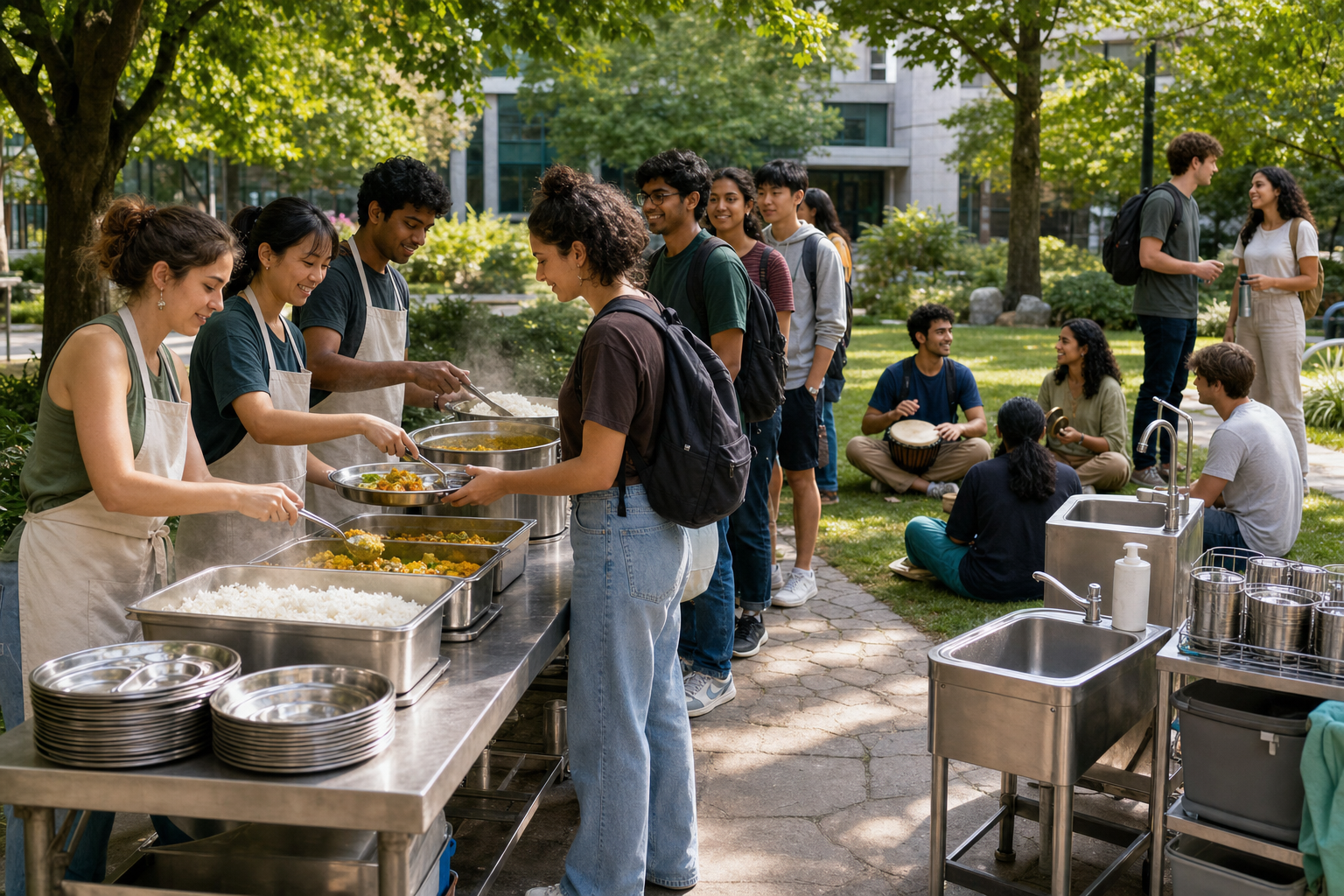
Credit matters. Gargamuni is associated with the early Krishna Lunch concept, while his cooking knowledge came through direct training from Srila Prabhupada and was then taught to others. Prabhupada’s legacy therefore does not depend on claiming that he personally designed every later program. It appears in the principles, skills, and devotional intent that disciples learned, adapted, and passed forward.
The basic campus pattern was remarkably clear: gather regularly for kirtan, offer a brief and intelligible presentation of bhakti, and share prasadam. The parts reinforced one another. Music made the gathering publicly approachable. A concise talk gave the encounter intellectual content without turning lunch into a lecture hall. The meal converted welcome from a slogan into something tangible.
The food was simple enough to reproduce and substantial enough to serve as a real meal: dahl, rice, vegetable subji, and hot buttered chapatis. Its appeal did not rest on novelty alone. Cooks coordinated soaking, simmering, chapati rolling, griddle work, tempering, portioning, and replenishment so that quality survived beyond one inspired day. The chaunce of the dahl also mattered: spices and aromatics bloomed in ghee sent a fragrant invitation well beyond the kitchen.
At the busy early cadence, service could reach roughly fifty people at lunch, another fifty at dinner, and twenty at breakfast. Those figures are useful because they expose the operational truth behind a warm memory. Once a program attracts people, devotion alone does not soak the legumes, keep the queue moving, or train the next cook. Seva needs schedules, role clarity, cleanliness, and succession.
Reliability was itself part of the teaching. Students working around crowded academic timetables could return because the gathering appeared at a predictable time. Familiarity produced trust; trust made philosophical inquiry possible. If you organize outreach, treat the announced schedule as a promise. A smaller program that appears consistently teaches more about steadiness than an impressive event that cannot be repeated.
Do not treat prasadam as bait. A guest who never joins a class should still receive genuine hospitality. The meal embodies reverence for food, compassionate vegetarian practice, and service before any explanation begins. It can also create respectful conversations with other dharmic communities: Sikh langar places equality and service around a shared meal, Jain ethics give particular weight to ahimsa, and Buddhist traditions honor dana and sangha. These are resonances, not claims that distinct traditions teach the same theology. Name the kinship without erasing the difference.
Test continuity through five practical questions
The distinction between anukarana, or outward imitation, and anusarana, or principled following, is crucial here. Anukarana asks how to reproduce the visible details of an earlier success. Anusarana asks which relationships made that success spiritually and socially coherent. Use the following questions whenever you evaluate a reading group, lunch program, kirtan, or student society.
| Continuity to preserve | Campus expression | Question for your team |
|---|---|---|
| Shastra-centered clarity | A brief explanation connected to Bhagavad Gita, Srimad Bhagavatam, or a clearly defined bhakti principle | Can a newcomer state the central idea without insider vocabulary? |
| Public spiritual practice | Welcoming kirtan that people can hear, observe, and join voluntarily | Does participation feel possible before someone knows the customs? |
| Prasadam and seva | A fresh, consistent vegetarian meal offered with dignity | Would you serve with the same care if no guest joined another activity? |
| Training through relationship | Experienced volunteers demonstrate cooking, service, speaking, and cleanup to newer volunteers | Can the program continue when its most experienced organizer is absent? |
| Adaptation without dilution | Plain language and campus-appropriate presentation with the devotional center intact | What are you changing for intelligibility, and what principle are you refusing to obscure? |
The inherited unit is not a frozen menu, a 1960s aesthetic, or a particular room arrangement. It is the relationship among practice, explanation, hospitality, and recurrence. Change one of those carefully if local conditions require it; remove one thoughtlessly and the whole program changes character.
This test also sharpens your reading of Prabhupada’s life. His international work joined accessible English exposition, systematic study, publishing, kirtan, prasadam, and community training. None was expected to carry the mission alone. A campus meal without philosophical integrity can become generic catering. Philosophy without relationship can become a seminar attended only by those already convinced. Kirtan without pastoral welcome can remain a performance rather than an invitation.
Build a campus program that can survive its founders
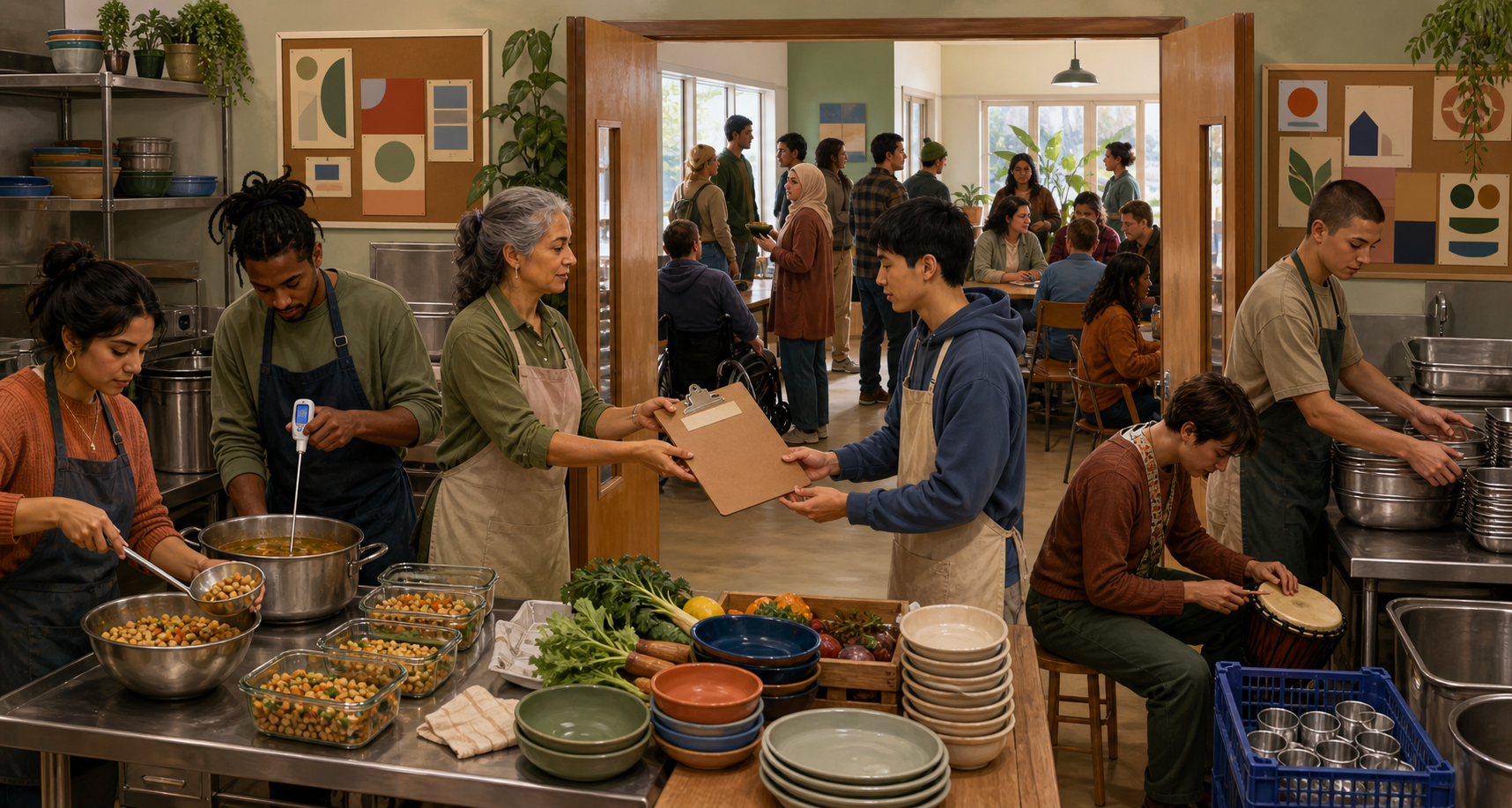
If you are moving from appreciation to action, build for continuity from the first meeting. The following sequence translates the legacy into decisions a student team can actually make.
- Write the mission in one sentence. Name the spiritual center and the service offered. If your team cannot say whether it exists primarily for kirtan, study, prasadam distribution, community, or an intentional combination, volunteers will make conflicting decisions later.
- Meet the institution’s requirements before announcing service. Confirm the applicable rules for food handling, allergens, space, sound, and campus solicitation. Devotional sincerity does not remove your responsibility to guests or to the university community.
- Choose a cadence you can keep. Daily service created powerful familiarity in the early model, but a new group should not promise a daily lunch unless it has the people, kitchen access, and supplies to sustain one. A fixed weekly service is better than an ambitious schedule followed by cancellations.
- Reduce kitchen complexity. Use a small, balanced menu that volunteers can learn and reproduce. Document soaking, preparation order, tempering, portioning, cleaning, and handover. Protect freshness and devotional standards, but do not make the program dependent on one unusually skilled cook.
- Teach by demonstration. Let a new volunteer observe a task, perform it with guidance, and then teach it to someone else. This follows the same practical chain through which cooking knowledge moved from Prabhupada to Gargamuni and onward. A recipe preserves ingredients; supervised practice preserves timing, judgment, and service culture.
- Keep the philosophical offering concise and complete. Present one core idea, explain any Sanskrit term in ordinary language, connect it to practice, and leave room for a sincere question. Brevity should remove unnecessary complexity, not the theology itself.
- Make consent visible. Let people eat, listen, chant, ask questions, or simply leave. Do not condition kindness on religious response. A non-coercive open door is especially important on a plural campus, where trust can be lost faster than it is built.
- Review what affects return and continuity. Look at whether service starts on time, whether food runs out or is wasted, where the queue slows, which tasks exhaust volunteers, whether newcomers return, and what questions recur. Use those observations to adjust operations while keeping the spiritual purpose explicit.
Catch three failure modes early
- Admiration without transmission: the team can recount Prabhupada’s sacrifices but cannot train a replacement cook, speaker, or coordinator. Attach every admired quality to a practice someone can learn.
- Hospitality as a recruitment transaction: guests sense that food is offered only to secure attendance elsewhere. Restore prasadam distribution as seva, then allow further participation to arise freely.
- Authenticity reduced to imitation: organizers copy the outer appearance of an earlier era even when it confuses the people in front of them. Preserve siddhanta, devotional intention, discipline, and generosity; adapt vocabulary, schedule, and presentation to the actual campus.
A durable program will also produce more than consumers. Give willing students bounded ways to contribute: setting up, serving, cleaning, learning a kitchen station, helping with kirtan, or preparing a short reflection under guidance. Belonging deepens when a person can move from receiving care to offering it.
Key takeaways
- Read Prabhupada’s life by tracking decisions, authorities, sustaining practices, and structures of transmission.
- Hold devotional interpretation and historical care together; neither requires you to dismiss the other.
- Recognize Gargamuni’s agency in Krishna Lunch while tracing the cooking discipline and seva culture he received from Prabhupada.
- Preserve the relationship among kirtan, clear teaching, prasadam, and reliable recurrence rather than copying only outward details.
- Measure campus outreach by trust, continuity, volunteer formation, and integrity of service, not merely by crowd size.
- Use anusarana as your standard: adapt the presentation responsibly while keeping the devotional center clear.
Your next step can be modest and concrete. At your next reading session, choose one episode and identify the practice and structure that carried it forward. At your next campus meeting, choose one recurring act of kirtan, explanation, and hospitality that your present team can sustain and teach to another. That is where remembered legacy becomes living parampara.
References
- Dandavats – From Kirtan to Chapatis: The Irresistible Rise and Legacy of Krishna Lunch on Campus
- Dandavats – Srila Prabhupada Lilamrita Unveiled by HG Daivi Shakti Mataji: Bhakti, History, and Shared Dharma
