
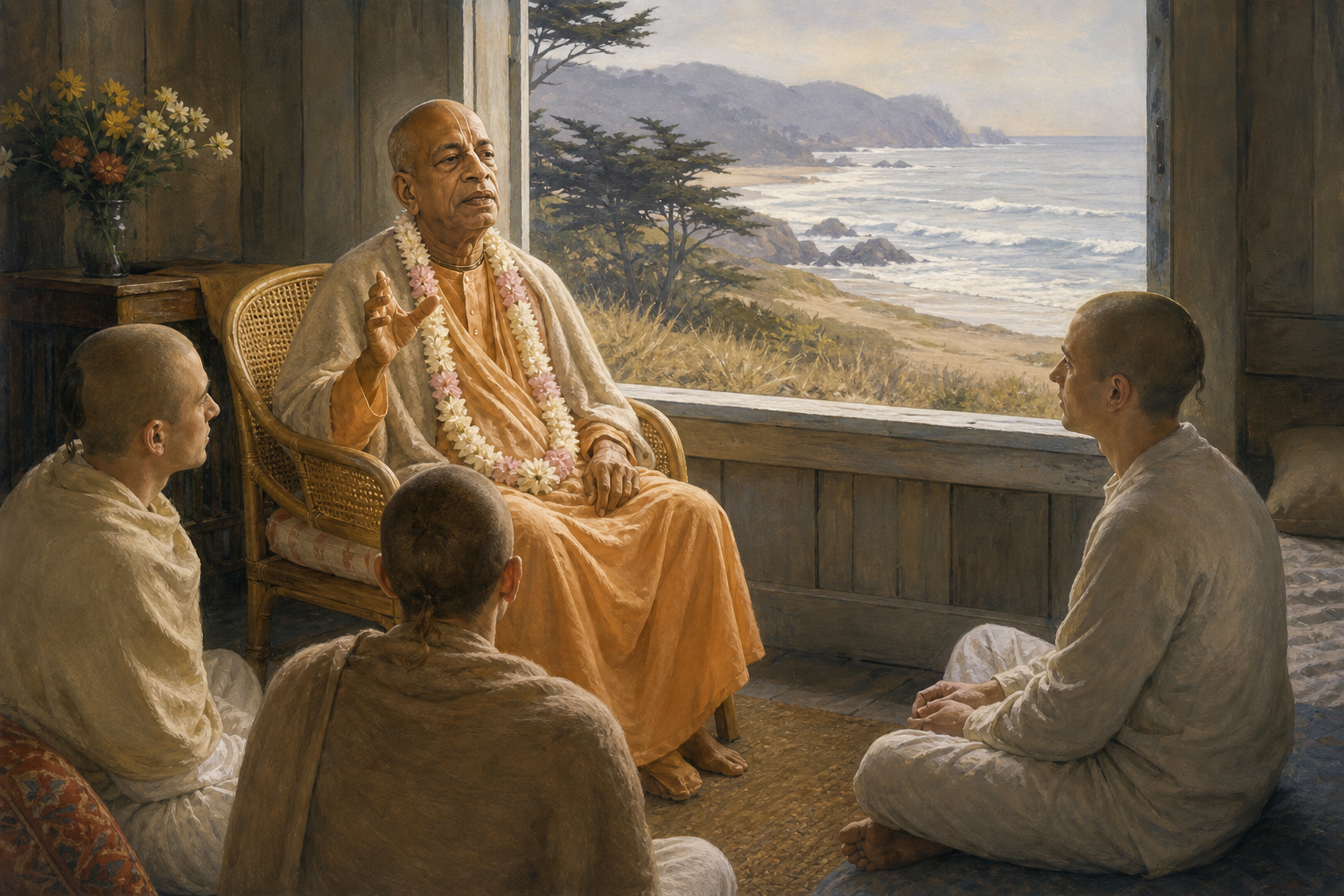
When illness interrupts seva, the hard question is rarely whether duty still matters. It is how to honor that duty without pretending the body has no limits.
If you are responsible for disciples, a family, a temple, or an institution, Srila Prabhupada’s recovery at Stinson Beach gives you a practical way to think: preserve the responsibilities that truly require you, change the conditions that obstruct recovery, and keep the mission moving without turning illness into a test of devotion.
Separate the duty from its usual setting
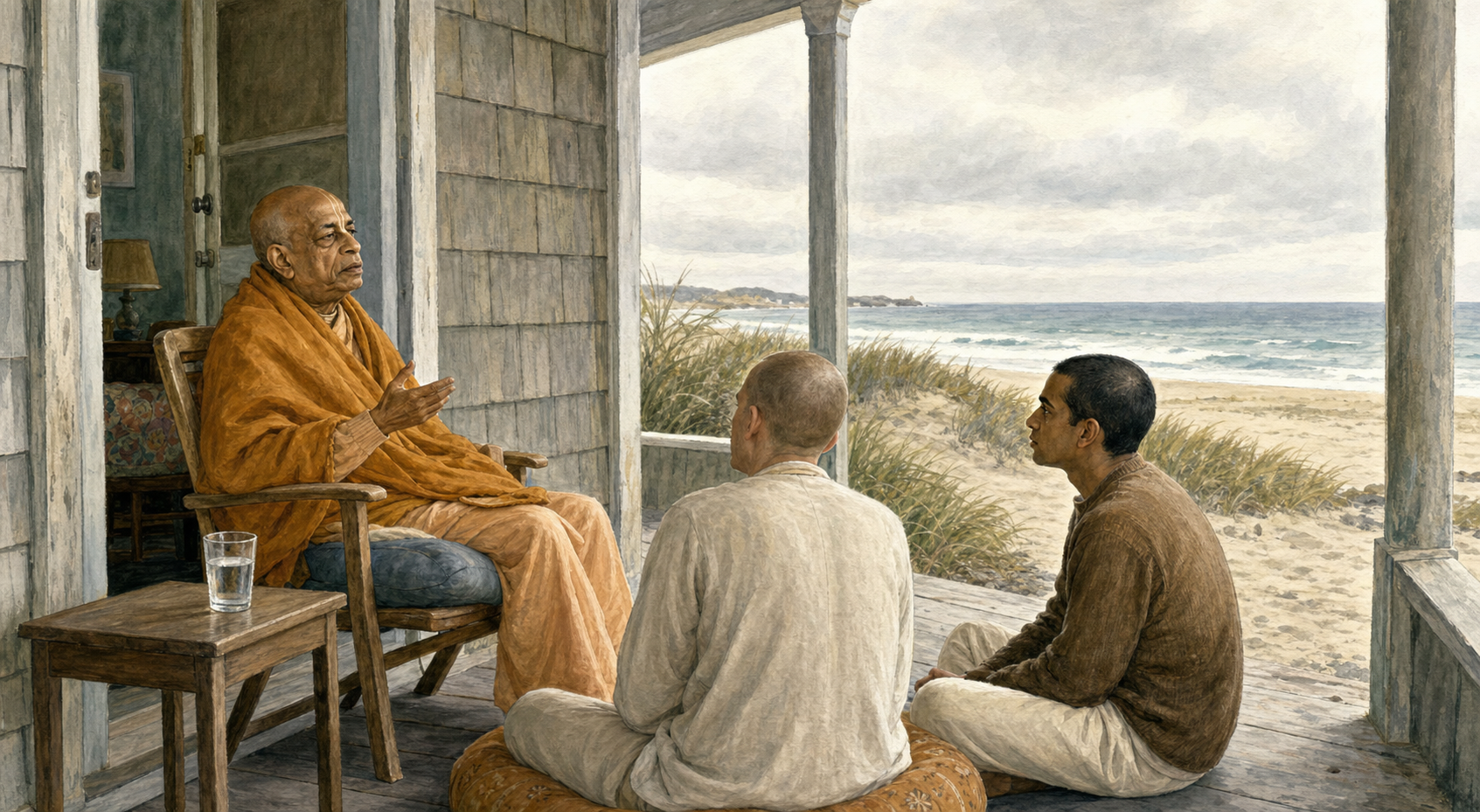
While recovering from a stroke at Stinson Beach near San Francisco, Srila Prabhupada could not travel to the temple, yet he continued to guide disciples by conducting initiations where he was convalescing. The responsibility remained. The location changed.
This distinction matters because leaders often confuse continuity with repetition. They assume that preserving a duty means reproducing its familiar venue, schedule, audience, and logistics. Illness exposes the weakness in that assumption. Some parts of a responsibility express its spiritual purpose; other parts are simply the ordinary way it has been arranged.
When your capacity changes, sort your work into three groups:
- Non-transferable duties: decisions, blessings, teachings, or acts of spiritual authority that depend on your particular role.
- Transferable duties: administration, transport, preparation, correspondence, and follow-up that another responsible person can perform.
- Deferrable activities: appearances, ceremonies, travel, and meetings whose postponement will not damage the spiritual purpose of the work.
Then examine each non-transferable duty. Ask whether its normal setting is essential or merely customary. At Stinson Beach, the journey to the temple stopped, but initiation did not. That was not abandonment of form for convenience. It was a disciplined distinction between the sacred responsibility and the avoidable physical burden surrounding it.
This does not give every leader permission to improvise every practice. Adaptation must remain within the leader’s actual authority and the requirements of the tradition. The useful question is not, “What can we discard?” It is, “What must be protected, and what can change so that it remains possible?”
Treat recovery conditions as leadership information
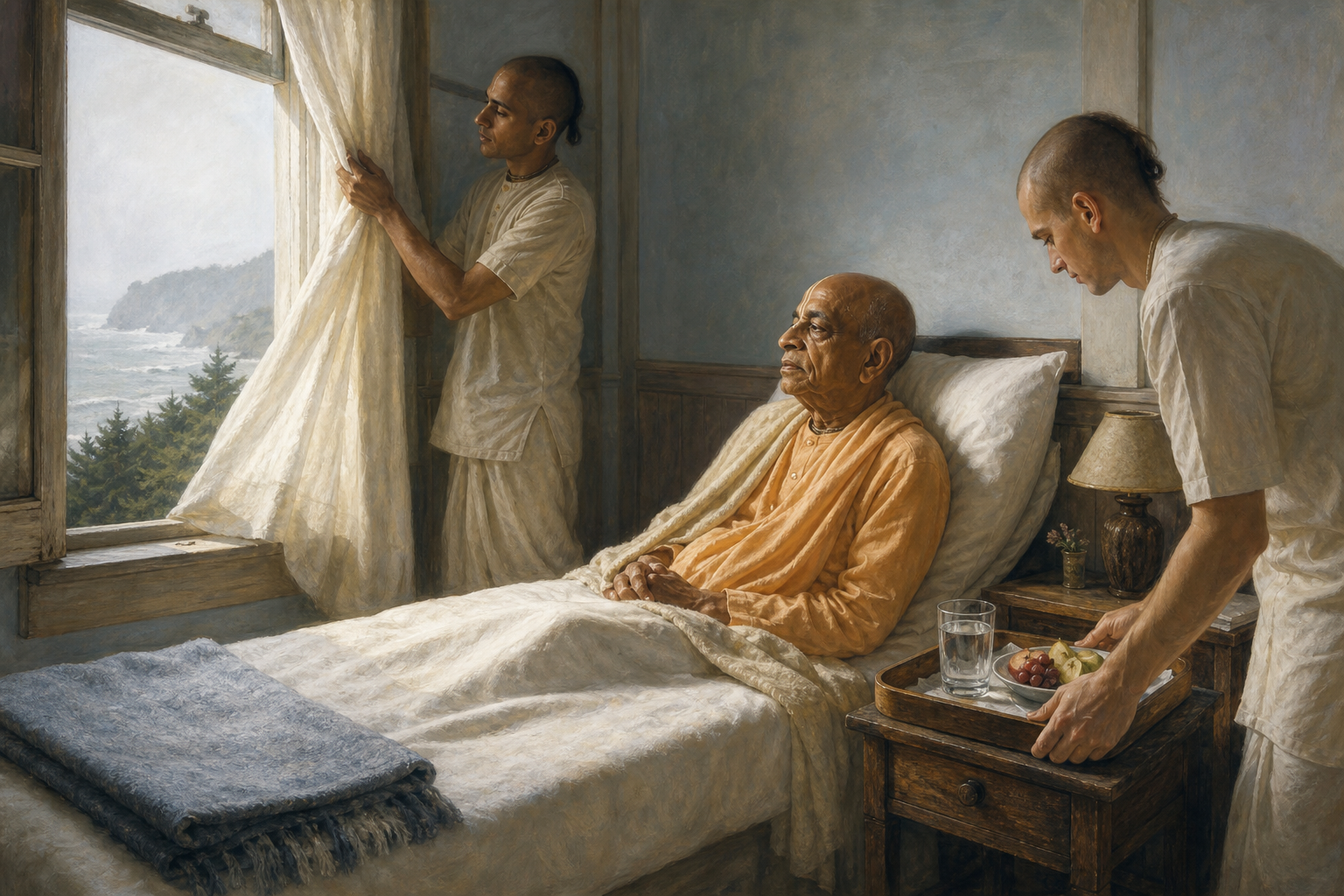
Srila Prabhupada assessed the cool coastal climate and limited sunlight at Stinson Beach, decided that the conditions did not support his recovery, and resolved to return to India. He did not treat the place where recovery had begun as a place where he was obliged to remain.
That decision corrects a common spiritual error: treating bodily limits as morally embarrassing. The body is not the whole person, but embodied service still depends on sleep, nourishment, mobility, medical care, and a workable environment. Ignoring those conditions can reduce the very service a leader hopes to protect.
Prabhupada’s judgment about Stinson Beach belonged to his particular circumstances. It is not a general treatment for stroke or a claim that one climate heals everyone. A stroke is a medical emergency, and possible new stroke symptoms require emergency medical care. Spiritual practice, sunlight, relocation, or determination is not a substitute for treatment. During recovery, decisions about long journeys, physical activity, and environment should be made with qualified clinicians who know the person’s condition.
Within that safe boundary, a leader and caregivers can make recovery planning more precise by answering three questions:
- Which conditions are creating avoidable strain? Name the travel, schedule, room, climate, audience, or administrative demand rather than saying only that the person is “unwell.”
- Which change would reduce that strain without interrupting the essential duty? Move the meeting, shorten the audience, delegate preparation, or defer a nonessential appearance.
- What arrangement protects service beyond this week? A decision that saves one event but delays recovery may not be continuity at all.
Self-care and seva become rivals only when service is defined too narrowly. If recovery preserves the ability to teach, guide, worship, write, or care for others over a longer horizon, attending to the body is part of responsible service.
Make the transition part of the mission plan
Srila Prabhupada planned a route from San Francisco through New York, London, and Moscow before reaching Delhi. The important detail is that this was a planned itinerary, not merely a vague intention to leave. Recovery had a destination, while the international field of responsibility remained present in the route.
You should not imitate that itinerary. The medical risks, transport options, and responsibilities in another person’s illness may be entirely different. Imitate the structure of the decision instead: identify where recovery can be supported, determine what must happen during the transition, and make continuity visible to the people who depend on you.
A sound transition plan should state four things plainly:
- The destination: where the leader will recover and why that setting is more workable.
- The minimum obligations: which duties must continue during the transition and which will pause.
- The delegated authority: who can make operational decisions without repeatedly disturbing the person who is ill.
- The safety boundary: who can shorten, cancel, or revise travel when medical circumstances change.
Without these distinctions, disciples or colleagues may interpret reduced visibility as withdrawal, fill silence with speculation, or continue sending every decision back to the recovering leader. A concise continuity plan protects the person from unnecessary demands and protects the community from uncertainty.
The plan should also remain revisable. Resolve is not the refusal to change course. In illness, steadiness means preserving the purpose while allowing the route, timing, workload, and delegation to respond to reality.
Preserve the dignity of the guru-shishya relationship
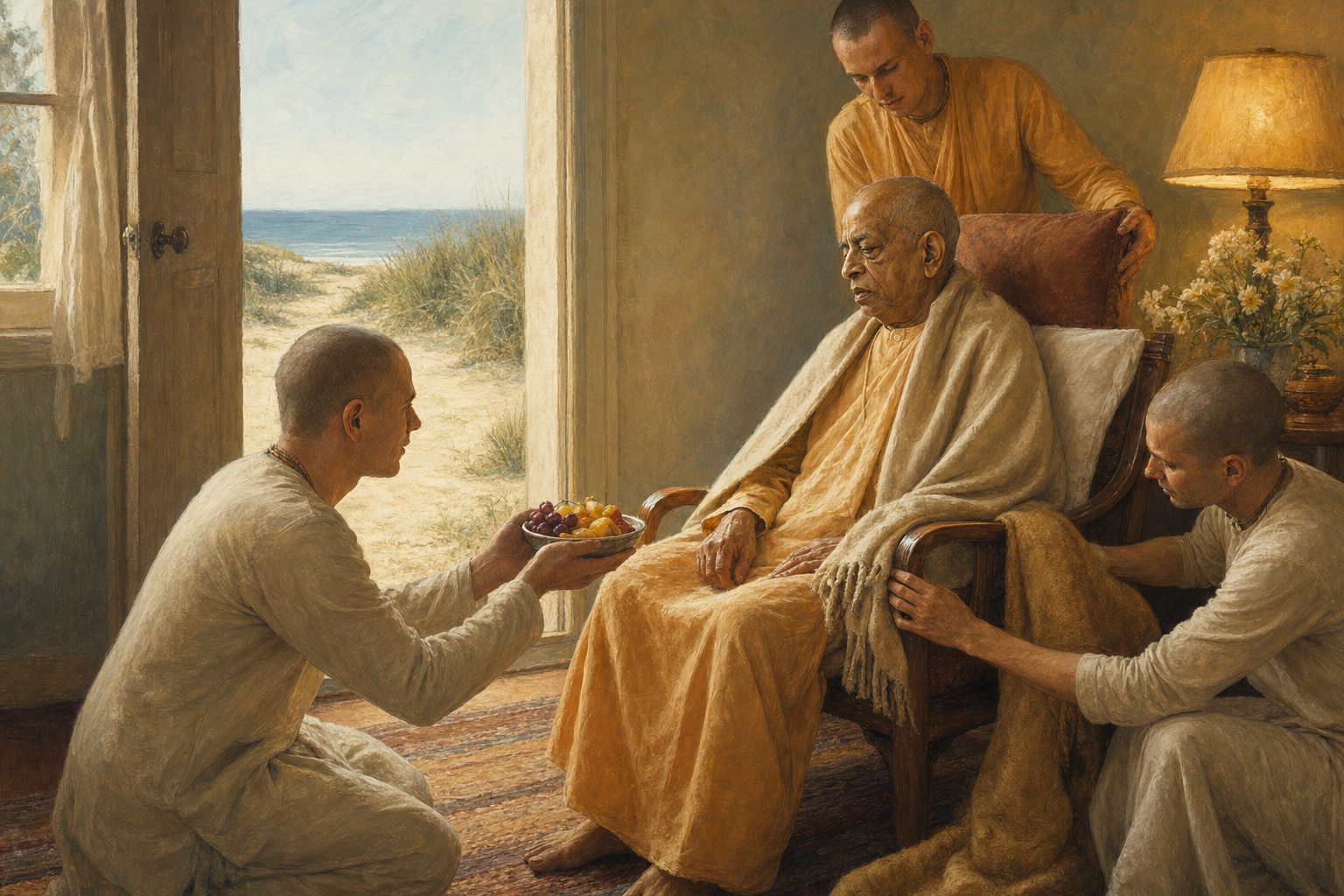
The Stinson Beach initiations were significant not because an unusual location made them more dramatic, but because physical limitation did not erase the relationship between guru and disciple. The setting became simpler and more intimate while Srila Prabhupada’s responsibility as guru remained clear.
There is an important safeguard here. The episode does not authorize casual alteration of sacred rites by people who do not hold the relevant authority. Srila Prabhupada himself conducted the initiations. When a community must adapt a ceremony because of illness, it should first establish who is authorized to decide what may change.
Before changing an arrangement, ask:
- What spiritual purpose and commitment must the rite preserve?
- Which elements are required by the lineage or established practice?
- Which elements belong only to the normal venue or logistics?
- What accommodation protects the ill person from exhaustion, exposure, or becoming a spectacle?
That last question is easy to neglect. A revered teacher’s illness can attract attention, but concern does not create an entitlement to access. Communities should limit audiences, reduce ceremonial complexity, control photography or public narration, and communicate through designated caregivers when those steps protect recovery. Reverence is shown not only by seeking the guru’s presence, but also by refusing to consume the strength needed for the guru’s service.
Key takeaways for leading through illness
- Do not measure commitment by unchanged performance. Ask which duty must continue and which surrounding demands can be removed.
- Accept bodily constraints as decision-making facts. Denial can turn a temporary limitation into a longer interruption of service.
- Protect the sacred core before protecting the familiar venue. A change of place need not mean a dilution of responsibility.
- Delegate operations, not accountability. Name who will handle routine decisions while keeping the leader’s essential authority clear.
- Keep medical and spiritual responsibilities properly ordered. Qualified medical care governs health decisions; spiritual resolve gives those decisions purpose but does not replace treatment.
Before a crisis forces hurried improvisation, prepare a one-page continuity note for your family, temple, or institution. Give it four lines: the current physical constraint, the duty that cannot be transferred, the work that has been delegated, and the next point at which the arrangement will be reviewed. Keep private medical details private; communicate only what others need in order to act responsibly.
Srila Prabhupada’s example does not ask you to choose between determination and recovery. It asks you to become more exact about both. Your next faithful step may be to bring the service closer, give an administrative task away, change the recovery setting with medical guidance, or pause what is not essential. Make the choice that preserves health, spiritual authority, and continuity together.
References
