

If you attend or help organize a Hindu festival, temple programme, yatra, or other crowded gathering, an alleged poison plot creates two immediate risks. One is the threat investigators are trying to establish. The other is a wave of rumours that can cause panic, misdirect suspicion, and make genuine warnings harder to recognize.
You do not have to choose between complacency and communal alarm. The useful response is disciplined vigilance: understand what has actually been alleged, know what evidence must still be produced, and prepare your gathering without treating an unverified message or a person’s identity as proof.
Key takeaways
- Gujarat ATS reported three arrests in an alleged plot involving ricin, but an arrest is an investigative action, not a conviction or final account of what happened.
- Ricin is a potentially lethal toxin, not an infectious organism. It does not reproduce in the body or spread from person to person like a contagious disease.
- Forensic identification, documented custody of evidence, proof of capability, evidence of intent, and a credible connection to a proposed target are separate questions. None should be collapsed into a headline.
- If you encounter a suspicious substance or container, do not touch, move, smell, sample, photograph at close range, or attempt to clean it. Move away, alert venue security or emergency services, and follow professional instructions.
- Report observable conduct and explicit threats, not someone’s name, clothing, language, profession, caste, or presumed religion.
- Protecting Hindu gatherings and protecting innocent citizens from collective blame are compatible duties. Both improve public cooperation and counterterror effectiveness.
Separate the allegation from the evidence questions

In November 2025, Gujarat ATS reported the arrest of three suspects, including a medical professional, in an alleged scheme involving ricin. Public gatherings were described as possible targets, with Hindu congregations mentioned among the potential venues. Those claims were preliminary when reported, and the investigation had not yet supplied a judicial verdict.
That wording matters. It is reasonable to take a ricin allegation seriously because the possible harm is severe. It is not reasonable to treat every element of the allegation as already proved. Presumption of innocence is not a courtesy extended after public anger subsides; it is part of the process by which a state distinguishes a real conspiracy from suspicion, exaggeration, planted material, misunderstood communication, or evidence that cannot survive scrutiny.
The description of one suspect as a medical professional can sound especially alarming. A qualification or occupation, however, does not prove possession of a toxin, the ability to prepare a harmful agent, or participation in an operational plan. Those propositions require evidence of their own.
The term bio-weapon plot can compress several distinct claims into one frightening phrase. Keep them separate as the case develops:
- Identity of the material: Did a qualified laboratory confirm ricin, or was ricin only discussed, suspected, or claimed?
- Integrity of the evidence: Can investigators document where the material and devices were found, who handled them, how they were sealed, and how they reached the laboratory?
- Capability and means: Is there evidence of an actual capacity to cause harm, rather than fantasy, internet searching, boasts, or fragmentary preparation?
- Intent: Do communications, conduct, procurement records, or other admissible evidence show deliberate criminal purpose?
- Target connection: Is there credible evidence tying the alleged activity to a particular gathering, community, place, or date?
- Network and responsibility: Were other people involved, and can each person’s alleged role be established individually rather than inferred from association?
Toxicology results, digital evidence, sourcing records, and cross-jurisdictional links can help answer these questions. Judicial oversight then tests whether the evidence was obtained lawfully and supports the charges. Until that work is complete, retain the word alleged. It signals accuracy, not indifference.
A ricin case demands two responses at once

Ricin is a toxin derived from castor beans and can be lethal. It is not a virus or bacterium, so it does not multiply inside a victim or move through a crowd by ordinary person-to-person transmission. That distinction should reduce indiscriminate fear, but it should not encourage amateur handling. A suspected toxic substance belongs with trained emergency personnel, hazardous-material specialists, medical teams, and forensic examiners.
The first response is protective. Police and venue staff must secure the immediate area, keep people away from a suspected hazard, create access for emergency responders, and identify anyone who may require professional medical assessment. If you believe you may have been exposed, tell responders promptly and follow their instructions. Do not rely on the absence of immediate symptoms, social-media remedies, or improvised decontamination advice.
The second response is evidentiary. Investigators must preserve the scene, maintain a documented chain of custody, obtain toxicology findings, examine relevant digital material, and establish motive and means. Moving fast is necessary when public safety may be at risk, but speed cannot substitute for evidence. A contaminated or poorly documented exhibit can weaken the prosecution and obscure what actually happened.
India’s counterterror architecture has several relevant layers: state ATS units, local police, forensic laboratories, healthcare systems, and central agencies where their jurisdiction or capabilities are required. They do not all perform the same job. Police may protect a venue, laboratories identify material, intelligence teams examine possible networks, healthcare personnel manage potential exposure, and prosecutors translate admissible evidence into charges. Coordination is effective when responsibilities and information channels are clear.
Public communication is also operational work. A sound update tells you what has been confirmed, what action the public should take, which authority is responsible, and what remains uncertain. It should not disclose sensitive methods or invite a public trial of suspects. When official communication leaves a vacuum, recycled images, communal speculation, and invented target lists tend to fill it.
What you should do before and during a gathering
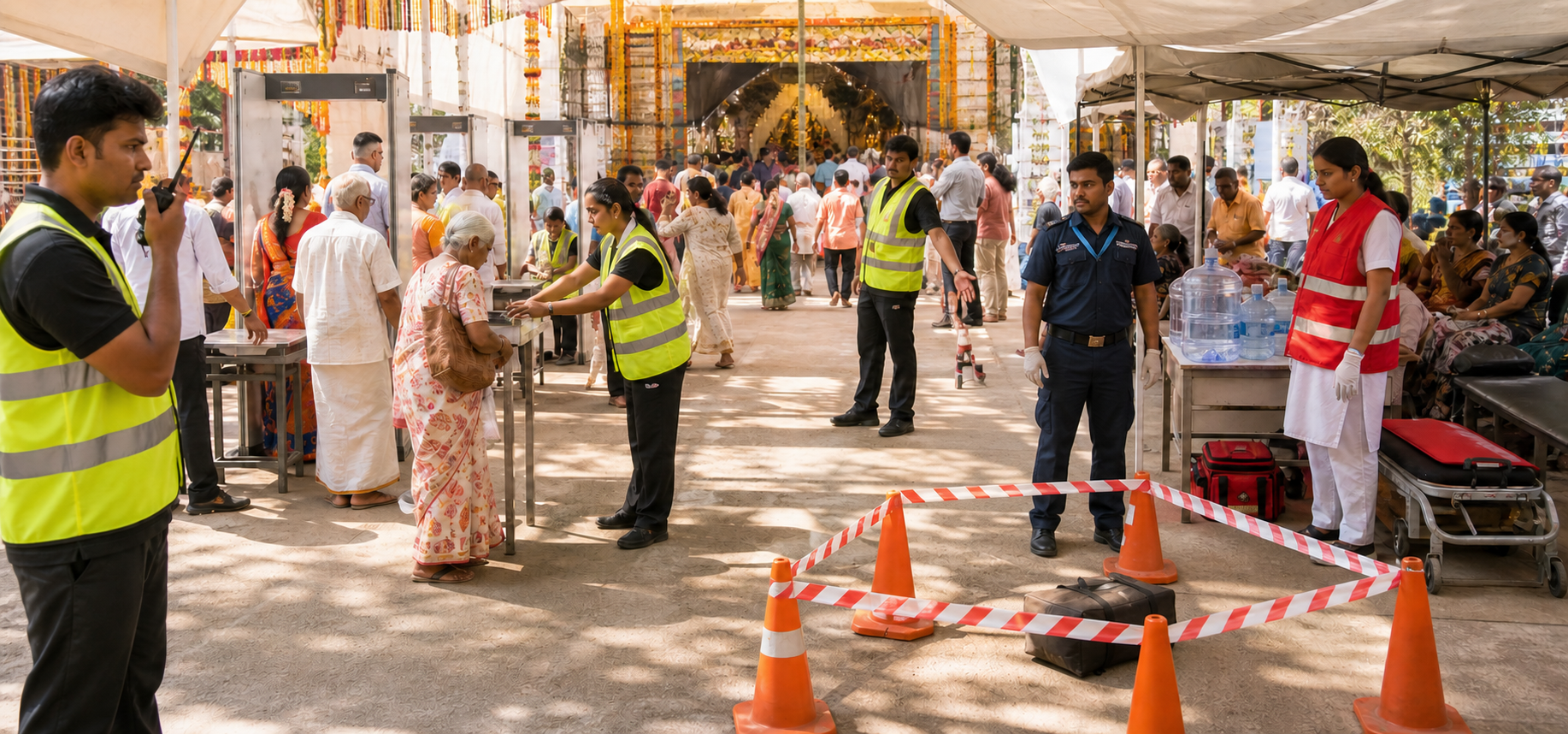
If you are attending
- Check the organizer’s official channel before travelling. A forwarded voice note, cropped screenshot, or unnamed warning is not an advisory. Look for a statement from the venue, police, district administration, or another identifiable authority.
- Locate ordinary safety points on arrival. Notice the marked exits, staffed help desk, security personnel, and first-aid area. This is useful for a fire, crowd surge, lost child, medical event, or suspicious item; it is not a reason to scan other attendees as suspects.
- Leave suspicious material alone. Do not touch, open, shake, smell, taste, carry, or clean an unexplained substance or container. Do not approach it for a photograph. Move away without creating a rush and tell venue security exactly where it is.
- Follow the instruction given at the scene. Depending on the hazard, trained personnel may direct people to leave, remain where they are, or use a particular route. Do not assume that running toward the nearest visible exit is always safest.
- Report possible exposure promptly. Give responders a plain account of where you were, what you observed, and whether anything contacted you. Seek professional medical assessment when advised; do not diagnose yourself from online symptom lists.
- Do not broadcast unverified identities or motives. Share practical safety instructions from accountable authorities. Avoid posting identifiable images of bystanders or naming a community before evidence has been established.
If you organize a temple or community event
Your plan should work for multiple emergencies rather than depend on predicting one exotic method. A simple, rehearsed structure is more valuable than an elaborate plan that volunteers have never seen.
- Name decision-makers in advance. Staff should know who contacts police or emergency services, who coordinates with medical personnel, who can pause entry, and who issues the public message.
- Conduct a pre-event walkthrough. Confirm that entrances, exits, emergency access routes, restricted areas, staff posts, and communication equipment are usable. Resolve ordinary crowd-control problems before the gathering begins.
- Brief volunteers on escalation, not investigation. Their job is to recognize an unusual item, explicit threat, access-control breach, or apparent tampering and report it. They should not interrogate attendees, handle suspicious material, or conduct searches beyond their training and legal authority.
- Create distance around a suspected hazard. Prevent additional contact, avoid disturbing the scene, and wait for trained responders. Record the time, location, and direct observations without encouraging staff to speculate about the substance.
- Preserve relevant records. Secure access logs, incident notes, and available surveillance material for lawful handover. Do not circulate sensitive footage through volunteer messaging groups, where it can compromise privacy and the investigation.
- Prepare a factual holding message. State what attendees must do, which authority is responding, and where the next verified update will appear. Do not guess at a substance, target, suspect, or motive.
- Coordinate a medical pathway. Staff must know where to direct anyone reporting possible contact or symptoms and how to obtain emergency help. Volunteers should never promise that a person is safe or attempt to replace professional assessment.
- Review after the event. Record delays, unclear instructions, blocked routes, or communication failures while memories are fresh, then correct them before the next gathering.
Visible preparation should reassure attendees that the venue is managed, not make them feel that every neighbour is under suspicion. Security personnel should receive behaviour-based instructions. A person’s religion, surname, accent, clothing, caste, region, or profession is not an incident indicator.
Security is stronger when suspicion stays evidence-based

If evidence ultimately establishes that Hindu congregations were selected for attack, the anti-Hindu character of that targeting should be stated plainly. Protecting Hindu life and freedom of worship is a legitimate public duty. But possible target reporting is not yet final proof of target selection, motive, or the responsibility of anyone beyond the accused individuals.
Collective blame weakens that duty. It directs attention toward identity instead of conduct, discourages innocent citizens from sharing useful information, gives propagandists material for recruitment, and can provoke retaliatory harm that consumes police resources. None of this helps investigators establish who acquired what, who knew about it, or whether an operational plan existed.
A behaviour-based report is concrete: an explicit threat was made, a restricted boundary was repeatedly tested, a suspicious item was abandoned, or protected property appeared to be tampered with. An identity-based report merely says that someone looked, spoke, dressed, or worshipped differently. The first may give authorities something verifiable. The second burdens them with prejudice and noise.
This is where dharmic restraint has practical force. Ahimsa does not require passivity toward a credible threat. It requires us to prevent harm without transferring guilt to innocent people. Constitutional equality and firm counterterror enforcement are not rival principles: due process protects the legitimacy of the prosecution, while equal treatment preserves the community trust on which timely intelligence often depends.
Before your next gathering, identify the organizer’s verified communication channel and the venue’s staffed safety point. If you are responsible for the event, run a short briefing that assigns escalation, medical, crowd-management, and communication roles. Then let each new claim change your judgement only when it comes with new, attributable evidence. That is vigilance capable of protecting both the gathering and the society around it.
References
