

You may support the ambition of a developed Bharat by 2047 and still wonder what deserves your attention before then. A distant national promise becomes useful only when you can tell whether India is gaining the ability to produce, protect, connect, innovate and represent itself on its own terms.
India’s seven-part Shakti Ki Saptadhara framework gives you practical lenses for doing that: manufacturing; agriculture and food processing; technology and innovation; Gati Shakti; defence; the green and blue economy; and soft power. These are best read as an interdependent test of national capacity, not as seven separate government compartments.
Key takeaways: how to judge progress toward 2047
- 2047 is the destination; self-reliance is the operating test. Ask whether India is becoming less vulnerable in capabilities that matter to national security, economic continuity and social well-being.
- The seven priorities must work as a system. Technology needs manufacturing, manufacturing needs infrastructure, agriculture needs processing, and all of them need skills and reliable institutions.
- Domestic capability matters more than a domestic label. Design knowledge, critical inputs, tools, production, maintenance and the ability to improve a system all belong in the assessment.
- Development is broader than industrial output. Agriculture, ecological stewardship, ocean-based opportunity and civilizational influence sit inside the national vision alongside factories, infrastructure and defence.
- Every major initiative should answer three questions. Which dependency does it reduce, which capability will remain in India, and which measurable public outcome should improve?
Self-reliance is the governing test, not an eighth sector
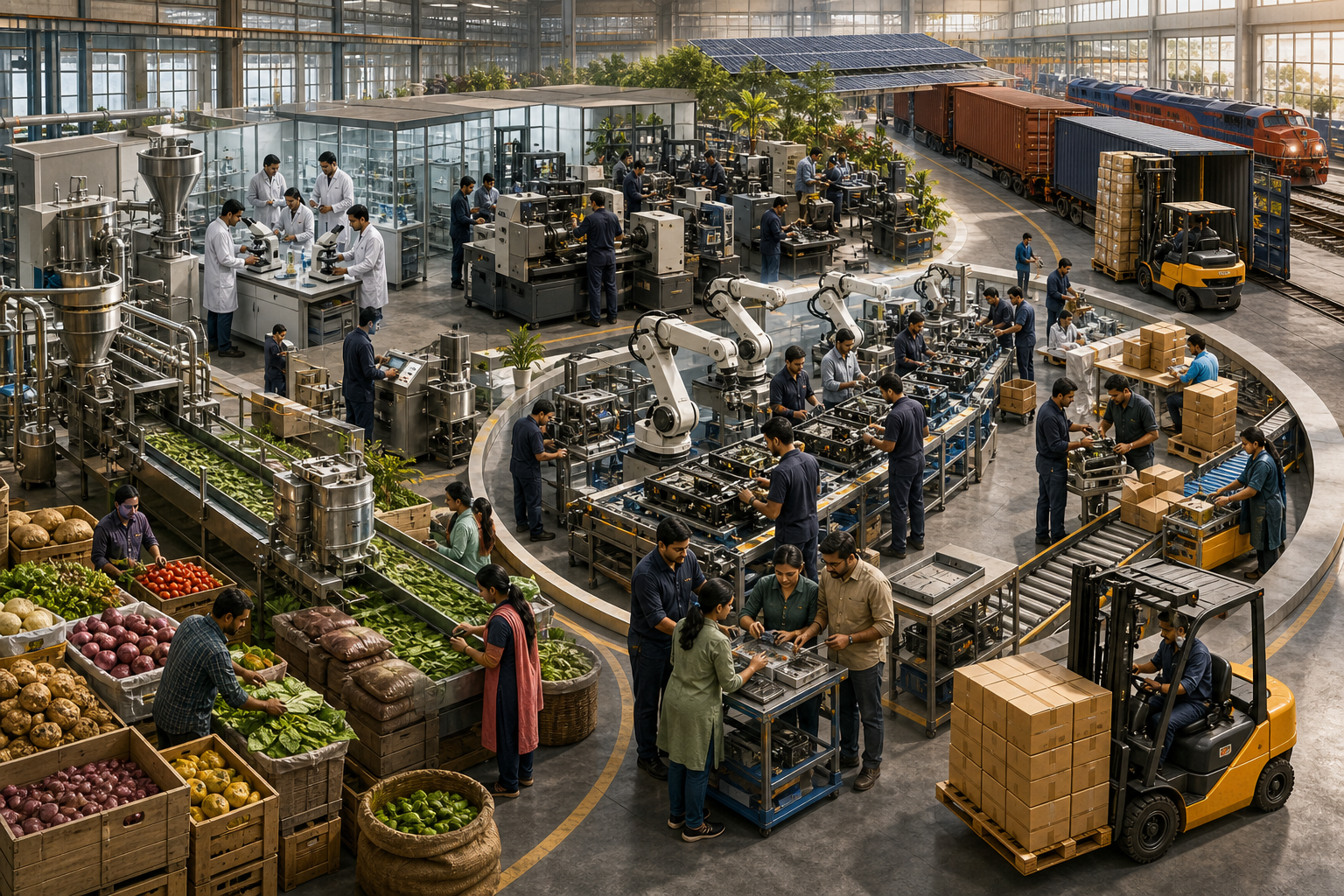
On 15 August 2026, Prime Minister Narendra Modi placed Viksit Bharat 2047 at the centre of India’s next development phase and called for reduced dependence on other countries in strategically important areas. That qualification matters. Self-reliance should concentrate attention where a disruption, denial or loss of control could seriously constrain India.
This is not the same as refusing international trade. A resilient Bharat can trade widely, cooperate with several partners and participate in global value chains. The decisive question is whether another country, a single supplier or an inaccessible technology can paralyse a critical Indian function.
Use this dependency audit when you assess a policy, business plan or public procurement decision:
- Define the failure clearly. What essential activity would stop or become dangerously constrained if an external supply disappeared?
- Map the full capability stack. Look beyond final assembly to knowledge, materials, components, machinery, software, skilled workers, testing, servicing and future upgrades.
- Locate the concentration. Is the exposure spread among substitutable partners, or does control sit with one supplier, country or proprietary system?
- Choose the proportionate remedy. Depending on the exposure, the answer may be domestic capability, diversified supply, interoperable standards, workforce development or a combination of them.
- Name the evidence in advance. Decide what would prove that vulnerability had fallen: a functioning domestic component, qualified personnel, reliable maintenance, multiple suppliers or successful operation at useful scale.
A product assembled in India may still depend on externally controlled designs, core components and servicing. Conversely, an imported item with several dependable suppliers and an easy replacement path may pose little strategic risk. This distinction keeps self-reliance focused on resilience rather than symbolism.
A seven-priority scorecard you can actually use

No single headline can establish that Bharat is becoming developed. Use the following questions when you read a budget, evaluate a company announcement, consider an educational programme or listen to a political claim. They are diagnostic tests, not official targets.
| Priority | Evidence of meaningful progress | A common false positive |
|---|---|---|
| Manufacturing | Indian firms can design, make, test, maintain and improve important products through capable domestic supplier networks. | Final assembly expands while essential designs, tools, components or repairs remain externally controlled. |
| Agriculture and food processing | More farm output can be stored, processed, transported and converted into higher-value products, with producers connected to dependable markets. | Raw production receives attention while storage, processing, quality control and market access remain weak links. |
| Technology and innovation | Indian institutions can move useful knowledge from learning and research into dependable products, services and production systems. | High adoption of foreign systems is treated as proof that India controls the underlying technology. |
| Gati Shakti | Physical and digital connections work as a network, helping people, materials, energy and information reach productive destinations reliably. | Individual assets are announced or completed without resolving the bottlenecks between them. |
| Defence | India can design, produce, maintain, replenish and upgrade critical systems without an unacceptable external point of failure. | Local assembly is counted as autonomy even when core inputs, servicing or upgrades remain dependent on an outside power. |
| Green and blue economy | Energy, industry and ocean-based activity create durable capability while respecting ecological limits and resource security. | A green or blue label conceals imported technological dependence or merely shifts environmental costs elsewhere. |
| Soft power | Interest in Bharat becomes sustained learning, cultural exchange, scholarship, travel, trusted institutions and long-term relationships. | Event attendance, online visibility or borrowed cultural imagery is treated as enduring civilizational influence. |
The false positives deserve as much attention as the progress column. Output can rise without control deepening. Infrastructure can grow without networks becoming reliable. Cultural visibility can expand while knowledge is simplified, detached from its origins or poorly taught. A serious 2047 assessment must examine the capability underneath the headline.
The seven streams must reinforce one another

Use the capability-connection-consequence test
The hardest part of Viksit Bharat is coordination. An invention that cannot move from a laboratory into reliable production remains isolated. Manufacturing that lacks efficient connections to workers, materials and markets loses competitiveness. Agricultural output without processing and logistics leaves potential value unrealised. Defence autonomy depends on technology, manufacturing and infrastructure together.
Green development creates the same challenge. Replacing one external dependency with another does not produce strategic resilience merely because the new system has a cleaner label. India has to examine the technology, materials, skills, maintenance and ecological consequences across the entire chain.
For any new initiative, trace three links:
- Capability: What knowledge, skill, tool, production system or institution is being created inside India?
- Connection: What links that capability to actual use: standards, infrastructure, training, finance, maintenance, distribution or public procurement?
- Consequence: What should become more secure, productive, accessible or sustainable if the initiative works?
If one of those links is missing, the proposal is incomplete. If no one can say what evidence will demonstrate the consequence, the claim is not yet accountable.
Keep civilizational continuity inside the definition of development
From a Dharmic perspective, we should not define development as consumption alone. Artha, or material prosperity, gains legitimacy when it operates within dharma: responsibility toward people, knowledge, nature, institutions and generations not yet born. This does not replace economic measurement. It tells us what economic power is for.
That lens changes the questions you ask. Does a project respect the dignity and agency of workers and producers? Does it leave future generations with stronger capabilities or depleted foundations? Does modernisation keep inherited knowledge alive as a serious intellectual resource, or reduce it to decoration? Does national confidence produce careful stewardship, or only louder branding?
Soft power is where this distinction becomes especially visible. Yoga, Bharatiya languages, philosophy, literature, pilgrimage, arts and the living Hindu, Buddhist, Jain and Sikh traditions can be presented with intellectual depth and fidelity. Durable influence requires accurate translations, trained teachers, accessible archives, credible scholarship and institutions able to sustain relationships. A viral fragment stripped of context may attract attention, but it does not necessarily strengthen Bharat’s civilizational voice.
This also provides a test for cultural organisations. Measure more than reach. Notice whether first-time curiosity becomes repeated study, whether teachers are being formed, whether primary knowledge is being preserved, and whether people can encounter a living tradition rather than a marketable caricature.
Turn the 2047 ambition into work you can begin now
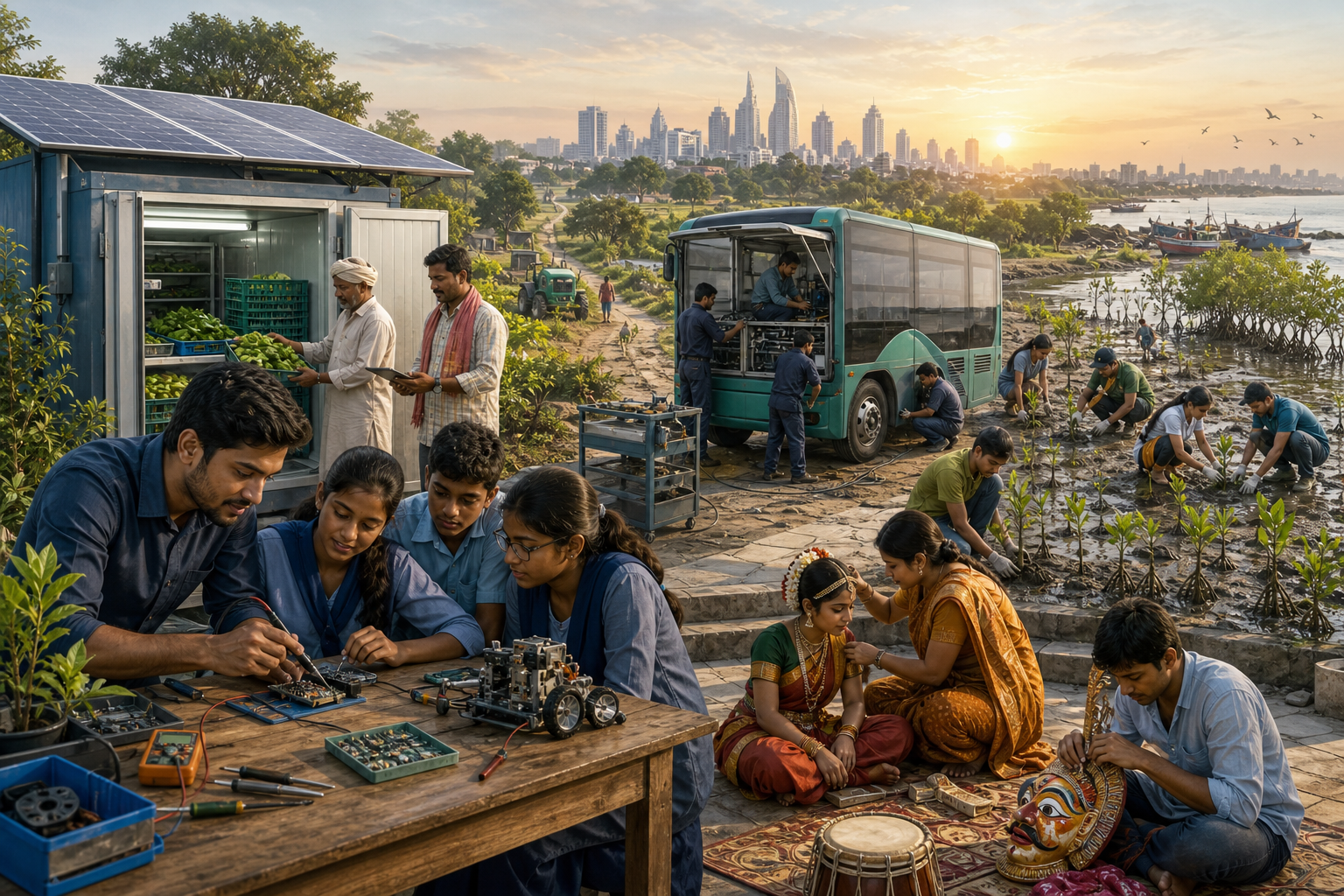
The national ambition has been framed as requiring the effort of 140 crore Indians. Collective effort does not transfer the state’s responsibilities to individuals. It means your work, procurement, study, institutional choices and public scrutiny can either deepen national capability or leave dependency untouched.
- If you run a business or control procurement, map one critical dependency through the full stack, including servicing and replacement. Compare suppliers on quality, continuity, domestic capability and ease of switching as well as price. Do not change a critical supplier on patriotic branding alone; an untested switch can create costly operational failures.
- If you are a student or professional, choose a capability connected to one of the seven priorities and build demonstrable competence in it. Industrial design, food science, logistics, advanced technology, defence maintenance, clean systems, ocean knowledge, translation and cultural curation are examples of directions, not promises of employment. Test your choice against real institutional demand.
- If you teach or conduct research, add a deployment path to the work. Identify who could use the knowledge, what prevents adoption, which standards or skills are missing, and what evidence would show that the idea works outside its original setting.
- If you serve a Dharmic or cultural institution, invest effort in translation quality, teacher formation, archives, primary-text access and sustained learning. Count repeat participation and deeper study, not only attendance or online impressions.
- If you are evaluating public policy, keep a one-page record of the capability promised, the dependency it is supposed to reduce, the next verifiable milestone and the unresolved weak link. Update the same record rather than starting afresh with each announcement.
You can build a personal annual scorecard in four steps:
- Select one of the seven priorities that intersects with your work, community or expertise.
- Write down one important dependency or bottleneck within that priority.
- Track one capability indicator and one outcome indicator. The first shows whether India can do something essential; the second shows whether that ability is improving life, resilience or productive performance.
- Review the same two indicators at a fixed interval and record delivered results, not only spending, launches or stated intentions.
Before you support the next Viksit Bharat announcement, ask what dependency will end, what Indian capability will remain and when evidence should become visible. Then choose one capability within your reach and help move it from aspiration to dependable practice. That is how 2047 stops being a distant anniversary and becomes a discipline for decisions made now.
References
