
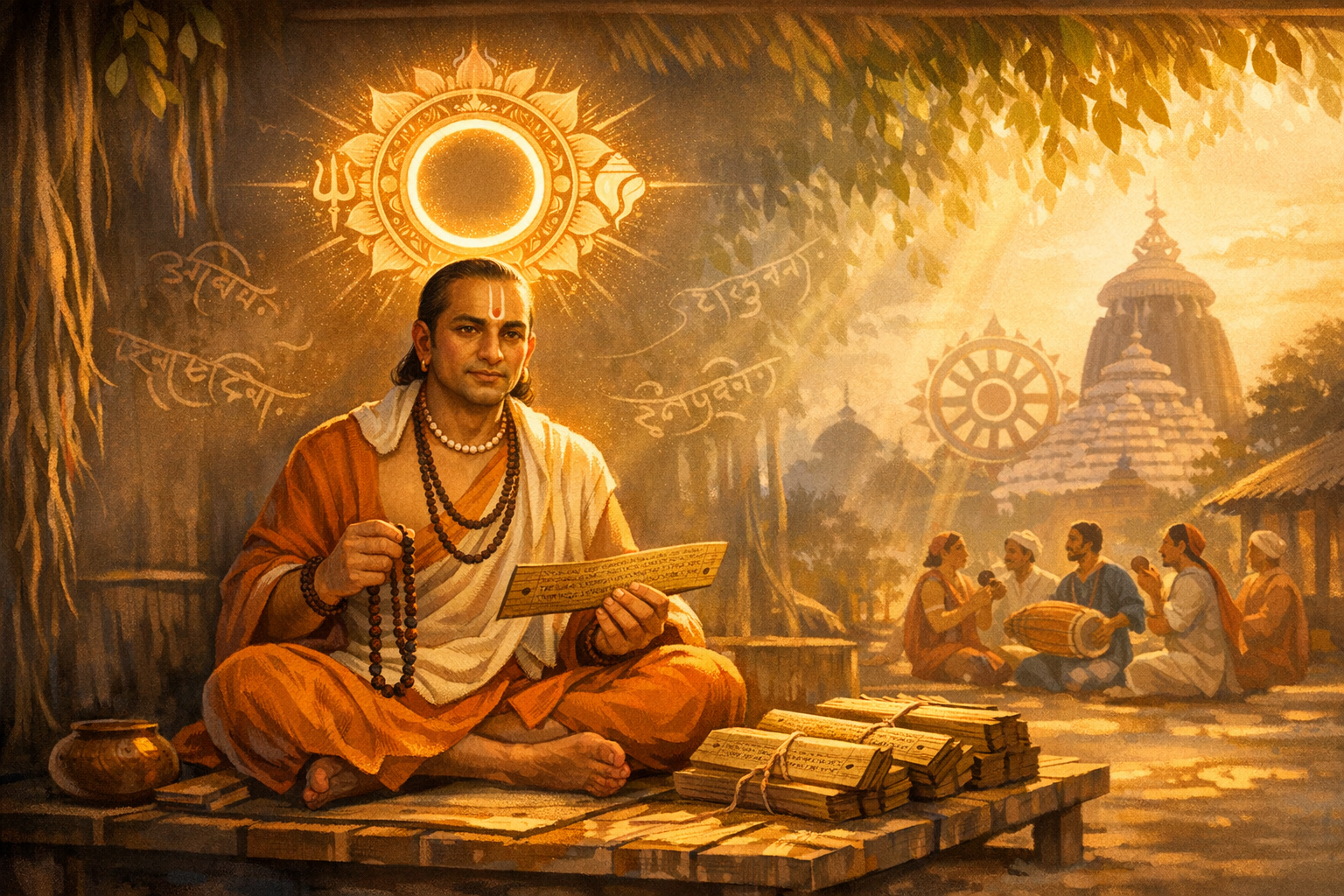
Achyutananda Dasa (15th–16th century) stands as one of Odisha’s most influential Vaishnava saints and vernacular intellectuals. Counted among the celebrated Panchasakhas (five Odia poet-saints), he is remembered for bringing the core of the Bhakti Tradition to the doorstep of ordinary devotees. Born between 1460 and 1512 CE to Dinabandhu in Tilakana village of Cuttack District, he shaped the religious and cultural landscape surrounding the Jagannath Temple at Puri and helped define the trajectory of Odia literature. His enduring legacy blends heartfelt devotion, philosophical insight, and social inclusivity in ways that continue to resonate across dharmic traditions.
Historically, Achyutananda’s life unfolds in the vibrant milieu of the Gajapati polity when Puri functioned as a sacral capital and cosmopolitan pilgrimage center. The arrival of Sri Chaitanya in the early 16th century intensified devotional currents and stimulated dialogue between Gaudiya Vaishnavism and Utkaliya Vaishnavism. Odisha’s religious ecology was already pluralinterlacing Vaishnava, Shaiva, Shakta, Buddhist, and Jaina strandscreating fertile ground for creative synthesis and intertradition exchange.
The PanchasakhasBalarama Dasa, Jagannatha Dasa, Achyutananda Dasa, Śiśu Ananta Dasa, and Yasovanta Dasacomposed in accessible Odia, privileging clarity of meaning over scholastic exclusivity. Through kirtan, narrative poetry, and didactic song, they democratized scriptural wisdom for households and village squares. The rise of community recitation spaces (tungi) exemplified this pedagogy, as families gathered to hear verses that harmonized theology, ethics, and everyday practice. Anchored in the Jagannath-centered Bhakti Tradition, this movement nurtured devotional participation and social cohesion.
While hagiographical sources vary on details, there is broad agreement that Achyutananda’s father was Dinabandhu and that his birth occurred in Tilakana of Cuttack District. Sources place his later years and memory at Nemala (present-day Cuttack district), where a matha or gadi preserves associated traditions, and many devotees venerate a samadhi. These anchors, coupled with the wide circulation of his compositions, situate him firmly within Odisha’s 15th–16th-century devotional renaissance.
A substantial Odia corpus is attributed to him. Notable among these are Shunya Samhita (also known as Shunya Purana), the Malika literature of propheciesoften referred to collectively as Achyutananda Malikanumerous bhajans and jananas, chautisas, and narrative retellings such as a Harivamsa in Odia. The Malika genre weaves calendrical cycles, eschatological motifs, and moral exhortation, while the Shunya literature contemplates a cosmogony in which the ineffable ground of being is named sunya, inviting readers to contemplate the sacred that exceeds verbal capture.
Philosophically, Achyutananda’s treatment of sunya signals not negation but the inexpressible fullness of Brahman. Within this frame, devotion to Jagannath-Krishna thrives alongside contemplative insight. His synthesis preserves Bhakti’s intimacy with the Divine Name while conversing with Vedantic nondual intuitions. It also shows a dialogical awareness of Buddhist reflections on emptiness and Jaina many-sidedness (anekantavada), demonstrating how a Vaishnava saint could affirm plurality without diluting devotion. The result is a devotional nondualism that honors both the personal Lord and the ineffable Absolute.
Poetically, his compositions employ memorable refrains, parallelism, and acrostic structures such as the chautisa, which sequences verses through the Odia alphabet. These forms supported oral transmission, aided memory, and enabled intergenerational learning in village settings. By elevating colloquial Odia as a vehicle for high theology, the Panchasakhas shaped the evolution of Odia literature and broadened the cultural reach of the Jagannath tradition.
In matters of practice, his teachings emphasize the guru-shishya relationship, nama-japa of Hari, satsang, vrata, and seva. Devotional merit is centered on disposition and disciplined practice rather than status at birth. Around the Jagannath Temple’s living traditions, these ideals fostered wider ritual participation and a culture of sharing mahaprasad, strengthening bonds across occupations and communities and affirming the dignity of collective worship.
Crucially, Achyutananda’s vision models dharmic plurality. The language of sunya accommodates the nirguna-saguna polarity, and the Jagannath tradition itself integrates Vaishnava, Shaiva, and Shakta resonances. This capacious frame is consonant with the broader dharmic familyHindu, Buddhist, Jaina, and Sikhthrough shared practices of song, remembrance of the Divine Name, ethical self-restraint, and compassionate service. The message of love and tolerance is not peripheral; it is integral to the fabric of the Bhakti way of life.
For many households in Odisha and the diaspora, seasonal kirtans, Panchasakha bhajans, and recitations of the Odia Bhagavata still animate festivals and family gatherings. These communal sounds keep Achyutananda’s inclusive theology close to daily life, making philosophical ideas tangible in rhythm and melody. The continuity of such practice reveals how literary heritage becomes lived heritage, linking personal devotion with a shared cultural memory.
From a historiographical standpoint, palm-leaf transmission and oral circulation mean that attributions and dates vary across manuscripts and editions. Scholars therefore approach the corpus as layered: central devotional and philosophical strands traceable to the 16th century, surrounded by later redactions. Despite textual variation, core through-linesdevotion to Jagannath, ethical clarity, and spiritual inclusivityremain remarkably stable across versions.
In contemporary terms, Achyutananda Dasa offers a balanced template for those seeking rooted identity and interfaith harmony. Firmly anchored in Odisha’s cultural heritage and the Jagannath-centered Bhakti Tradition, his synthesis honors multiple ways of worshiping and knowing. It exemplifies how a regional Vaishnava movement can articulate a universal ethic of empathy, dialogue, and unity in spiritual diversity, aligning with the enduring dharmic ideal of Vasudhaiva Kutumbakam.
In sum, remembered as Mahapurusha Achyutananda, he emerges as a Vaishnava saint, vernacular poet, and cultural bridge-builder whose influence spans temple ritual, village pedagogy, and literary history. As one of the Panchasakhas, his voice helped define the moral and aesthetic contours of Odisha’s civilization and continues to guide seekers toward a compassionate, inclusive, and dharmic way of life.
Inspired by this post on Hindu Blog.
