
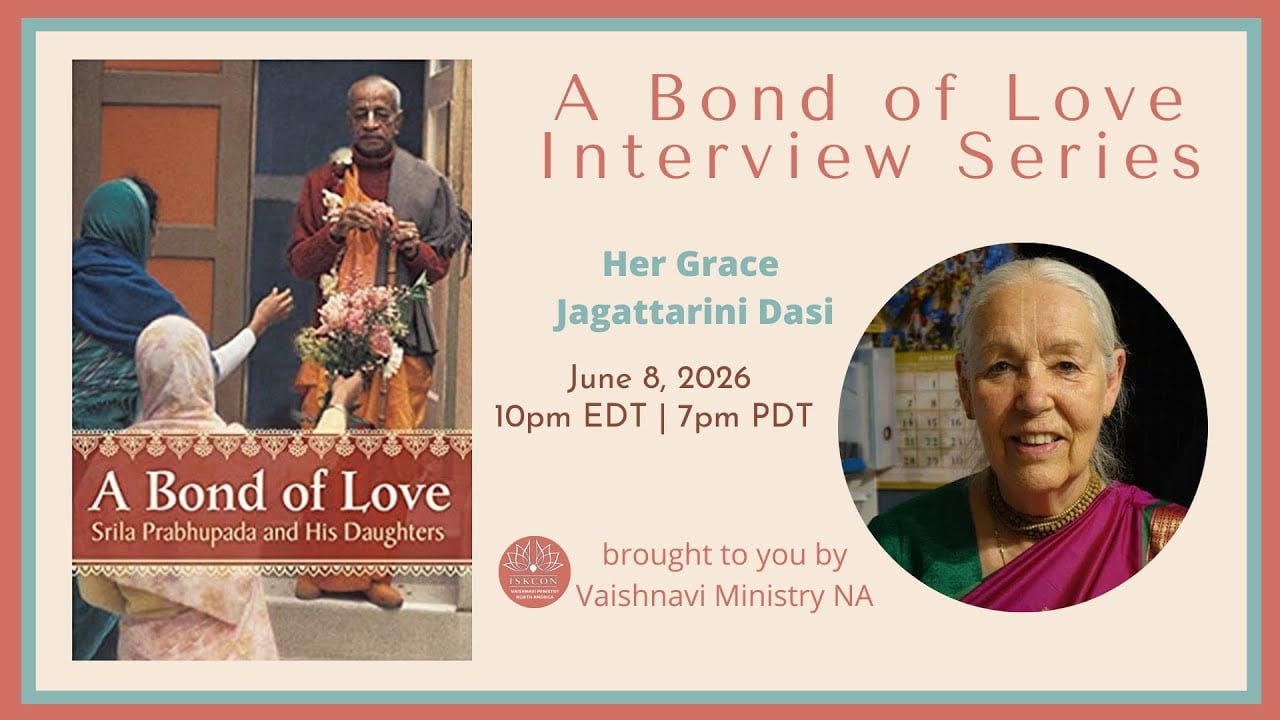
A Bond of Love Interview Series, hosted by Vaishnavi Ministry NA, documents the living history of Srila Prabhupada’s daughters in the Hare Krishna Movement and their enduring contributions to Gaudiya Vaishnavism. Part 3 of the series features HG Jagattarini dasi, whose journey illuminates the transformative power of guru-bhakti, the pedagogical depth of devotional art, and the evolving role of women in Hindu spirituality. The conversation stands as an archival resource that strengthens unity in spiritual diversity while preserving cultural heritage for future generations.
Beyond biography, the series operates as a carefully curated oral history initiative: it captures first-person experiences, contextualizes them within scriptural foundations, and translates them into guidance the global community can understand and apply. In doing so, it offers scholars, educators, and practitioners a rare window into how the Guru–Shishya Relationship is embodied in contemporary life and how personal devotion interweaves with community leadership, seva, and pedagogy.
HG Jagattarini dasi is widely recognized for pioneering devotional storytelling through immersive exhibition design. Her work with The Sacred India Gallery in Perthespecially the signature installation known as The Vrindavan Experiencetranslates the aesthetics and theology of bhakti into accessible, research-informed displays for diverse audiences. These narrative environments function as living classrooms, preserving memory, ritual, and sacred geography through carefully crafted visual and spatial compositions.
In Part 3, the discussion highlights how artistic practice becomes sadhana when rooted in scriptural understanding and service to guru and community. The curatorial choicesiconographic fidelity, narrative sequencing, and material selectionare presented not as mere artistic preferences but as a form of seva that safeguards doctrinal clarity while inviting empathetic engagement. This approach aligns with the Vaishnava emphasis on hearing and remembering (śravaṇam, smaraṇam) and extends them into a multi-sensory, museum-quality format.
The phrase “bond of love” is both emotive and technical within Gaudiya Vaishnavism. It refers to the covenantal intimacy between guru and disciple described in Bhagavad-gita 4.34 (tad viddhi praṇipātena), where knowledge transmission unfolds through humility, inquiry, and service. In HG Jagattarini dasi’s account, this bond translates into practical guidancehow to cultivate steadiness in sadhana, how to communicate the tradition without dilution, and how to harmonize artistic innovation with siddhānta.
Prema-bhakti, the theological heart of Gaudiya Vaishnavism, offers a second anchor. Śrīmad-Bhāgavatam 1.2.6 (sa vai puṁsāṁ paro dharmo…) frames the supreme dharma as causeless, uninterrupted devotion that satisfies the self. The interview connects this principle to real-world practice: consistent japa, kirtan, and seva as non-negotiables that refine character, stabilize community life, and sustain long-term projects such as devotional galleries and outreach.
The conversation also traces the scriptural basis for inclusive participation in bhakti. Bhagavad-gita 9.32 affirms universal eligibility, and the series foregrounds how women in spirituality have carried this legacy forwardfrom the poetic theology of Andal to contemporary Vaishnavi leadership. HG Jagattarini dasi’s trajectory maps a pathway for future Vaishnavis: rigorous study, hands-on service, and mentorship that cultivates both competence and compassion.
Methodologically, A Bond of Love Interview Series advances the preservation of intangible cultural heritage. It records memory while correlating it with scriptural and historical frameworks, thereby supporting both emic (insider) voices and academic analysis. As a digital archive, it mitigates the fragility of oral transmission, enables intergenerational learning, and democratizes access to the living tradition for diaspora communities.
Devotional art, as presented by HG Jagattarini dasi, operates at the intersection of aesthetics and theology. Drawing on the rasa theory of the Nāṭyaśāstracondensed in the sutra “vibhāva–anubhāva–vyabhicāri–saṁyogād rasa–niṣpattiḥ”the exhibits harness lighting, scale, gesture, and narrative pacing to evoke śānta, dāsya, sakhya, and especially mādhurya rasas consistent with Gaudiya sensibilities. This is not entertainment; it is pedagogy that trains perception toward sacred meaning.
Technical considerationsarchival materials, color temperature, acoustic design for kirtan soundscapes, and ergonomic visitor floware integrated to encourage contemplative states without overwhelming the senses. The result is a research-based, emotionally resonant environment in which theology is learned not only through texts but through carefully orchestrated aesthetic experience.
The interview situates this work within the broader ethos of the Hare Krishna Movement: to communicate Krishna-bhakti with fidelity and warmth. Such fidelity is coupled with cultural translation, enabling audiences unfamiliar with Hindu spirituality to appreciate the ethical and contemplative dimensions of bhakti. This approach helps bridge public humanities, museum studies, and religious education.
Importantly, the series affirms unity among dharmic traditions. The compassion and service cultivated in Vaishnavism harmonize with Buddhist mettā and karuṇā, Jain ahiṁsā and saṁyama, and Sikh sevā and simran. By emphasizing shared ethical aspirations and contemplative disciplines, the conversation models how Sanatana Dharma’s plural strands can move in concert toward social harmonyVasudhaiva Kutumbakam in practice.
Leadership insights emerge organically. The discussion underscores “servant leadership” as a Vaishnavi competency: leading by example, decentralizing credit, and prioritizing community formation over personal profile. This model resonates with contemporary organizational theory while remaining rooted in the Guru–Shishya Relationship and the ethics of seva.
For practitioners, the interview outlines a pragmatic sadhana architecture. Daily japa anchors cognition; kirtan stabilizes affective life; śāstra study refines judgment; and practical seva develops resilience and humility. Together, these disciplines nurture both personal transformation and the social trust required for long-duration cultural projects.
Across the conversation, moments of vulnerability are acknowledgedbalancing family responsibilities with service, sustaining creativity through setbacks, and maintaining equipoise amid public scrutiny. These are recognizable challenges for many householders and community leaders, and the suggested remedies remain classical: sādhana regularity, wise association, and incremental, transparent teamwork.
From a cultural heritage perspective, The Sacred India Gallery demonstrates how diaspora communities curate memory. By reconstructing sacred topographies such as Vṛndāvana through diorama and narrative, they enable second-generation learners to encounter tradition as lived space, not abstraction. This materially grounded pedagogy complements textual study and supports long-term identity formation.
The series also contributes to academic discourses in religious studies, gender studies, and pedagogy. It offers primary-source testimony on how women shape tradition, evidence for how aesthetic environments teach theology, and data on transnational transmission of Sanatana Dharma. Such intersections are valuable for scholars investigating continuity and change within modern Hindu movements.
Ethically, the conversation reiterates the bhakti commitment to nonsectarian goodwill. While anchored in Gaudiya Vaishnavism and ISKCON, its message encourages inter-dharma respect and collaborationconsistent with the blog’s aim to strengthen unity among Hinduism, Buddhism, Jainism, and Sikhism. The shared focus on compassion, self-discipline, and service provides robust common ground.
In sum, A Bond of Love Interview SeriesPart 3 with HG Jagattarini dasifunctions as a living archive, a leadership seminar, and a contemplative primer. It preserves Srila Prabhupada’s legacy through the voices of his daughters, illustrates how devotional art can teach with rigor and warmth, and models inclusive, tradition-faithful leadership. For communities seeking durable, values-driven cultural renewal, the conversation offers both inspiration and method.
Inspired by this post on Dandavats.
