
“It is not your responsibility to figure out what someone else is feeling and why. Let go of the illusion that ‘fixing’ their bad mood will make you feel better.” ~Sarah Crosby
Consider a common scene: during a brief phone call, one partner sounds irritated about work. The listener’s heart tightens, the stomach drops, and a surge of anxiety races through the body. Within seconds, a cascade of discomfort gathers momentum, as though someone else’s mood has taken over the entire internal landscape.
In such moments, a predictable loop often forms. Irritation on one side prompts fear on the other; fear then fuels further frustration; the exchange accelerates into a feedback cycle that leaves both people emotionally flooded. Afterward, lingering despair or rumination can set inplotting solutions, replaying words, or silently nursing grievances.
This pattern rarely limits itself to one relationship. Many experience a similar pull with family, friends, colleagues, and childrenthe mere sight or thought of someone else’s strong feelings can feel unbearable. Instinctively, people rush to fix, reassure, or soothe, often suppressing their own needs to escape the discomfort of being near intense emotion.
When a relative becomes angry, it can feel like a deliberate attack. When a child is sad or disappointed, the impulse may be to rescuechanging plans, offering treats, or talking them out of what they feel. Yet in human community, emotions are inevitable. If other people’s feelings feel threatening, space for healthy expression quietly disappears, replaced by a subtle demand: please stop feeling that, because it makes me uncomfortable.
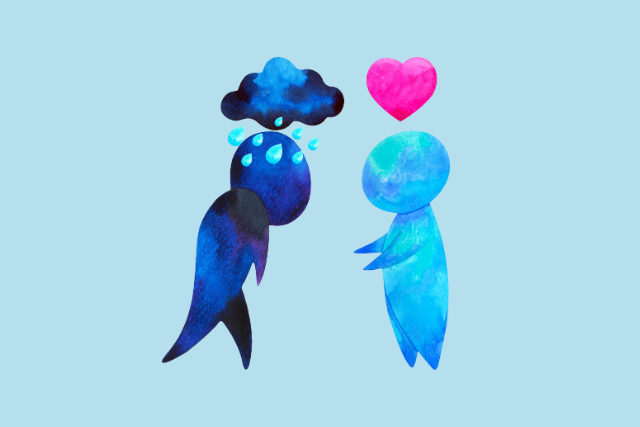
A more sustainable approach begins by naming a foundational distinction: my feelings are separate from your feelings. Emotional overwhelm in relationships often arises because this separation is not recognized in real time. The nervous system senses another’s activation and reflexively treats it as one’s own.
It commonly sounds like this internally: Stop being scared! It’s making me scared! or Stop being irritable! It’s making me anxious! In reality, no one is making another person feel. Emotions arise and pass within each body-mind. With practice, it becomes possible to notice, “Oh, my own feelings are activating here,” and then redirect attention to self-support rather than reaction.
Another clarifying principle: people are not having feelings on purpose. Different nervous systems default to different strategies under stressone person may pursue and press to fix everything immediately, while another distances and withdraws. Both are discomfort-management strategies, not deliberate efforts to cause harm. When each person learns to create a little space and regulate their own activation, the relational dynamic shifts dramatically.
It is also useful to remember that genuine empathy is hard to access during emotional activation. When anger, fear, or sadness is intense, perception narrowsanger sees more offense; fear sees more danger. Conversations about behavior or problem-solving are more productive after the surge has settled. Knowing this reduces the urge to argue with words spoken in the heat of the moment and supports emotional boundaries.
Because feelings activate feelings, a calm person exposed to someone else’s anger may experience fear or reactive anger of their own. This co-activation is natural. The task is not to suppress it but to support the body through itthrough mindful breathing, somatic awareness, and self-compassionso the emotion completes its cycle rather than looping.
One practical cue is to notice and name the experience. A simple internal statement can reorient attention: The best thing I can do right now is support myself in feeling my feelings, and not engage in their feelings. This naming provides immediate self-support and begins to restore agency.
Offering oneself empathy, understanding, and validation further calms the system. Phrases such as This is hard for me because… I understand why this is so challenging. It makes sense that this is tough for me since… and It’s hard seeing someone feel so disappointed or angry. It’s hard to hold these feelings. signal safety to the nervous system and reduce reactivity.
Physical reassurance can help: a hand on the heart, gently stroking the arms, or a self-hug while breathing slowly. These simple gestures, combined with slow exhalations, support regulation and invite the body to release the “runaway train” feeling.
Changing lifelong habits is rarely instantaneous. Yet with awareness and intention, it is possible to reinterpret other people’s emotional wavesnot as threats to be extinguished, but as experiences that can be witnessed with steadiness. Practices recognized across dharmic traditions reinforce this shift: mindful attention and equanimity (Buddhism), ahimsa and pranayama (Hinduism), anekantavada’s respect for multiple perspectives (Jainism), and simran’s grounded remembrance (Sikhism). Each tradition lifts up compassionate witnessing, responsible self-regulation, and non-reactive presence, strengthening unity and mutual care.
Applied consistently, these principles yield tangible change. Hearing a partner’s disappointment or a child’s sadness becomes a cue to remember, “These are their feelings.” Rather than jumping into the pool of another’s emotion, one can stand on solid ground, support oneself, andby not adding secondary reactivitylighten the overall emotional load in the room. Owning one’s feelings, while allowing others theirs, creates spaciousness, clarity, and peace in relationships.
Inspired by this post on Tiny Buddha.
