
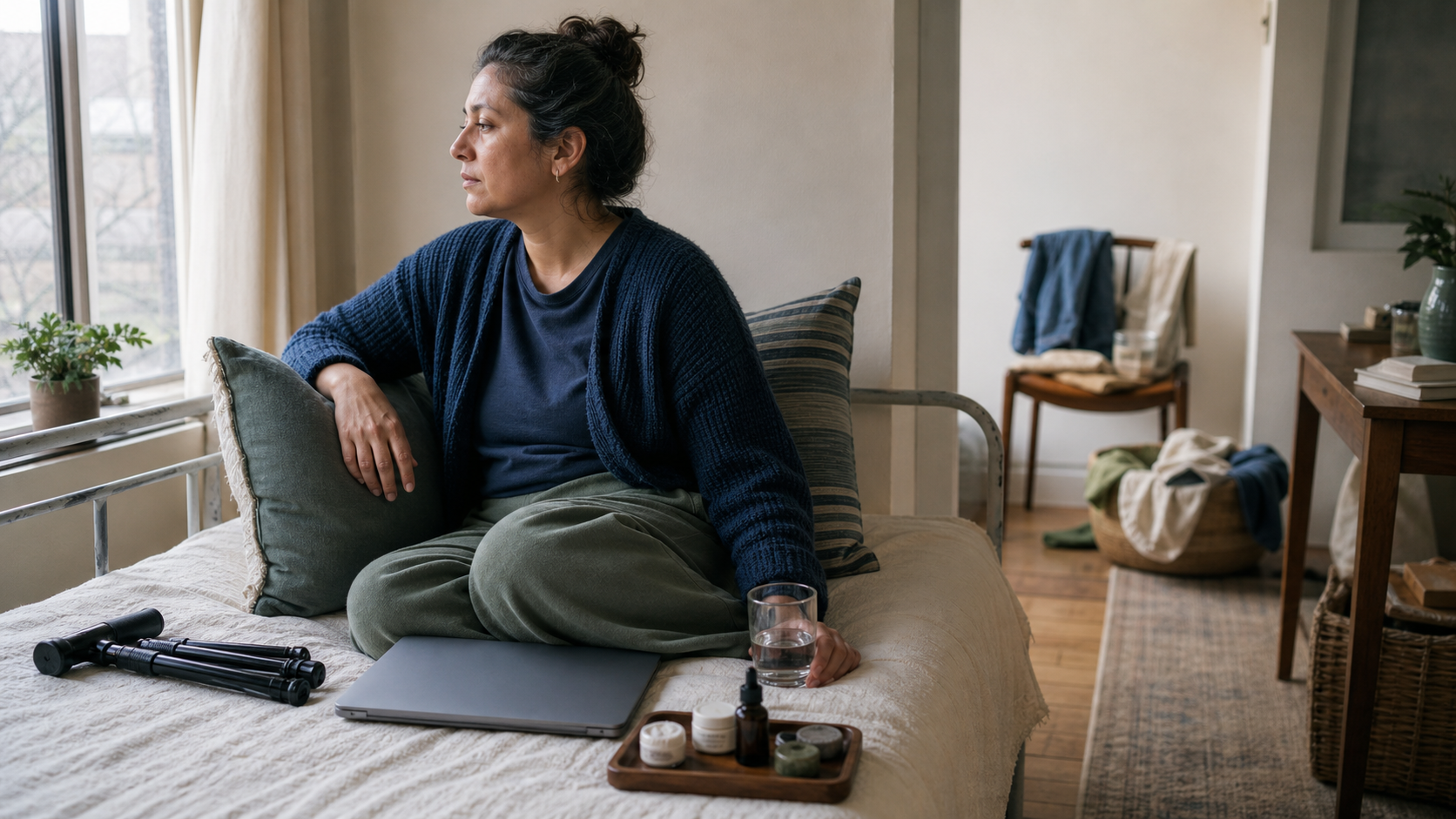
If chronic illness has made your old routines unreliable, you may be wondering whether personal growth is still possible when so much energy goes into simply managing the day. It is, but growth does not require you to admire the illness, deny your anger, or turn suffering into an inspirational performance.
You can begin somewhere more honest: accept the reality in front of you, protect your health, and decide what kind of person you want to be within conditions you did not choose. That is a practical form of dharma.
Begin with truth, not a forced silver lining
Acceptance is often confused with approval. They are not the same. Acceptance says that a symptom, diagnosis, treatment requirement, or limitation belongs in today’s decisions. Approval would mean calling it desirable. You do not have to do that.
Acceptance is not passive, either. You can accept that you are ill while seeking better care. You can follow a treatment plan while asking questions about it. You can acknowledge a limit without deciding that the limit defines your entire identity.
When your mind is moving between fear, resentment, and premature optimism, make a three-part inventory:
- Fact: Write only what you can presently observe or what a qualified clinician has established. A symptom disrupted sleep. A treatment was prescribed. A planned activity is beyond your current capacity.
- Loss: Name what the condition has cost you. It may be spontaneity, privacy, work, food, confidence, money, or a former picture of your future. Grief becomes easier to understand when it has an object.
- Choice: Identify the next safe action that remains available. That may be arranging follow-up care, taking prescribed treatment, cancelling a demand, recording a symptom, or asking someone for practical help.
Keep spiritual theories out of the Fact line. Illness is not proof that you failed morally, thought impure thoughts, or practised with insufficient faith. Whatever your understanding of karma, it is not a clinical diagnosis and should never be used to cancel medical care.
You are also allowed to remain unhappy about what happened. Gratitude is not an entrance requirement for growth. Sometimes the first sign of growth is simply refusing to lie to yourself about pain.
Advocate for your body without diagnosing yourself

Chronic illness can place you in an exhausting position: you must rely on professional care while also insisting that your own observations matter. One person with recurring abdominal pain heard stress offered as the explanation at three consultations before pushing for deeper investigation; a CT scan, specialist referral, colonoscopy, and biopsy eventually led to a Crohn’s diagnosis.
That experience does not prove that every unexplained symptom has a hidden disease, nor does it make stress irrelevant. It shows why persistent symptoms deserve a clear plan rather than indefinite dismissal. Advocacy is not arriving with a self-diagnosis and demanding that it be confirmed. It is making the pattern visible, asking what uncertainty remains, and finding out what happens next if the first explanation is wrong.
Before an appointment, prepare a short record that covers:
- What the symptom feels like and where it occurs.
- When it began, what pattern you have noticed, and whether it interrupts sleep or ordinary activity.
- What has changed since the previous appointment.
- What you have already tried and what happened afterward.
- Which prescribed treatments you are following and any concerns you need to discuss.
- The practical effect on eating, movement, work, rest, or other daily functions.
Then ask questions that require a plan: What possibilities are being considered? What finding would justify further investigation? If the current approach does not help, what is the next step? When should you return? Would another qualified opinion or a specialist be appropriate?
A clinician may reasonably decide that a particular test is not indicated. Advocacy does not guarantee the test or answer you expect. It should, however, produce an explanation you understand and a route for follow-up. If important symptoms persist, worsen, or repeatedly receive no adequate evaluation, seeking another qualified medical opinion is reasonable.
Do not stop prescribed treatment, conduct risky experiments, or delay urgent help while trying to assemble perfect evidence. If symptoms are severe, rapidly worsening, or feel life-threatening, seek urgent or emergency care rather than waiting for a routine appointment.
Turn restrictions into a careful feedback loop

A diagnosis may give your illness a name without immediately telling you how to live with it. That gap can be frustrating. Some conditions vary substantially from person to person, and useful patterns may emerge only through sustained observation.
For one person with Crohn’s, identifying food triggers took about two years of paying attention, removing items, and cautiously adding them back. Alcohol, spicy food, orange juice, greasy fast food, and coffee became that person’s problem list. It is not a universal Crohn’s diet and should not become yours by imitation. The useful lesson is the method: observe your own body patiently, and separate a suspected pattern from a proven one.
Build that method around your clinical care:
- Follow the agreed treatment plan first. A personal log complements professional care; it does not replace medication, testing, or follow-up.
- Choose what you are observing. Ask your clinician which symptoms, functions, foods, activities, or treatment effects are useful to record for your condition.
- Record before interpreting. Note what happened and when. Avoid turning a single bad day into a permanent rule.
- Change only what is safe to change. When feasible, make clinician-approved adjustments separately so that the result is easier to interpret.
- Review the pattern with a professional. Bring the record to your treating clinician. If diet is involved, ask whether guidance from a qualified dietitian is appropriate.
Do not discontinue medicine, reintroduce something known to be dangerous, or remove whole groups of foods merely to make the experiment cleaner. Unnecessary restriction can make eating harder and may compromise nutrition. Safety outranks a tidy data set.
This feedback loop can produce growth even before it produces certainty. You learn to notice without panicking, to question without guessing, and to practise discipline without turning it into punishment.
Practise dharma at the scale of the day
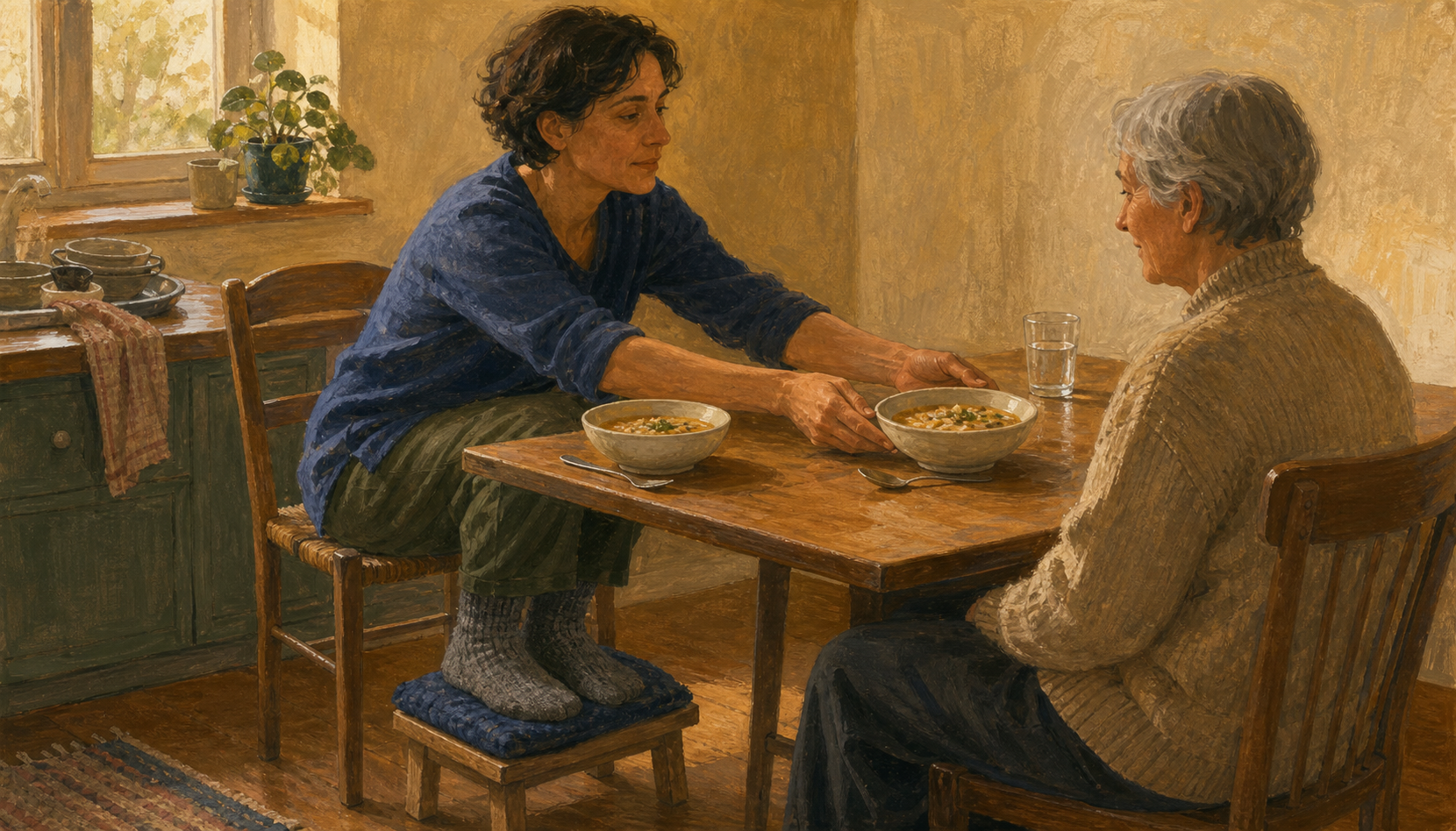
Seen through a dharmic lens, the central question is not how to prove that you are above suffering. It is what right action remains possible under today’s conditions. Right action changes scale. A task suitable for a stable day may be unwise during a flare or other period of low capacity.
Choose a mode for the day instead of building every schedule around your best possible condition:
- Protect: Put medically necessary care first. Keep only the essential obligation, tell an affected person what has changed, and release the rest without conducting a moral trial against yourself.
- Maintain: Complete health routines and a modest amount of ordinary work. Preserve enough capacity for food, rest, treatment, and the relationships that support you.
- Build: Move a larger goal forward while retaining the routines that keep you stable. Do not use a better day to repay every postponed demand at once.
This is not surrender to illness. It is stewardship of the body you actually have. Ahimsa can be directed inward: do not use needless pain, concealment, or overexertion as proof of worth. That does not mean avoiding every difficult thing. It means choosing difficulty for a sound reason rather than because shame is driving you.
Spiritual practice and clinical care also have different jobs. Prayer, meditation, contemplation, seva, and other disciplines may help you meet fear, craving, uncertainty, or dependency with greater honesty. They cannot diagnose inflammation, determine which treatment is safe, or tell you whether a symptom needs urgent evaluation. Let spiritual practice support treatment, never substitute for it.
On a difficult day, reduce reflection to a few direct questions: What is true now? What is mine to do? What needs to wait? Whose help should I request? The answers may be humble. Humble action is still action.
Measure growth by changed conduct, not compulsory gratitude

Personal growth through illness is easiest to recognize in conduct. You advocate earlier instead of waiting to be believed. You stop negotiating with a limitation that has already proved real. You ask for help before a situation becomes a crisis. You keep a boundary even when someone else finds it inconvenient. You resume your practice after a setback without declaring the entire effort a failure.
Over about fifteen years, one person with Crohn’s found that discipline learned around food gradually changed how the body was treated more broadly, alongside a long period without a flare-up. That is one person’s outcome, not a medical promise. It does not prove that illness makes people healthier or that discipline controls every disease. It does show how a necessary practice in one part of life can shape choices elsewhere.
Look for your own transfer. Perhaps symptom tracking teaches careful attention at work. Saying no to a harmful food may help you say no to a harmful demand. Receiving care may soften your judgment of dependency in others. Living with uncertainty may clarify which commitments are genuinely yours.
None of these benefits makes the illness good. Growth belongs to your response; it is not a debt you owe because you became ill. If all your capacity is currently going toward treatment and survival, that is not spiritual failure.
Key takeaways
- Accepting present reality does not mean approving of illness or abandoning the search for better care.
- Bring concrete observations and follow-up questions to medical appointments; advocate for evaluation without trying to diagnose yourself.
- Track personal patterns under professional guidance, and do not copy another person’s triggers, diet, or treatment decisions.
- Plan the day around actual capacity, with medically necessary care protected before optional demands.
- Use spiritual practice to cultivate truthful attention, patience, and self-directed ahimsa, never as a replacement for clinical treatment.
- Measure growth through wiser conduct and clearer boundaries, not through an obligation to feel grateful for suffering.
Start with one page today. Write the facts, the losses, and the choices. Then take one safe next step: arrange the follow-up, begin the clinician-approved record, release a demand, or ask one person for specific help. You do not need to redeem the whole illness. You only need to meet the next part of your life truthfully.