
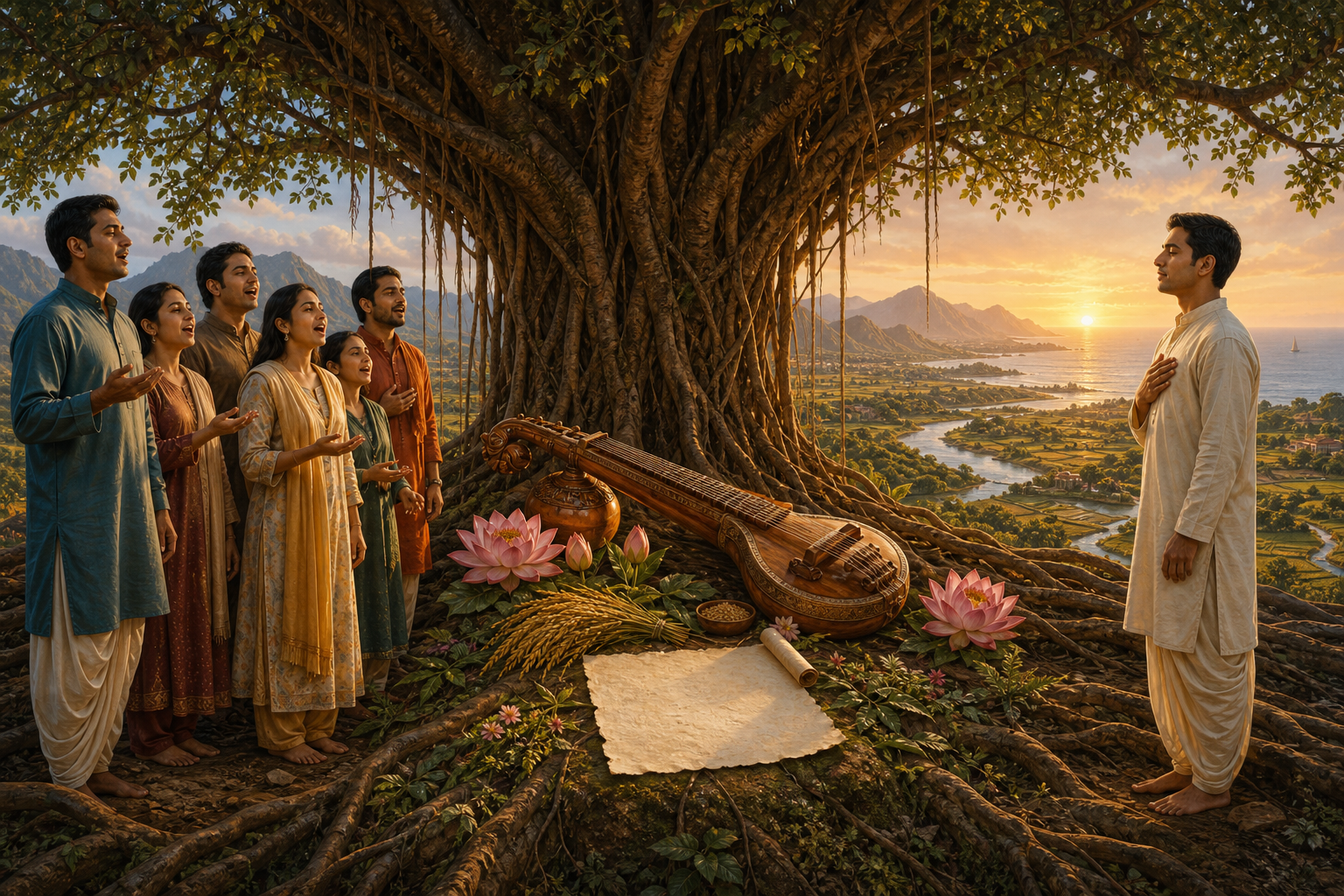
You may revere Vande Mataram and still wonder how to answer someone who says its later invocations are incompatible with belief in one God. The useful question is not whether a believer can feel that conflict. The useful question is what, if anything, that personal conflict entitles the believer to demand from everyone else.
On 20 August 2026, Sharmila Tagore argued that Bharat should use the first two stanzas because later invocations such as “Vande Kali” and “Vande Durga” may trouble people who believe in one God. You can answer that position without mocking anyone’s faith and without accepting that Hindu civilizational expression must be cut down to fit a non-Hindu theology.
The objection bundles three different claims
When someone raises a monotheist objection, ask which claim is actually being made. Three very different questions are often compressed into one sentence:
- A claim of conscience: “My faith does not permit me to utter these invocations.”
- A claim about Hindu theology: “Naming Kali and Durga necessarily means worshipping several rival gods.”
- A public demand: “Because I cannot sing these words, Bharat should exclude them from its common cultural life.”
The first claim can be sincere even when the second is mistaken and the third is unjustified. This distinction should govern your response. You do not have to prove that another person’s conscience is false. You do have to question the leap from “I cannot say this” to “your civilization should no longer say this.”
Begin with one clarifying question: Are you requesting freedom not to recite particular words, or are you requesting that those words be removed from public memory? The answer tells you whether the discussion concerns personal liberty, interpretation or cultural power.
Keep the speaker’s marriage, conversion or personal history out of the rebuttal. Biography may explain why a person encounters the song in a certain way, but it does not establish whether the argument is sound. Address the proposed rule and its consequences.
Monotheism is not a neutral editing rule for Hindu culture
The formula “one God or many gods” comes with assumptions that do not map neatly onto Hindu traditions. Hindu understandings of divine plurality are not governed by one compulsory metaphysical formula. A devotee may approach a particular deity as supreme, understand several forms as expressions of one ultimate reality, distinguish divine powers without treating them as competing absolutes, or enter a devotional relationship that cannot be reduced to an arithmetic count.
Those positions are not identical, and we should not flatten them into a convenient slogan. The narrower point is enough: the presence of several divine names does not, by itself, settle the theology behind them. Naming Kali and Durga cannot automatically be translated into the monotheist’s idea of several separate gods competing for worship.
A Hindu answer also need not plead, “We are monotheists too.” That response gains acceptance only by letting another tradition define the permitted categories. Hindu thought can contain unity, multiplicity, non-duality, personal devotion and sacred form without asking an external theology to certify the combination.
A believer is entitled to let a doctrine govern his or her own worship. That doctrine does not become a neutral standard for deciding which names another civilization may preserve. Otherwise, “accommodation” means that Hindu expression is edited wherever it exceeds the conceptual boundaries of the objector’s faith.
Respect, recitation and worship are not the same act
Public arguments become confused when every encounter with sacred language is treated as worship. Learning a text, acknowledging its place in national memory, standing respectfully, singing selected lines, reciting the full composition and personally venerating a deity are not identical acts.
At the same time, this distinction should not be used as a trick to override conscience. If a believer understands a particular recitation as an impermissible act of worship, a dictionary explanation will not necessarily resolve the conflict. Respecting that person may require room for quiet non-participation or a shared ceremonial selection.
But an individual’s refusal to utter a line does not turn the line into an illegitimate part of Bharat’s inheritance. Nor does non-participation permit contempt for those who sing it. Conscience protects a person from being made to profess what the person rejects; it does not confer authority to erase what other communities revere.
| What the person says | What is actually at issue | A fair response |
|---|---|---|
| “My faith prevents me from saying these words.” | Personal conscience | Make respectful non-participation possible where appropriate; do not infer that the text must disappear. |
| “Several divine names mean several competing gods.” | Interpretation of Hindu theology | Explain that Hindu plurality cannot be reduced to that binary, without forcing every Hindu school into one formula. |
| “Only the first two stanzas should be used.” | The difference between a particular program and a universal restriction | A selected portion may suit one shared event, but that choice does not make the later stanzas culturally illegitimate. |
| “No public setting should include the later invocations.” | Control over cultural expression | Ask why one community’s doctrine should determine the limits of another community’s heritage. |
Fair accommodation protects people without amputating memory
The sound principle is simple: accommodate the person where accommodation is appropriate; do not amputate the tradition.
That principle produces different choices in different settings:
- At a mixed civic gathering, organisers may choose a commonly accepted portion to enable broad participation. They should describe this honestly as a program choice, not as a verdict that the rest of Vande Mataram is defective.
- In education, students should be allowed to encounter the fuller composition, including its Goddess imagery and the disagreement surrounding it. Concealing the disputed words does not teach pluralism; it prevents people from understanding what the dispute is about.
- At a Hindu or cultural observance, there is no reasonable basis for demanding that the song be stripped of Hindu imagery merely because a non-participant follows another theology.
- For an individual participant, a respectful opt-out from particular lines can protect conscience without converting absence of participation into denunciation.
Using the first two stanzas at one event and declaring that Bharat should “stick to” those stanzas everywhere are therefore not the same proposal. The first is a decision about a particular gathering. The second makes one theological discomfort a continuing boundary on civilizational expression.
Apply a reciprocity test before accepting that boundary. Would the same rule protect a Hindu who declined to repeat another religion’s confession? Would respect for that Hindu require the other religion to remove the confession from its own institutions, memory and ceremonies? If the first answer is yes and the second is no, the same distinction should apply to Vande Mataram.
Reciprocity prevents pluralism from becoming a one-way transfer of burdens. A diverse society can protect people from compelled profession while allowing communities to retain symbols that do not satisfy every participant’s theology.
How to answer without turning disagreement into hostility
If this question arises in a classroom, family discussion, public meeting or online exchange, use the following sequence:
- Identify the exact words being challenged. Do not argue about “the song” or “monotheists” in the abstract when the concern is a particular invocation.
- Ask whether the request is personal or public. “Are you saying that you cannot sing this, or that nobody should sing it?” These positions require different answers.
- Acknowledge conscience without conceding the conclusion. Say plainly that no sincere believer should be mocked for declining an utterance understood as worship.
- Correct the theological shortcut. Explain that many divine names in Hindu traditions do not automatically signify several rival supreme beings. Do not claim that every Hindu tradition offers the same explanation.
- State the cultural boundary. Personal non-recitation is one matter; deletion, delegitimisation or enforced secularisation of Hindu imagery is another.
- Offer a setting-specific arrangement. A shared portion may work for a mixed ceremony, while the complete text remains available for teaching, cultural remembrance and voluntary performance.
A compact response can sound like this: “If your faith prevents you from singing particular invocations, your conscience deserves respect. That does not establish that Hindu references are illegitimate or that the fuller song must be erased. We can make room for personal non-participation while preserving the complete cultural inheritance.”
Avoid two weak responses. The first is coercion: “If you love Bharat, you must utter every word.” It turns cultural attachment into a theological test. The second is surrender: “If anyone objects, the words must go.” It gives every sincere objection a veto over everyone else’s inheritance. Neither approach can sustain a genuinely plural society.
Key takeaways
- A sincere objection of conscience can justify personal non-recitation without justifying cultural deletion.
- Several Hindu divine names cannot be interpreted adequately through a simple one-God-versus-many-gods binary.
- Choosing the first two stanzas for a particular mixed event is not the same as declaring the later stanzas unfit for Bharat.
- Pluralism should protect respectful opt-outs and the full expression of Hindu heritage at the same time.
- The fairest test is reciprocal: give other consciences the freedom you expect for your own, but do not hand any theology control over another tradition’s memory.
The next time this controversy surfaces, ask one question before entering a theological argument: “Are you asking for the freedom not to sing, or for Bharat not to remember?” Protect the first freedom. Decline the second demand. That is a clear boundary you can defend without hostility and without apology for Hindu civilization.

References
