
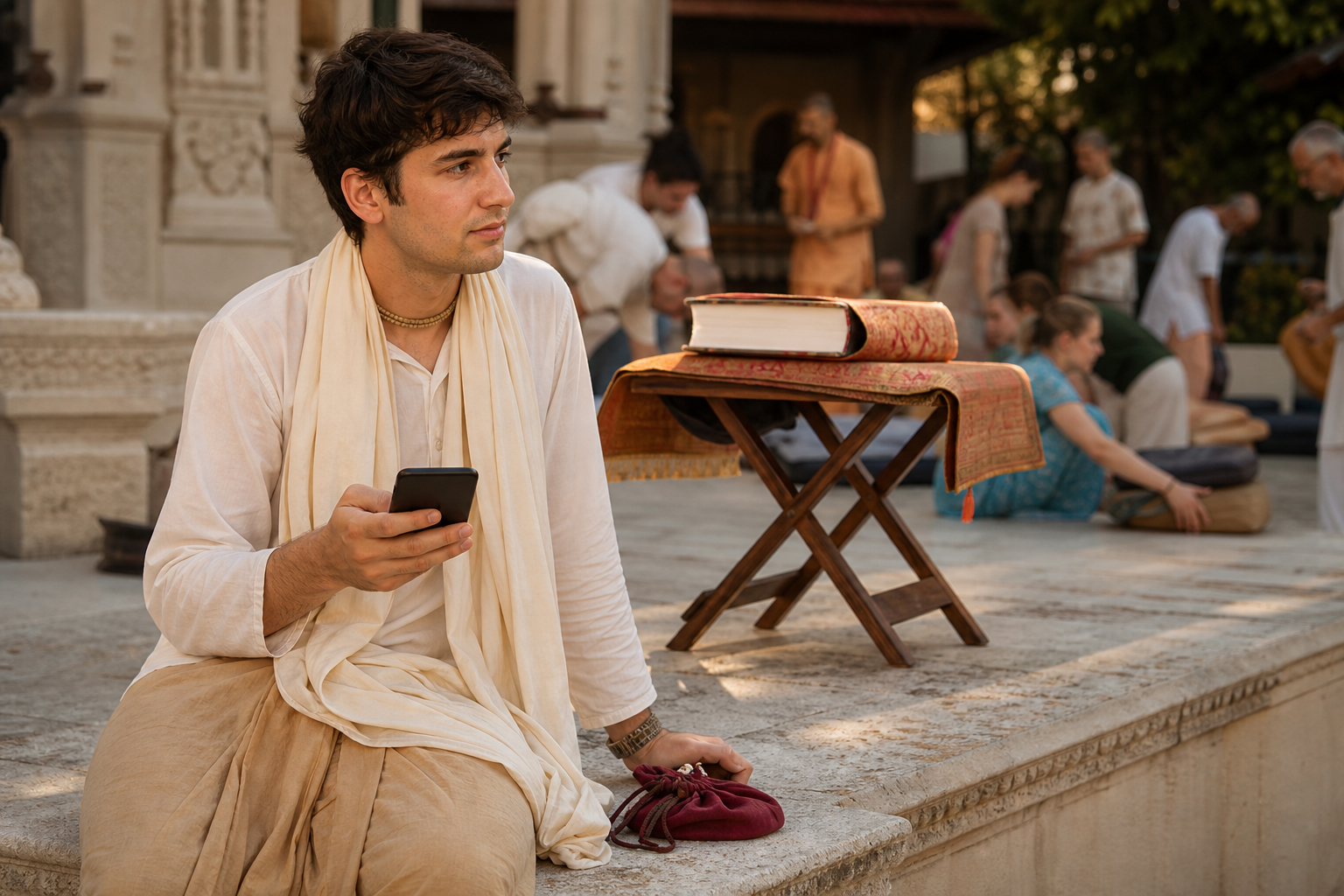
You leave a Bhagavatam class with a clear mind. Then a difficult message arrives, a family member speaks sharply, or a community disagreement reopens. Within minutes, the teaching feels distant and the old reaction takes over.
This is where contemporary Vaishnava sanga either becomes practical or remains devotional content. Whether you hear in a temple, a home gathering, or through a livestream, the real question is the same: what will you remember and do when life stops cooperating?
Sanga succeeds when your next response changes

You can attend regularly, admire the speaker, and collect many explanations without changing the pattern that causes your difficulty. Hearing becomes transformative only when it reaches the short interval between an event and your response.
One practical teaching associated with Srimad-Bhagavatam 11.8.29-30 draws a clean boundary: life is not fully under your control, but your response can be trained. Acceptance, in this sense, is not passivity. It means refusing to waste your strength demanding that reality first become agreeable.
Suppose another person behaves unfairly. You may not be able to change that person, secure an apology, or repair the relationship immediately. You can still decide whether to retaliate, speak truthfully, keep a necessary boundary, perform your duty, and remember Krishna before acting. Those choices are not small. They are the field in which hearing becomes character.
When agitation rises, separate the situation into four parts:
- The event: State only what happened, without adding a theory about another person’s motives.
- The impulse: Notice what the mind wants to do immediately: attack, withdraw, exaggerate, seek approval, or postpone a duty.
- The remembered principle: Recall one relevant teaching, not every teaching you have heard.
- The response: Choose one truthful, restrained, service-oriented action that is actually under your control.
This distinction also prevents spiritual language from becoming denial. A painful event can remain painful. Acceptance does not require you to call adharma harmless, tolerate mistreatment, or pretend that grief has disappeared. It asks you to meet the event without surrendering your conduct to the first movement of the mind.
Keep the verse, its explanation, and your application distinct
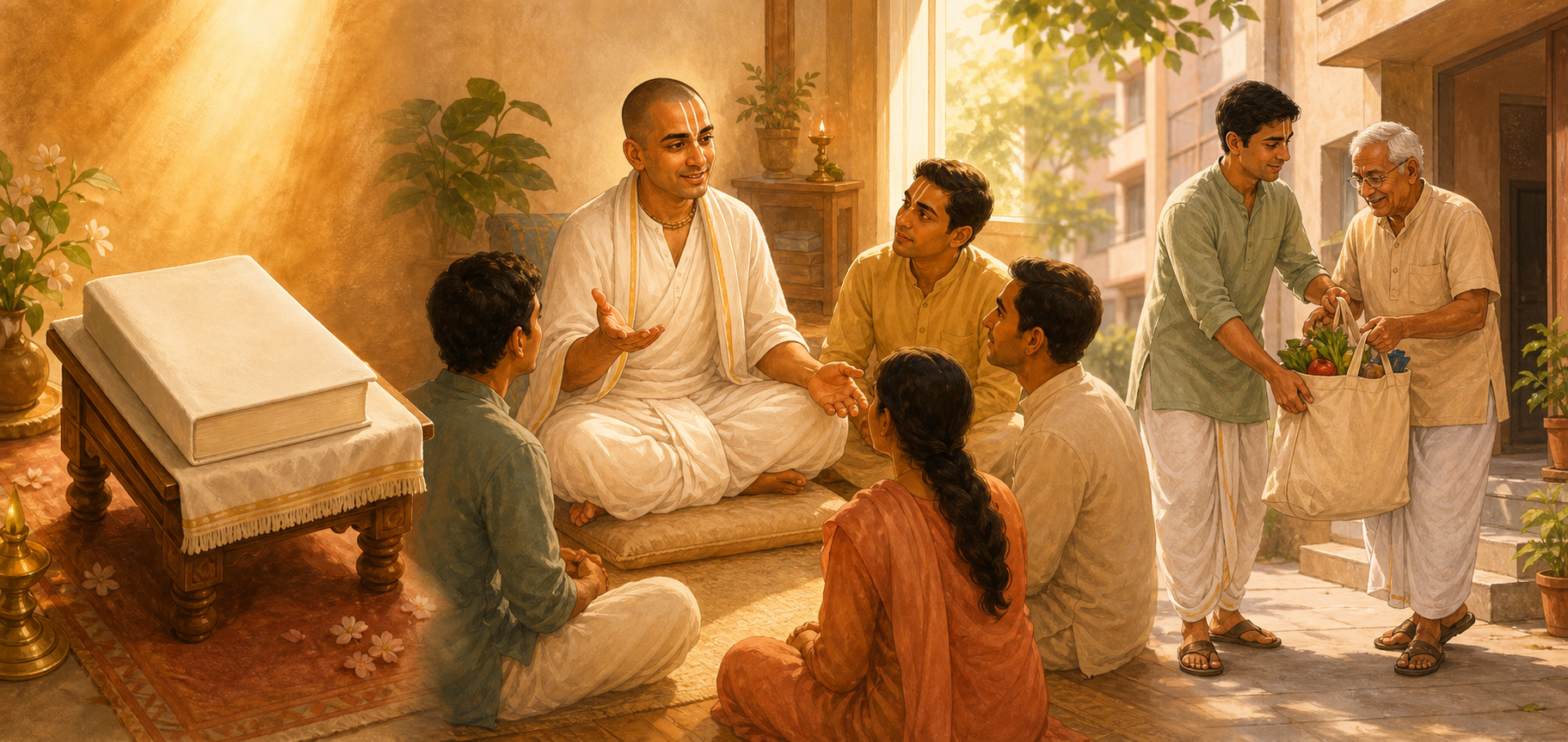
A Bhagavatam class usually moves through three layers: the scriptural passage, the teacher’s explanation, and the listener’s application. Confusion begins when those layers are merged. A memorable example may illuminate a verse without being the verse itself. Advice suited to one person’s circumstances may not become a universal command for everyone who hears it.
A gathering anchored to an exact locus such as Srimad-Bhagavatam 4.27.28 gives you a useful discipline: open the passage and keep it visible. Record what the text establishes, what the speaker draws from it, and what you intend to practise as three separate notes.
- Text: Write the book, canto, chapter, and verse. Note the central words or idea without relying only on memory.
- Explanation: Summarize the teacher’s main connection in one sentence. Mark illustrations and pastoral advice as explanation rather than silently treating them as literal verse text.
- Application: Turn the lesson into one action appropriate to your duties, relationships, and stage of practice.
This method matters when you later repeat the teaching. Say, “This was the speaker’s application,” when that is what you mean. Say, “This is how the verse was explained in our gathering,” when you have not checked whether other Vaishnava teachers read the passage differently. Precision protects both shastra and the person listening to you.
It also helps when two respected teachers emphasize different aspects of the same passage. You do not have to manufacture a contradiction. First check whether they are answering different practical questions, speaking to different audiences, or operating at different levels of instruction. If a real doctrinal difference remains, ask a qualified teacher within your lineage instead of settling it through fragments circulated without context.
Use a one-question, one-action sanga routine

General inspiration fades because it has no assigned place to land. Before the next sanga, identify one live question. Not “How can spiritual life improve?” but “How should you respond to this recurring conflict without anger or avoidance?” A concrete question makes relevant instruction easier to notice.
Use this routine for a temple class, home discussion, recorded talk, or livestream:
- Before hearing, name the pressure point. Choose one current reaction, duty, attachment, or relationship that needs light from the teaching.
- During hearing, capture one governing principle. Write the verse reference and the clearest explanation connected to your question. Do not try to preserve the whole class.
- After hearing, define one observable response. Choose an action you can perform, rather than an outcome another person must produce.
- At the next sanga, review the attempt. Tell a mature devotee what happened, where the mind resisted, and what needs clarification. Honest review turns association into accountability.
The difference between an outcome and a response is crucial. “Make the other person respect you” is not a practice because it depends on someone else. “Pause before replying, remove the accusation from the message, state the relevant fact, and keep the agreed duty” is a practice. “Never feel anxious again” is not an actionable commitment. “When uncertainty appears, complete the next duty while maintaining your established nama-japa or prayer” is.
Keep the commitment small enough to remember under pressure. One teaching, one practice, and one review is usually more useful than a page of resolutions that disappears into a notebook. If the practice works, continue it until it becomes steadier. If it fails, examine the mechanism: Was the action vague? Did it depend on another person’s cooperation? Did you remember it only after reacting? The failure then becomes material for the next honest question.
This approach also changes the quality of questions asked after class. Instead of requesting another broad explanation, you can say: “The teaching helped you see that the other person’s conduct is outside your control. What would a dharmic response look like when silence would neglect a real duty?” That question gives the teacher something definite to address.
Choose sanga by its fruits, not its prestige
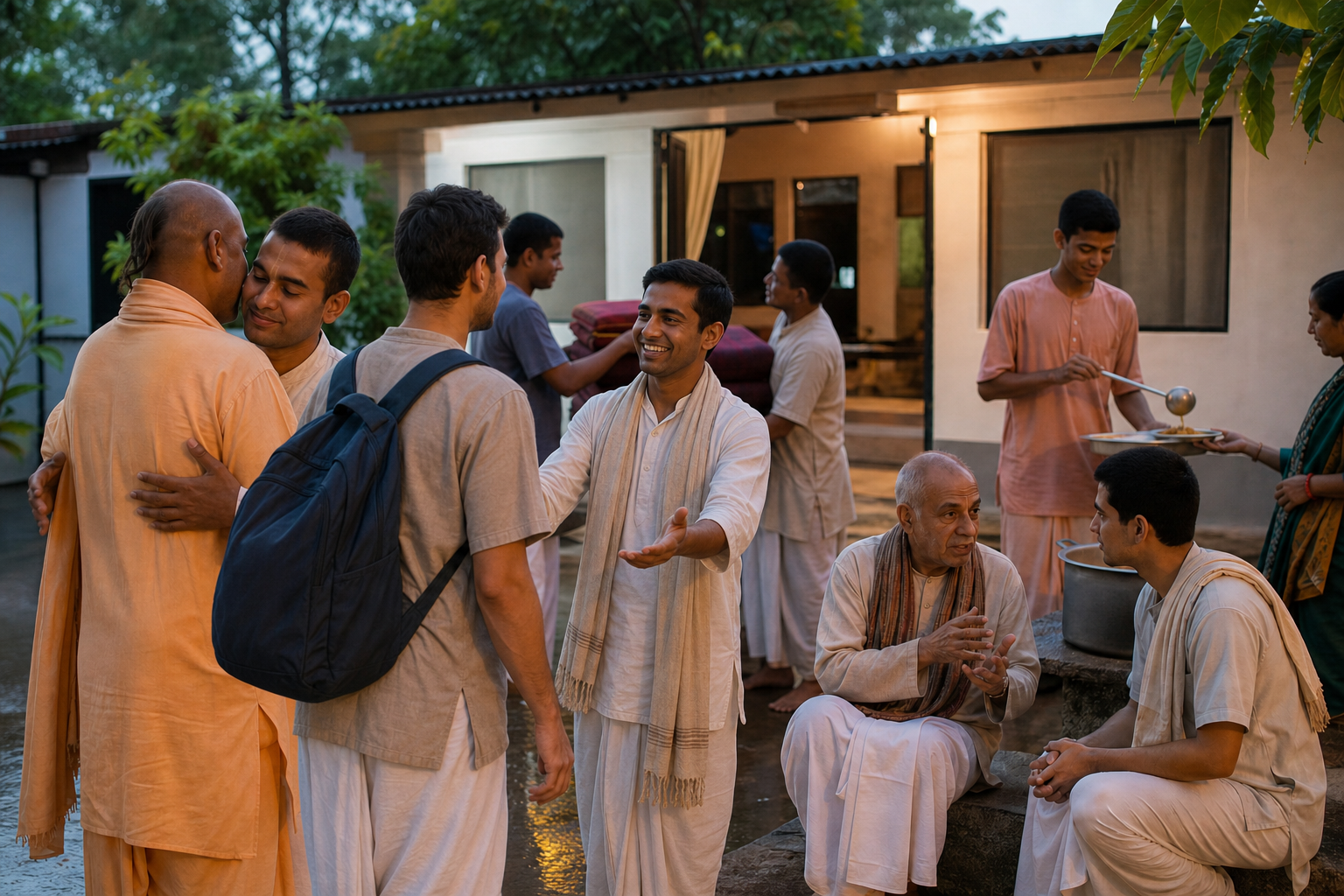
A special sanga with HH Bhakti Ashraya Vaisnava Swami Maharaj Ji can provide concentrated access to senior guidance. Yet the word “special,” the speaker’s reputation, or the size of the gathering cannot do the listener’s work. The enduring value appears in what the association teaches you to remember, practise, and serve afterward.
When deciding which gatherings deserve regular space in your life, look for five qualities:
- Krishna and shastra remain central. Personality, institutional news, and social belonging do not displace Bhagavatam hearing.
- The teaching is traceable. You can identify the passage being discussed and distinguish its words from commentary and application.
- Application deepens responsibility. You leave more prepared to speak truthfully, restrain harmful impulses, keep commitments, and serve—not merely to judge people outside the gathering.
- Sincere questions have a place. Respect for a teacher does not require careless listening. Clarification helps prevent a partial statement from becoming a rigid rule.
- Association continues beyond consumption. Devotees notice one another, practise together, and provide appropriate correction and encouragement.
Digital access is valuable when distance, work, family obligations, or health prevents physical attendance. Use it deliberately: open the verse, silence unrelated notifications, take one application note, and discuss it with an accountable devotee afterward. A stream can carry katha, but passive playback does not automatically create reciprocal association.
In-person attendance has its own danger: physical presence can be mistaken for inner participation. Sitting in the room while planning the day, monitoring who arrived, or evaluating the speaker’s style is still distraction. The remedy in both settings is the same—arrive with a question, stay with the passage, and leave with a practice.
A healthy Vaishnava community should also make room for different levels of readiness. A new listener may need basic orientation; a long-standing practitioner may need correction of a subtle habit. Do not imitate an advanced instruction merely because it sounds elevated, and do not dismiss a foundational instruction because you have heard it before. Ask what faithfully addresses your present duty.
Key takeaways
- Measure sanga by the response it helps you practise when circumstances become difficult.
- Separate the scriptural passage, the teacher’s explanation, and your personal application in your notes.
- Bring one current question to the gathering and leave with one action under your control.
- Review the attempt with a mature devotee; accountability reveals where understanding has not yet become habit.
- Choose regular association that keeps Krishna and shastra central while deepening humility, responsibility, and service.
Before your next Bhagavatam class, write down the situation most likely to disturb your steadiness. Carry that question into the hearing. When the class ends, choose one response you can practise before the day is over, and arrange to review it with someone whose Vaishnava judgment you trust. That is how sanga moves from something you attended to something that begins shaping the person who responds.
References
- Dandavats — We Can’t Control Life, but We Can Control Our Response to Life |SB 11.8.29-30| HG Vraj Vihari
- Dandavats — 20.08.26, SB class 4.27.28, SSRRT, Durban
- Dandavats — Special Sanga with HH Bhakti Ashraya Vaisnava Swami Maharaj Ji
