
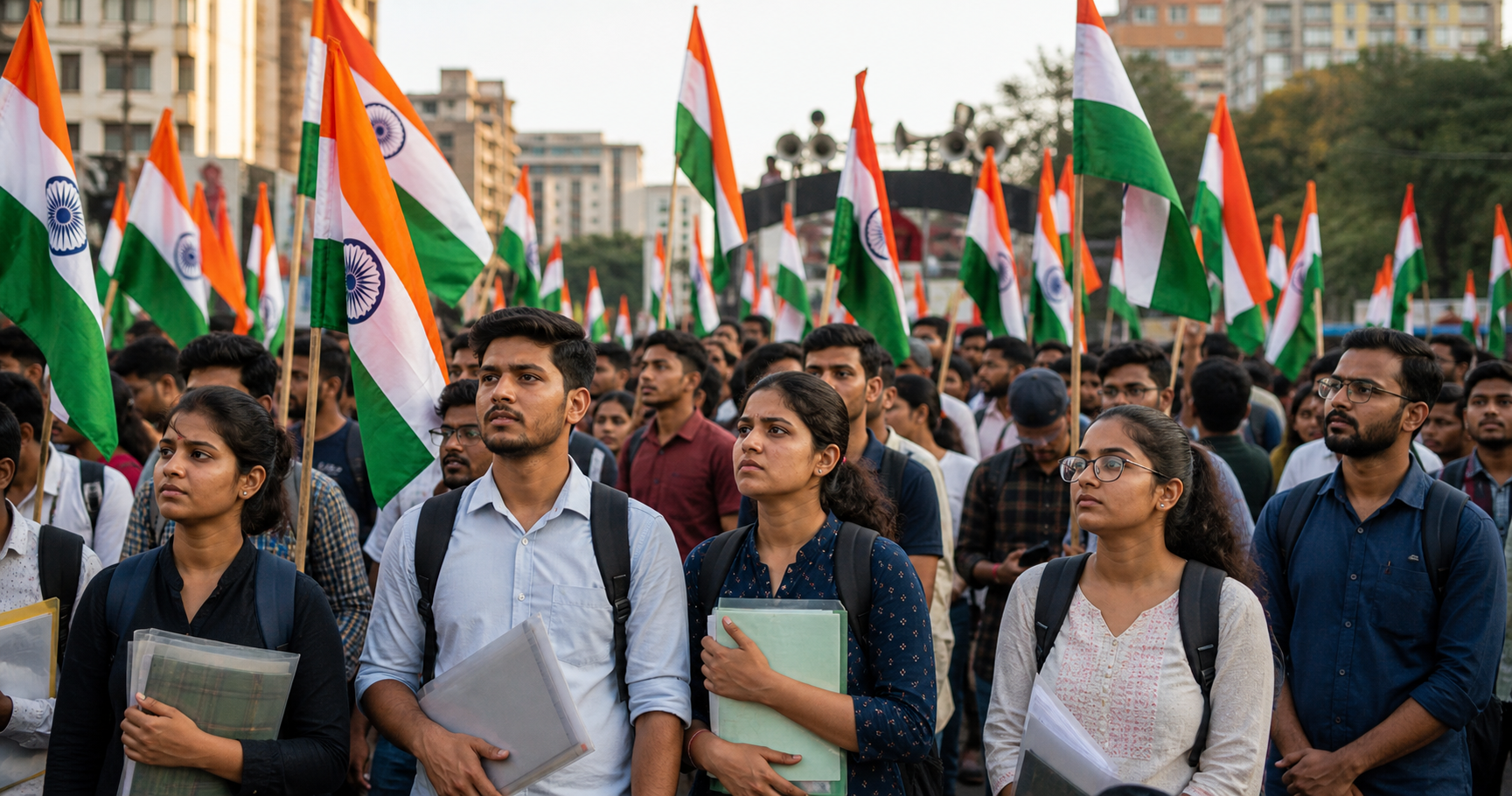
You see a protest about examinations or jobs. The tricolour dominates the photographs. Placards invoke justice, democracy and the Constitution. You want to know whether you are looking at patriotic citizens pursuing a legitimate remedy, or an ideological mobilisation using national symbols to broaden its appeal.
Do not let either reverence for the flag or suspicion of the Left make that decision for you. Treat the symbolism as a clue, then examine the grievance, organisers, demands and direction of travel. That approach respects the people in the crowd while keeping your political judgement intact.
What the tricolour proves, and what it does not
A tricolour at a protest proves one limited but important fact: the movement wants to speak within Bharat’s national moral vocabulary. The flag offers legitimacy, emotional familiarity and a claim to represent the public interest. It does not, by itself, reveal the organisers’ ideology or their long-term objective.
The same symbol can perform at least three different functions. It can express sincere national attachment. It can serve as the minimum language shared by a politically mixed coalition. It can also reassure citizens who would avoid an explicitly Marxist platform. These possibilities can coexist in the same gathering.
At a gathering described at Jantar Mantar, tricolours and placards about examinations, jobs, justice and constitutional rights appeared without the red flags or communist portraits traditionally associated with the organised Left. That contrast is enough to justify questions about political authorship. It is not enough to settle them.
A nationalist interpretation holds that sections of the protest Left adapted after the collapse of the Soviet Union: overt revolutionary imagery lost public appeal, while the language of citizenship, constitutional protection and national concern opened a much wider door. This is a plausible account of political strategy. It remains a hypothesis to be tested in each mobilisation, not a licence to declare every flag-bearing dissenter a disguised revolutionary.
The reverse mistake is just as serious. Displaying the national flag cannot place organisers beyond scrutiny. Patriotism is demonstrated through consistent conduct: respect for Bharat’s integrity, acceptance of democratic disagreement, honesty about affiliations and willingness to apply constitutional principles even when they protect an opponent.
Separate the participant, the coalition and the leadership
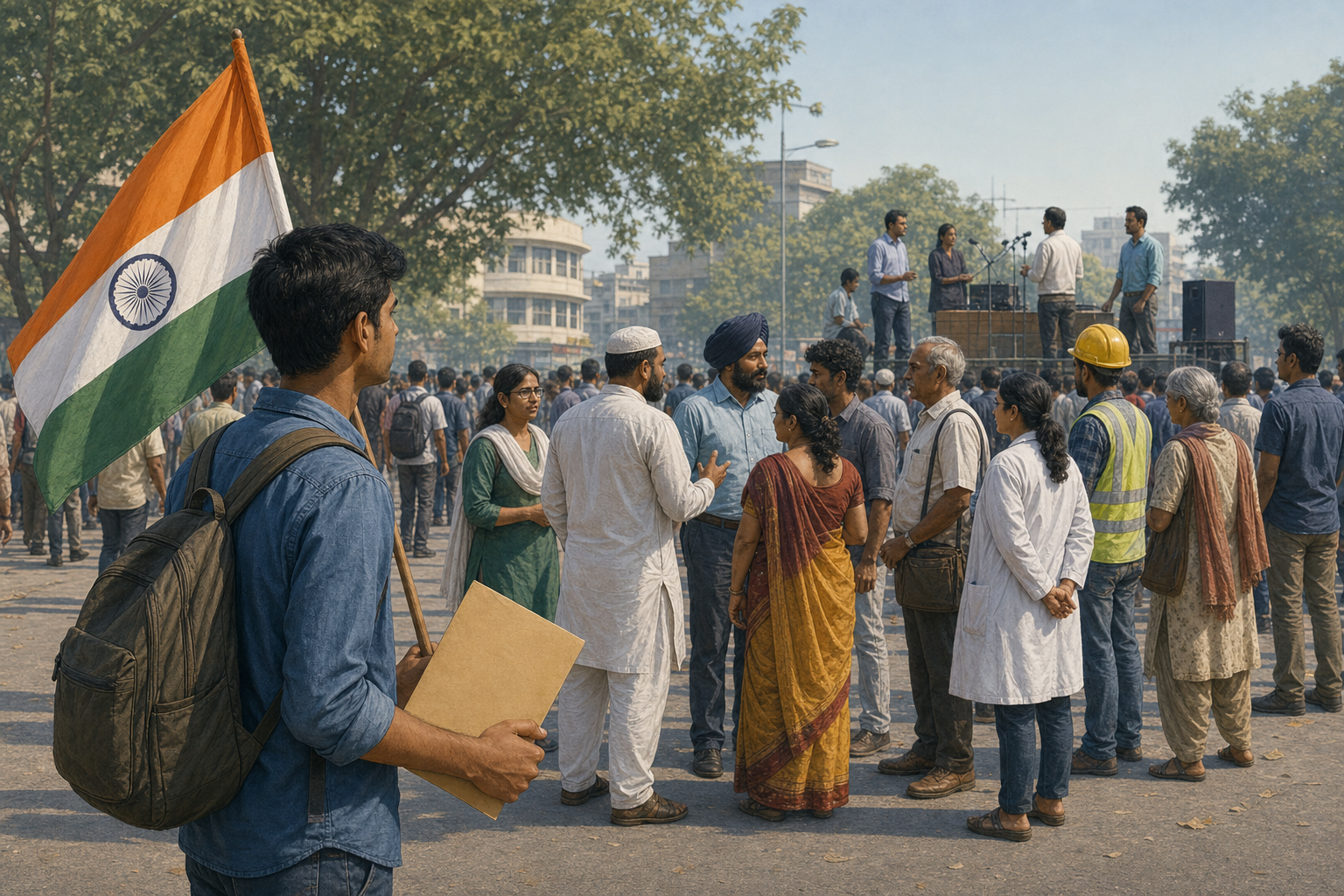
A protest is not a single mind. Confusion begins when you treat everybody in the photograph as though they possess the same information and seek the same destination.
- The participant may have a narrow and sincere concern. A student worried about an examination, recruitment decision or job opportunity may know little about the organisations behind the stage.
- The coalition supplies a common vocabulary. Words such as justice, rights and democracy allow people with different motives to march together without resolving their deeper disagreements.
- The leadership controls the political conversion. Organisers usually determine the speakers, slogans, publicity, negotiating representatives and decision to widen or end the campaign.
This distinction prevents two errors. The first is guilt by association: assuming that an ordinary participant secretly endorses every group connected to a protest. The second is political naivety: assuming that the participant’s sincere grievance must also be the leadership’s final objective.
A Hindu name proves nothing in either direction. It does not establish a Hindutva worldview, communist commitment, civic nationalism or hostility to Dharma. Political identity must be inferred from choices, statements and affiliations, not from a person’s name or inherited community.
The staged coalition is a recognised revolutionary method. Strategies associated with Lenin permit movements to use the language and alliances useful to a particular phase. Mao’s On New Democracy describes a broad front in which students, peasants, intellectuals and parts of the middle class can cooperate before agreeing on an ultimate political order. This history explains why nationalist observers examine temporary coalitions carefully. It still does not prove that every broad civic protest is following a Leninist or Maoist plan.
You therefore need to make three separate decisions: whether the grievance deserves a remedy, whether the coalition deserves your participation, and whether the leadership deserves political trust. Supporting the first does not oblige you to grant the other two.
Use six tests before accepting or rejecting the mobilisation
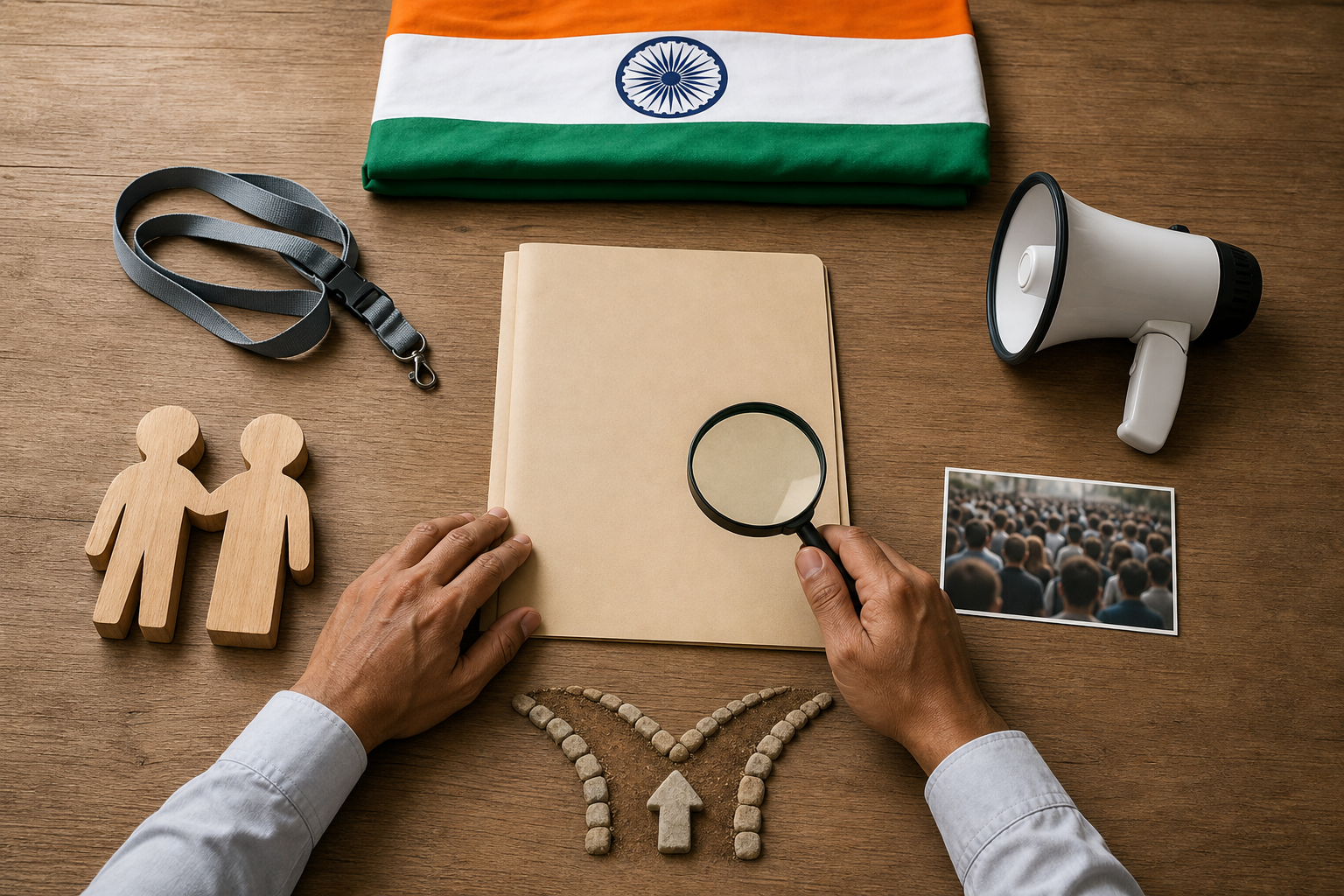
A viral image is the weakest possible basis for judgement. Work through the following tests using public material: the original protest call, named conveners, stage announcements, recorded speeches, official social accounts and written demands. If a fact remains unknown, label it unknown. Do not fill the gap with either goodwill or suspicion.
- Demand test: Reduce the stated grievance to one sentence. Identify the disputed decision, the authority capable of correcting it and the remedy being requested. A demand that cannot name any attainable remedy can keep expanding long after the original issue should have been resolved.
- Ownership test: Find the earliest public call for the event. Record the organisations that supplied conveners, speakers, publicity, legal representation, transport or stage infrastructure where those relationships are publicly disclosed. Do not allege a funding trail merely because the arrangements look professional.
- Escalation test: Compare the initial demand with later speeches and slogans. A move from correcting a specific examination or employment problem to declaring the entire constitutional order illegitimate marks a political expansion. That expansion does not erase the grievance, but it changes what support for the campaign now means.
- Consistency test: Ask whether the movement applies its principles to ideological opponents. Does its defence of speech, due process, federalism or institutional restraint survive when a Hindu nationalist is the person seeking that protection? Selective constitutionalism is a political weapon, not a constitutional ethic.
- Pluralism test: Ask whether a peaceful nationalist participant could question the dominant diagnosis from the stage or within the organising forum. A coalition claiming to represent young India should be able to tolerate young Indians who speak from a Hindutva or civilisational perspective. Exclusion must be established through conduct, however, not inferred from the absence of a familiar face in one photograph.
- Exit test: Determine what would count as success and who has authority to conclude the campaign. If every concession is followed by a new, unrelated demand, the original grievance may be functioning as an entry point into a larger political project.
Keep an evidence hierarchy. Written affiliations, repeated leadership roles, recorded statements and acknowledged organisational relationships are strong evidence. Recurring personnel, shared logistical infrastructure and coordinated messaging are reasons to investigate further. Clothing, surnames, isolated social-media follows and the absence of an expected symbol are weak evidence.
The same standard applies to claims of a concealed Left-Islamist alignment. Marxism and Islamism can cooperate tactically despite incompatible final visions, so the possibility is not irrational. But possibility is not proof. For a specific mobilisation, look for named organisations, common representatives, acknowledged legal or media coordination, joint statements, funding records or a persistent operational relationship. The absence of Islamist slogans cannot establish a hidden alliance any more than the presence of the tricolour can establish nationalist conviction.
Do not publish personal details, harass participants or turn pattern analysis into a hunt for private citizens. Besides causing unjust harm, such behaviour shifts attention away from the organisers and claims that actually deserve examination. Political scrutiny should move upward toward accountable institutions and public leaders, not downward toward the least powerful person in the crowd.
A Dharmic response combines openness with viveka
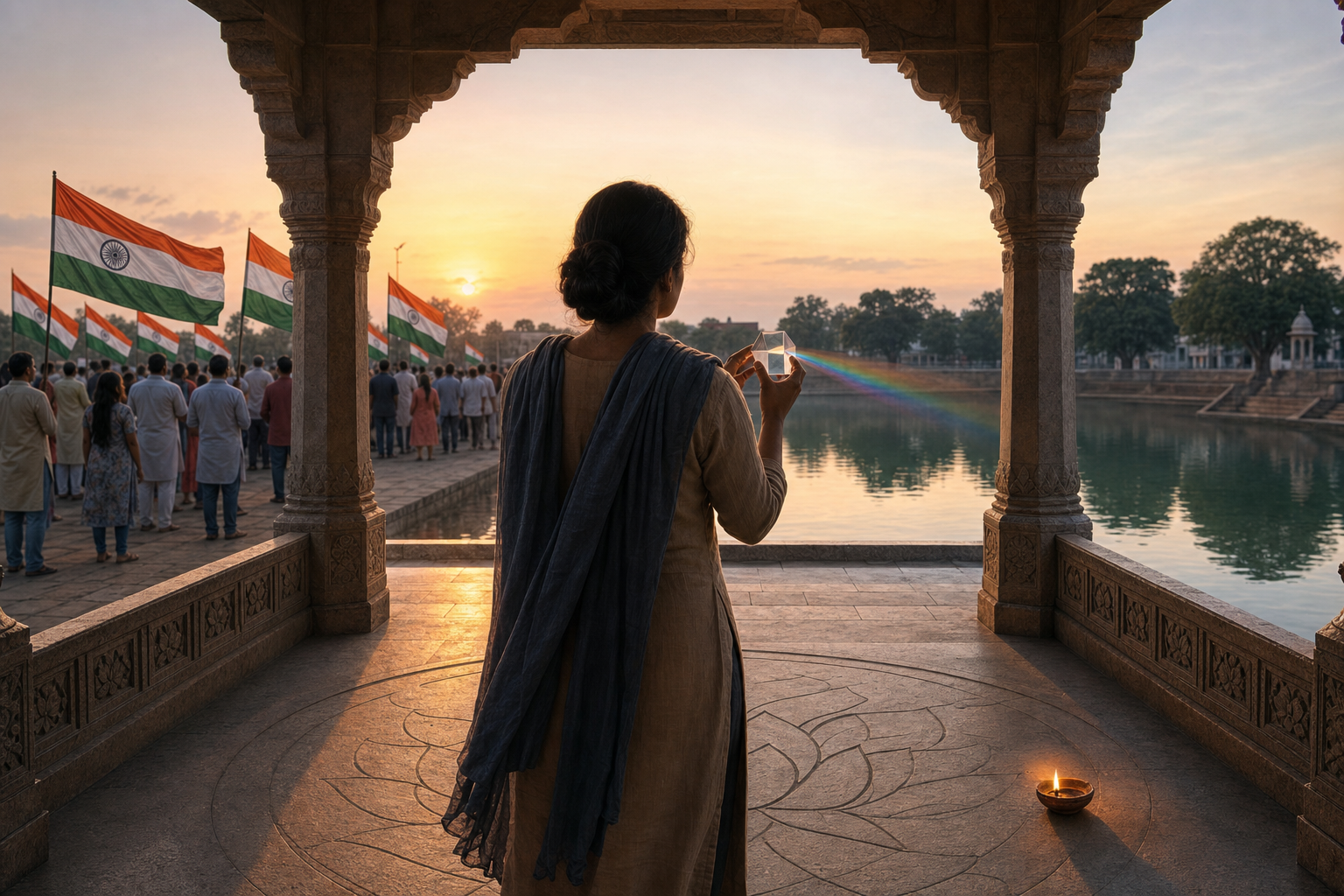
Dharmic pluralism does not require political gullibility. A civilisation able to accommodate different deities, philosophies and disciplines can hear a dissenter without assuming that disagreement is treason. The same civilisation can practise viveka: discrimination between appearance and substance, legitimate dissent and strategic manipulation, a temporary ally and a trusted guide.
Descriptions of a tolerant Hindu mind and a calculating revolutionary mind are useful as models of political behaviour, but they are not fixed descriptions of every human being. A Hindu can be manipulative. A left-wing citizen can be sincerely patriotic. A disciplined analysis judges conduct before assigning motive.
Begin with satya. State what is visible, what is documented and what remains an inference. Say, for example, that red symbols were absent from a particular gathering. Do not turn that observation into a claim that named organisations secretly controlled the event unless evidence identifies those organisations.
Continue with reciprocity. If constitutional protection is invoked, ask whether it extends to temples, Hindu institutions, nationalist speech and citizens targeted for their Dharmic identity. If national unity is invoked, ask whether the platform rejects separatism and political violence without choosing exceptions for convenient allies. These questions test the content of proclaimed nationalism without demanding uniformity on every policy.
Then address the grievance on its merits. If students have a valid complaint, a nationalist response should help establish the facts, identify the responsible authority and press for a bounded remedy. Answering every concern about examinations or employment with an accusation of communism abandons the affected citizen. It also gives ideological organisers exclusive possession of an issue that should concern the whole nation.
At the same time, support for a remedy need not become an endorsement of the platform. You can defend a fair examination process while refusing slogans that delegitimise Bharat’s institutions. You can support peaceful dissent while asking organisers to disclose affiliations. You can honour the tricolour while objecting to its tactical use. These are coherent positions, not evasions.
If you attend a demonstration, first understand its declared purpose and named organisers. Follow lawful public directions, remain clear of intimidation or violence, and leave if the event changes into something you did not agree to support. Physical confrontation or unlawful conduct can carry serious personal and legal consequences; documenting a concern from a safe public position is preferable to escalating it.
Key takeaways
- The tricolour shows that a protest seeks national legitimacy; it does not prove either sincere nationalism or ideological deception.
- Judge the participant’s grievance, the coalition’s composition and the leadership’s political objective separately.
- Track specific demands, organisers, escalation, ideological consistency, internal pluralism and exit conditions.
- Require direct, case-specific evidence before alleging hidden communist, Islamist or opposition control.
- A Dharmic response should combine truthfulness, civilisational confidence and concern for genuine grievances with disciplined political scrutiny.
Before reacting to the next viral protest image, open a note with four headings: Grievance, Convener, Demand and Escalation. Fill each with public evidence and write “unknown” where the evidence stops. Then decide whether to support the issue, join the coalition or oppose the larger project. Those are three decisions, not one.