
If you have seen demands to ban Hindus for Human Rights after its activists were linked to a New York protest against Israel and Benjamin Netanyahu, your immediate question may be whether the accusations are established well enough to repeat. You can take the controversy seriously without turning every allegation into a conclusion.
The useful task is to separate four things: what happened at the demonstration, what HfHR officially authorized, what political conclusions the evidence supports, and what remedy would be proportionate. Keeping those questions separate lets you defend Hindu interests without sacrificing accuracy.
Start with the narrow claim that can actually be supported

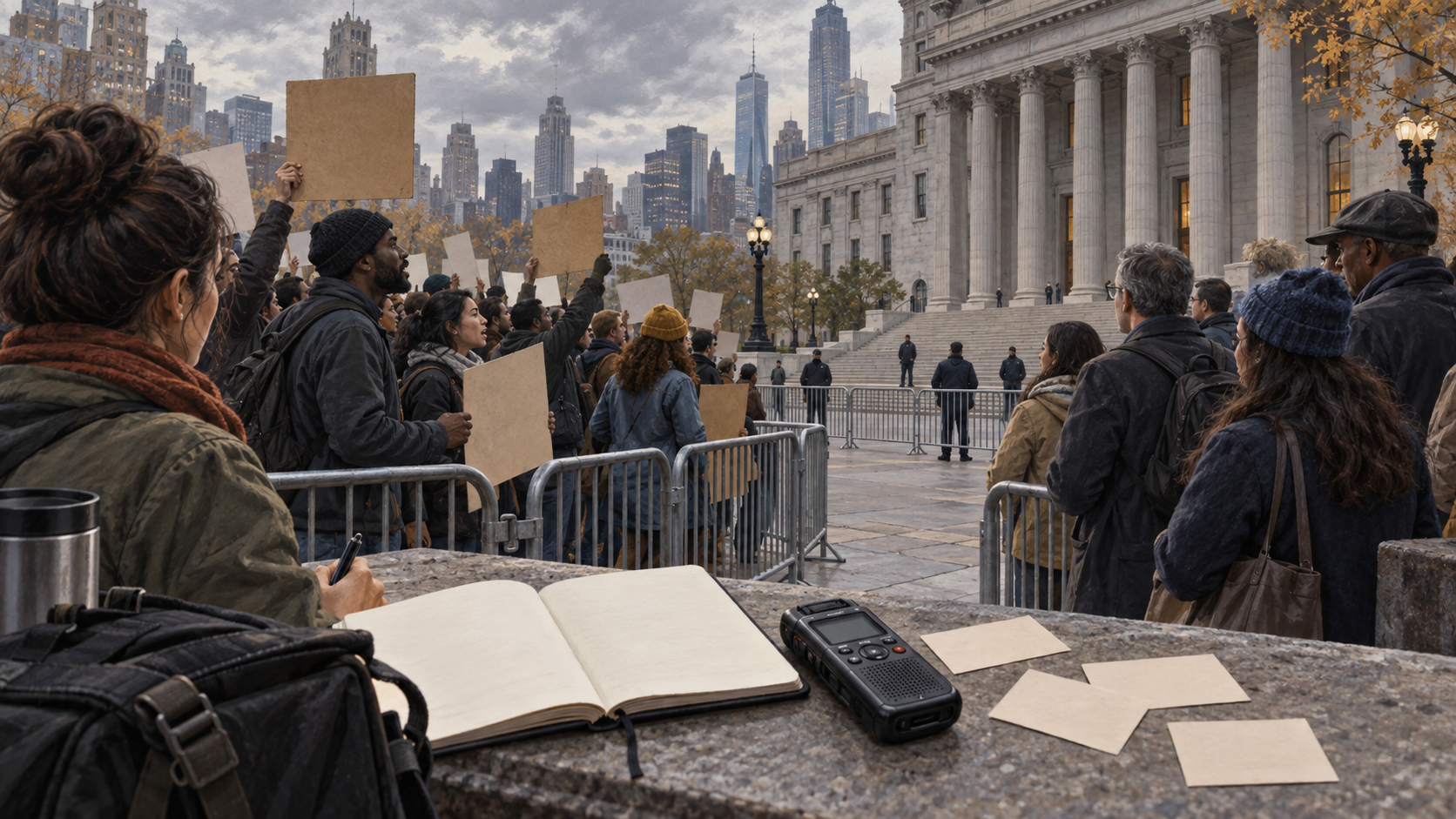
By 26 September 2026, a dispute had formed around the reported participation of HfHR activists in a New York protest against Netanyahu and Israel, followed by calls from Hindu groups for a US ban on HfHR. Critics also characterized HfHR as pro-Islamist.
Those claims do not all carry the same evidentiary weight. Attendance at an event is potentially observable. Describing a demonstration as anti-Netanyahu, anti-Israel, or antisemitic requires examination of its actual slogans, signs, speeches, and stated purpose. Calling an organization pro-Islamist is a broader political judgment. Demanding a ban is a proposed remedy that requires an independently stated basis.
- Event-level question: Which identifiable people attended, and what did they personally say or do?
- Organization-level question: Did HfHR organize, sponsor, endorse, fund, or officially represent itself at the demonstration?
- Interpretive question: Do the attributable words and actions oppose a particular leader, a government policy, Israel itself, Jewish people, or some combination of these?
- Remedy question: What specific conduct is supposed to justify action by a US authority?
Do not answer one question with evidence meant for another. A photograph may establish that people shared a location. It does not, by itself, prove that every participant accepted every belief held by every other participant. Conversely, repeated official partnerships, co-sponsorships, fundraising appeals, and direct organizational statements can establish a pattern that a single photograph cannot.
The distinction between opposition to Netanyahu and opposition to Israel is especially important. A protest can criticize a prime minister, reject a particular military or diplomatic policy, challenge the legitimacy of a state, or express hostility toward a people. These are different positions. The exact language used at the event determines which criticism is justified.
The Hindu name creates scrutiny, not automatic representation

Putting Hindu in an organization’s name naturally creates a public association with Hindu communities. It does not give that organization a mandate to speak for all Hindus, nor does disagreement automatically settle whether its participants are personally Hindu. The sharper question is whether HfHR presents a contested political program as the Hindu position.
If that is your concern, avoid the vague charge that the group is simply not Hindu. State the representative objection precisely: it does not speak for you, your mandir, your sampradaya, or the Hindu organizations with which you work. Then identify the policy, alliance, statement, or omission that creates the disagreement.
Ask HfHR questions that can produce verifiable answers:
- Was the organization an official organizer, sponsor, endorser, or participant in the New York demonstration?
- Who authorized the use of its name, logo, or representatives, if any?
- Which chants, signs, speeches, and public statements were attributable to HfHR rather than to unrelated protesters?
- Was the objection directed at Netanyahu, a policy of the Israeli government, Israel’s existence, or Jewish people?
- How does HfHR distinguish legitimate political criticism from antisemitism?
- Does it apply its human-rights principles consistently when Hindus, Jews, Muslims, Sikhs, Buddhists, Jains, or others are targeted?
The final question matters because selective advocacy is a legitimate subject of criticism. Make the comparison with documented positions and omissions, however, not with an assumption about hidden motives. That makes your case harder to dismiss as partisan name-calling.
A Dharmic response should be governed by satya and viveka: truthfulness in what we claim and discernment in the distinctions we draw. Neither principle requires political passivity. Both require us to make the strongest claim the evidence supports, not the strongest accusation that will circulate online.
Criticizing HfHR and demanding a ban are different actions

You may conclude that HfHR’s position is misguided, unrepresentative, hostile to Hindu interests, or inconsistent with its stated human-rights posture. Those are political and moral judgments that can be argued in public. A demand for a US ban is different because it asks an authority to impose a coercive remedy.
A ban is not a self-executing slogan. Anyone advocating one should identify five elements:
- Conduct: the specific act attributed to HfHR, not merely to someone standing nearby.
- Evidence: complete recordings, original statements, organizational records, or other primary material connecting the conduct to the organization.
- Rule: the law, regulation, or enforceable condition allegedly violated.
- Authority: the institution legally empowered to investigate and decide the matter.
- Remedy: the exact action being requested and why a narrower response would be inadequate.
Without that chain, the demand communicates anger but does not establish a case. Participation in a controversial protest, even one many Hindus find objectionable, does not by itself explain what legal ground would support prohibition.
This does not mean you must soften your criticism. It means matching the request to the proof. A public rebuttal may require evidence of an official statement. A request for disclosure may require evidence of an organizational partnership. A formal complaint requires a credible legal basis and properly preserved evidence. If you or your organization is considering such a complaint, obtain advice from qualified US counsel before accusing named people of unlawful conduct; unsupported public allegations can create legal exposure of their own.
A six-step response that protects Hindu credibility

If you plan to speak, publish, petition, or organize around this controversy, use the following sequence.
- Locate the primary material. Find complete videos, original social posts, the event announcement, any co-sponsor list, and statements from identifiable HfHR accounts or representatives. A cropped photograph or short clip should lead you to fuller evidence, not become the endpoint.
- Preserve context. Record the original URL, account name, publication date, and enough surrounding material to show what came before and after the disputed words. Do not rely exclusively on screenshots that conceal provenance.
- Build a claim ledger. Mark every assertion as confirmed, disputed, or unresolved. Record what would be needed to move an unresolved claim into the confirmed column. This prevents a political interpretation from quietly becoming a factual premise.
- Request an answer on the record. Ask HfHR about its formal role, the messages it authorized, and its position on the disputed language. Use narrow questions and preserve the complete response. A refusal to answer may be relevant, but it is not proof of every allegation.
- Publish fact before judgment. State what is shown, what critics allege, what remains unknown, and what you are requesting. Keep descriptions such as pro-Islamist or anti-Hindu in the attributed-claim category unless direct organizational evidence supports them.
- Choose a proportionate remedy. Depending on the evidence, that might be a rebuttal, a request for correction or disclosure, a call for Hindu institutions to withhold endorsement, or a properly grounded complaint. Do not demand prohibition merely because it is rhetorically stronger.
A defensible initial statement could therefore be structured this way: individuals described as HfHR activists were reported at a New York protest directed against Netanyahu and Israel; HfHR’s formal role and the exact messages attributable to its representatives still require primary evidence; HfHR should disclose its role and clarify its position; any further demand should be assessed against documented conduct and a named legal basis.
Keep private addresses, family details, and threats entirely out of the response. Doxxing or inviting harassment does not establish the truth of a political charge. It endangers people and allows the underlying questions to be displaced by misconduct from your side.
Key takeaways
- HfHR activists were reported at a New York protest against Netanyahu and Israel, but the organization’s formal role must be established separately.
- Anti-Netanyahu, anti-government-policy, anti-Israel, and anti-Jewish positions are not interchangeable; the actual words and conduct determine the category.
- Sharing a venue proves co-presence, not agreement with every participant, while repeated official partnerships can justify deeper scrutiny.
- Using Hindu in a name does not confer authority to represent all Hindus. Challenge representative claims with specific evidence and clearly identified constituencies.
- A demand for a US ban needs a defined act, reliable evidence, a governing rule, a competent authority, and a proportionate remedy.
If you want to act now, begin with the complete footage, original event material, and any official HfHR response. If those are unavailable, say plainly that the record is incomplete. Then make the narrowest claim you can defend. That discipline is not weakness; it is how Hindu advocacy earns the credibility it needs when a genuinely documented threat demands public attention.
References

Leave a Reply
You must be logged in to post a comment.