

If you have ever paused before an image of Sri Radha and wondered how to contemplate Her beauty without reducing it to physical appearance, begin with one small detail. Her delicate nose can train the mind to move from looking, to remembering, to serving.
The devotional vision brings together Her sesame-flower-like nose, its enchanting ornament, and its important place in the Surya-puja Lila. Each element teaches a different discipline: attend carefully to what is revealed, receive beauty as relational rather than consumable, and resist filling sacred narration with attractive inventions.
Transcendental beauty changes the purpose of seeing
The easiest mistake is to hear “transcendental beauty” as though it meant material beauty intensified without limit. That leaves the ordinary habit of seeing untouched. The eye still compares features, judges appearances, and treats the person being seen as an object.
A bhakti reading changes the purpose of attention. Sri Radha’s form is not presented for detached inspection. A detail of Her face becomes a stimulation for ecstatic love: it gathers the devotee’s wandering awareness and directs it toward remembrance of Her person, Her relationships, and Her pastimes.
You can test the quality of your contemplation by its direction. Does the description merely give you a sharper mental picture, or does it deepen reverence? Does it provoke curiosity about external specifications, or awaken a wish to hear faithfully and serve attentively? The image has been received devotionally when it changes the beholder, not merely when it can be visualised.
This does not make form unimportant. It makes form inseparable from personhood. Sri Radha’s beauty is transcendental precisely because it cannot be detached from who She is and converted into an inventory of attractive features.
What the sesame-flower comparison asks you to notice

The comparison with a sesame flower gives the mind a concrete natural image while preserving delicacy. It is suggestive rather than anatomical. You are being directed toward a quality of form, not handed a set of measurements.
Receive the comparison with restraint. Notice the fineness implied by the flower and then stop where the revealed image stops. Do not manufacture a colour, fragrance, size, or symbolic meaning merely because those additions make the meditation seem richer. In sacred contemplation, imaginative excess can quietly replace attention.
A useful reading method is to separate three movements. First, identify the image actually given: the sesame flower. Second, identify the quality it illuminates: the delicacy of Sri Radha’s nose. Third, notice the devotional response the comparison invites in you. This keeps the natural metaphor connected to Sri Radha rather than turning it into an independent botanical puzzle.
That discipline matters beyond this one feature. Devotional poetry often brings the created world into the work of remembrance. A flower, jewel, moon, cloud, or river can direct attention toward the divine person. The comparison succeeds when you follow its direction; it fails when you become more absorbed in the comparison than in the one being praised.
The nose ornament reveals beauty as relationship
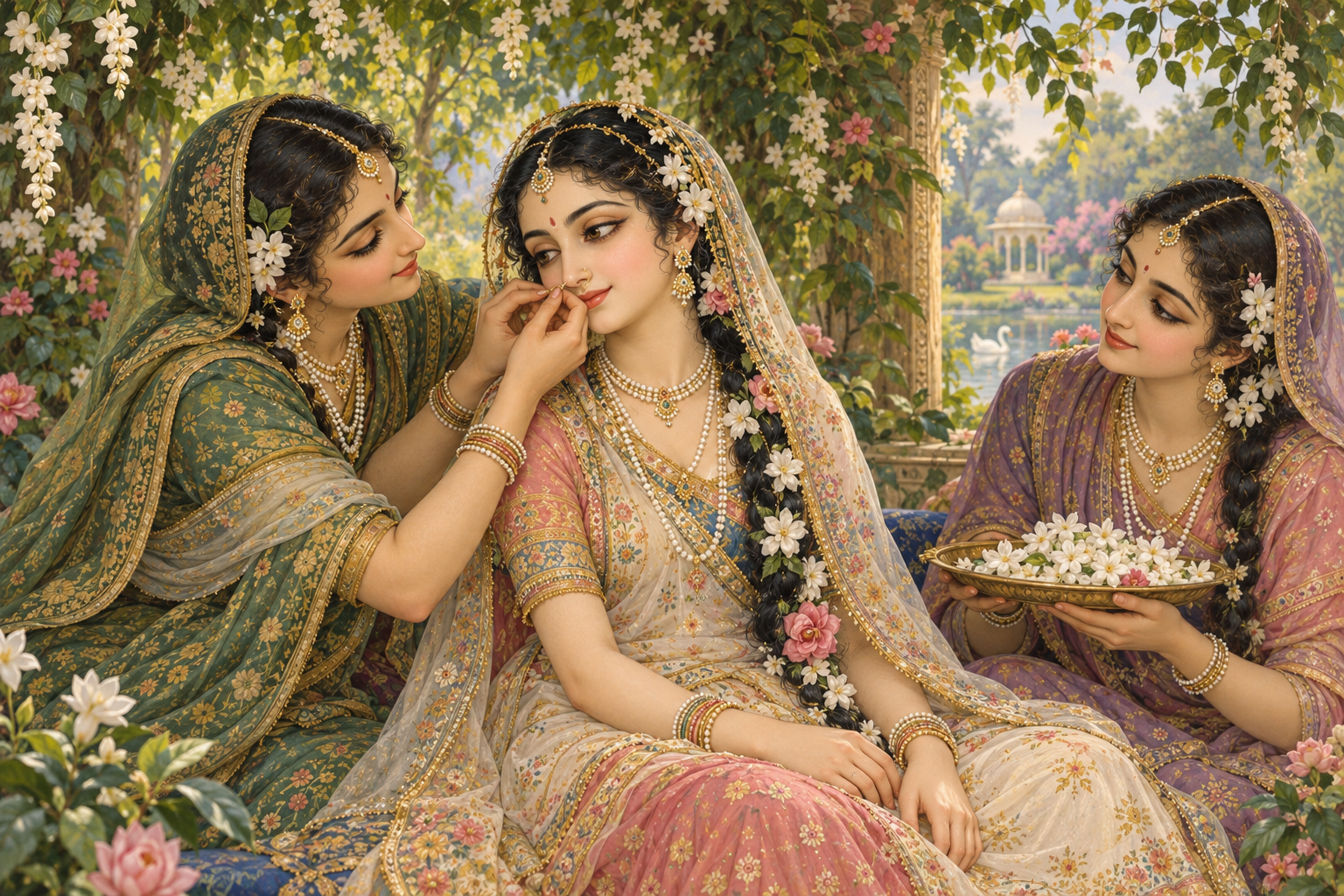
The ornament on Sri Radha’s nose is described as enchanting. Yet ornament and beauty are not the same thing. The ornament does not manufacture Her beauty; it draws attention to a beauty already present. This distinction prevents devotional description from collapsing into a catalogue of jewellery.
When contemplating an ornament, move through three layers. Notice what is adorned. Notice the ornament as it has actually been described. Then return to Sri Radha and ask how the adornment helps you remember Her. The third movement is essential. Without it, attention can remain fixed on the accessory and lose the person.
Precision also includes knowing what you have not been told. If a trustworthy narration does not specify the ornament’s material, colour, stones, or construction, do not present private imagination as received tradition. You may appreciate an artist’s rendering, but an artistic choice and a lineage teaching are not interchangeable.
This gives you a practical standard whenever you hear an elaborate description of a divine form. Ask which details belong to the narration, which come from an acarya’s explanation, and which have been supplied by the speaker or artist. The distinction protects both devotion and honesty.
Surya-puja Lila turns a beautiful feature into action

A portrait allows you to contemplate stillness. Lila places beauty inside relationship, timing, and exchange. In the Surya-puja Lila, the worship of Surya provides the setting, and Sri Radha’s nose takes on a particularly important role in the charming pastime. The feature is therefore not merely something to observe. It participates in an event.
That movement from form to lila is crucial. Sri Radha is not a static ideal assembled from perfect attributes. Her beauty lives within divine relationship. The nose that resembles a sesame flower and the ornament that enhances it become memorable because they belong to Her presence and activity.
When the full sequence of a pastime is not before you, keep to firm anchors: Sri Radha is central; the setting is Surya-puja; Her nose matters to the exchange; and the mood is charming. Do not invent the missing action and then retell it as tradition. Seek the fuller narration or guidance from a qualified teacher before teaching its plot to others.
It helps to distinguish three layers of engagement. Received narration tells you what occurs. Acarya commentary helps you understand its devotional significance. Personal contemplation concerns how the lila turns your own attention toward remembrance. All three can have a place, but the third should never masquerade as the first.
A disciplined way to contemplate Sri Radha’s beauty

You do not need to accumulate many details at once. A single well-received feature can hold attention more fruitfully than a crowded scene assembled from uncertain particulars. Use this sequence when you next read, hear, or sit before an image of Sri Radha:
- Choose one received detail. Begin with Sri Radha’s delicate, sesame-flower-like nose rather than trying to visualise Her entire form.
- State only what is given. Include the enchanting nose ornament and the connection with Surya-puja Lila, but do not supply its material or the pastime’s missing actions.
- Attend to the mood-bearing words. “Delicate” and “enchanting” tell you how the feature is being perceived, not merely what object is present.
- Return from the feature to the person. Ask how the image helps you remember Sri Radha rather than how completely you can reconstruct Her appearance.
- Connect still beauty with lila. Remember that the nose and its ornament belong within a charming divine pastime, not in an isolated display.
- Close with an established practice from your tradition, such as prayer, nama, or a familiar verse. Let contemplation feed devotion instead of ending as aesthetic consumption.
If the mind drifts into speculation, return to the simplest reliable phrase: Sri Radha’s delicate nose is compared to a sesame flower. That is enough material for attentive remembrance. Depth comes from sustained receptivity, not from multiplying unsupported details.
Key takeaways
- Transcendental beauty is approached through reverence and relationship, not comparison or possession.
- The sesame-flower image directs attention to the delicacy of Sri Radha’s nose without supplying an anatomical specification.
- Her enchanting nose ornament should lead attention back to Sri Radha, not become a separate catalogue of decoration.
- Surya-puja Lila places the beautiful feature within divine action and exchange.
- Keep received narration, acarya interpretation, artistic representation, and personal contemplation clearly distinguished.
At your next darshan or devotional reading, choose one trustworthy detail and remain with it. Let the sesame-flower comparison lead you from form to Sri Radha, and from Sri Radha’s form to remembrance of Her lila. When seeing becomes careful, truthful, and service-minded, the description has begun to fulfil its devotional purpose.
References

Leave a Reply
You must be logged in to post a comment.