
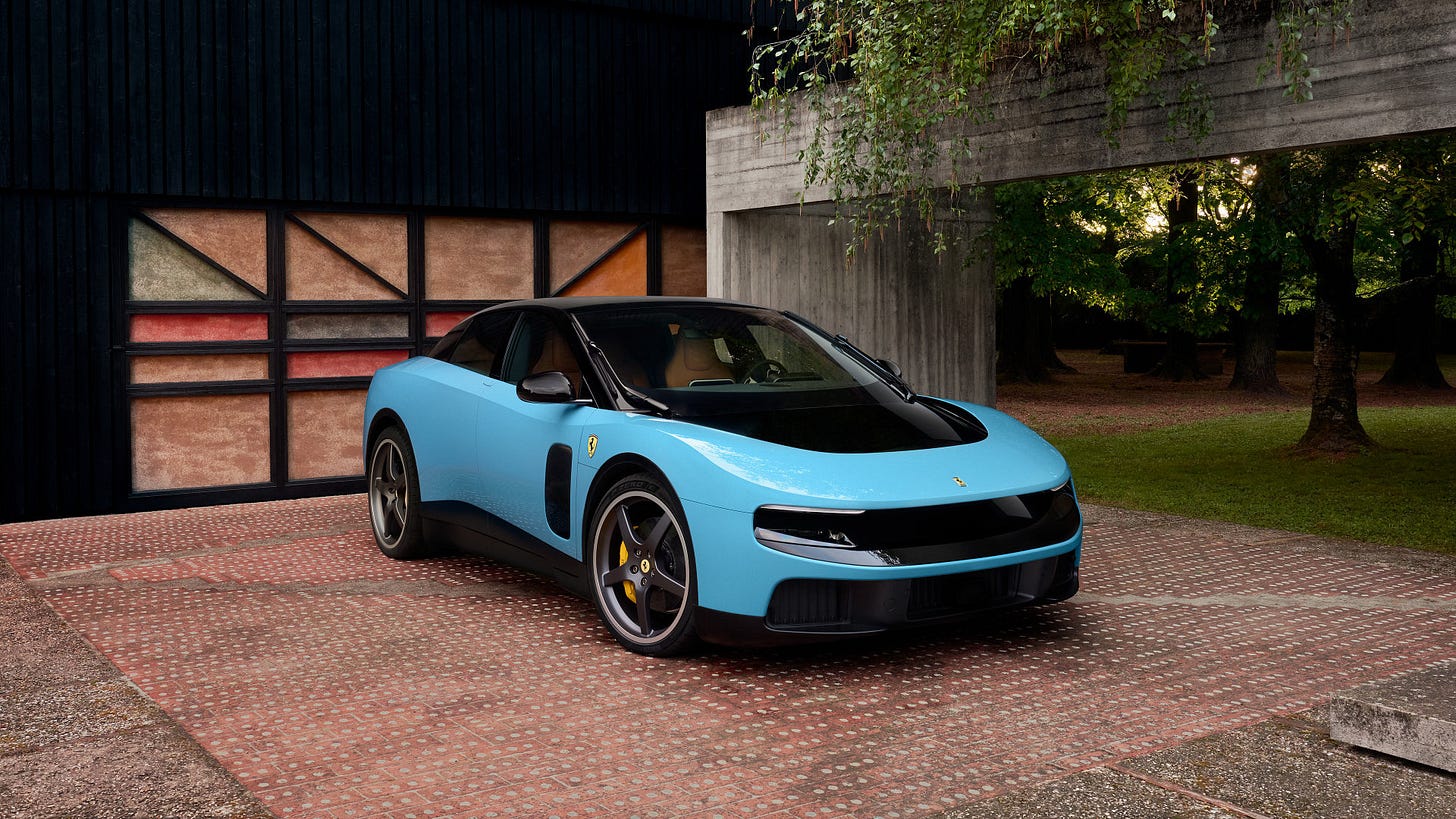
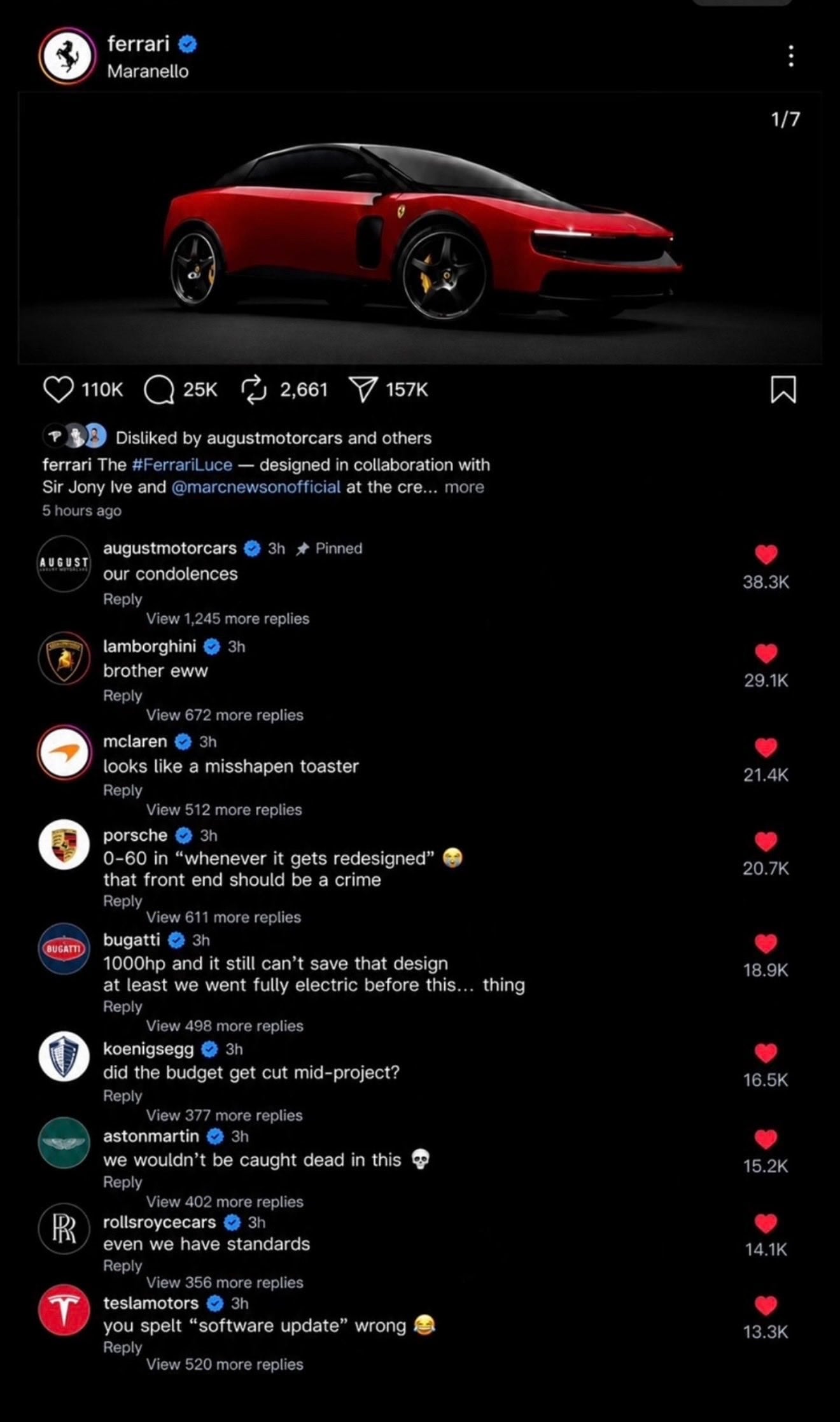
Ferrari’s unveiling of the all-electric Ferrari Luce, presented with design input publicly associated with Jony Ive’s independent studio LoveFrom, triggered an immediate and polarized global response. While many observers praised the interior’s retention of physical controls over expansive touchscreens, social feeds rapidly filled with memes critiquing the exterior form. This piece documents that moment, analyzes why such debuts attract intense, memetic scrutiny, and offers a technical lens for separating viral reaction from durable product signal in the luxury EV market.
Jony Ive is widely recognized for catalyzing Apple’s late-1990s to 2010s design renaissance, spanning the iMac through the iPhone era, before establishing LoveFrom. A collaboration of this kind with Ferrari was always going to be consequential: it places one of the world’s most rigorously managed automotive identities into dialogue with a studio known for reductive elegance and user-centered minimalism. That brand-design intersectionlegacy performance codes meeting contemporary purityhelps explain both the enthusiasm and the anxiety visible in the immediate public reaction.
The most consistent early compliment centers on human–machine interface (HMI): the use of tactile, “workable buttons” and physical controls rather than fully subordinating driving to layered touch menus. Empirically, physical controls reduce eyes-off-road time for high-frequency tasks, support muscle memory, and improve operation in vibration-heavy contexts. For a performance brand, this aligns with a safety-first, driver-first philosophy and echoes emerging research and regulatory caution around touchscreen overload in vehicles.
By contrast, the exterior drew sharp critique. At issue is not a single surface or detail, but perceived proportion, stance, and brand DNA. EV packaging often shifts the engineering baselinebattery mass distribution, cooling pathways, and aero-first front endsaltering cues that define long-hood/short-deck nostalgia or the venting and intakes associated with combustion-era performance. When those constraints meet a luxury performance identity, even carefully considered surfacing can read as unfamiliar, triggering cognitive dissonance that memes then amplify.
Memes function here as a rapid, crowd-sourced semiotic audit. They compress visual unease into humor and propagate it through networks where negativity bias raises shareability. Tesla’s rise benefited from memetic enthusiasm that framed its disruption as culturally aspirational; the Luce’s reaction suggests the inverse risk: early meme narratives can set a tone that incumbents must actively reframe. Importantly, meme dynamics are noisy. They measure first impressions and in-group humor, not long-horizon product satisfaction or brand equity retention among actual buyers.
Price compounds perception. With reports placing the Luce near the USD 600,000 mark, Ferrari is addressing a scarcity-driven, allocation-based clientele rather than the mass EV segment. That framing changes the question from “Can memes sink sales?” to “Do memes meaningfully influence collector sentiment and brand halo?” In a space where vehicles such as Rimac Nevera, Pininfarina Battista, and Lotus Evija established reference points at even higher prices, the Luce competes more on narrative, provenance, and driving experience than on a spec-sheet arms race alone.
From a technical standpoint, expectations for a top-tier performance EV include high-voltage architecture (commonly 800V), silicon-carbide inverters for efficiency at high load, sophisticated torque vectoring, and meticulous thermal management for battery, power electronics, and brakes. Effective heat rejection under repeat hard use remains the EV supercar’s defining challenge; thermal derate curves and consistency over multiple laps often matter more to expert drivers than single-sprint peak figures. Weight control through multi-material strategies and low H-point packaging further shapes dynamics and feel.
Aerodynamics intersects with identity. Modern EVs favor minimized frontal area, controlled wake structures, and carefully managed underbody flow; closed or near-closed grilles alter the face of a vehicle, and subtle ducting replaces flamboyant intakes. Brake cooling and battery chiller loops require intelligently hidden apertures, trading theatricality for performance efficiency. If a Ferrari front graphic once communicated combustion-fed aggression, a quieter aero-led face can read as generic to some eyes unless the underlying brand geometry is boldly reinterpreted.
UX is not only about buttons; it is also about sensation. Ferrari’s historic signature includes aural theater, tactile steering and pedal feedback, and the choreography of gears, revs, and vibration. With EVs, designers shift toward curated soundscapes, haptic cues, and pedal/steering tuning to convey speed, traction, and load without the combustion soundtrack. The most credible solutions blend subtle acoustic design with clear, confidence-building feedback loops so that the driver remains connected, not insulated.
Design minimalism, a LoveFrom hallmark, can either elevate or erase character depending on how it engages brand codes. The path to coherence lies in disciplined reductionremoving only what no longer serves the experiencewhile preserving the geometric language that signals “Ferrari” at a glance. That is a nontrivial synthesis problem: a brand famed for expressive tension must reconcile with EV-era efficiency and restraint. Early discomfort often attends such boundary-pushing; over time, proportional logic and surfacing quality can re-educate perception if the driving experience validates the choices.
There is also a cultural dimension worth recording. The creative reactionwhether playful satire or serious critiquespeaks to a society negotiating rapid technological change. Plural responses are natural: enthusiasts parse heritage, designers parse form, engineers parse constraints. A constructive ethos values this diversity of viewpoints, seeking respectful dialogue over derision. As with the pluralistic spirit found across dharmic traditionswhere many valid paths coexistthe automotive discourse benefits when multiple tastes and truths are allowed to stand without dismissing one another.
Three practical takeaways emerge. First, archiving initial reactions has historical value: it captures how this moment in EV transition felt to a global audience. Second, social media can accelerate or impede product acceptance; it is a force that companies must engage with design literacy and transparent storytelling. Third, originality remains the pointed critique here: many observers argue the Luce appears to lack distinctiveness; only extended exposuredesign refinements, on-road impressions, and independent testingwill determine whether that perception holds.
What to watch next: durability of the meme narrative versus professional reviews; clarity on pack, inverter, and thermal strategies; real-world repeatability of performance; and how Ferrari bridges sensorial identity in the absence of a combustion soundtrack. If the interior HMI philosophy proves as driver-forward as early impressions suggest, it could become a benchmark in a touchscreen-saturated field. If the exterior reads more coherent in motion and in the roundwhere sculpture, stance, and light interplay matterthe initial dissonance may fade.
In sum, the Ferrari Luce enters a market where engineering excellence, narrative control, and user experience must align. Memes have set an early, provocative frame; they are not the final verdict. The long test is the road, the lap, and the daily interaction with controls that either empower or frustrate. Should the vehicle’s dynamics, ergonomics, and sensory design match Ferrari’s historic bar, the conversation will inevitably shift from viral imagery to verifiable experience.
Inspired by this post on RightViews.
