
Reports of collective Namaz being offered at Ganga Udyan in Ahilyanagar prompted local Hindu organisations to stage protests and demand administrative action, while MLA Shri. Sangram Jagtap publicly criticised the handling of the situation. The episode underscores a recurring policy question in Indian cities: how should administrations balance constitutionally protected religious freedom with obligations to maintain public order, ensure equitable access to public spaces, and foster interfaith harmony?
Ganga Udyan functions as a public gardena civic space typically shared by morning walkers, families, children, and senior citizens. When any collective religious activitywhether Namaz, kirtan, satsang, path, or langar-linked assemblytakes place in such a setting, two legitimate interests converge: the right to profess and practice religion (Article 25, Constitution of India) and the public authority’s duty to regulate assemblies in the interest of public order, health, and the rights of other users. The Ahilyanagar development therefore sits at the intersection of law, administration, and community relations.
In the absence of authoritative event-specific disclosures, key practical questions frame the analysis. Was prior permission sought or granted? Did the gathering impede movement, compromise safety, or deploy sound amplification? Was it a one-off observance or part of a recurring pattern? Each variable directly affects the appropriate administrative response, the proportionality of regulation, and the breadth of community consultation required.
From a constitutional perspective, Article 25 guarantees freedom of conscience and the right to freely profess, practice, and propagate religion, subject to public order, morality, and health, and to other provisions of Part III. Jurisprudence beginning with the Shirur Mutt decision (1954) and built upon in later cases recognises both the protection of essential religious practices and the State’s limited authority to regulate the time, place, and manner of public manifestations to safeguard competing rights. In other words, collective prayer in itself is not unlawful; it must, however, be conducted in ways consistent with public order and equitable use of common spaces.
Regulatory frameworks typically operate through municipal by-laws and state police acts. In Maharashtra, public assemblies that may affect traffic, safety, or order commonly require prior intimation or permission from local police under the Maharashtra Police Act. Parallel rules under the Noise Pollution (Regulation and Control) Rules, 2000reinforced by Supreme Court and High Court directionsgovern sound amplification, daytime sound limits, and night-time restrictions (commonly 10 p.m. to 6 a.m., with narrowly defined exemptions). Parks and gardens are further covered by municipal regulations that prescribe permitted activities, timings, and group-use protocols.
Equally relevant are the free speech and assembly guarantees in Article 19(1)(a) and 19(1)(b), subject to reasonable restrictions in the interest of public order and decency. Lawful protest by Hindu organisations (or any group) is protected within the same framework. The administrative task is to apply neutral, content-agnostic criteriatime, place, manner, capacity, safety, and noticeto all gatherings, religious or otherwise, thereby protecting rights while minimising disruption.
Community sentiment frequently turns on everyday experience. Morning walkers value unobstructed pathways and predictable access. Parents prefer a safe, calm environment for children. Worshippers value the dignity, focus, and sanctity of collective prayer. When expectations collide in a shared space like Ganga Udyan, friction becomes more likely unless moderating normswidely communicated and fairly enforcedare already in place.
Political communication can either escalate or defuse tensions. MLA Shri. Sangram Jagtap’s criticism of the administration’s handling reflects a public demand for clarity: citizens typically want to know whether permissions were taken, what conditionsif anywere breached, and how the administration will uphold both religious freedom and orderly use of public spaces. Transparency around these administrative facts usually lowers temperature and curbs speculation.
Nationally, similar situations have been managed through practical, viewpoint-neutral protocols. Cities that succeed tend to follow well-publicised “shared spaces” checklists: predictable time-windows for group activities, designated zones within parks to avoid chokepoints, caps on group size without special permission, sound-control adherence under the 2000 Rules, and clearly marked emergency egress routes. These principles apply equally to collective Namaz, bhajan-kirtan, satsang, path, or other faith-based gatherings.
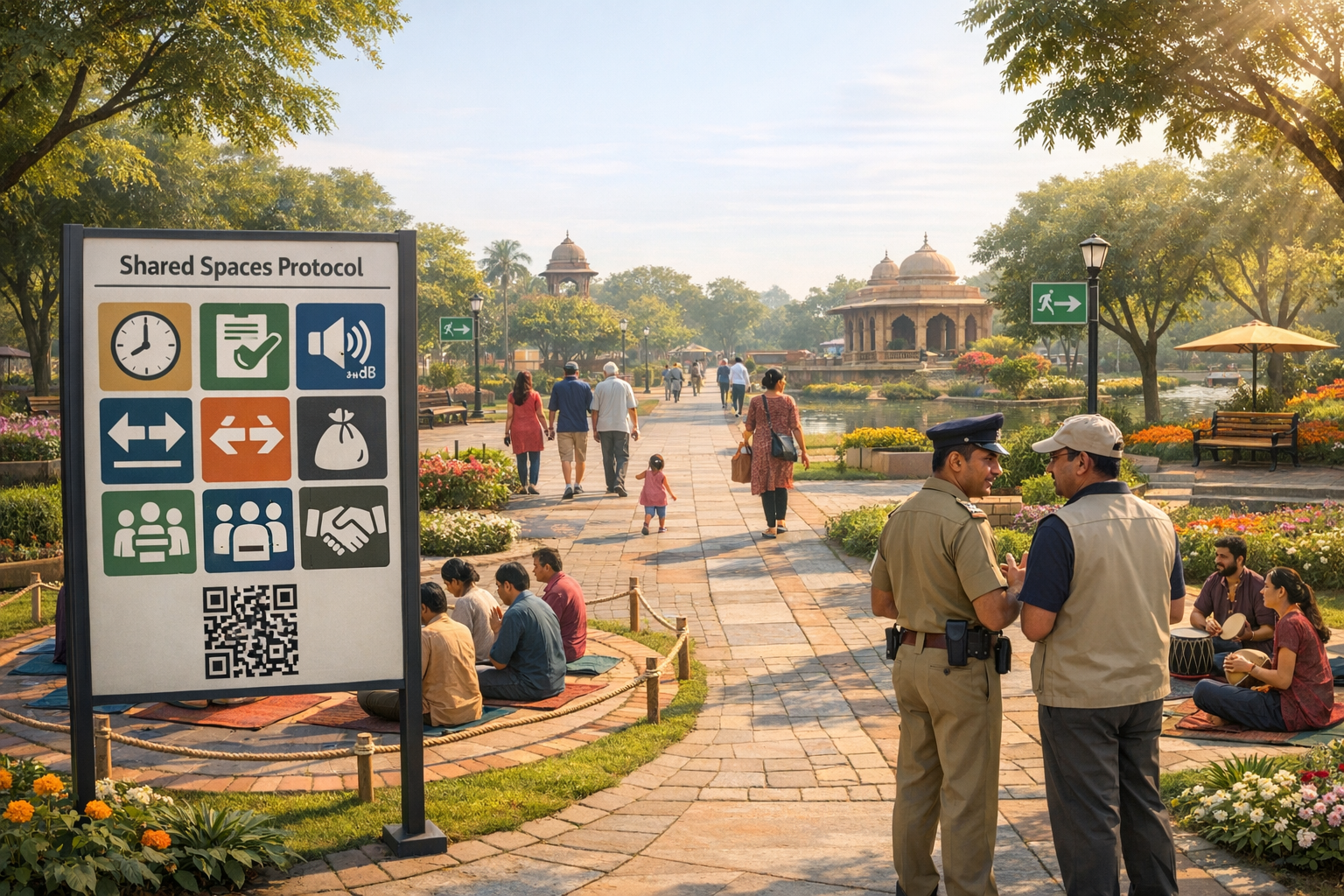
A structured “Shared Spaces Protocol” tailored for Ahilyanagar would help operationalise neutrality and fairness:
1) Time, Place, Manner (TPM) Rules: Identify specific time-bands for collective activities that avoid peak park usage; map at least one designated zone in Ganga Udyan with unobstructed thoroughfares.
2) Permissions and Notice: Require prior permission for any assembly exceeding a threshold size; institute an online, time-bound permit process (with a 72-hour service-level commitment) and a simple on-site display of permission status by organisers.
3) Sound Compliance: Enforce the Noise Pollution (Regulation and Control) Rules, 2000 uniformly; permit low-amplitude devices only within statutory limits, ensuring conversations, schooling, and medical rest in nearby residences are not disturbed.
4) Access and Safety: Keep pathways, play areas, and emergency routes open; deploy stewards from organising groups to coordinate entry/exit and coordinate with the nearest police outpost for support if required.
5) Sanitation and Upkeep: Make organisers responsible for litter removal and immediate post-event sanitation within a short, clearly defined timeframe, with refundable deposits tied to compliance.
6) Non-Exclusion Principle: Ensure no public space is treated as permanently reserved for any group; reiterate equal access for all citizens, regardless of faith or affiliation, on a first-come-first-served or permission-based schedule.
To embed trust, an Interfaith and Community Mediation Committee can be convened under the district administration, including representation from Hindu, Muslim, Buddhist, Jain, and Sikh organisations, resident welfare associations, women’s groups, teachers, and senior citizens. Its mandate should be threefold: proactively schedule large assemblies to avoid clashes, provide rapid-response mediation when sentiments run high, and periodically review data on permissions, complaints, and compliance to refine rules.
Police and civic staff benefit from de-escalation training, rumor-management protocols, and micro-mapping of sensitive nodes around parks, schools, hospitals, and transit corridors. Standard operating proceduresdrawn from past lessonsshould prioritise dialogue first, proportionate deployment second, and calibrated dispersal only as a last resort, consistent with CrPC powers designed to prevent breach of peace.
Communication is central to preventing polarisation. Timely public advisories that confirm whether permissions were obtained, what conditions applied, and how they were observed (or breached) help anchor discussion in fact rather than speculation. Equally, rapid clarification when misinformation circulates on social media can avert crowd formation, confrontation, and resource-intensive law-and-order responses.
When grievances arise, lawful remedies should be the first and only recourse. Organisers of any collective activity can be advised on compliance gaps; residents can file structured complaints through a single-window civic portal; and peaceful, permissioned protestsif pursuedshould be routed to designated demonstration sites to limit disruption. Vigilantism, confrontational blockade, or intimidation have no place in a rules-based civic order and undermine everyone’s rights, including those seeking remedy.
A dharmic ethosanchored in ahimsa (non-violence), mutual respect, and shared civic responsibilityoffers a unifying vocabulary for diverse communities. The same spirit that guides Hindu, Buddhist, Jain, and Sikh traditions toward compassion and restraint can also inform how all communities, including Muslims, approach shared spaces: asserting rights responsibly, listening to neighbours, and embracing solutions that protect the dignity of prayer and the tranquillity of public life.
Practically, Ahilyanagar can convert the present contention into a replicable good-governance template: conduct a short, time-bound administrative review of the Ganga Udyan events; publish a neutral fact-sheet (permissions, timings, sound levels, traffic, sanitation); convene an interfaith huddle to codify the Shared Spaces Protocol; and pilot it in a few parks with clear signage and a QR code linking to rules, complaint channels, and a public calendar of permitted group activities.
Measured steps of this nature strengthen Article 25 protections while advancing Article 14 equality and the broader objective of communal harmony. They also offer predictability: organisers know exactly how to comply, residents know what to expect, and administrators can enforce neutral standards without appearing partisan. Experience from other Indian cities shows that predictability, transparency, and neutrality are the most effective antidotes to polarisation.
The Ahilyanagar episodecollective Namaz at Ganga Udyan, community protests, and criticism by MLA Shri. Sangram Jagtapcan thus be read not as a zero-sum conflict, but as a governance problem that invites a balanced solution. With a clear, even-handed protocol for public gardens, Ahilyanagar can protect religious freedom in India, preserve public order, and model the interfaith dialogue and civic cooperation that sustain a plural society.
Inspired by this post on Hindu Jagruti Samiti.
