

If you have encountered Bhartrhari through the label “India’s Diogenes,” you have been given a shortcut that quietly decides the destination for you. Diogenes becomes the original type, Bhartrhari becomes the local variation, and a Sanskrit poet is interpreted through a Greek figure before his own intellectual world has been allowed to speak.
You do not need to reject every Western translation or every comparison across civilizations. You need to know when comparison is clarifying a feature and when it is replacing the object being studied. That distinction will help you read Bhartrhari without inheriting the hierarchy built into some influential interpretations.
The “Indian Diogenes” label conceals its own argument
A cross-cultural analogy can be useful when it remains limited. If two figures embrace austerity, a reader may compare their outward conduct. That resemblance does not establish that they understand renunciation, society, the body, desire or liberation in the same way. Similar conduct can arise from different accounts of human life.
C.H. Tawney crossed that boundary when he placed Hindu rishis, parivrajakas and sadhus beside Greek Cynics and used descriptions of Diogenes to frame Bhartrhari’s verses on asceticism. The analogy did not merely illuminate one visible resemblance. It supplied the type into which the Indian figure was fitted.
Three different claims are often compressed inside such a label:
- Resemblance: two figures share an observable feature, such as austerity.
- Equivalence: that feature has the same meaning in both traditions.
- Reduction: one figure can be adequately understood as the other civilization’s version of a familiar Western type.
Only the first claim follows from the visible resemblance. Equivalence requires evidence from each tradition’s own concepts. Reduction requires far more: it must show that the borrowed label explains Bhartrhari better than Bhartrhari’s own setting does. Calling him “India’s Diogenes” usually skips those burdens.
Use a simple reverse test whenever you see an “Indian X” formula. Would a history of Greek philosophy introduce Diogenes primarily as “Greece’s Bhartrhari”? If the reversed description sounds inadequate, the original probably carries an unacknowledged centre and periphery. One civilization is being treated as the storehouse of universal types; the other merely supplies examples.
How a foreign benchmark became an apparent universal

The problem did not begin with one unfortunate nickname. Bhartrhari passed through several layers of interpretation in which European assumptions were treated as neutral measures.
Abraham Rogerius used the openly theological slur “renowned Heathen.” Christian Lassen, who lived from 1800 to 1876, initially declared that Bhartrhari had never existed; he later abandoned that position but continued trying to settle Bhartrhari’s dates through conjecture. These were not minor choices of wording. One subordinated Bhartrhari to a Christian classification, while the other allowed speculation to outrun a long oral, written and popular tradition surrounding him.
Paul Regnaud introduced his standalone 1875 translation of the shataka-traya with a more systematic hierarchy. He granted Sanskrit monuments a place beside classical antiquity and then denied them comparable literary value. Greek and Roman achievement supplied his standard; Sanskrit literature stood before it for judgment. Valmiki was measured against Homer, Kalidasa against Virgil, and Indian civilization was faulted for not producing equivalents of Demosthenes, Thucydides, Cicero, Livy or Tacitus.
With Tawney, the hierarchy could operate through apparently ordinary comparison rather than overt abuse. Bhartrhari became intelligible by being brought close to Diogenes. Indian ascetics became intelligible by being brought close to Greek Cynics or medieval European hermits. The European reader’s inherited categories remained stable, while the Bharatiya material was moved into them.
These examples do not prove that every Western scholar, translation or analogy works in the same way. Nationality does not determine whether an interpretation is sound. Method does. What you should notice is a repeated direction of travel: the Western category acts as the measure, and the Indian figure is asked to qualify for a place within it.
When you meet that pattern, do not stop at identifying prejudice. Ask what the prejudice permitted the interpreter to omit. Did he establish the relevant Indian concepts before reaching for a European parallel? Did he distinguish an ascetic practice from the purpose assigned to it? Did he treat inherited Indian memory as evidence to be examined, or as an obstacle to speculation? Those questions expose the scholarly consequence of the bias.
Bhartrhari must first be read by literary criteria native to his world
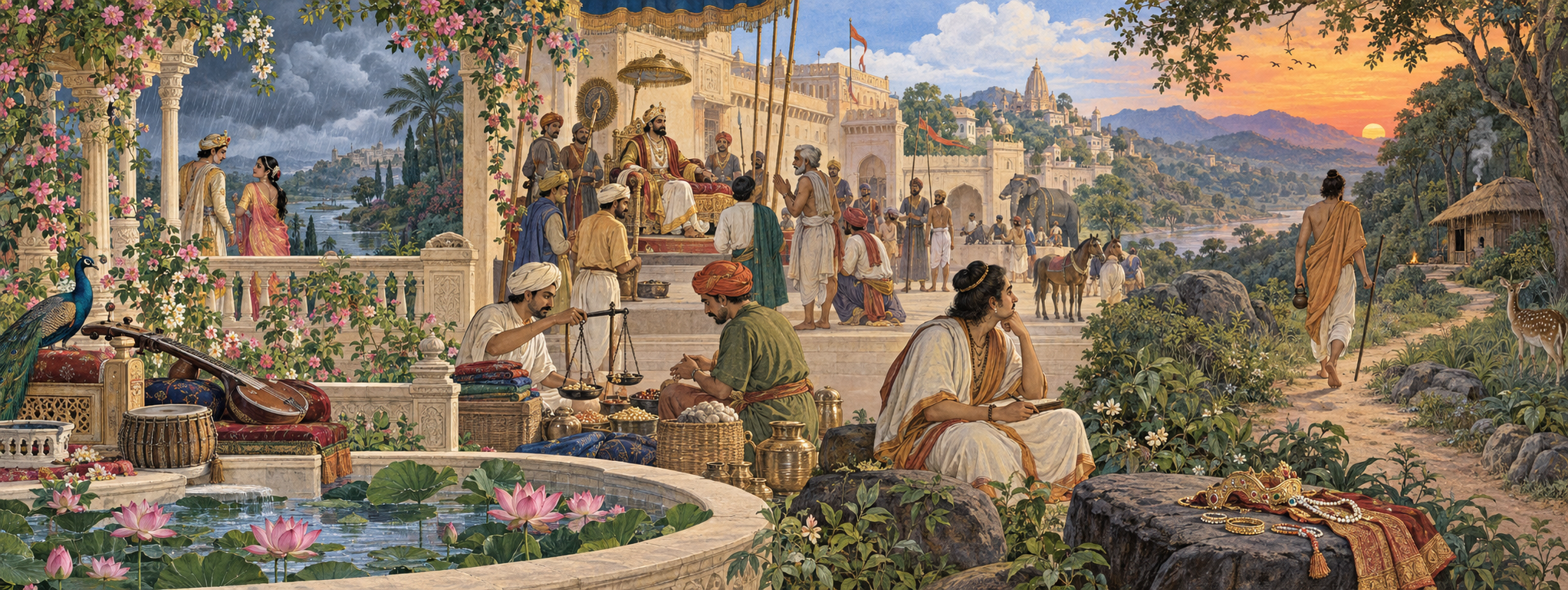
Regnaud’s hierarchy contained a basic category error. He treated accomplishments central to Greek and Roman public culture, including political rhetoric and historical oratory, as though their prominence created a universal test of civilization. Sanskrit poetry then appeared deficient because it had not optimized itself for a different culture’s genres.
A literary tradition has its own grammar of excellence: its purposes, forms, vocabulary, conventions and ways of producing meaning. You cannot establish the worth of Sanskrit poetry by importing a standard from political oratory and then counting what is absent. That procedure reveals the evaluator’s preference, not the poem’s achievement.
The same discipline applies to Regnaud’s complaints about elaborate alliteration and comparison. A device cannot be dismissed as childish merely because another tradition distributes prestige differently. Before judging it, you need to ask what work it performs within the verse and what a competent audience is expected to notice. The internal function comes before the external ranking.
This does not mean that only insiders may evaluate Bhartrhari, or that comparison itself is illegitimate. It means that interpretation should proceed in the right order:
- Identify what kind of work and literary practice you are encountering.
- Establish the concepts and evaluative criteria active within that practice.
- Explain what the relevant language, image or ascetic gesture does there.
- Only then introduce an external comparison, naming both its usefulness and its limit.
If an interpreter begins at the fourth step, the comparison is likely to become the explanation. If the first three steps are present, Diogenes may serve as a narrow point of orientation for some readers without becoming Bhartrhari’s identity.
A six-question test for reading inherited interpretations

You can apply the following test to a preface, lecture, encyclopedia entry or social-media claim. It lets you use helpful scholarship without surrendering judgment to its framing.
- What is the exact claim? Rewrite “Bhartrhari was the Indian Diogenes” as a proposition you could actually test. Does it mean that both were austere, that both rejected social convention, or that both held the same view of life? A label often survives because nobody makes it precise.
- Which part is observation, which part is inference, and which part is judgment? “Both are described as ascetic” is an observation. “Their asceticism expresses the same ideal” is an inference. “One is the Indian version of the other” is a classificatory judgment. Evidence for the first does not automatically prove the next two.
- Has the Indian context been established first? Look for an account of the literary and ascetic categories that give the verse meaning. If those categories are missing but European parallels are abundant, mark the conclusion as provisional.
- Is the comparison reversible? Ask whether each side illuminates the other, or whether the Indian side alone is renamed. An irreversible comparison may still offer a useful hint, but it should not govern the interpretation.
- What disappears under the borrowed label? Note every distinction the analogy leaves unexplained. The critical question is not merely whether Bhartrhari resembles Diogenes somewhere, but what becomes invisible when that resemblance organizes the entire reading.
- Can the useful work be separated from the frame? A translator may offer lexical access while carrying a poor civilizational hierarchy. Keep what can be checked and supported; refuse the assumption that European familiarity is the final court of meaning.
This method also guards against reverse chauvinism. Rejecting an imposed hierarchy does not require declaring every comparison hostile or every non-Indian reading worthless. It requires proportion: resemblance is admitted where evidence supports it, difference is preserved where the analogy cannot reach, and Bhartrhari is not made derivative merely to make him familiar.
Key takeaways
- “India’s Diogenes” is not a neutral nickname. It makes a Greek figure the type and Bhartrhari the derivative instance.
- Shared austerity can support a limited comparison, but it does not prove shared philosophy, purpose or civilizational meaning.
- Theological dismissal, speculative reconstruction, literary hierarchy and forced analogy are different moves, but each can displace Indian evidence with an imported standard.
- Sanskrit poetry should first be interpreted through the purposes and criteria of its own literary world. Comparison belongs after that work, not in place of it.
- You can retain verifiable philological help from an interpreter while rejecting the hierarchy in which that help was presented.
The next time someone presents Bhartrhari as an Indian copy of a Western figure, pause before accepting or rejecting the comparison. Ask for the exact resemblance, the Bharatiya context and the point where the analogy stops. That small change in reading order gives Bhartrhari room to be encountered on his own terms.
References

Leave a Reply
You must be logged in to post a comment.