
If you have heard Gundappa’s misadventure reduced to a joke about someone taking idioms literally, you have missed half its warning. His failure begins before he misunderstands a word: he wants public office so that he can exercise power over others, while his king assumes that excellence in one demanding role guarantees fitness for another.
That makes this South Bharatiya folktale useful whenever you must decide what faithful obedience actually requires. Should you reproduce the words you were given, or understand the purpose, limits and consequences of the instruction? The answer lies in the tale’s Kannada wordplay, but also in its treatment of ambition, appointment and authority.
The first mistake happens before the literal obedience
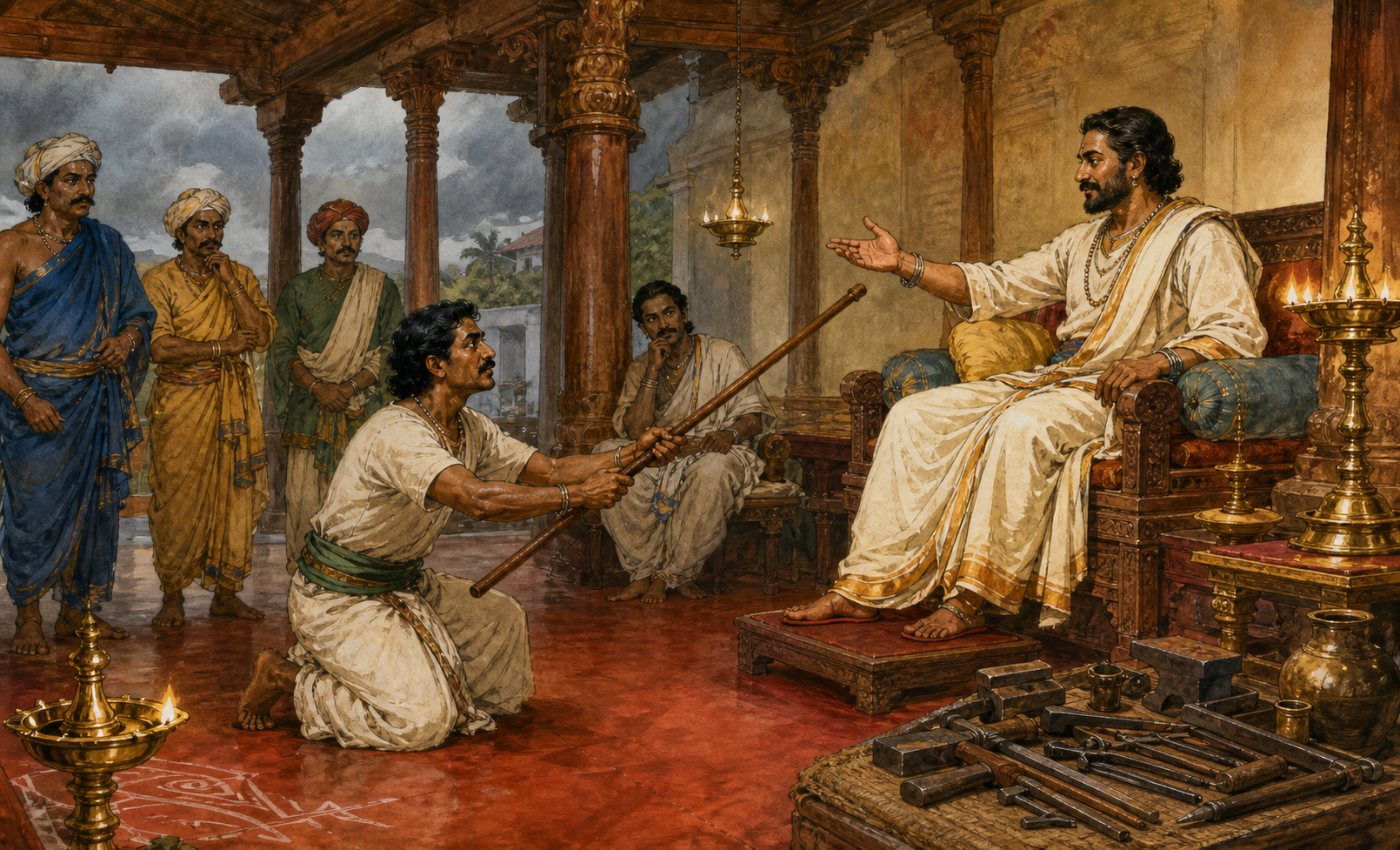
Within the tale’s Karnatakadesha setting, King Chamunda is pleased with the ritual service of his household purohita, Gundappa. He offers to grant him a wish. Gundappa asks to become an amildar, a district office-holder, because he has long wanted to exercise power over a number of people. The amildari of Nanjangud is vacant, so Chamunda appoints him.
Notice what Gundappa does not ask for. He does not speak of protecting the people, administering the district well or accepting a difficult responsibility. His stated attraction is power. Folly therefore appears first as a misunderstanding of office: he sees the position from the ruler’s chair, not from the lives of those who will be ruled.
Chamunda makes a different error. Gundappa is well versed in rituals and faithful in performing his sacred duties, so the king assumes that he will also succeed in administration. The assumption sounds reasonable only until you identify the change of domain. Ritual competence demonstrates discipline within a structured responsibility. District administration also demands interpretation, practical judgement, knowledge of people and the ability to act under conditions that are not fully specified.
If Gundappa were incompetent at everything, the tale would offer only easy ridicule. Making him accomplished in his original vocation gives the warning its edge: a capable person can become foolish when status changes faster than understanding. When you evaluate someone for authority, ask what the new role requires that the old one never tested. Reputation is evidence of competence, but only within the field in which it was earned.
Three Kannada commands contain three different traps
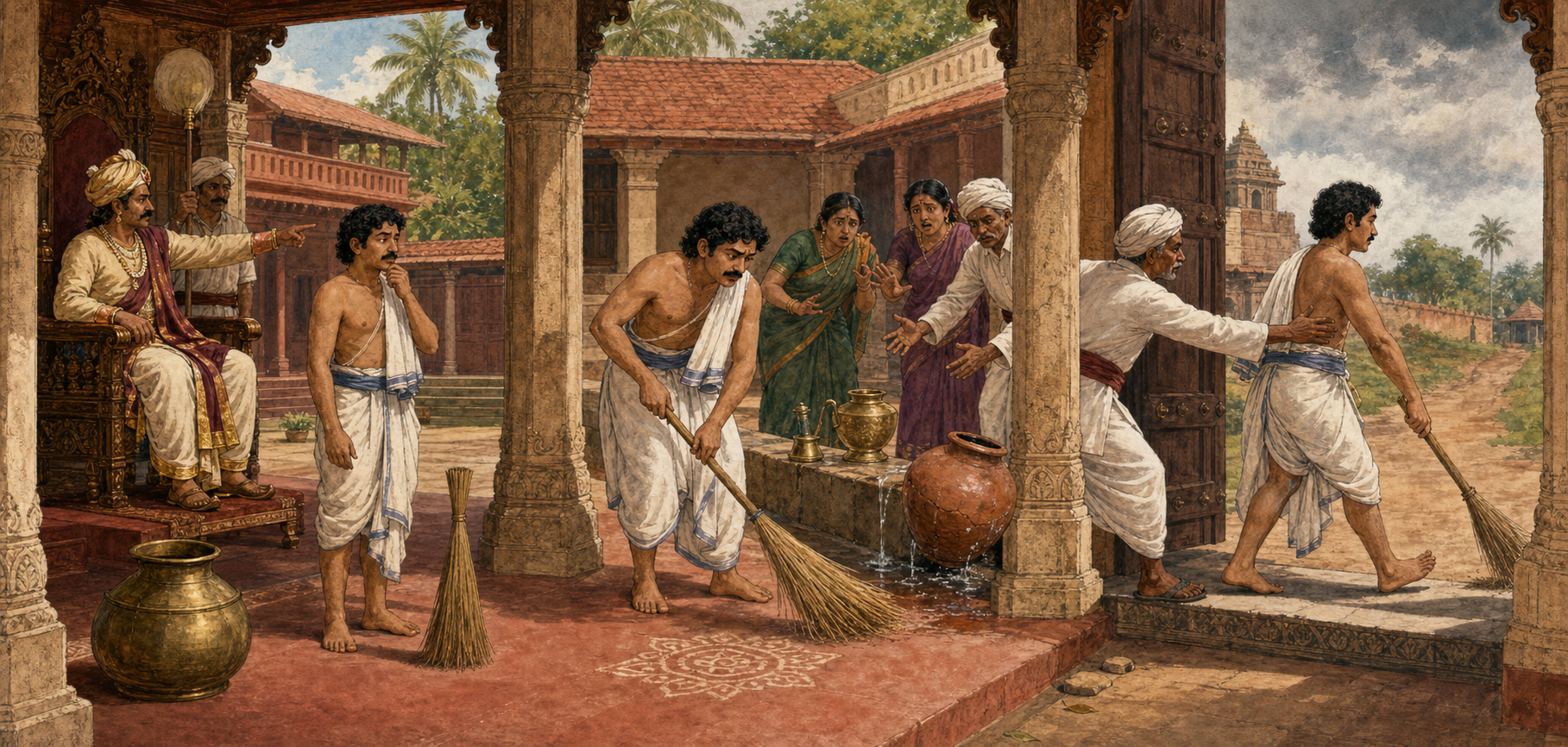
Before sending Gundappa to Nanjangud, Chamunda gives him three instructions in Kannada. Each uses a bodily image to communicate an administrative attitude. Each can also be converted into a ridiculous physical act.
| Kannada instruction | Intended administrative sense | Literal trap |
|---|---|---|
| Mukha kappage irabeku | Keep a black or frowning countenance: present yourself as stern. | Treat blackness as a physical property of the face rather than an expression of severity. |
| Ellara kiviyannu kachchi matan adu | Discuss affairs secretly, speaking close to a person’s ear. | Turn the image of biting an ear into an actual bodily action. |
| Ellara juttu kaiyalli irabeku | Keep influence over everyone and make them subservient. | Take people’s locks of hair physically into one’s hand. |
The comedy is systematic. Face stands for official bearing. Ear stands for confidential speech. Hair held in the hand stands for control over people. Gundappa’s literalism preserves the image while discarding the institutional purpose carried by it.
Using a familiar Indic distinction, he clings to abhidha, the direct denotative sense of an expression, when the context plainly requires an indicated sense. This does not mean that literal meaning is inherently inferior. It means that context decides whether literal meaning completes understanding or merely begins it.
You can use three questions to uncover that context. What do the words denote? What result does the speaker intend? What action would be appropriate to the listener’s role? Gundappa can answer only the first. A responsible amildar would need all three answers before acting.
Disciplined obedience and mindless compliance are not the same

Gundappa carries the wrong kind of exactness into a new duty
The tale need not be read as mockery of ritual learning. Gundappa’s faithful ritual performance is precisely what earns Chamunda’s confidence. Exactness is not presented as his original defect. His defect is the inability to recognise when exactness must move from reproducing a form to fulfilling a purpose.
An instruction can function in several ways. It may prescribe an exact act, state a desired outcome, compress experience into a maxim or use metaphor to shape conduct. Obedience becomes foolish when you treat all four as if they were exact physical commands. Before carrying out an ambiguous order, test it against four things:
- Language: Is the expression literal, idiomatic or metaphorical?
- Purpose: What result is the instruction meant to produce?
- Role: What conduct is proper for the responsibility you hold?
- Consequence: Would the surface reading violate dignity, duty or common sense?
If the wording and the purpose point in different directions, clarification is not disobedience. It is part of competent obedience. Repeat the intended result in your own words and ask whether you have understood it correctly. That small pause supplies the discernment Gundappa lacks.
Chamunda also fails the test of responsible authority
The king is not merely a wise speaker burdened with a foolish listener. He gives a district to an untested administrator because the man has served well elsewhere. He then substitutes three figurative maxims for preparation. The resulting literalism exposes the listener, but the conditions that make it dangerous were created by the appointing authority.
Even the intended meanings deserve examination. A frowning face, whispered state business and control that makes everyone subservient form a curriculum of severity, secrecy and domination. They describe how to look powerful and keep hold of people; they do not explain how to judge disputes, restrain oneself or serve the district. The tale can therefore be read at two levels: Gundappa mishandles the language of power, and Chamunda offers an impoverished model of power in the first place.
If you are giving instructions, do not rely on colourful language where errors will affect other people. State the outcome, the boundary and the point at which the person must return for guidance. Instead of telling an official to keep everyone in hand, specify which decisions belong to that office, what must remain confidential and which matters require escalation. Clear authority is defined authority.
How to retell the tale without flattening its meaning

The bodily comedy makes the story memorable, but a retelling can easily reduce it to slapstick about a stupid Brahmin. That loses the role transition, the administrative criticism and the Kannada mechanism that generate the joke. Preserve them in this order:
- Locate the story. Say Karnatakadesha, Chamunda, Gundappa and Nanjangud. These are not disposable ornaments; they keep a Kannada tale rooted in its cultural landscape.
- Establish Gundappa’s competence. He is a learned and faithful purohita before he becomes a foolish administrator. The contrast is essential.
- Name his ambition accurately. He wants the amildari because he wants power over people. This prepares the listener to notice that his misunderstanding of office precedes his misunderstanding of language.
- Give each Kannada line before its explanation. Then separate the direct image, the administrative intention and the absurd bodily enactment. Translation should preserve both available meanings rather than replacing the idiom with a single English instruction.
- Turn the final question toward both men. Ask what Gundappa should have clarified and what Chamunda should have done before granting him authority. This prevents the king’s failure from disappearing behind the subordinate’s comedy.
For a family or classroom discussion, place three headings on a page: words, intended result and responsible action. Fill them using the three commands. The third column matters most. Speaking secretly may be the intended meaning of the ear image, but a responsible official must still ask when confidentiality serves public duty and when it merely conceals power.
With younger listeners, avoid ending with the verdict that Gundappa is simply foolish. Ask: Who gave him the position? What did the king know about his administrative ability? Could Gundappa have repeated the instructions in his own words? These questions turn laughter into moral attention without draining the tale of humour.
With adults, the same method can examine a real instruction from work or community life. Remove confidential details, write down its exact wording, identify the intended outcome and name the conduct that your role actually permits. If those three do not align, seek clarification before performing confidence you do not possess.
Key takeaways
- Gundappa’s folly begins with his desire to wield power, not merely with his literal reading of three commands.
- The tale’s humour depends on Kannada expressions whose bodily images carry figurative administrative meanings.
- Precision learned in one role does not automatically become judgement in another; competence must be tested against the actual duty.
- Chamunda shares responsibility because he appoints on an assumption and teaches postures of power instead of the work of just administration.
- When an instruction is ambiguous, identify its words, purpose, role boundaries and likely consequences before acting.
The next time someone gives you a command dressed as a metaphor, do one small thing Gundappa does not: state the intended result back to the speaker before you act. That pause preserves discipline where exactness is required and makes room for viveka where duty demands judgement.
References
