
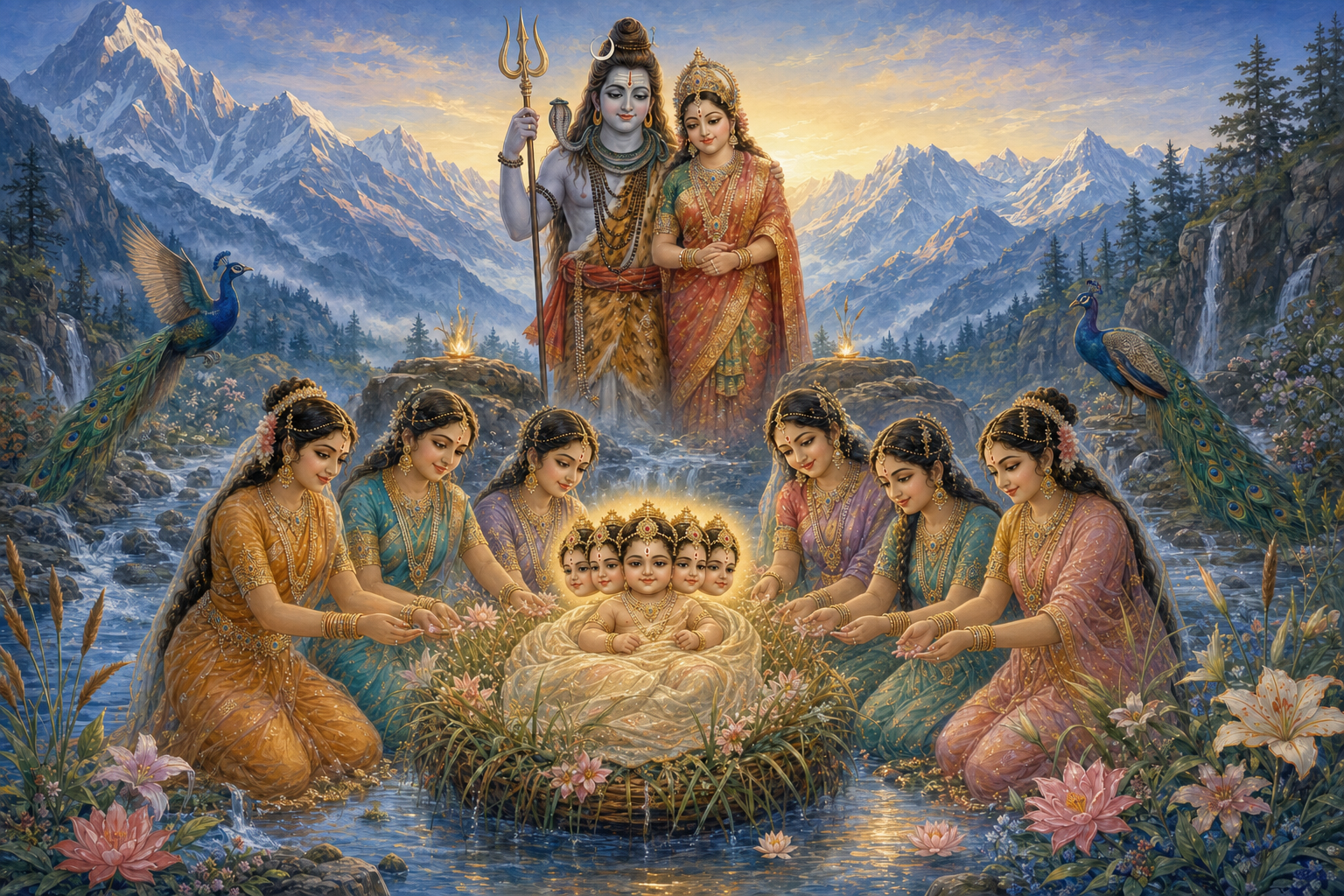
You came for the birth of Skanda, yet Kālidāsa first gives you a mountain kingdom, an inaccessible ascetic, a god of desire reduced to ashes, Pārvatī’s severe tapas, and a divine wedding. The apparent delay is the first thing to understand: Skanda’s arrival matters because of everything that must be transformed before he can appear.
Read Kumārasambhava as an inquiry into the right use of power. Desire must become disciplined devotion, ascetic potency must re-enter the world, and martial strength must acquire a dharmic purpose. Once you follow that sequence, the poem’s title no longer feels like a destination postponed for too long.
Key takeaways
- Skanda’s birth answers a specific cosmic crisis: Tāraka can be defeated only by a son of Śiva, while Śiva remains absorbed in ascetic withdrawal.
- Kāma’s failed intervention and Pārvatī’s successful tapas are not two versions of the same courtship. One attempts to provoke desire from outside; the other develops the inner fitness required for a sacred partnership.
- Agni, Gaṅgā, the Saravana reed-beds, and the Kṛttikās form a sequence of bearing, channeling, receiving, and nurturing divine potency.
- Not every edition tells the same amount of the story. The first eight cantos are widely accepted, while the authenticity of later cantos, sometimes extending the work to seventeen, remains debated.
- Skanda’s valor is protective rather than acquisitive. He becomes the devas’ commander because force is needed to restore balance, not because conquest is treated as an end in itself.
The birth begins with a problem that attraction cannot solve
The narrative machinery begins with Tāraka. His boon makes ordinary defeat impossible: only Śiva’s son can overcome him. The devas therefore face a precise contradiction. The protector they need does not yet exist, and the prospective father is the great yogin whose consciousness is turned away from worldly involvement.
This is why you should keep the causal chain visible as you read:
- Tāraka’s power disturbs cosmic order.
- His boon limits who can defeat him.
- Only a son of Śiva can meet that condition.
- Śiva’s ascetic detachment makes such a birth appear impossible.
- Kāma’s attempt to force the issue fails.
- Pārvatī’s tapas prepares a union based on recognition, resolve, and consent.
- The power generated by that union is carried, received, and nurtured until Skanda emerges for his appointed duty.
That sequence guards against a common misreading. Kumārasambhava is not simply a divine romance interrupted by mythology. The romance, austerity, birth, and coming battle are different stages of one question: how can transcendent power become active in the world without becoming disordered power?
Kāma can awaken sensation, but he cannot establish fitness
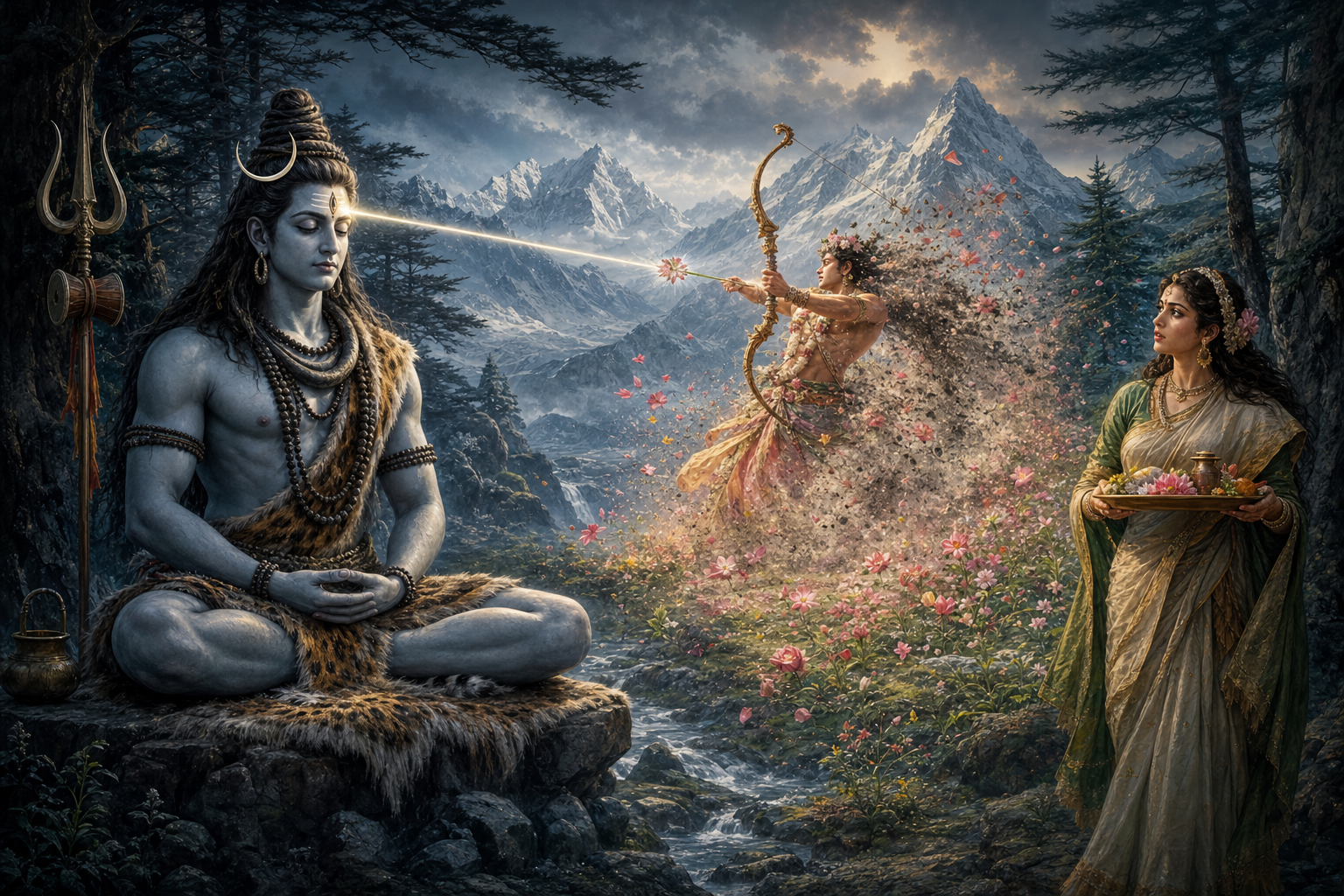
Kāma tries to direct Śiva’s attention toward Pārvatī. Śiva’s third eye opens, and the god of desire is incinerated. Rati’s lament then brings grief into a scene that could otherwise be read only as a spectacle of yogic severity.
Do not turn this episode into the crude rule that Hindu spirituality rejects love. The rest of the narrative would contradict that conclusion. Kāma’s failure distinguishes compulsion from communion. Desire imposed upon an absorbed consciousness cannot create the union the cosmos requires. Love must pass through self-command before it can bear responsibility.
When you read this passage, ask two separate questions: what is being burned, and what survives the burning? Immediate stimulation fails. Pārvatī’s commitment does not. That distinction carries you into the spiritual center of the work.
Pārvatī’s tapas makes her an author of destiny
Pārvatī does not wait for the devas’ plan to deliver a husband. She undertakes demanding vows and directs her whole being toward Śiva. Her tapas transforms longing from an appetite for possession into a capacity for steadfast relation.
Śiva later appears as a brahmacārin and tests her commitment. The importance of this encounter lies in the combination Pārvatī displays: devotion joined to discernment. She does not abandon judgment in the name of bhakti, nor does scrutiny dissolve her devotion. If you read her merely as a patient bride, you miss the force that actually moves the narrative.
This also changes how you should understand tapas. It is not self-punishment performed to purchase a divine reward. Within the poem’s logic, tapas is a discipline of alignment. Pārvatī becomes able to participate consciously in a purpose larger than personal fulfillment. Her agency lies not in rejecting the cosmic need but in making that need her own vowed action.
The wedding joins capacities that were incomplete in isolation
The divine marriage brings austerity into auspicious social form through Vedic rites, processions, ornaments, and celestial celebration. These details are not a decorative pause after the serious spiritual labor. The public ritual confirms that a private transformation has consequences for the whole order of existence.
Śiva does not cease to be the yogin, and Pārvatī does not disappear into his identity. Their union holds together consciousness and creative power, stillness and activity, jñāna and śakti. Later sensuous passages can therefore be read on more than one level: as conjugal śṛṅgāra and as an image of complementary principles becoming generative.
The practical test is simple. Whenever the poem moves from austerity to beauty, or from solitude to ceremony, do not assume it has changed subjects. Ask what the new mode makes possible. Tapas prepares the persons; marriage establishes the relation; birth directs their combined potency toward dharma.
The sacred birth is a relay of power, place, and care
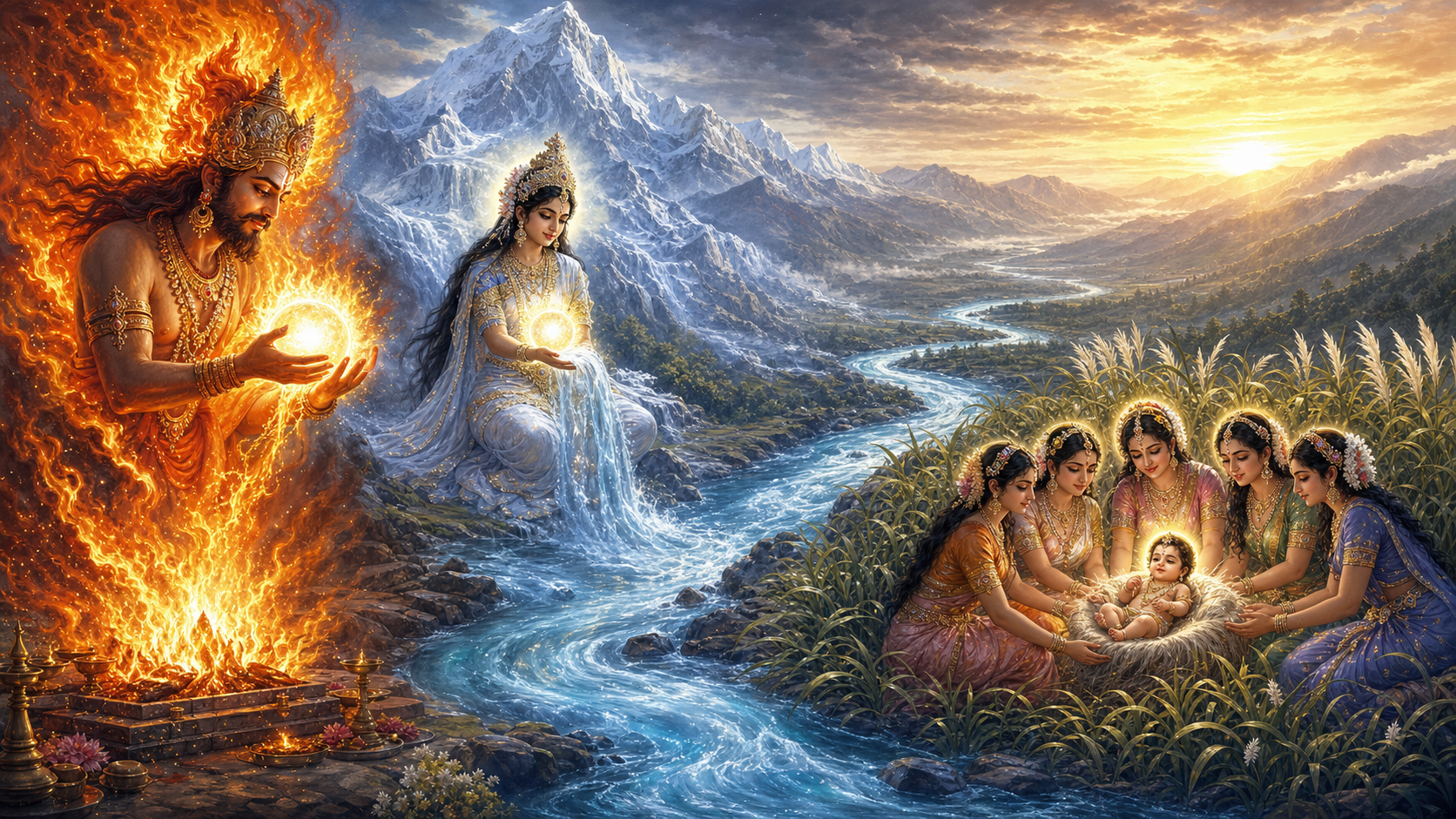
Skanda’s manifestation unfolds through several agents rather than one ordinary biological scene. Agni bears the fiery seed, Gaṅgā channels its force, the reeds of Saravana receive the nascent deity, and the Kṛttikās foster him. Each transition tells you that raw divine potency must be carried in a form the created world can sustain.
| Figure or place | Narrative role | What to notice |
|---|---|---|
| Agni | Bears the fiery potency | Power first appears as something intense enough to require a capable bearer. |
| Gaṅgā | Channels the potency onward | Sacred power moves through a purifying, life-giving current rather than remaining enclosed. |
| Saravana | Receives and cradles the nascent child among reeds | The wilderness becomes a place of gestation, not an empty space outside sacred order. |
| The Kṛttikās | Nurture the child | Divine origin does not eliminate the need for care, relation, and maturation. |
You do not have to choose between reading this sequence as a literal sacred history and recognizing its symbolic structure. The narrative itself works by placing cosmic potency in a chain of relationships. No single bearer claims the whole event. Fire, river, earth, and foster-mothers all participate in bringing the commander into being.
That pattern gives the birth a wider meaning. Power becomes beneficial only when it can be transmitted without being squandered, received without being possessed, and nurtured toward a purpose. Skanda is extraordinary from the beginning, but the sacred ecology surrounding him is part of what makes his arrival intelligible.
His names reveal relationships, not competing identities
The child appears under several names, and you will understand him more clearly if you resist treating one as the only correct label:
- Kumāra keeps the destined child or youthful deity at the center and supplies the poem’s title.
- Skanda commonly identifies the divine warrior who becomes senāpati, commander of the devas, and confronts Tāraka.
- Kārttikeya preserves his bond with the Kṛttikās who nurture him.
- Ṣaṇmukha identifies the familiar six-faced form.
- Subrahmaṇya carries particular devotional warmth in South Indian worship.
The six faces, the vel or spear, and the peacock mount belong to the iconographic world through which devotees recognize this same deity. Instead of reducing them to ornamental identifiers, read them alongside his office. The weapon signifies directed force; the commander exists to confront a defined disorder; and his many-faced form visually resists the idea that sacred intelligence sees from only one narrow position.
The final distinction is crucial. Skanda does not embody violence without moral limits. His kṣatra serves dharma-yuddha: courage used to restore balance. Tāraka supplies the threat, the boon supplies the constraint, and Skanda supplies the proportionate answer. Remove that framework, and the warrior becomes a mascot. Preserve it, and martial valor remains answerable to cosmic and ethical order.
Why your edition may end before the birth

A reader can finish an edition of Kumārasambhava and reasonably wonder why a work called The Birth of Kumāra has stopped at or near the divine union. The difficulty comes from textual transmission, not necessarily from careless editing. The first eight cantos are generally accepted, while later cantos, in some recensions bringing the total to seventeen, have long attracted questions of authorship and authenticity.
Some transmitted forms conclude with the marriage. Others continue into conjugal life and the circumstances of Kumāra’s birth. This difference matters because two readers can truthfully say they read Kumārasambhava while having encountered different endpoints, emphases, and degrees of martial narration.
Before choosing or judging an edition, check five things:
- Count the sargas. The table of contents immediately tells you whether the volume presents only the broadly accepted core or a longer recension.
- Read the editorial or translator’s note. Look for an explicit statement about how later cantos are treated. Silence on this point leaves you unable to distinguish a textual decision from simple abridgment.
- Identify the narrative endpoint. Does the text stop with the wedding, continue into conjugal union, narrate the birth, or proceed further toward Skanda’s martial purpose?
- Separate authorship from reception. Doubt that every later verse came from Kālidāsa does not erase the role those cantos acquired in the poem’s living tradition.
- Match the edition to your purpose. An annotated edition helps with grammar, meters, and alaṅkāras; a literary rendering may better preserve pace and emotional movement for a first reading.
M. R. Kale’s annotated work and Chandra Rajan’s literary renderings represent those differing kinds of help. Whichever form you choose, keep the textual question open rather than forcing a false certainty. The accepted core establishes the spiritual and aesthetic movement toward generative union; the extended tradition makes the promised birth more narratively explicit.
This is one place where devotional reading and philological reading should remain in conversation. Philology asks which verses can confidently be attributed to Kālidāsa. Devotional and cultural reception asks how communities have received the complete sacred story. Those are different questions, and neither has to cancel the other.
Read for rasa first, then return for philosophy
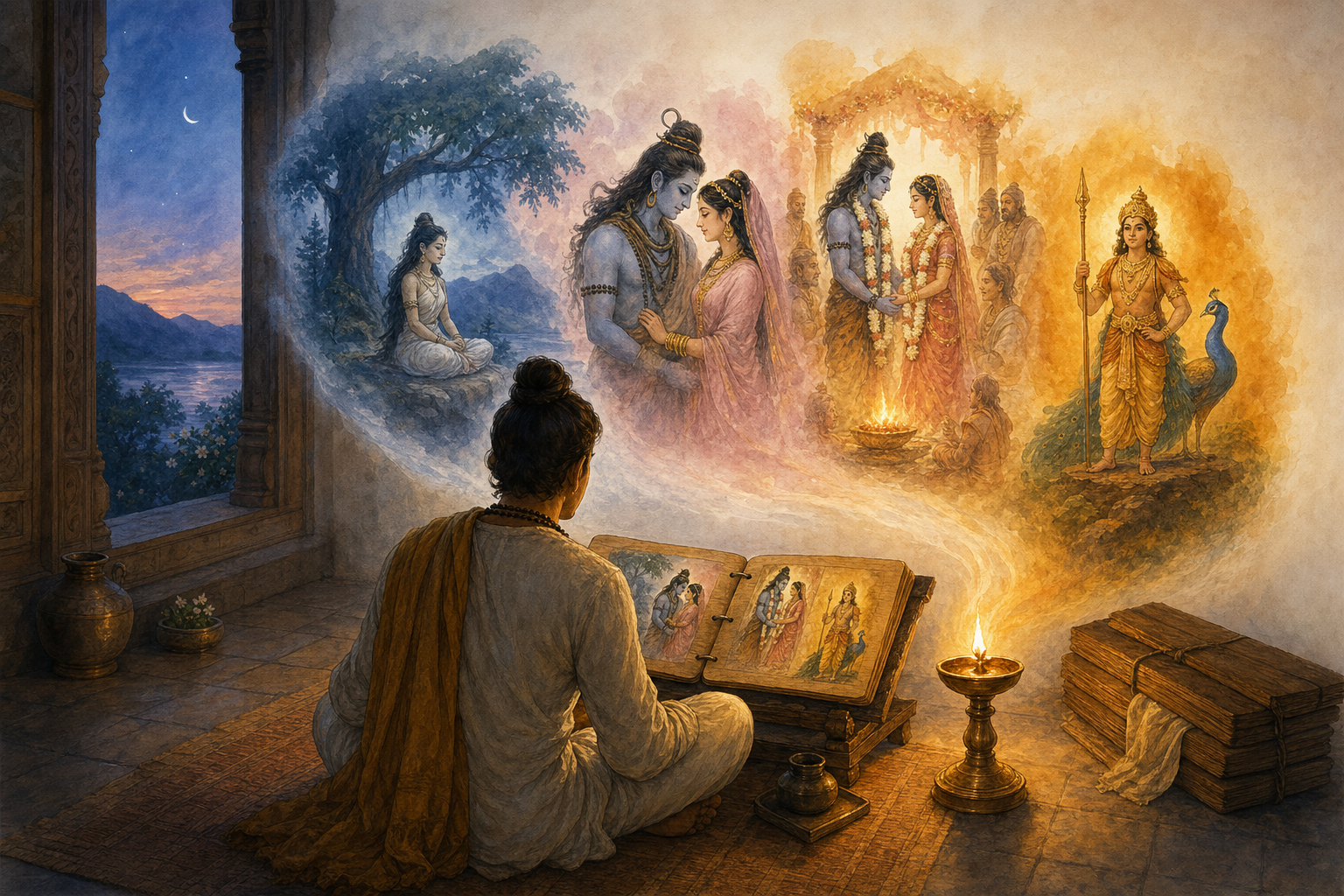
A plot-only reading will give you the sequence but not the experience Kālidāsa designed. The poem moves among śṛṅgāra, vīra, and karuṇa: love, heroic energy, and pathos. Kāma’s destruction would be thinner without Rati’s grief; Pārvatī’s austerity would be flatter without the beauty surrounding it; Skanda’s valor would be less meaningful without the long discipline that precedes his birth.
The landscape works in the same way. Himālaya is both sacred geography and an image of steadfastness. Forests, rivers, flowers, seasons, and peaks do more than establish scenery. They externalize states of consciousness and make inward transformation perceptible. A mountain can suggest meditative stability; a changing season can register movement in attention; a delicate natural image can hold a cosmic implication.
Use this five-pass method if you want more than a remembered plot:
- Map the necessity. On the first pass, mark every event that makes Skanda’s birth necessary or possible. This keeps the cosmic crisis connected to the intimate story.
- Track the emotional register. Note where love, grief, wonder, and valor take the foreground. Ask why a change of rasa occurs at that exact point.
- Circle the transformations. Follow desire into tapas, isolation into marriage, potency into birth, and birth into duty. These transitions carry the philosophical argument.
- Mark the figures of speech. When a simile, metaphor, poetic supposition, or sound pattern arrests your attention, ask what relation it reveals. Kālidāsa’s celebrated upamās are instruments of thought, not detachable verbal decoration.
- Return through the names. On a second reading, follow Śiva, Pārvatī, Kumāra, Skanda, Kārttikeya, Tāraka, tapas, and dharma as a working glossary. Each term identifies a force or role in the causal structure.
This approach also prepares you to recognize the narrative beyond the page. South Indian devotion keeps Subrahmaṇya present at temples including Tiruchendur and Palani, while Thaipoosam and Skanda Ṣaṣṭhi carry the theology of disciplined power into communal observance. Bharatanāṭyam, Kuchipudi, Kathakali, and Yakṣagāna can translate Pārvatī’s vow, Kāma’s burning, the wedding, and Skanda’s investiture into gesture, rhythm, costume, and embodied rasa.
The story can also enter a wider Dharmic conversation without flattening distinct traditions. Skanda’s protective role finds an echo in Buddhist settings where he is remembered as a guardian of Dharma. Pārvatī’s disciplined restraint offers a point of recognition for Jain reflections on tapas. Skanda’s union of sacred orientation and righteous courage can be placed in conversation with the Sikh sant-sipāhī ideal. These are civilizational resonances, not claims that the doctrines or deities are identical.
For your next reading, place three headings on a page: tapas, grace, and duty. Assign each major scene to one or more of them. The scenes that belong under all three will show you why Skanda’s birth is sacred: it is the point where disciplined power, divine recognition, and responsibility to the world finally meet.
References
