
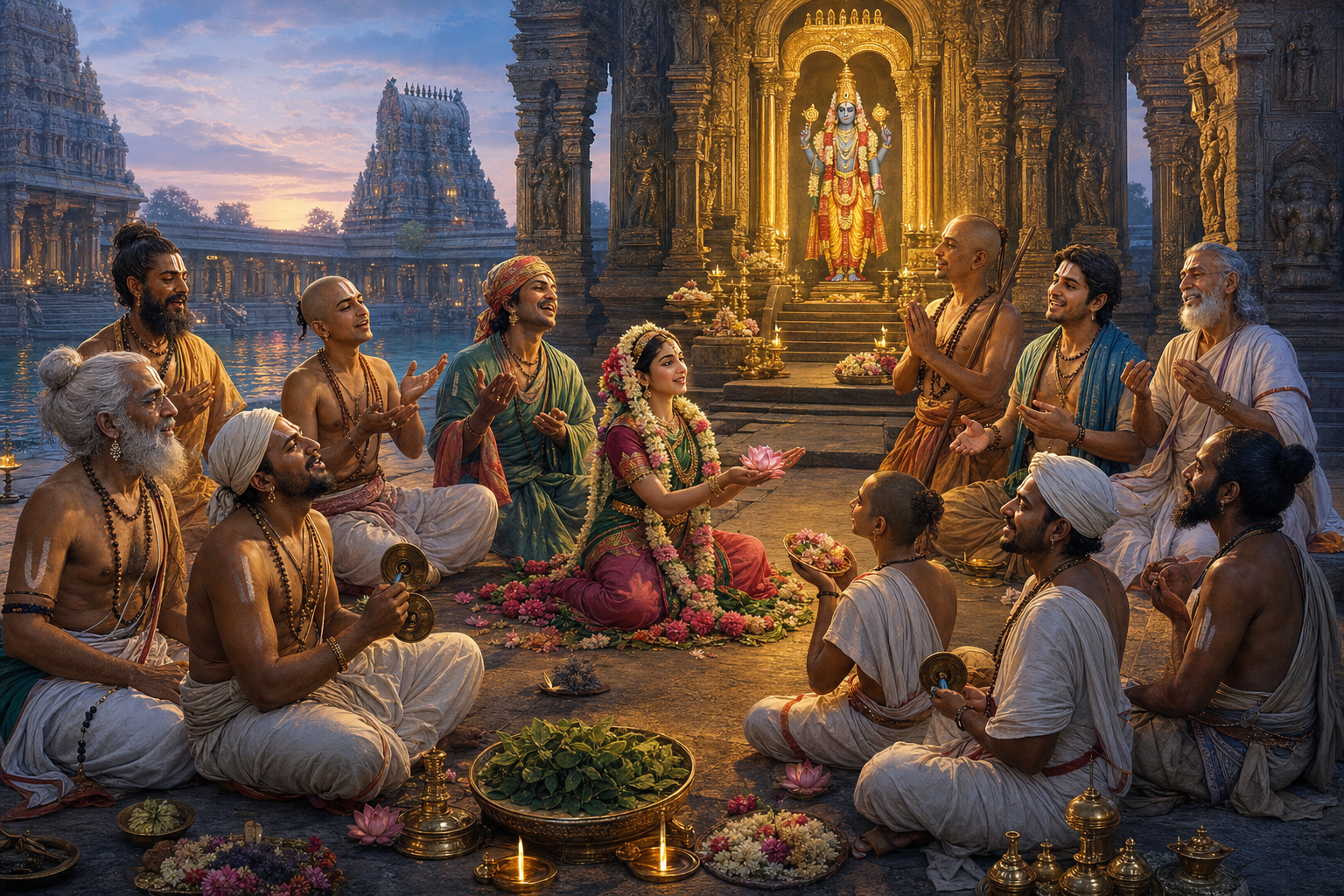
You may know Andal’s Tiruppavai, the grandeur of Srirangam, or Ramanuja’s Vishishtadvaita without yet seeing how they belong to one tradition. The missing link is the Azhwars: twelve Tamil saint-poets whose devotion gave Sri Vaishnavism its emotional language, sacred geography, and much of its temple voice.
You don’t need to memorise twelve biographies or begin with all four thousand hymns. Start by following three connections: from poetry to surrender, from surrender to service, and from service to the living presence of Narayana in the temple. That map will tell you what to read, what to notice, and how to move from admiration into practice.
Key takeaways
- The Azhwars were twelve Tamil saint-poets active broadly between the sixth and ninth centuries CE. Their defining posture was immersion in Vishnu bhakti.
- Their hymns were gathered into the Nalayira Divya Prabandham, the Four Thousand Sacred Hymns, whose recovery and transmission are credited to Nathamuni in the tenth century.
- Nammalvar supplies much of the tradition’s theological depth; Andal makes disciplined, intimate devotion especially approachable; other Azhwars open distinct paths through temple service, pilgrimage, praise, contemplation, and guru-bhakti.
- Sri Vaishnavism joins the Tamil Prabandham and Sanskrit revelation through ubhaya Vedanta. It does not force you to choose between vernacular devotion and philosophical discipline.
- The hymns remain alive through recitation, festival, music, gesture, pilgrimage, and kainkarya, or loving service. They are meant to be inhabited, not merely catalogued.
The twelve Azhwars are a map, not a memorisation test

Within Sri Vaishnava tradition, the name Azhwar is normally connected with the Tamil root azhndu, to sink or become deeply immersed. A philological distinction between forms meaning “immersed” and “one who rules” is sometimes discussed, but the devotional sense is the important one for a beginner: an Azhwar is not simply a writer describing Vishnu from a distance. The hymns speak from a consciousness absorbed in the Lord.
That explains why a list of dates and works can leave you cold. The Azhwars flourished as temple culture and Agamic worship were expanding under Pallava, Pandya, and Chera polities. Their Shaiva contemporaries, the Nayanmars, were giving Tamil Shaiva bhakti a similarly public and personal voice. You should therefore picture an efflorescence of vernacular sacred poetry, temple devotion, and congregational remembrance, not twelve isolated literary careers.
Use the following groupings as reading doorways. They are not a traditional ranking of the saints.
- Poigai, Bhuthath, and Pey: The Mudhal, or first, Azhwars composed the first three Tiruvandadis. Their compact verses establish themes that recur throughout the tradition: Vishnu’s presence, remembrance of the divine name, and the joy of devotion. Begin here if you value short, concentrated verses that can remain in the mind during the day.
- Tirumazhisai: Naanmugan Tiruvandadi and Tiruchanda Viruttam emphasise Vishnu’s supremacy within a unified vision of reality. Read him when your question is doctrinal: who is the ultimate refuge, and how does the rest of existence relate to that reality?
- Nammalvar and Madhurakavi: Nammalvar, also revered as Satakopa, is the great theological and poetic centre of the canon. His Tiruvaymoli contains 1,102 verses, presenting Vishnu as both supreme reality and intimately beloved. Tiruviruttam, Tiruvasiriyam, and Periya Tiruvandadi further explore surrender, grace, and service. Madhurakavi’s Kanninun Sirutambu, addressed through devotion to his guru Nammalvar, shows why the acharya is not incidental to Sri Vaishnava life.
- Periyalvar and Andal: Periyalvar’s protective love toward the Lord and Andal’s yearning give devotion a familial, seasonal, and deeply personal texture. Andal’s Tiruppavai has 30 verses, while Nachiyar Tirumoli has 143. If you want a manageable daily discipline, Tiruppavai is the clearest doorway: one verse a day produces a complete 30-day first encounter.
- Kulasekara, Thondaradippodi, and Tiruppaan: Kulasekara’s Perumal Tirumoli turns royal status toward humility. Thondaradippodi’s Tirumalai and Tiru-palli-yezhuchi make the Lord’s temple the axis of life. Tiruppaan’s compact Amalanadhipiran contemplates the divine form of Ranganatha. Enter through these saints if temple presence, beauty, and service speak to you more immediately than abstract doctrine.
- Tirumangai: The prolific pilgrim-poet celebrates numerous Divya Desams in Periya Tirumoli and related compositions. His hymns help you see pilgrimage as a network of remembered divine presences rather than a collection of disconnected destinations.
This arrangement gives you a practical decision. Choose the saint who meets the question you actually carry. For daily discipline, begin with Andal. For surrender and the nature of the soul, approach Nammalvar. For guru-bhakti, read Madhurakavi. For temple contemplation, turn to Tiruppaan or Thondaradippodi. For sacred geography, follow Tirumangai. You can widen your reading after one relationship has become real.
Poetry became Sri Vaishnava theology through a living lineage
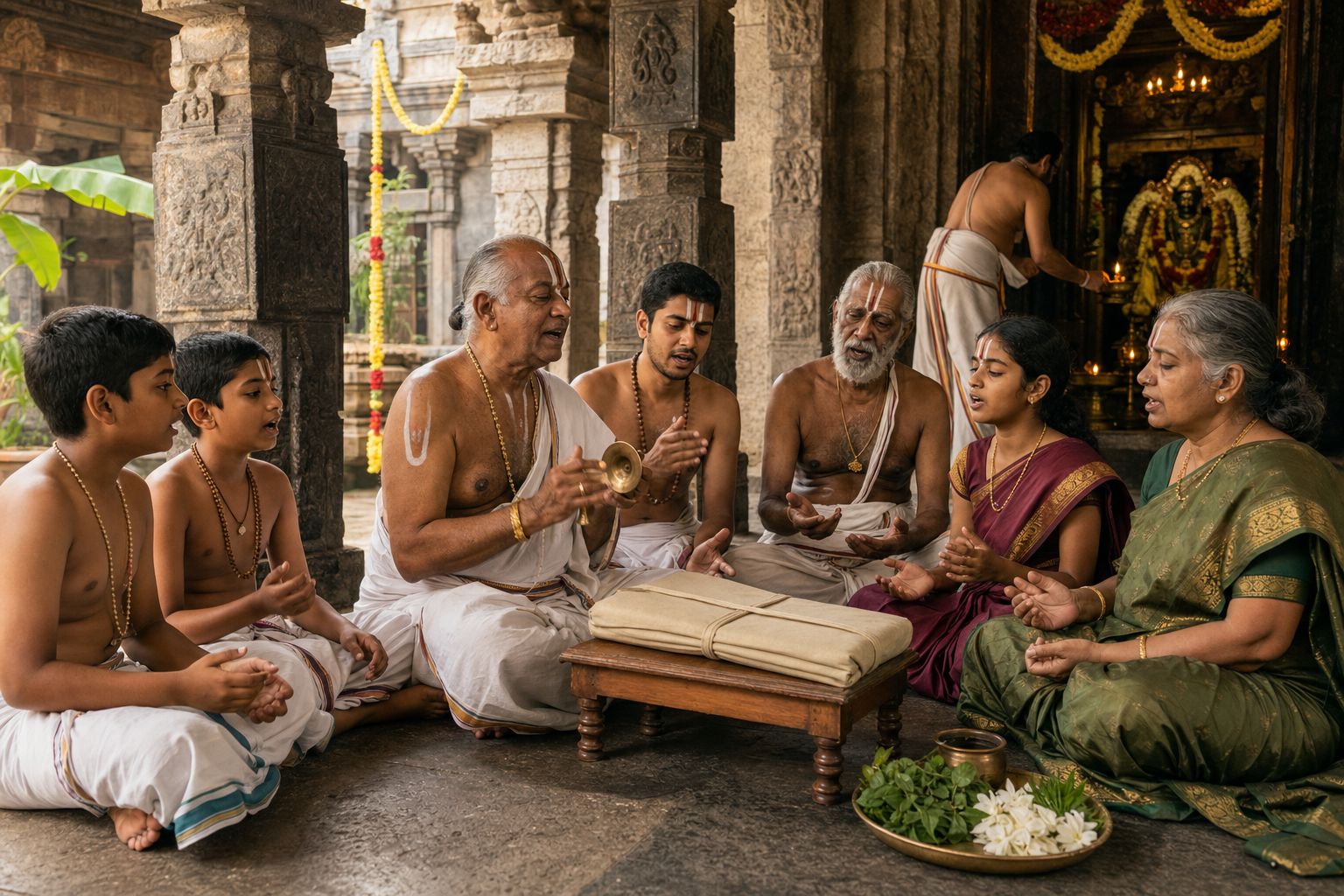
The Azhwars and the later Sri Vaishnava acharyas should not be collapsed into one historical moment. The poets sang broadly between the sixth and ninth centuries. Nathamuni is credited with recovering, organising, and transmitting their canon in the tenth century. Yamunacharya developed its systematic implications, and Ramanuja gave Vishishtadvaita its defining philosophical articulation. Vedanta Desika and Manavala Mamuni later extended the tradition through commentary, interpretation, and liturgical guidance.
This sequence matters because it corrects two common mistakes. The Prabandham is not philosophy diluted into popular songs; its poetry already carries serious claims about Narayana, Sri, the soul, grace, and liberation. Nor is later theology detached speculation placed on top of emotional verse. The acharya lineage made explicit, teachable, and transmissible a vision already experienced in the hymns.
The framework joining these dimensions is ubhaya Vedanta, the twofold Vedantic inheritance in which Sanskrit revelation and the Tamil Divya Prabandham are honoured together. The Prabandham is consequently revered as the Dravida Veda, a Tamil complement to the Sanskrit Veda. This pairing prevents an unnecessary choice between textual worlds: philosophical precision and vernacular intimacy belong to the same discipline.
| Term | Meaning in Sri Vaishnava life | What to notice in a hymn |
|---|---|---|
| Vishishtadvaita | Narayana is Brahman endowed with attributes; individual selves and matter are inseparable modes of that ultimate reality. | How the Lord can be supreme and yet intimately present to the devotee. |
| Bhakti | Loving devotion cultivated as a disciplined orientation toward Narayana. | How remembrance, praise, longing, and worship reshape the speaker. |
| Prapatti | Wholehearted surrender to the Lord as refuge. | Where self-reliance gives way to trust in divine grace. |
| Sri | Lakshmi, honoured as the compassionate mediator of grace. | How divine compassion makes surrender possible rather than terrifying. |
| Kainkarya | Service arising from the soul’s relationship to the Lord. | What the devotee wishes to do, offer, protect, praise, or sustain. |
| Archa | The Lord’s accessible iconic presence in the sanctum. | How a particular temple form is addressed as a present person, not an abstract symbol. |
Keep three questions beside you while reading: What does this verse reveal about Narayana or Sri? What does it reveal about the soul’s dependence? What form of service follows from that relationship? These questions will take you farther than hunting for isolated metaphysical slogans.
Prapatti also should not be mistaken for passivity. Surrender ends the fantasy that the isolated ego is self-sufficient; it does not end action. The hymns lead repeatedly into recitation, pilgrimage, temple worship, remembrance, and kainkarya. A surrendered life remains active, but its action is reoriented from possession toward service.
Read the hymns in a way that preserves sound, sequence, and service
A translation can tell you what a verse appears to mean, but the Prabandham was built for more than silent information transfer. Its poetic forms aid memory and devotional continuity. In an antadi, the ending of one verse connects with the beginning of the next. Viruttam and chanda metres give different room to contemplation, praise, rhythm, and congregational recitation. Older Tamil panns also carried melodic associations that later interacted with Carnatic ragas.
A useful first practice therefore has five passes:
- Identify the voice. Note the Azhwar, the work, the temple or divine form addressed when that information is available, and whether the verse belongs to a continuing sequence. Do not treat every speaker or mood as interchangeable.
- Hear the Tamil. Read the transliteration aloud or listen to an established recitation while following the words. Even before you understand every term, repetition will expose sound patterns and linked phrases that prose translation cannot preserve.
- Read for relationship. Mark what the verse says about the Lord, what the devotee desires or fears, and where dependence becomes surrender. The emotional movement is often part of the theology.
- Keep the central terms visible. If a translation renders prapatti, kainkarya, archa, or Sri with a single English word, retain the original term in your notes. A convenient equivalent can hide the network of meanings the tradition gives it.
- Give the verse a practical consequence. Carry one divine name through the day, learn one verse accurately, support a legitimate temple activity, or offer time to a community responsibility. The aim is not to manufacture a dramatic feeling; it is to let remembrance become dependable service.
For a first month, Tiruppavai offers a natural scale: 30 verses closely associated with Margazhi observance. Read one verse each day. Make three short notes: the image or quality of the Divine, the request or vow expressed by the devotees, and one action the verse asks you to reconsider. At the end of the month, reread the full sequence so that no verse remains detached from its movement.
If you begin with Tiruvaymoli, resist the urge to race through all 1,102 verses. Take a coherent group with a reliable commentary or teacher, and return to it until the changes in voice and relationship become intelligible. If two translations diverge, do not force an instant verdict. Check which Tamil term is being interpreted, how the surrounding verses constrain its meaning, and how the Sri Vaishnava commentary lineage reads it.
Most importantly, do not extract a beautiful line merely to make it support an idea you already hold. Antadi links, hymn sequences, temple settings, and the speaker’s devotional role all supply context. Slow reading is not a scholarly luxury here; it protects the spiritual claim of the verse from becoming a decorative quotation.
The tradition becomes visible in temples, festivals, and sacred geography

Sri Vaishnava temple worship is where poetic theology becomes embodied. The Lord’s archa presence is encountered through daily puja, alankara, festival processions, and recitation under Agamic traditions such as Pancharatra and Vaikhanasa. The image, chant, flowers, music, movement, and assembled devotees do not function as unrelated embellishments. Together they make a disciplined encounter with the Lord praised in the hymns.
The 108 Divya Desams praised by the Azhwars form a devotional map extending from major southern centres such as Srirangam, Kanchipuram, Tirupati, and Alwar Tirunagari to Badrinath in the Himalaya. This map is pan-Indic without becoming placeless. Each shrine retains a particular form, setting, memory, and relationship voiced in Tamil.
Do not approach that geography as a checklist demanding 108 photographs. Begin with one Divya Desam that is accessible to you or one that recurs in the hymn you are studying. Before the visit, identify the Azhwar and verses associated with it. During worship, notice how the deity is addressed, how recitation relates to the ritual sequence, and how alankara or procession reveals a quality celebrated in the hymn. Afterwards, return to the verse. The place will change how you hear it, and the verse will change what you notice in the place.
The Adhyayana Utsavam shows the scale of this integration. The Nalayira Divya Prabandham is ceremonially recited in full, with the observance culminating in Satrumurai. Recitation order, communal response, and concluding benediction renew the relationship among saint, text, temple, and congregation. If you attend, prepare by learning the meaning of even a small portion. Recognition turns a long liturgical sequence from background sound into participation.
Araiyar Sevai at Srirangam makes the interpretive power of performance especially clear. Hereditary practitioners render Prabandham verses through melody, codified gestures, and narrative movement. Watch how a hand gesture or melodic phrase interprets a theological relationship. The performance is not merely an artistic supplement to the words; it teaches the congregation how the words move.
The Azhwar community also prevents a narrow picture of who can voice devotion. Andal is honoured as the woman Azhwar. Tiruppaan comes from the Paanar community. Kulasekara appears as a king who turns rank toward humility. Tamil made sacred participation available beyond a small scholastic circle, while the hymns repeatedly place souls before Narayana in a shared condition of dependence and grace.
That accessibility should be stated carefully. It would be too simple to claim that devotional poetry erased every social inequality in history. The more exact lesson is that the canon preserves authoritative voices across gender, social location, and vocation, while Sri Vaishnava memory honours teachers who welcomed seekers from varied backgrounds. If a community praises these saints while using birth, status, or language to dismiss sincere devotees, the contradiction deserves to be noticed.
You can also recognise a wider Dharmic kinship without flattening distinct traditions. The Azhwars and Nayanmars share an emphasis on vernacular praise, personal devotion, and temple-centred service. Jain and Buddhist disciplines resonate in their concern for compassion and self-cultivation, while Sikh kirtan offers another powerful example of sacred teaching carried through communal hymnody. These parallels invite respect; they do not make the traditions doctrinally identical or prove a direct line of influence.
Choose one doorway now. Take Andal for a 30-day discipline, Nammalvar for sustained theological study, Tiruppaan for contemplation of Ranganatha, Madhurakavi for the guru-disciple bond, or Tirumangai for pilgrimage. Keep a simple page with three columns: what the hymn reveals about Narayana and Sri, what it reveals about the soul, and what service follows. Then encounter the verse in recitation or temple worship when you can. That movement from word to remembrance to kainkarya is where the Azhwars stop being historical names and become guides.