
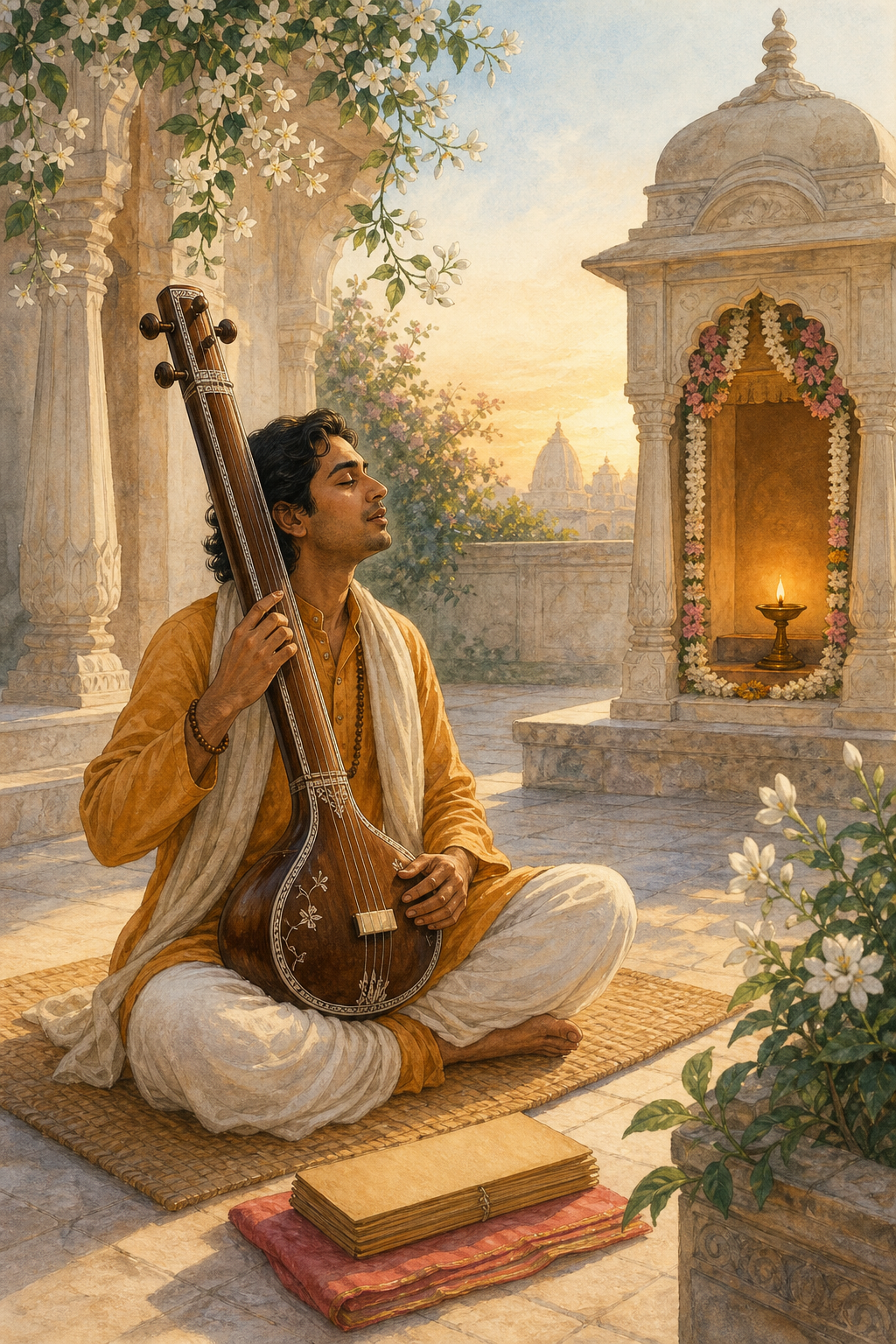
You may have a bhajan that stops you in your tracks, yet once it ends you cannot say what changed. The melody lingers, perhaps the eyes moisten, but the next morning the same practice feels flat. The missing link is often not stronger emotion. It is knowing what relationship the composition asks you to inhabit.
Bhakti rasa gives you a practical way to find that relationship. It can help you choose what to sing, listen beneath the surface mood, and turn a beautiful encounter with sacred poetry into a devotional discipline that continues after the music has stopped.
Start with the relationship, not the emotional intensity
Rasa is often translated as taste, flavour, or aesthetic relish. In bhakti, the crucial taste is relational. You do not merely feel peace, tenderness, sorrow, or joy; you savour the Divine as majestic presence, master, friend, child, or beloved. Poetry supplies the words and images for that encounter. Music holds your attention inside it. Devotional practice gives the relationship continuity.
This distinction prevents a common mistake: treating any powerful feeling as evidence of spiritual depth. A mournful melody can produce sadness without devotion. A technically brilliant performance can impress the ear while leaving the heart’s orientation unchanged. Conversely, a simple recitation may carry profound bhakti when the words, attention, and relationship are aligned.
Tears can be genuine, but they are neither the goal nor a credential. During the traditional education of Rallapalli Anantakrishna Sarma, his elderly guru once asked him to continue reading a Ramayana passage in which Sumitra consoles the grieving Kausalya. The guru repeatedly set aside his scholarly task to savour the passage, and his eyes filled with tears as he listened. That response arose within a life formed by disciplined study, contemplation, and refined attention. It was not a performance of sensitivity.
After listening to sacred poetry, therefore, ask three questions. Who is speaking? To whom? What relationship does the speaker enact? These questions are more dependable than asking only whether the song moved you. They turn emotion into discernment.
Use the five rasas as a map, not a ladder
A widely used fivefold map names shanta, dasya, sakhya, vatsalya, and madhurya. Each describes a different way of approaching the Supreme. The map helps you identify the governing relationship in a composition and choose a corresponding form of practice.
| Rasa | Devotional relationship | What to notice in the poetry | How to embody it |
|---|---|---|---|
| Shanta | Peaceful reverence before divine presence | Stillness, praise, contemplation, spacious description, and freedom from possessiveness | Remain quiet after darshana, japa, or recitation instead of immediately seeking another stimulus |
| Dasya | The devotee as servant of the Divine | Offering, obedience, duty, surrender, and work performed for the Lord | Complete one needed act of seva carefully, especially when nobody will applaud it |
| Sakhya | The Divine as trusted friend and companion | Direct speech, confidence, counsel, shared danger, play, and affectionate familiarity | Speak honestly in prayer, keep a promise, or become a steadier companion to someone who depends on you |
| Vatsalya | The Divine approached with parental tenderness | Feeding, bathing, dressing, protecting, forgiving, guiding, or delighting in the divine child | Prepare an offering attentively or perform an act of patient care without turning care into control |
| Madhurya | The Divine as beloved | Longing, separation, meeting, intimacy, beauty, and complete self-giving | Let longing reduce possessiveness: offer undivided attention and release one demand to control the outcome |
Do not turn this map into a ranking system for your own emotions. Madhurya may be celebrated as the most intimate mode in traditions centred on the loving lilas of Krishna, but forcing its language because it appears elevated only produces imitation. Shanta or dasya may be the honest doorway for you. The relationship taught by your sampradaya, guru, chosen form of the Divine, and sacred text matters more than selecting the most dramatic category.
One composition can also contain several passing moods while remaining grounded in one principal relationship. A song of madhurya may include grief during separation. Vatsalya can include worry or affectionate correction. Sakhya can contain awe. Identify the stable bond beneath the changing feelings; otherwise every emotional turn will appear to be a different rasa.
The larger dharmic family contains resonant dispositions without erasing theological differences. Buddhist metta, karuna, mudita, and upekkha cultivate loving-kindness, compassion, appreciative joy, and equanimity. Jain maitri and karuna deepen friendship, care, and non-violence. Sikh prem, nam-simran, and seva join love, remembrance, and service. These can echo aspects of peaceful reverence, tenderness, friendship, and service, but they should be practised in their own doctrinal settings. If you learn across traditions, preserve the native name, purpose, and discipline of each practice rather than relabelling everything as the same experience.
Let poetry establish meaning and music deepen attention
Poetry tells you what an emotion means. Longing by itself might be worldly desire, grief, loneliness, or devotion. A divine name, a remembered lila, a form of address, and the speaker’s posture orient that longing toward bhakti. Music then makes the words return through melody, rhythm, breath, and refrain. What began as an idea can gradually become a way of addressing the Divine.
This is why the text cannot be treated as disposable packaging around a pleasant tune. The Annamacharya repertoire remained available because preservation itself became seva. Beginning in October 1950, Rallapalli Anantakrishna Sarma continued the archival work of earlier scholars and, by 1975, brought the publication effort to its twenty-second volume after eight earlier volumes. A living devotional repertoire depends upon accurate words, careful transmission, musicianship, and people willing to do patient work outside the spotlight.
Work with one composition in six passes
- Establish the text. Find out what the words actually say. Identify the language, speaker, addressee, divine form, and narrative setting. If a term remains unclear, mark it as unclear instead of building a spiritual interpretation on a guess.
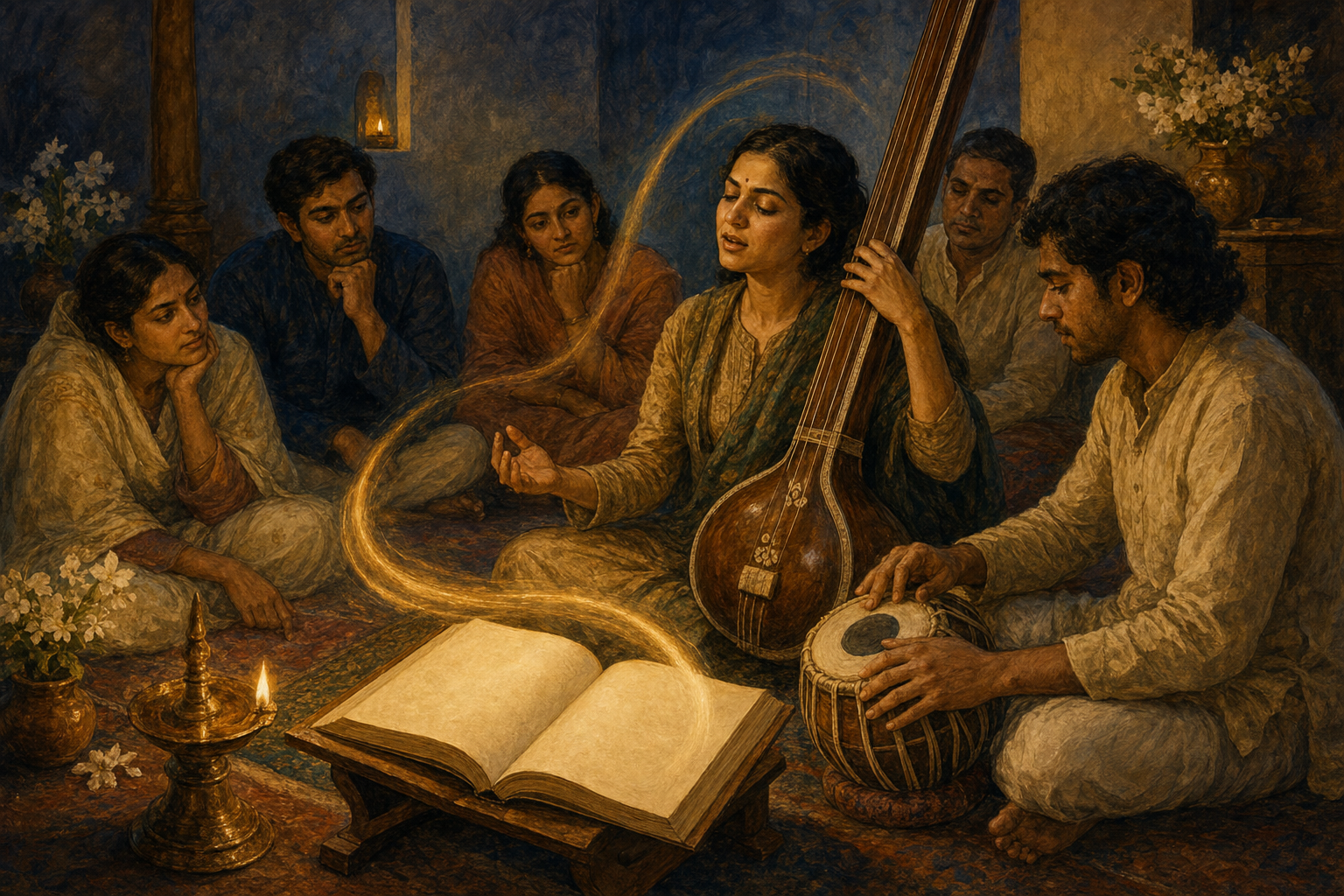
- Read it as ordinary speech. Paraphrase each stanza without melody. This exposes whether you understand the composition or have been relying on the emotional atmosphere of the performance.
- Mark the relational verbs. Look for actions such as seeing, praising, serving, trusting, protecting, waiting, longing, surrendering, or remembering. These often reveal the operative rasa more clearly than decorative imagery does.
- Name the primary rasa tentatively. Use the fivefold map as a question, not a label you must defend. If the composition does not fit neatly, retain the ambiguity and learn more about its tradition.
- Listen again for emphasis. Notice which name, phrase, or image the singer repeats; where the voice pauses; and where musical expansion holds attention on a word. Treat these features as aids to contemplation, not automatic proof of the performer’s spiritual attainment.
- Recite or sing the portion you understand, then remain silent. In that silence, address the Divine in the same relationship expressed by the composition. This is the bridge from observing someone else’s devotion to making a truthful response of your own.
If the language is unfamiliar, pronunciation and meaning should develop together. Perfect diction is not a prerequisite for beginning, but indifference to meaning eventually limits the practice. Learn a manageable portion well enough that you can address rather than merely imitate. A teacher, a reliable written text, and a clear recording can each correct a different kind of error.
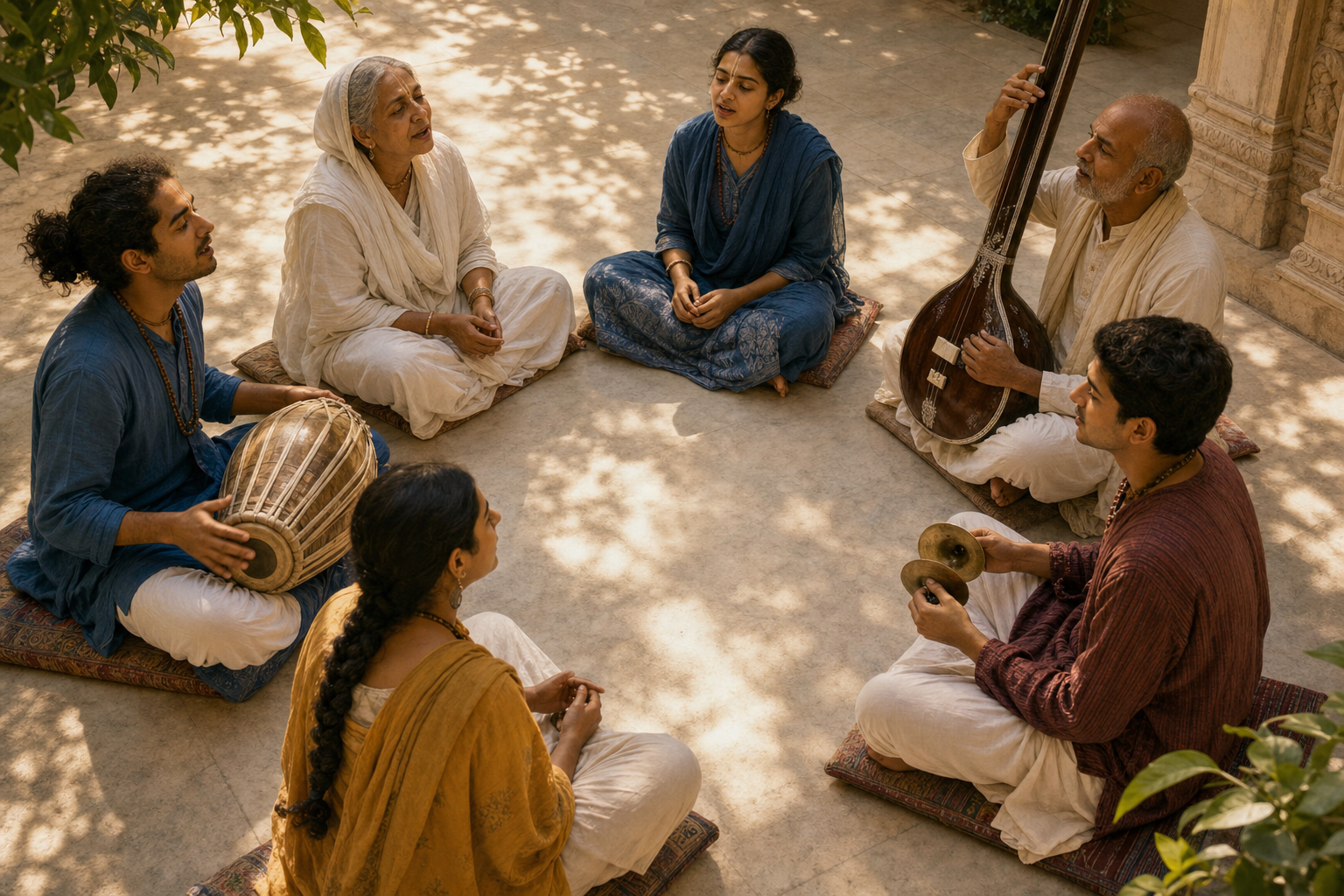
In group kirtana, give listeners a concise meaning before singing an unfamiliar composition. Keep the refrain accessible, and do not make every repetition a display of vocal complexity. The lead singer serves the shared act of remembrance; the gathering does not exist to certify the lead singer’s virtuosity. Musicians, lyric keepers, organisers, and those who prepare the space are also participating in devotional transmission.
Complete the devotional loop in conduct
Aesthetic enjoyment becomes sadhana when it changes what you repeatedly attend to and how you act. You do not need to manufacture an exalted state. You need a repeatable loop in which meaning, sound, silence, and conduct reinforce the same devotional relationship.
A simple practice sequence
- Prepare before pressing play. Keep the text and meaning ready, remove avoidable distractions, and decide which composition will form the practice.
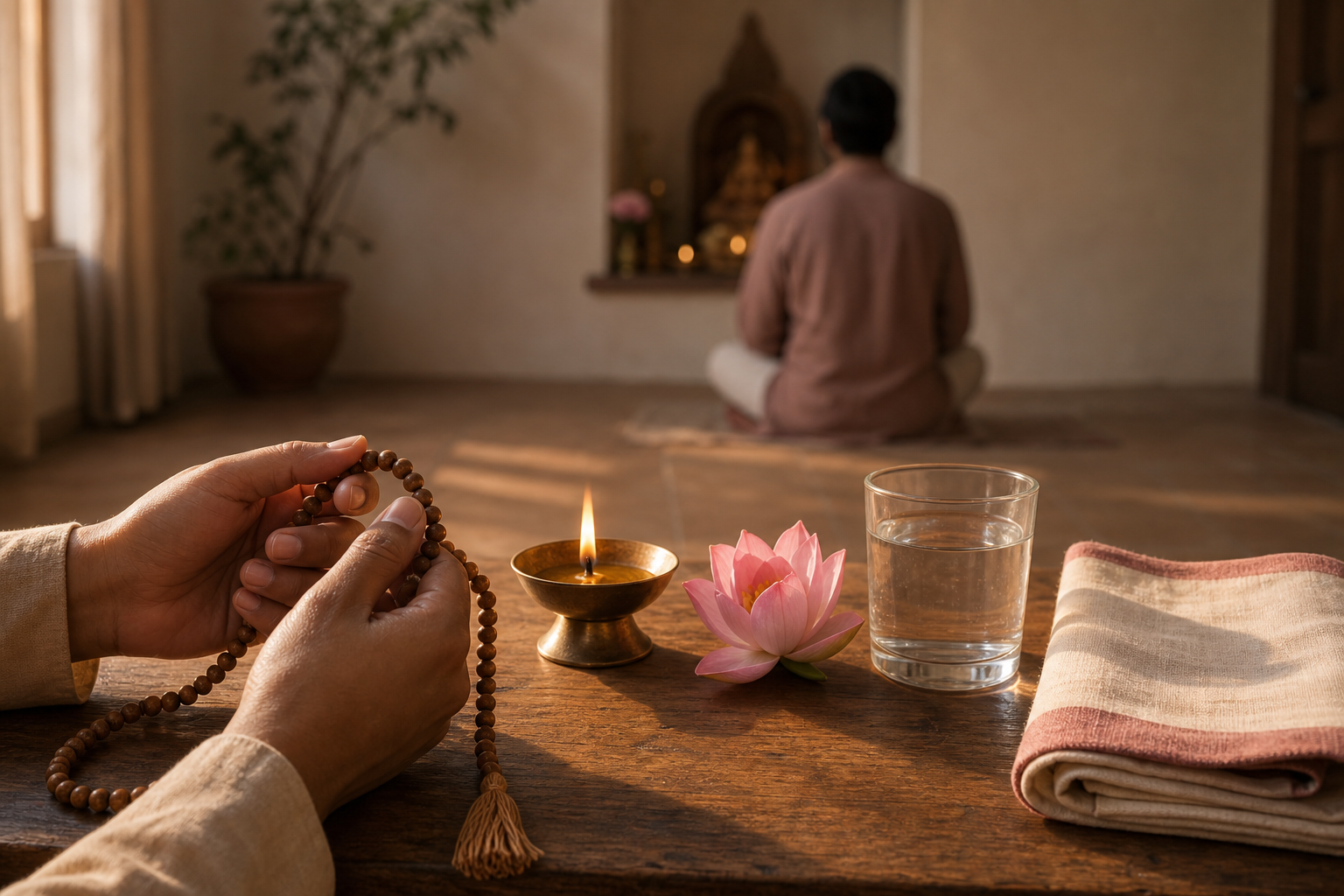
- Begin with a clear orientation. Offer a namaskara, remember the divine name or form, and state inwardly that the recitation is an offering rather than entertainment.
- Read one portion without music. Let its literal sense become present before melody amplifies its feeling.
- Listen or sing with one relational focus. In shanta, attend to presence. In dasya, offer the act of singing. In sakhya, speak candidly. In vatsalya, let tenderness guide the voice. In madhurya, attend to self-giving rather than emotional excitement.
- Allow silence after the final sound. Do not immediately evaluate the performance, check a device, or search for a more moving song. Give the meaning room to settle.
- Choose one corresponding action. Let shanta steady the next duty, dasya complete an overlooked service, sakhya strengthen truthful companionship, vatsalya become patient care, or madhurya loosen a possessive demand.
- Return to the same composition until its words are familiar enough that decoding them no longer consumes all your attention. Change because the practice has matured or your discipline calls for it, not merely because novelty has faded.
Test the fruit without grading your feelings
The intensity of a single sitting is a poor measure of growth. Use questions that can still be answered when the music does not produce tears:
- Can you remain attentive to the addressed Divine instead of continually judging your voice or emotional state?
- Can you explain the relationship enacted by the composition in plain language?
- Does the practice produce a concrete form of service, care, honesty, restraint, or remembrance?
- Are you becoming less dependent on public display and recognition?
- Can you continue faithfully when the familiar feeling is absent?
Rallapalli Anantakrishna Sarma expressed a demanding measure of devotional maturity in a Sanskrit prayer: freedom from dejection over what remains unfinished, freedom from pride over what has been completed, and freedom from laziness toward what can still be done. That combination of equanimity, humility, and diligence is a useful test for bhakti rasa. If sacred music makes you more self-important, careless, or passive, its beauty has not yet completed its work in you.
When strong emotion appears without ethical fruit, do not condemn the emotion. Give it a task. Perform the seva implied by the song. When no emotion appears, do not fake one. Return to meaning, recitation, and duty; shanta and dasya are often steadier entrances than staged ecstasy. When several rasas seem present, distinguish the enduring relationship from the temporary mood. When intimate sacred imagery makes you uneasy, learn its theological setting and remain with a form of devotion you can practise truthfully. Sacred eros must never be used to excuse possessiveness, manipulation, or the suspension of ethical boundaries.
Key takeaways
- Bhakti rasa is a savoured relationship with the Divine, not simply a strong or pleasant emotion.
- Use shanta, dasya, sakhya, vatsalya, and madhurya as interpretive possibilities, not as a ladder on which dramatic feeling ranks highest.
- Identify the speaker, addressee, relational verbs, and narrative setting before allowing musical atmosphere to determine your interpretation.
- Let music deepen attention to understood words; virtuosity, tears, and emotional force are not independent proofs of devotion.
- Complete every practice with conduct appropriate to its rasa: steadiness, service, trustworthy companionship, patient care, or self-giving love.
- Judge ripening by sustained attention, humility, ethical action, and faithfulness when emotional intensity is absent.
Choose one sacred composition you already return to. Before hearing it again, write down four things: speaker, addressee, relationship, and requested response. Then let the final answer determine one action before the day ends. That is the point at which bhakti rasa ceases to be an atmosphere around devotion and becomes part of your sadhana.

References
- DharmaRenaissance Blog – When One Verse Moved a Sage to Tears: Rallapalli A. Sarma and Annamacharya’s Revival
- DharmaRenaissance Blog – Manmatha’s Five Arrows and the Five Bhakti Rasas: Symbolism, Practice, and Dharmic Unity
