
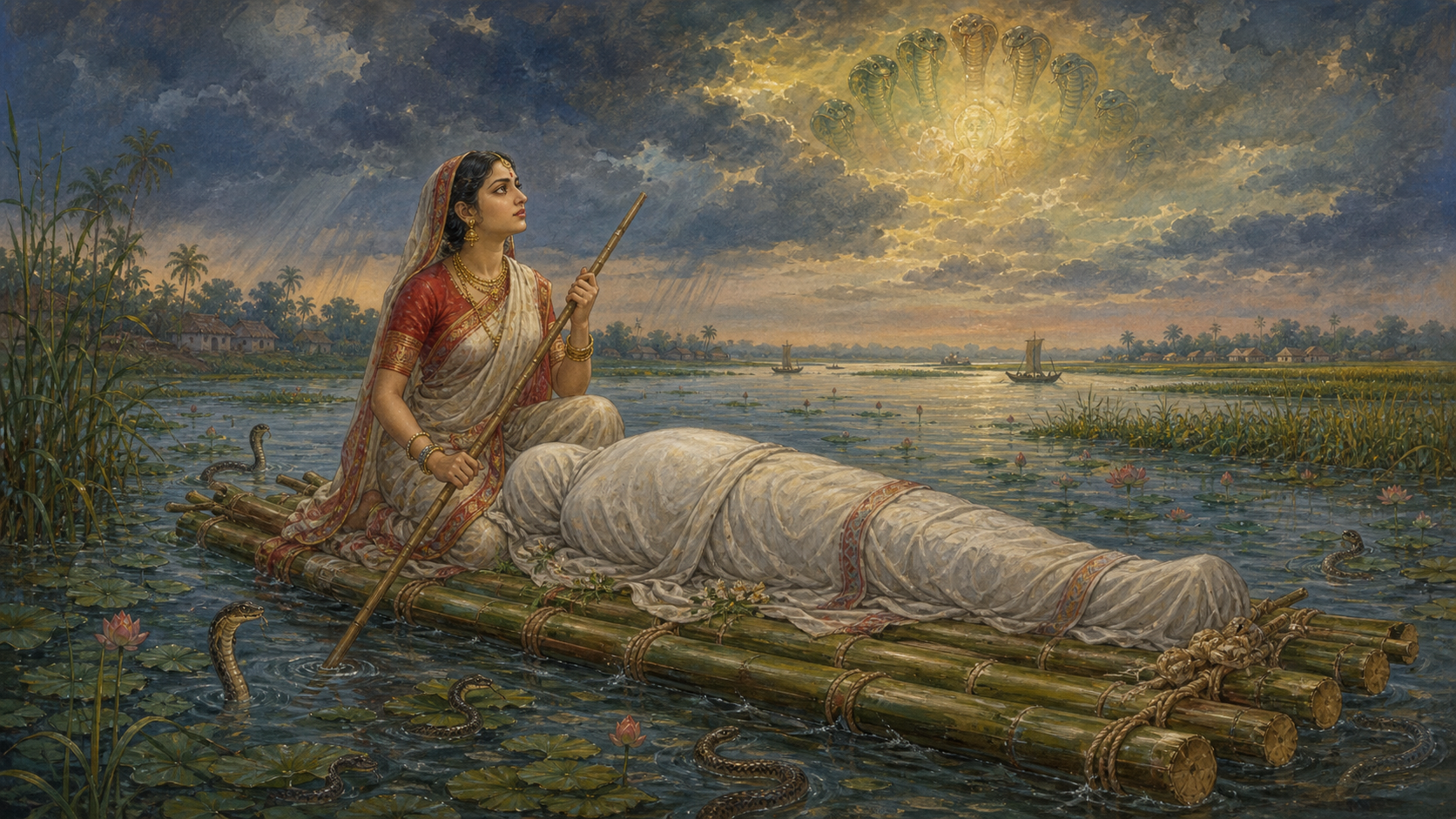
If you have encountered Behula travelling by river with Lakhindar’s lifeless body, you may have wondered why this sorrowful marriage story stands at the heart of Manasa Devi worship. The answer is larger than a wife’s attempt to recover her husband. It concerns who receives sacred recognition, how human pride meets powers it cannot master, and how one woman’s devotion repairs a broken relationship between a community and a goddess.
Once you follow that movement, Manasamangal becomes easier to read. Chand Sadagar’s refusal creates the conflict, Lakhindar’s death gives it terrible personal weight, Behula changes its direction, and the final act of worship turns a household tragedy into a living religious tradition.
The conflict begins with recognition, not a snakebite
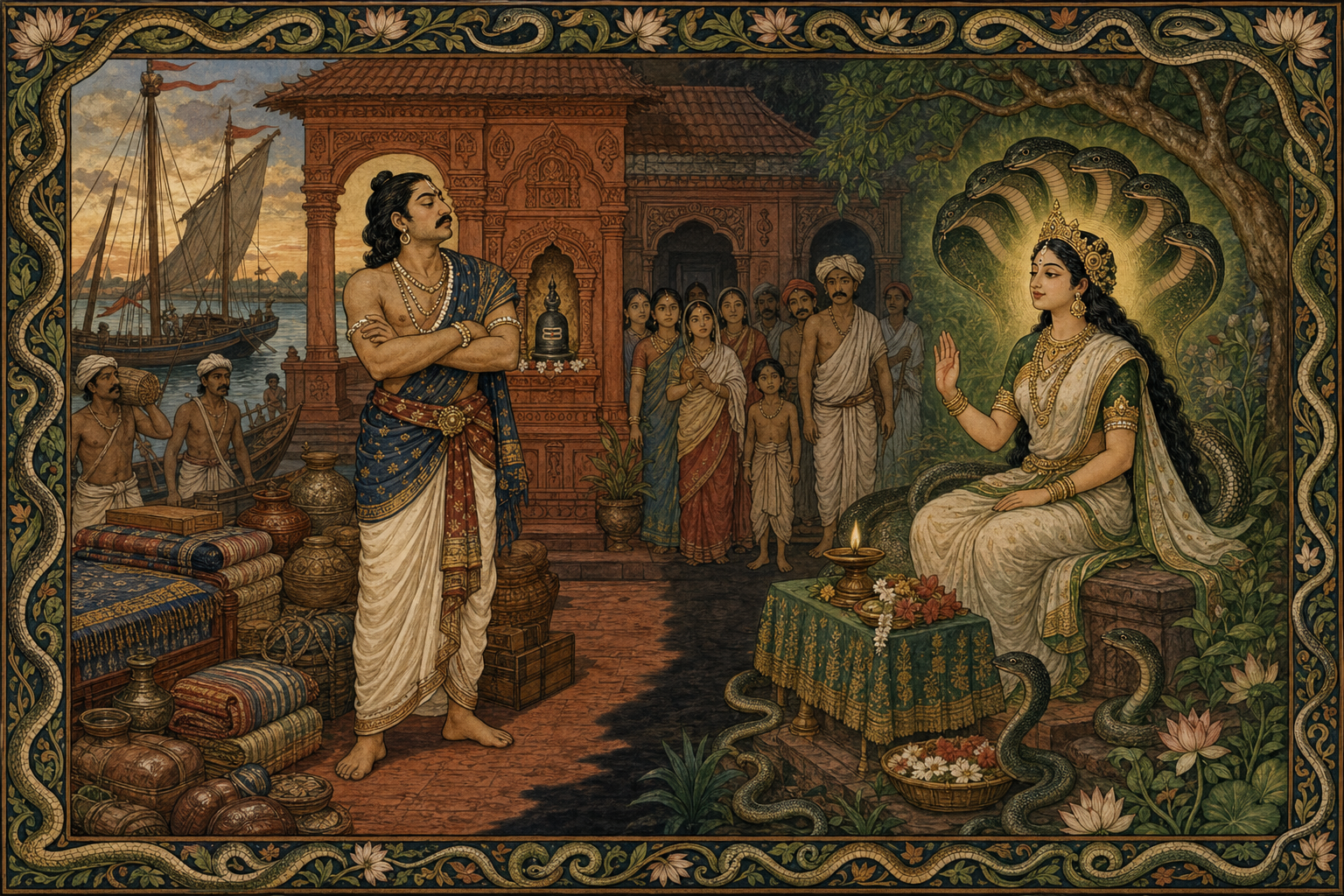
Manasamangal belongs to a medieval Bengali body of sacred narrative concerned with Manasa’s rise to ritual prominence. Its central dispute is therefore not simply between a human being and a dangerous serpent. Manasa seeks a recognized place in worship, while the merchant Chand Sadagar refuses to grant it.
That distinction matters. Chand does not merely doubt Manasa’s existence. He withholds honour from her. His resistance represents the confidence of established mercantile status confronted by a local devotional current demanding admission into the recognized sacred order. The conflict is about ritual standing as much as personal stubbornness.
Manasa answers Chand’s refusal with calamities. The struggle eventually reaches the wedding of Lakhindar, also called Lakhai, and Behula. An iron bridal chamber is built to keep snakes away, yet Lakhindar dies from a serpent’s bite on the wedding night. Within the narrative, the chamber exposes the limit of Chand’s strategy. A physical barrier cannot settle a religious relationship that remains defiantly unresolved.
Behula then travels on the rivers with Lakhindar’s body, refusing to treat his death as the last word. Her supplication moves the divine order toward mercy. Lakhindar is restored, and Chand finally offers worship to Manasa. The full chain is essential: refusal leads to disaster, disaster calls forth Behula’s devotion, devotion opens the way to restoration, and restoration is completed by recognition of the goddess.
When you retell the story, do not begin and end with the wedding-night tragedy. The serpent bite is the crisis, but the refusal to honour Manasa is the cause of the larger conflict. Chand’s eventual worship is not an incidental epilogue. It is the resolution that explains why Manasa Puja belongs to the story at all.
Behula is the moral agent, not merely the grieving bride
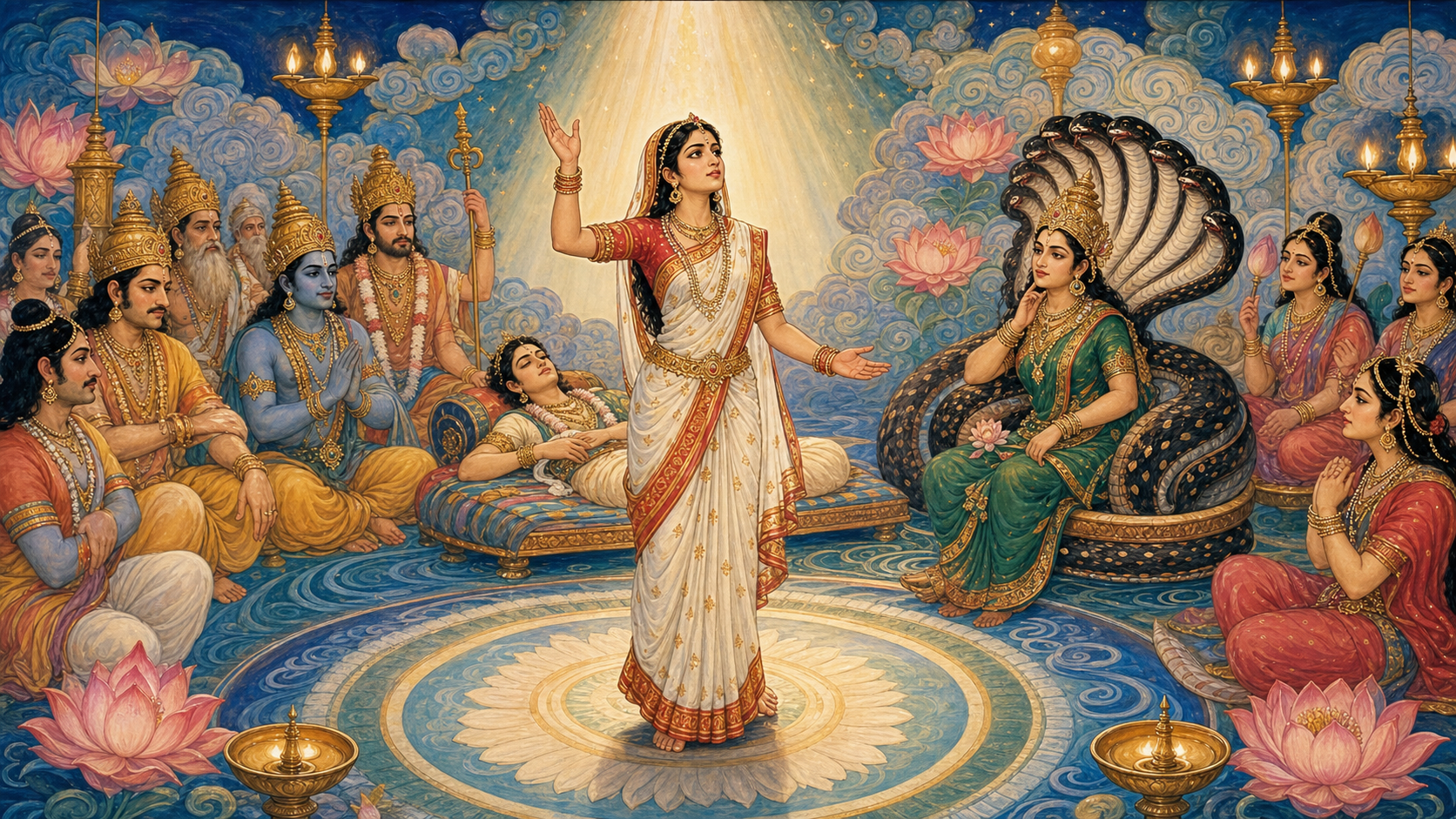
Behula is sometimes reduced to an emblem of faithful wifehood. Fidelity is certainly central to her character, but that description becomes misleading when it makes her sound passive. Lakhindar lies dead. Chand remains trapped in resistance. Behula alone takes the journey that changes the outcome.
Her response to grief is action. She accepts neither the apparent finality of death nor the idea that the conflict must continue on Chand’s terms. She carries her private loss into a sacred encounter and perseveres until divine compassion answers it. Her devotion is effective because it does something: it turns confrontation into negotiation and makes reconciliation possible.
This is a distinctly dharmic form of agency. Behula does not establish herself by abandoning relationship, duty, or sacred order. She works through them with extraordinary purpose. Her strength is neither military nor political. It lies in disciplined fidelity, moral courage, and the capacity to address powers before which wealth and defensive construction have failed.
If you are explaining Behula to a child, a class, or a cultural gathering, ask three questions while telling the story: What does she choose after the wedding night? What does she endure that others will not? What changes because she acts? Those questions prevent the language of devotion from hiding her initiative. They also reveal why she, rather than Chand or Lakhindar, remains the emotional centre of Manasamangal.
Behula’s achievement is also public. She seeks Lakhindar’s return, but the settlement reached through her journey establishes a place for Manasa in collective worship. Personal love produces a change in communal religious life. The story honours her not only because she remains loyal to one person, but because her loyalty becomes the means by which a wider disorder is repaired.
Rivers, fields, and serpents are part of the theology
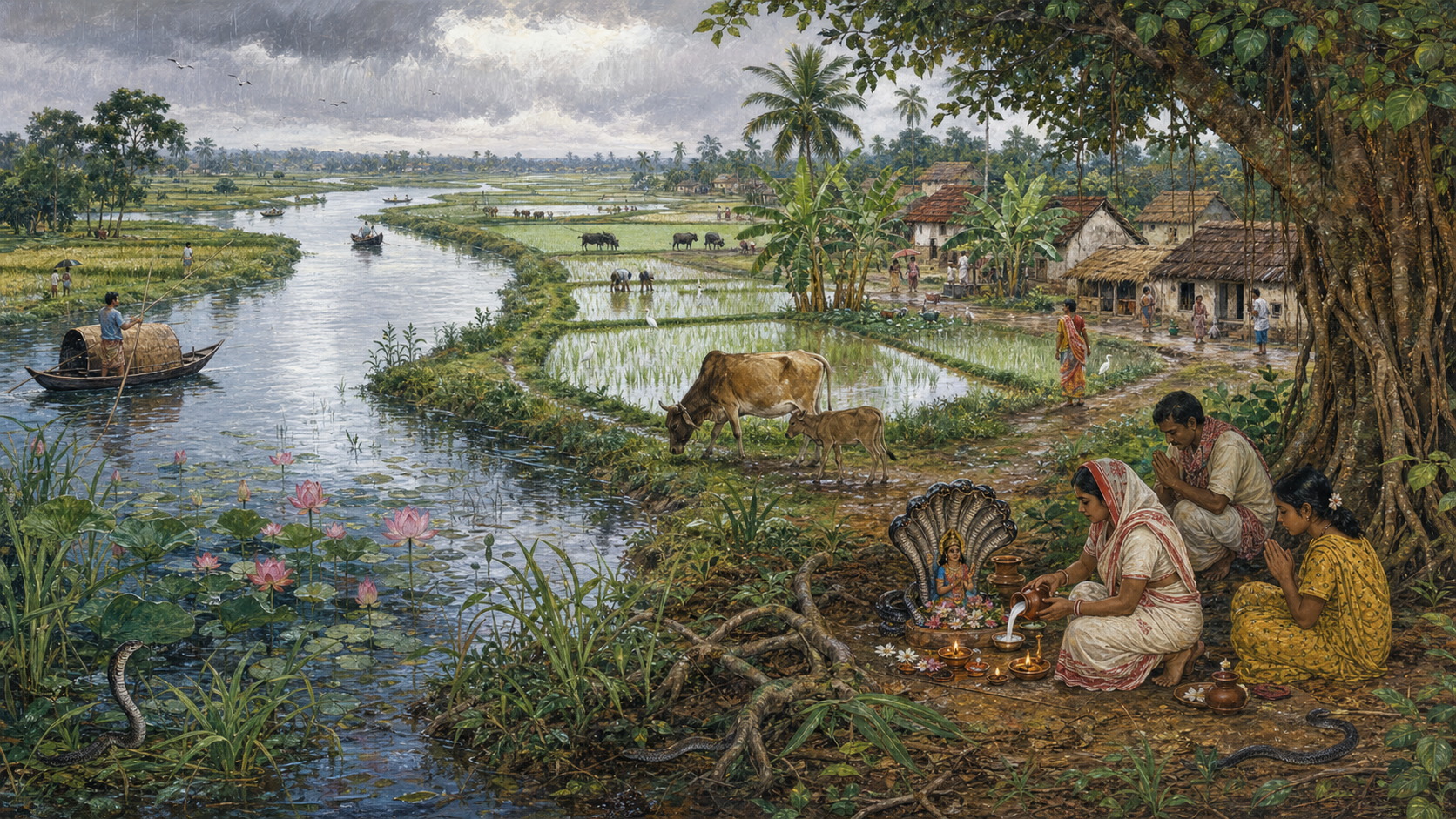
Manasa worship makes particular sense in Bengal’s landscape. Waterways, cultivated land, and human proximity to serpents shaped everyday vulnerability as well as religious imagination. The setting is not decorative scenery placed behind Behula’s voyage. It explains why a serpent goddess could be experienced as both formidable and protective.
This double character is easy to miss. Manasa brings punishment when recognition is refused, yet her established worship is associated with protection from serpents, agrarian well-being, prosperity, and communal security. She cannot be flattened into either a villain who attacks Chand’s household or a gentle guardian detached from danger. The same power that inspires fear becomes a source of protection when the relationship is rightly ordered.
The iron chamber and Behula’s river journey offer two contrasting responses to vulnerability. One attempts complete enclosure; the other enters a world of uncertainty and seeks a restored relationship within it. The lesson is not that practical precautions are useless. It is that human life cannot be understood entirely through the fantasy of separation from nature. In a land of rivers, fields, and serpents, coexistence is not an abstract virtue.
That is the ecological intelligence within Manasa devotion. Venerating the serpent changes it from an unwanted intrusion into a being situated within a sacred moral world. The practice does not deny danger. It teaches that danger, dependence, reverence, and protection may occupy the same landscape.
This religious meaning should never be confused with medical treatment. A suspected snakebite is an emergency requiring urgent professional care; ritual observance is not a substitute. Manasa Puja belongs to the community’s devotional, cultural, and ethical relationship with the natural world, not to a delay in obtaining lifesaving help.
If you wish to participate in Manasa worship, begin with the living tradition around you rather than treating the narrative as a universal ritual manual. Manasamangal has survived through household observances, festivals, oral narration, and jatra performance, so local and family settings may place different emphasis on its elements. Learn the procedure from a knowledgeable practitioner in that community while keeping the story’s underlying movement—from refusal to respectful recognition—in view.
The ending models integration without erasing difference
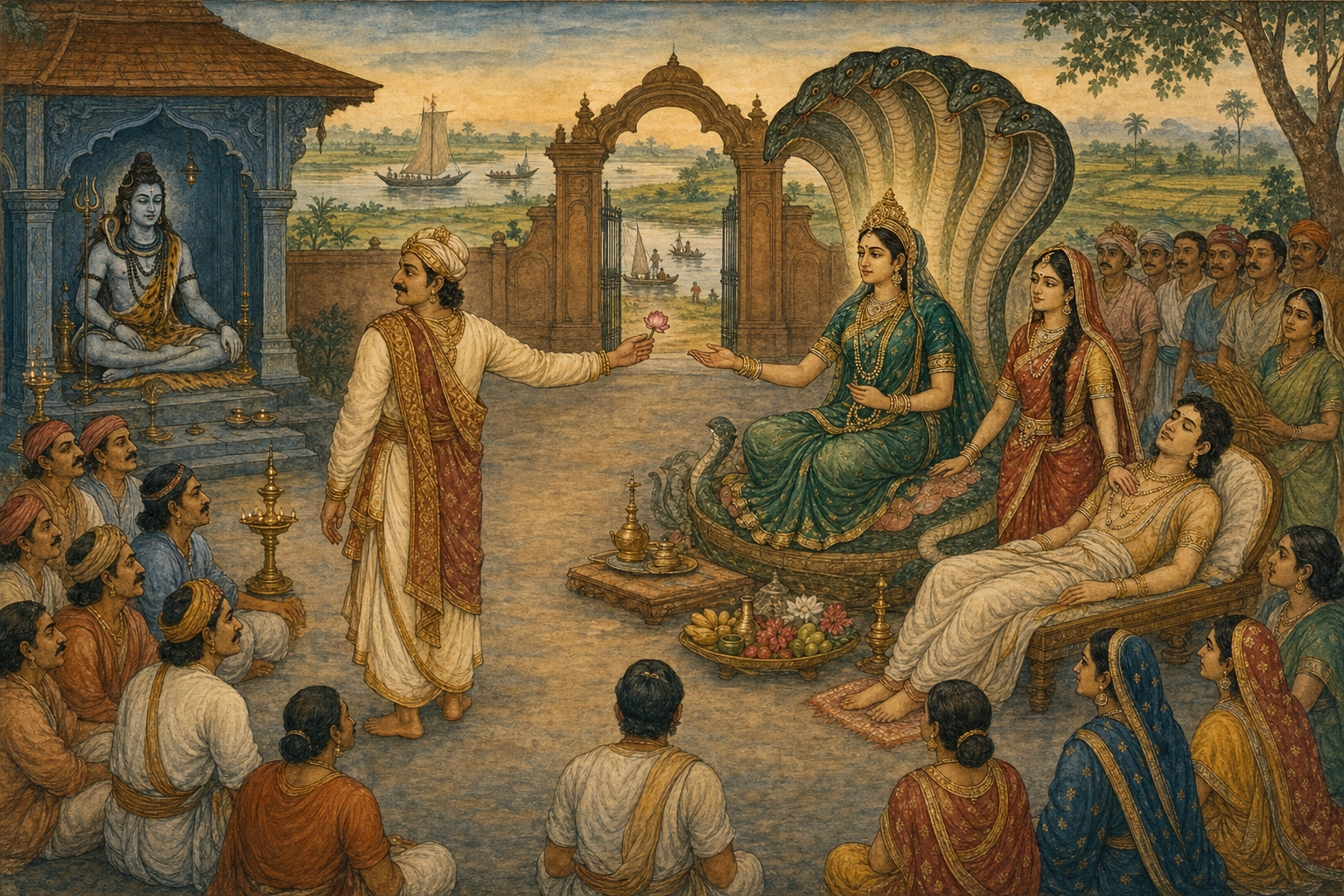
Chand’s final act does not replace every established deity with Manasa. It gives Manasa the acknowledgement he had denied her. The conclusion therefore represents integration: a regional goddess enters a broader pattern of recognized worship without requiring the destruction of everything already present.
This is a valuable example of dharmic pluralism, but it should not be sentimentalized. Harmony does not arrive effortlessly. Chand’s pride, Manasa’s wrath, Lakhindar’s death, and Behula’s ordeal all stand before the settlement. The tradition remembers both the cost of exclusion and the labour required for reconciliation.
Nor does reconciliation mean that every participant becomes identical. Manasa receives worship as Manasa, with her particular connection to serpents, fertility of the land, danger, and protection. Chand remains the figure whose resistance has been overcome. Behula remains the human mediator whose devotion makes mercy possible. Their differences are not dissolved; they are brought into a workable sacred relationship.
This helps clarify what an inclusive dharmic outlook can mean. It is not the claim that every deity, path, or community is interchangeable. It is the capacity to make room for distinct sacred forms without insisting that only one form may exist. Compassion, duty, perseverance, and moral courage can resonate with Hindu, Buddhist, Jain, and Sikh readers while Manasamangal remains unmistakably Bengali and centred on a Hindu serpent goddess.
That balance matters whenever we speak of a shared dharmic inheritance. Shared values become meaningful through particular languages, landscapes, narratives, and rites. Removing those particulars in search of a vague universality would erase the very culture that carried the values forward.
Key takeaways for reading or watching Manasamangal
- The central dispute is Chand Sadagar’s refusal to give Manasa ritual recognition; the serpent bite is a consequence within that wider conflict.
- Behula is the story’s active moral force. Her journey turns private bereavement into divine reconciliation and communal change.
- The iron bridal chamber represents the limits of control, while the river journey places human vulnerability inside a larger sacred and natural order.
- Manasa’s association with both danger and protection reflects Bengal’s close relationship with waterways, agriculture, and serpents.
- Chand’s eventual worship integrates Manasa alongside established devotional forms rather than replacing them.
- The tale can express values shared across dharmic traditions without losing its specifically Bengali and Hindu character.
The next time you hear Manasamangal recited or see Behula represented in performance, follow three transitions: refusal becomes acknowledgement, enclosure gives way to a river journey, and one household’s grief becomes a community’s worship. Those movements reveal why Behula’s courage and Manasa’s recognition belong to the same enduring story.
References
