
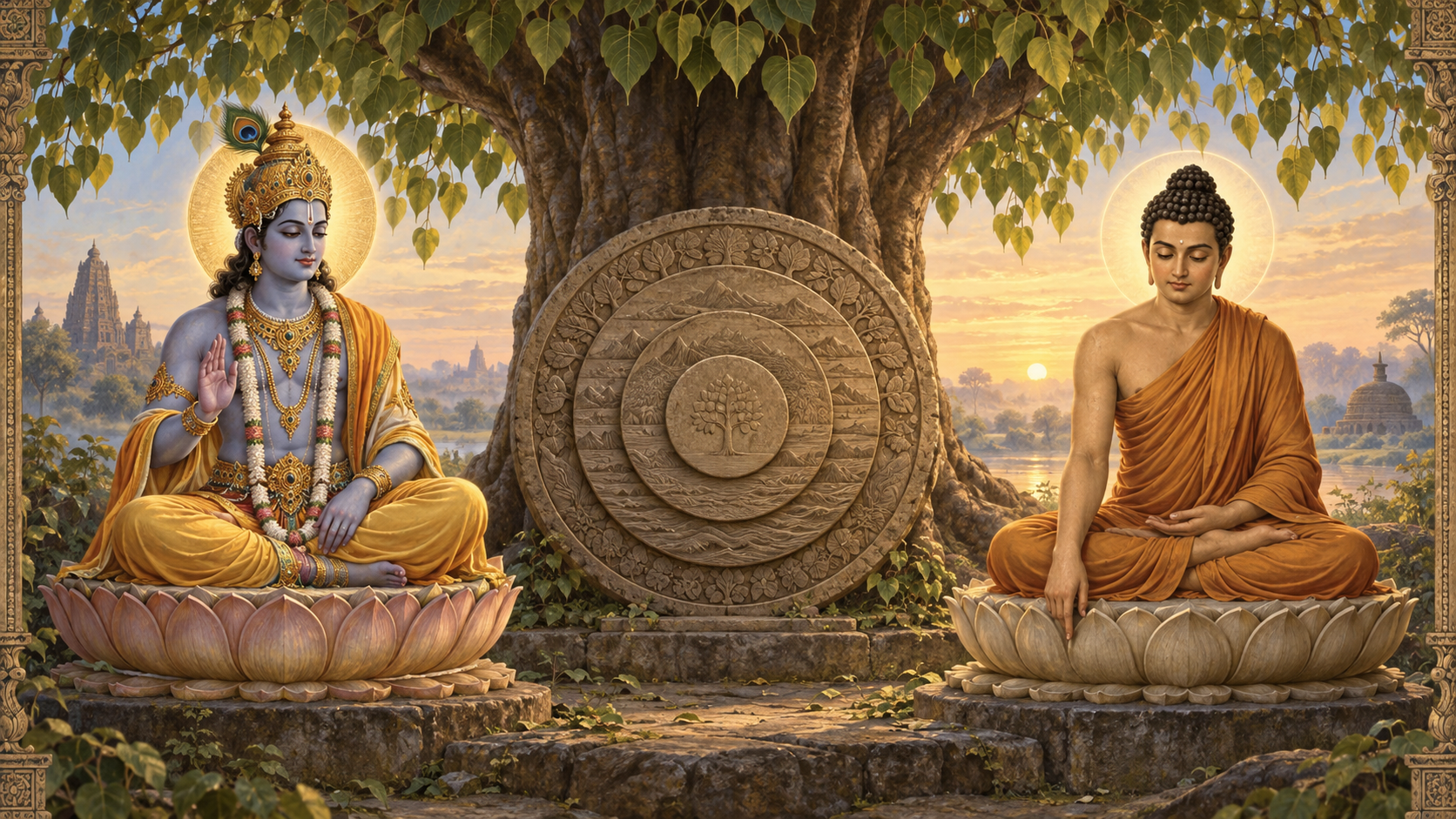
You may have heard two confident statements: Buddha is an avatara of Vishnu, and Buddha was Siddhartha Gautama, the Shakya prince born at Lumbini. If you are trying to decide whether these claims contradict each other, do not begin with a date. Begin by asking what the speaker means by “Buddha.”
The name can function as a title, a historical identification or a theological identity. Some Gaudiya Vaishnava writers make a more specific claim: the Anjana-born Buddha avatara and Maya’s son Gautama were two different figures. That distinction can be stated coherently, but it should not be confused with a separate attempt to move Gautama himself into the second millennium BCE.
Key takeaways
- “Buddha” is not enough to identify one person. Buddhist traditions recognize multiple Buddhas, while Vaishnava traditions also use Buddha as the name of a Vishnu avatara.
- The proposed avatara is identified by Anjana, Bodhgaya and a mission centered on ahimsa. Siddhartha Gautama is identified by Maya or Mayadevi, Lumbini, the Shakyas and his enlightenment at Bodhgaya.
- An early date for Gautama does not by itself establish a second Buddha. Identity and chronology are two different questions.
- The dates near 1887 BCE, 1858 BCE and 1807 BCE belong to a Puranic chronological reconstruction. They should not be presented as uncontested historical dates.
- When discussing the issue, name the tradition, the biographical markers and the kind of claim being made. That prevents devotional theology from being mistaken for neutral historiography, or vice versa.
Start with identity markers, not a date

Three questions are often collapsed into one: What does the word “Buddha” mean? Which life story is being discussed? When did that life occur? You will get a clearer answer if you settle them in that order.
In ordinary Buddhist usage, a Buddha is an awakened one. Gautama is therefore not the only being to whom the title can apply. The Theravadin framework invoked in this debate includes earlier Buddhas such as Vipasyin, Sikin, Krakuccanda, Konagamara and Kashyapa, as well as the future Buddha Maitreya. This establishes an important linguistic point: “Buddha” is not inherently a unique personal name.
| Claim or referent | Identifying markers | What the claim can establish |
|---|---|---|
| Vishnu’s Buddha avatara | Mother Anjana; birth associated with Bodhgaya; mission of ahimsa directed against the misuse of animal sacrifice | A distinct Vaishnava theological identity and purpose |
| Siddhartha Gautama or Shakyamuni | Mother Maya or Mayadevi; birth at Lumbini; prince of the Shakyas; enlightenment at Bodhgaya; teaching concerned with release from suffering | The familiar biographical identity associated with historical Buddhism |
| Early chronology for Gautama | Shuddhodana as father; links to Kshemajit, Bimbisara and Ajatashatru; birth placed in 1887 BCE | A proposed redating of Gautama, not automatically a third identity or proof of two people |
Bodhgaya appears in both portraits, but in different roles. It is described as the avatara’s birthplace and as the place where Gautama attained enlightenment. Shared geography is therefore not enough to merge the biographies. By the same rule, a different mother or birthplace is significant only when the underlying traditions can be shown to refer consistently to different figures.
A useful naming practice follows from this. Say “the Anjana-born Buddha avatara” when discussing the Vaishnava claim. Say “Siddhartha Gautama” or “Shakyamuni” when discussing Maya’s son. Reserve the unqualified word “Buddha” for passages in which the intended identity is already unmistakable.
Why the date dispute does not settle the identity
The early-date argument actually contains two different chronological proposals. Keeping them apart is essential.
- The two-person proposal places the Buddha avatara near 1800 BCE and Gautama around 560 to 550 BCE.
- The alternative Puranic chronology places the birth of the Buddha associated with Shuddhodana, Bimbisara and Ajatashatru in 1887 BCE, his renunciation in 1858 BCE and his death in 1807 BCE.
- A related calculation places Buddha about 1,259 years after a Mahabharata war dated to 3138 BCE, producing a date around 1880 BCE. An astronomical proposal gives the much broader Kruttika-period range of 2621 to 1661 BCE.
These claims cannot simply be stacked as if they independently prove the same conclusion. The first distinguishes an early avatara from a later Gautama. The second moves the familiar Gautama network into approximately the same early period. If Gautama himself is being dated to 1887 BCE, the temporal gap used to separate him from an avatara near 1800 BCE becomes smaller, not larger. Independent biographical evidence would still be needed to establish two people.
The Puranic calculation proceeds through the succession and stated duration of Magadha dynasties: 22 rulers over 1,006 years, five Pradyota rulers over 138 years and ten Shishunaga rulers over 360 years. Kshemajit is then placed from 1892 to 1852 BCE, Bimbisara from 1852 to 1814 BCE and Ajatashatru from 1814 to 1787 BCE. Gautama’s age at Ajatashatru’s coronation is used to work backward to the proposed birth year of 1887 BCE.
That is a chain of dependent identifications, not a single observation. If the length assigned to a dynasty, the order of its kings, the correspondence between two royal names or the synchronization with Shuddhodana changes, every downstream date can move. An astronomical window spanning many centuries cannot by itself decide which individual occupied which year. Before accepting the final number, you need to inspect every link in the chain.
- Identity test: Do the names, parents, places and life events form two internally consistent biographies?
- Chronology test: Can the royal sequence and every reign length be verified without assuming the conclusion?
- Independence test: Do the biographical and chronological claims arise from genuinely independent witnesses, or do several later retellings depend on the same reconstruction?
Doctrine can help you recognize which portrait is being invoked, but doctrine is not a birth certificate. In the Vaishnava account, Vishnu descends to restrain sacrificial violence and restore ahimsa. In the Gautama account, a renunciant awakens to the causes of suffering and teaches a path of release. These are meaningfully different religious portraits. They do not, without further evidence, prove that every difference originated with two historically separate people.
The same caution applies to the proposed role of Adi Sankara. A Gaudiya Vaishnava interpretation holds that Sankara helped blur the two identities while countering Buddhism through an impersonal reading of Vedanta. That is a tradition-specific explanation of intellectual history. Demonstrating an actual biographical merger would require evidence that the two identities were clearly distinguished before Sankara and systematically combined afterward. Philosophical rivalry by itself does not demonstrate that process.
How to evaluate and state the claim responsibly

You do not need to erase a devotional claim in order to examine it historically. You do need to tell your listener which kind of truth claim you are making. The following method works whether you are preparing a lecture, answering a family question or writing about the issue publicly.
- Name the framework first. Use phrases such as “in this Gaudiya Vaishnava interpretation,” “within Buddhist tradition” or “in the proposed Puranic chronology.”
- Build an identity card before discussing dates. Record the person’s mother, father, birthplace, community, decisive life event and stated mission. Do not merge records merely because both use the title Buddha.
- Classify each kind of evidence. A theological identification, a royal genealogy, a later commentary and a retrocalculated astronomical date do different jobs. None should silently substitute for another.
- Audit dependencies. If a proposed date depends on a Mahabharata date, dynasty lengths and the synchronization of several kings, state those dependencies. Repeating the final year without them creates a false impression of precision.
- Match your conclusion to the evidence. “A tradition distinguishes” is appropriate for a tradition-specific identity. “A reconstruction proposes” fits a disputed chronology. “History proves” requires a much stronger and more independently checkable case.
Word choice matters here. Calling Buddhism simply “godless” or “monist” may reproduce one side of a sectarian controversy, but it does not identify the full range of Buddhist thought neutrally. Likewise, “Mayavada” expresses a Vaishnava criticism of Advaita rather than a description every Advaitin would accept. When speaking across traditions, state the positive claim: Gautama’s path does not center devotion to Vishnu, while the avatara account places Buddha within Vishnu’s divine descents.
These formulations keep the discussion precise:
- “In a Gaudiya Vaishnava reading, an Anjana-born Buddha avatara taught ahimsa to restrain the misuse of animal sacrifice.”
- “Siddhartha Gautama, Maya’s son and the sage of the Shakyas, was born at Lumbini and attained enlightenment at Bodhgaya.”
- “A Puranic chronological reconstruction places the Buddha associated with Shuddhodana and Ajatashatru in the second millennium BCE; this differs from the date around 560 to 550 BCE commonly cited in the same discussion.”
- “Some Vaishnava writers distinguish the Buddha avatara from Gautama, but the proposed early redating of Gautama is a separate argument and does not by itself prove two individuals.”
Avoid the tempting but inaccurate hybrid: “The Puranas prove that the avatara lived in 1887 BCE and Gautama lived in 560 BCE.” The 1887 BCE calculation is attached to Shuddhodana’s son and his royal contemporaries, which are markers of Gautama’s biography. Moving that date to the avatara column without an additional argument changes what the chronology is claiming.
The answer you can responsibly use
Were there two Buddhas? There are three responsible answers because there are three distinct questions.
- If “Buddha” means an awakened one, then the category includes more than Gautama. Buddhist tradition itself speaks of previous Buddhas and the future Maitreya.
- If the question concerns Vaishnava theology, Buddha can be affirmed as an avatara of Vishnu whose mission concerns ahimsa and the correction of violent ritual practice.
- If the question is whether an Anjana-born avatara and Maya’s son Gautama have been established as two independently documented historical people, the case remains tradition-specific and contested. The alternate chronology introduces further questions because it also places Gautama’s familiar biographical network in the early period.
This conclusion neither dismisses the avatara nor asks a Buddhist to surrender Gautama’s identity. It keeps theological meaning, biographical identification and historical dating in their proper lanes. That is especially important in a Dharmic conversation: respect is not achieved by flattening differences, and confidence is not strengthened by presenting a disputed calculation as settled fact.
The next time you encounter an unqualified claim about “the date of Buddha,” write down three things before accepting or repeating it: which Buddha, identified by which biographical markers, and dated by which chain of evidence. Those three questions will resolve most of the apparent contradiction before the debate begins.
References

Leave a Reply
You must be logged in to post a comment.