
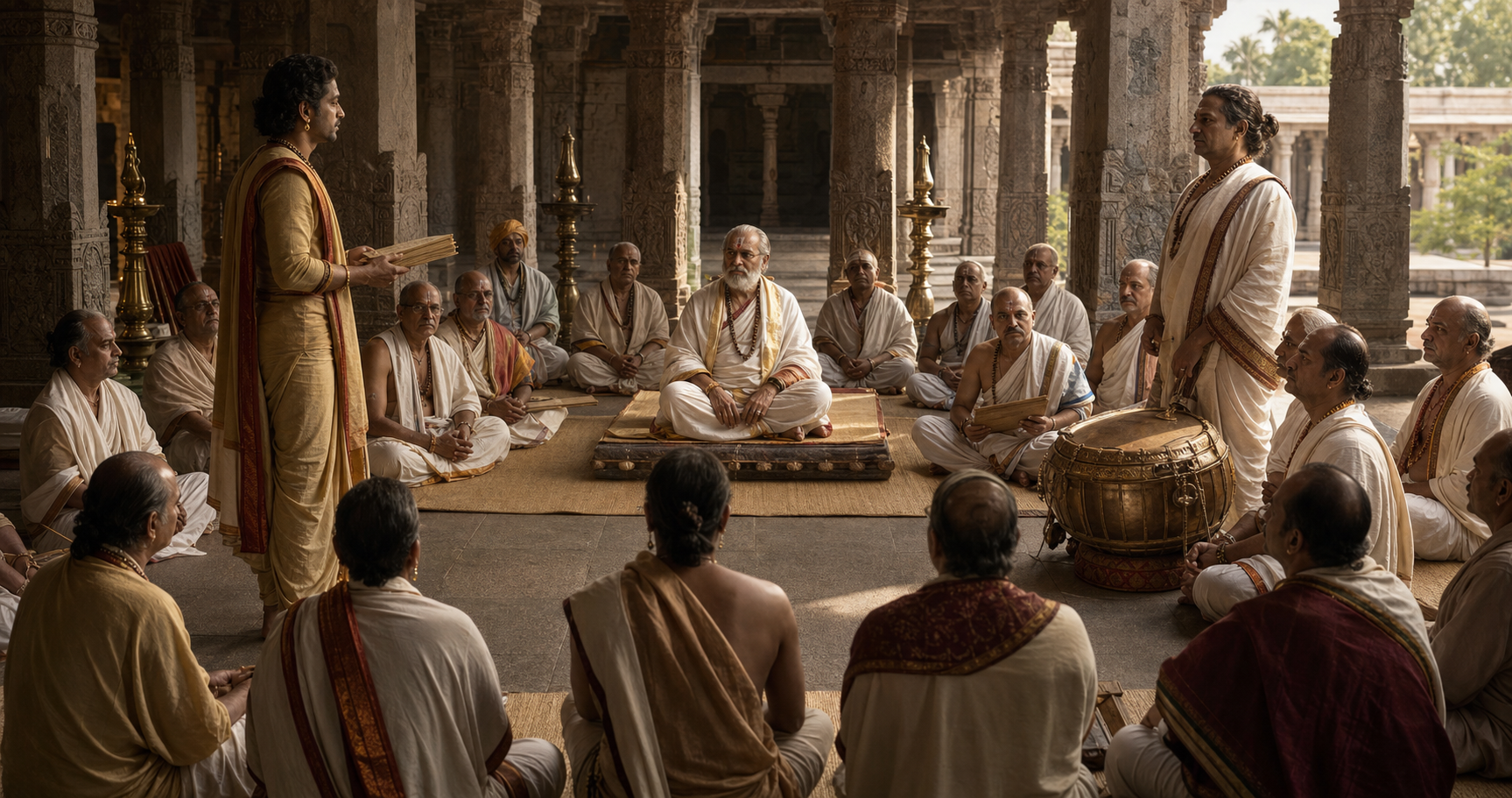
Perhaps you have met the Srinatha-Dindima episode as a simple victory tale: Srinatha arrived at Vijayanagara, defeated a formidable rival, and received the honours. If that is all you retain, you miss the part most worth carrying forward.
You need to know what the judges were deciding. The contest asked whether an expression that appears grammatically improper can become a poetic ornament when intention, suggestion, and rasa make it work. Srinatha prevailed because the assembly answered that question within carefully defined rules, not because it rewarded the louder personality.
Read the episode as intellectual history, not a scorecard
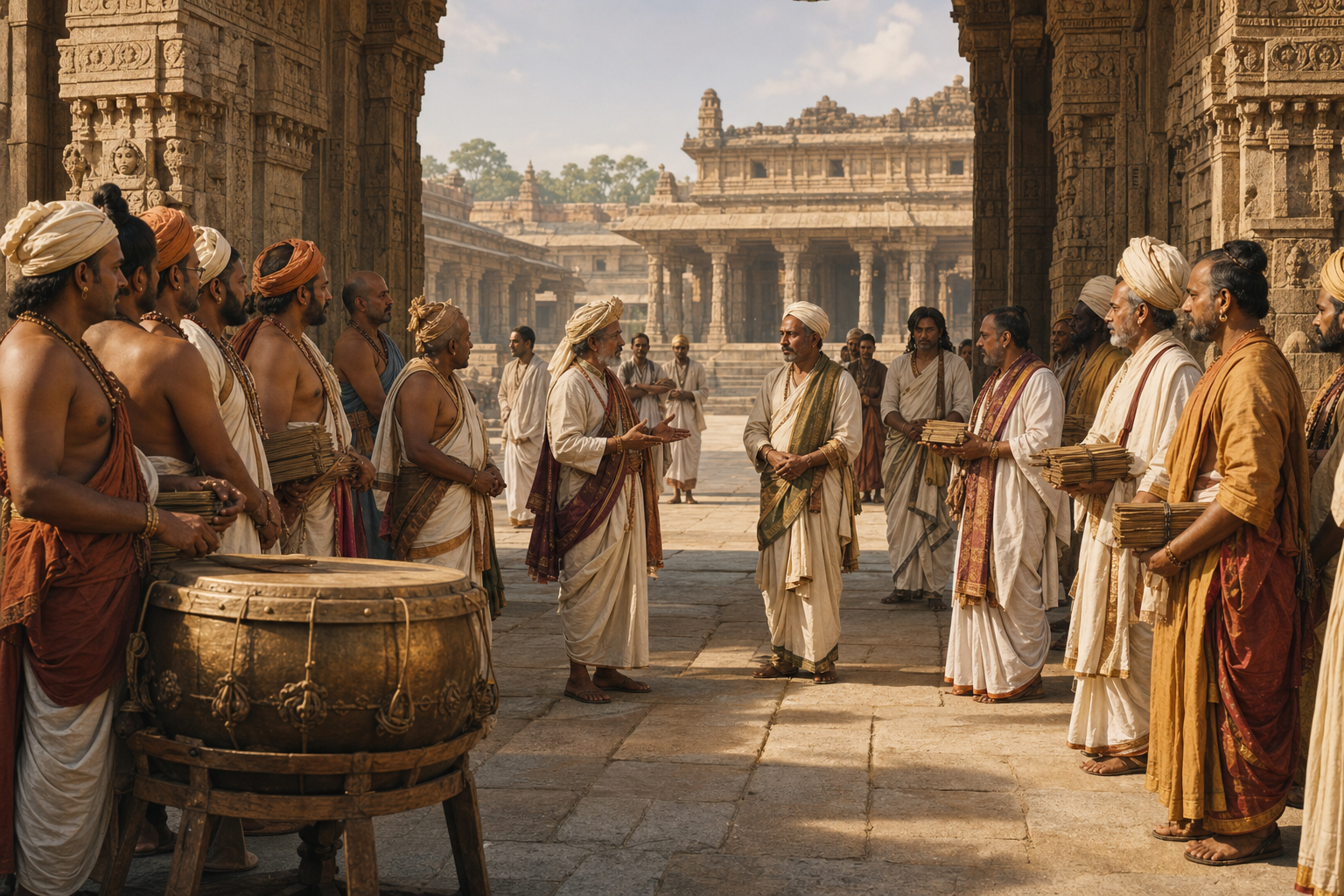
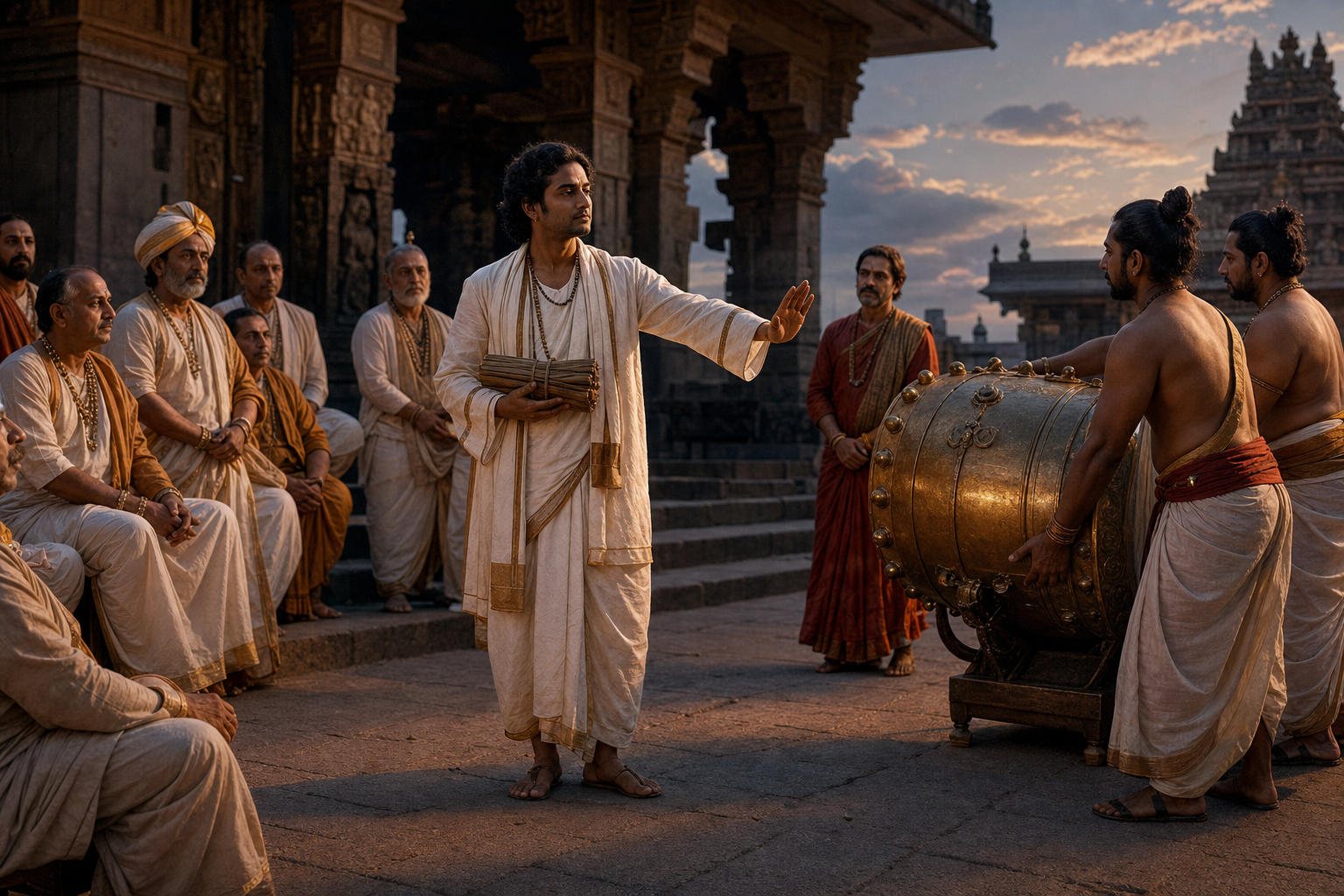
Arunagirinatha, known as Dindima Kavi, did not enter the contest as an obscure challenger. He was a logician-poet with a commanding public identity. His processions featured a bronze drum, laudatory bards, representations of earlier victories, and prominent titles. His characteristic boast likened the force of his speech to the Ganga pouring from Shiva’s matted locks. The performance told prospective opponents that defeat was already expected.
Srinatha brought a different kind of confidence. Already experienced in public disputation and conversant with logical method, he did not mistake ceremonial dominance for demonstrated command of every shastra. The clash was therefore not between learning and showmanship, or poetry and logic. It was between two learned men whose strongest methods did not have equal authority over the particular question before the court.
Much of the episode’s present literary texture comes through Nori Narasimha Sastry, who drew on Srinatha’s chaatu verses and courtly memory. That gives you a sensible reading rule: do not treat every flourish as though it were a stenographic court transcript. Pay closest attention to the institutional structure of the remembered contest: the formal challenge, examination of competence, selection of judges, agreement on authoritative works, technical argument, verdict, and ethical treatment of the defeated scholar.
You should also resist turning the encounter into a narrow regional boast. Navya Nyaya had developed and flourished in Navadvipa in Bengal; Srinatha represented the Andhra literary world; the Tamil scholar Mummakavi held influence at court; and Vijayanagara provided the common arena. These were not isolated intellectual provinces shouting past one another. They participated in a shared civilizational conversation, even when they disagreed sharply.
The decisive question was whether a fault could become an ornament
The technical centre of the debate was apashabdābhāsa, the semblance of improper word use. The word semblance matters. Srinatha was not asking the court to declare that every grammatical error becomes beautiful if a poet calls it intentional. He was defending the more exact proposition that an apparently defective expression can perform a legitimate aesthetic function under specified conditions.
Grammar and poetics approach such an expression from related but distinct directions. A grammarian asks whether the form conforms to accepted linguistic rules. An alankarika asks what the form does inside the poem: whether its obliquity is purposive, whether it activates suggestion, whether it intensifies rasa, and whether a sensitive reader can experience the resulting poetic force. Neither inquiry is dispensable, but they are not interchangeable.
A careless error does not become poetry merely by being defended
Srinatha’s case depended on vakrokti, purposeful obliquity, and on vyañjanā, the suggestive operation central to dhvani theory. An unusual expression could qualify as an alankara when its apparent irregularity helped the poem communicate more than its literal statement. The deviation had to produce an intelligible aesthetic gain; intention by itself was not enough.
This distinction gives you a practical test whenever someone invokes poetic licence. First ask what the regular expression would have been. Then identify the effect created by departing from it. Finally ask whether that effect deepens suggestion or rasa for a sahrdaya, a discerning and aesthetically trained reader. If no one can identify the gain, you are probably looking at a defect defended after the fact, not a successful ornament.
Why Nyaya could inform the debate but not govern it
Dindima requested the addition of Nyaya specialists to the mediating panel. Srinatha objected on jurisdictional grounds. In the theoretical framing accepted by the assembly, Nyaya’s formal treatment of meaning did not give primacy to vyañjanā in the way required by dhvani-centred poetics. Giving Nyaya decisive control would therefore have allowed a discipline less committed to poetic suggestion to determine whether suggestion had succeeded.
The objection did not declare Nyaya inferior. Srinatha himself understood logical method. It established a narrower and more defensible rule: use an intellectual discipline where its instruments fit the object being judged. Logical precision can expose contradiction, but it cannot by itself replace cultivated aesthetic judgment. Expertise in one shastra does not automatically confer jurisdiction over another.
The sabha was designed around the question it had to answer
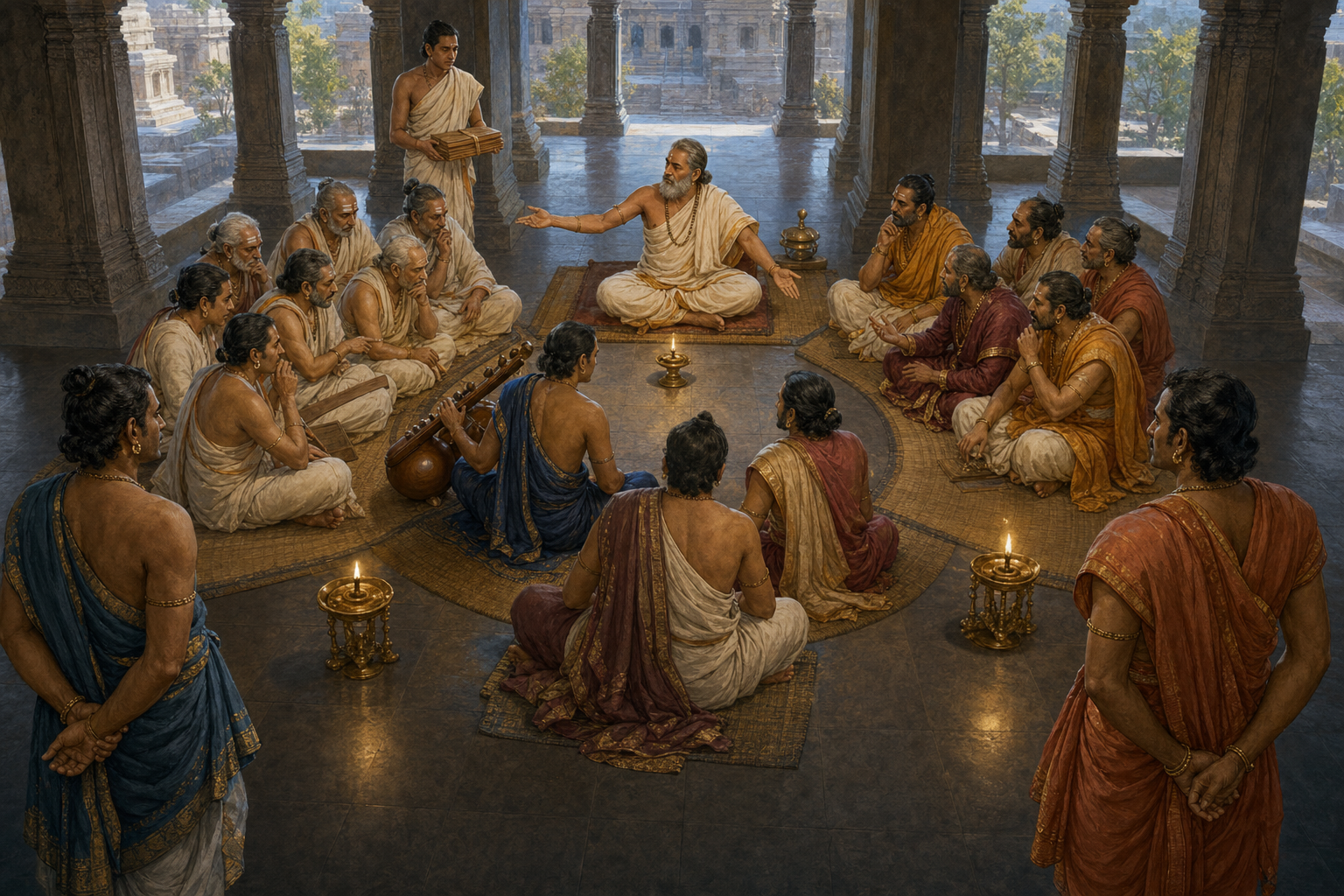
The Vijayanagara assembly did not improvise its standards after hearing which side appeared stronger. It appointed five alankarikas, specialists in poetics, and five vaiyakaranas, specialists in grammar. Pandita Chandrabhushana Kriyashakti, a Mimamsa authority of the Kalamukha tradition, served as chief arbitrator. The arrangement matched three needs: aesthetic judgment, grammatical discipline, and a method for interpreting authoritative texts and reconciling competing claims.
The sabha then identified its pramāṇa granthas, the works that would count as authoritative for this dispute. For grammar, it accepted Panini, Katyayana, and Patanjali. The Aindra, Cāndra, and Jainendra schools were set aside as outside the requirements of this particular case. For Alankara Shastra, the works of Bhamaha, Dandi, Anandavardhana, and Abhinavagupta were admitted.
The judges also accepted sahrdayas as a form of pramāṇa. That did not reduce poetic truth to a popularity vote. A sahrdaya is not simply anyone who likes a verse; the term denotes a connoisseur whose literary formation and sensitivity make refined aesthetic recognition possible. The sabha thus required both doctrinal support and experienced reception. A theory of rasa that could not be realized by a qualified reader would remain incomplete.
This procedural care mattered because tensions had already escaped the realm of argument. As Srinatha passed an agrahara occupied by northern poets, protest escalated into thrown stones and physical blows. The civic official Teluguraya intervened, de-escalated the confrontation, guaranteed a formal sabha, and restored an orderly path to adjudication. Free intellectual exchange needed administration capable of protecting it; scholarship alone could not restrain a heated crowd.
If you are arranging a serious debate, seminar, or public disagreement, put five lines in writing before anyone begins: the exact proposition, the discipline with primary jurisdiction, the accepted authorities, the composition of the judging body, and the rules of conduct. If the participants cannot agree on those five lines, they are not ready to debate the substance. They are still fighting over what kind of event they are entering.
Preparation secured the verdict; restraint protected its value
Srinatha investigated the method, not merely the reputation
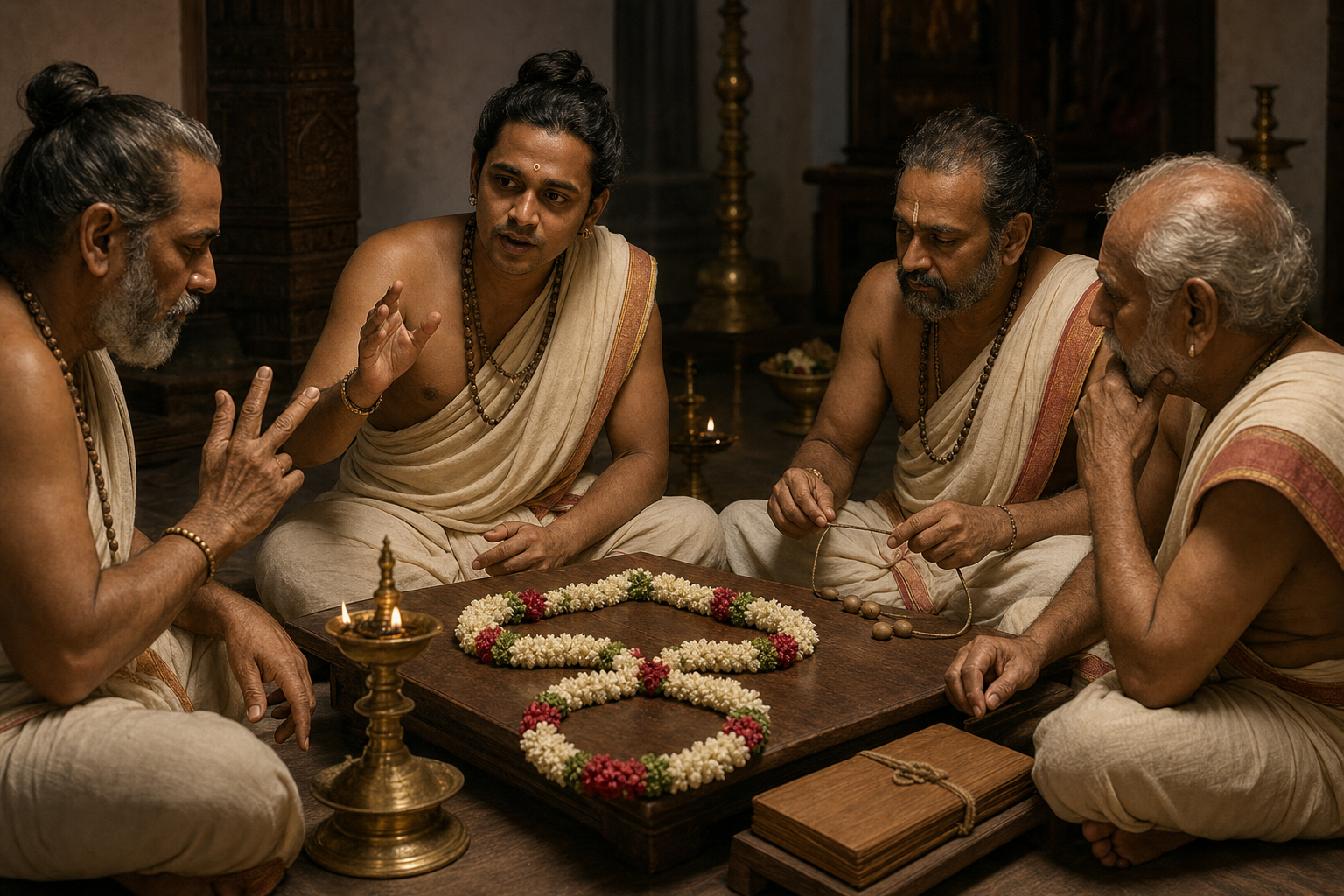
Srinatha did not walk into the court relying on inspiration. He met scholars who had previously debated Dindima and sought a detailed assessment of his strengths and limitations. Along with a second challenge letter, he sent Nrisimha Bhatta and scholars of Veda, Nyaya, Sankhya, Purva Mimamsa, and Vedanta to converse with his opponent and observe the range of his learning.
The assessment was specific: Dindima was exceptionally strong in Nyaya, less secure in Veda and Purva Mimamsa, and limited in Prakrit. Srinatha used that knowledge to anticipate where the analytical habits of logic might be extended beyond their proper domain. He still kept his decisive case within the recognized authorities of Alankara Shastra. The preparation sharpened a relevant argument; it did not become an ambush based on unrelated trivia.
He prepared for the court as carefully as he prepared for the opponent. Srinatha adopted local Vijayanagara attire and ornaments, learned the court’s etiquette, consulted influential aesthetes, and built a collegial relationship with Mummakavi of Tamil Nadu. These actions were not substitutes for scholarship. They removed avoidable social friction so that scholarship could be heard on its merits.
The useful distinction is between adapting your manner and surrendering your position. Srinatha did the former without doing the latter. When you enter an unfamiliar institution, learn its language, protocols, and relationships before presenting your case. Cultural competence cannot rescue a weak argument, but needless disregard for the setting can prevent a sound argument from receiving a fair hearing.
The victor refused to convert judgment into humiliation
Once the sabha ruled for Srinatha, Dindima acknowledged defeat and offered him the bronze drum that had symbolized his public acclaim. Srinatha declined it. The proposition had been settled; confiscating the rival’s emblem would have added humiliation without adding truth.
This was not ornamental courtesy after a ruthless contest. It completed the ethics of the contest. A dharmic debate must permit a clear verdict, including defeat, while leaving the defeated person a path back into the scholarly community. Otherwise every disagreement becomes a struggle for social survival, and participants learn to defend prestige rather than examine claims.
The friendship between Srinatha’s wife Sridevi and Dindima’s wife Gauridevi strengthened that social counterweight to rivalry. Their association grew through visits to the Shri Matha established by Vidyaranya Swami. Their goodwill reminds you that an intellectual community is sustained by relationships beyond the formal platform. Families, friendships, shared institutions, and common sacred commitments can prevent a disputed proposition from turning into permanent enmity.
Before entering a consequential disagreement, decide what victory should require. A correction, a clarified doctrine, or a properly reasoned verdict may be necessary. Public degradation is not. When the remedy exceeds what is needed to settle the claim, triumph has begun to replace inquiry.
Key takeaways: a dharmic debate checklist
- Define the proposition precisely. Srinatha and Dindima were not debating whether grammar mattered; they were debating whether an apparent verbal fault could acquire poetic value under aesthetic constraints.
- Assign the right intellectual jurisdiction. A powerful method such as Nyaya should contribute where relevant, but it should not control a poetry-specific question when its treatment of meaning does not centre the disputed function of suggestion.
- Fix the pramāṇas before hearing the case. Naming accepted authorities in advance prevents either side from changing the standard when an argument becomes inconvenient.
- Use complementary judges. Grammar guarded linguistic discipline, poetics evaluated rasa and ornament, and Mimamsa supplied interpretive and procedural mediation.
- Demand an observable aesthetic gain. Apparent impropriety becomes defensible poetic craft only when its obliquity produces suggestion or intensifies rasa for a qualified sahrdaya.
- Study your opponent without demeaning the person. Identify the other side’s strongest method and possible overreach, then answer the relevant argument instead of exploiting unrelated weakness.
- End victory at the proposition. A sound verdict can be firm without turning the opponent’s loss into a spectacle of social destruction.
When you next invoke the Srinatha-Dindima encounter, do more than repeat who won. Ask four questions of the debate in front of you: What exactly is being decided? Who has jurisdiction? What counts as proof? How will the defeated participant be treated afterward? If those questions have no clear answers, the Vijayanagara model has not yet been followed.
References
