
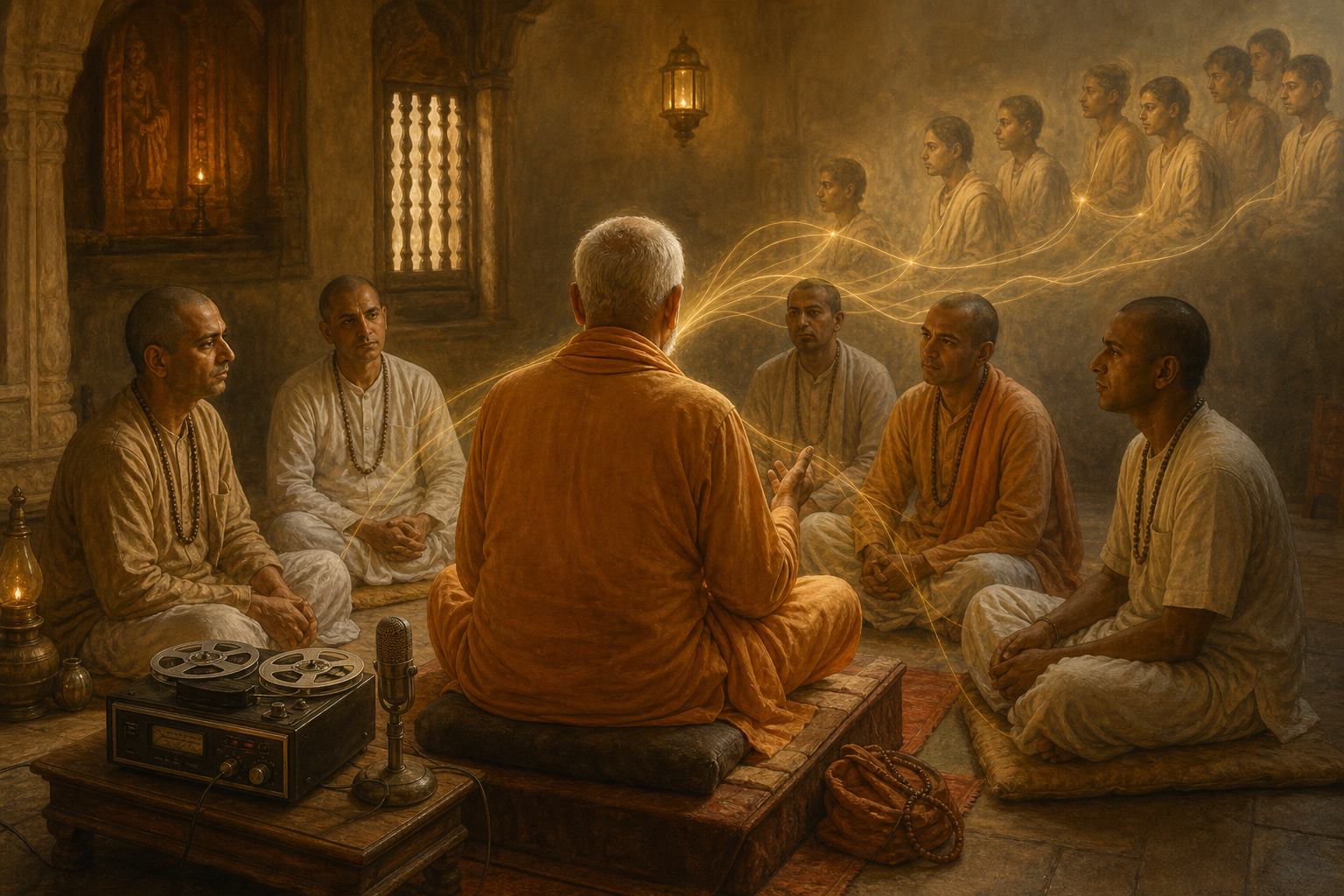
The most revealing question raised by Prabhupada Memories DVDs 108 and 109 is not simply what happened in Srila Prabhupada’s presence, but how encounters with a spiritual teacher were remembered, interpreted, and passed to people who were not there. Read together, the two source articles present these recordings as devotional testimony, evidence of spiritual formation, and part of the historical record of modern Gaudiya Vaishnavism.
This combined perspective also clarifies the limits of the available material. The articles describe the character and value of the recollections without supplying detailed transcripts of individual incidents. A responsible synthesis therefore does not manufacture anecdotes; it asks what these sources establish about memory itself and how such testimony can be approached with both respect and critical care.
One archive, several kinds of evidence

The article on Prabhupada Memories DVD 108 identifies Dhrti dasi, Rama Das Abhirama Das, and Sabhapati as its witnesses. The article accompanying Prabhupada Memories DVD 109 names Anandamaya, Ghosh Thakur, Nayanabhirama, and Ramestha. The different groups matter because oral history is cumulative: no disciple’s perspective can contain the entire life of a teacher or the full experience of a diverse international movement.
Both articles contrast recollection with conventional institutional history. Public events, publications, temples, organizational developments, and formal teachings establish the scale of Srila Prabhupada’s work. Personal testimony addresses another set of questions: how instruction was received, what correction felt like, which habits disciples associated with spiritual seriousness, and why seemingly ordinary encounters remained significant.
Three layers of evidence consequently meet in each episode. There is the original encounter as experienced by a disciple, the later act of remembering it on video, and the article’s interpretation of that recorded memory. These layers should not be collapsed into one. A recollection may offer evidence about an event, but it also reveals how the speaker came to understand discipleship and how the community wishes to preserve its formative values.
What the two episodes jointly reveal about discipleship
The strongest point of agreement between the source articles is that Srila Prabhupada’s influence cannot be understood through public achievement alone. Both direct attention to conduct: walking, eating, chanting, translating, teaching, questioning, encouraging, and correcting. DVD 109’s article emphasizes the intimacy of small remembered moments, while the DVD 108 article stresses the conversion of philosophy into punctuality, cleanliness, study, restraint, service, and responsibility.
Together, these emphases show why the guru-shishya relationship is more than the communication of information. In the framework presented by the sources, the guru connects scriptural teaching with a disciplined pattern of life. The disciple does not merely learn definitions of bhakti or seva; the disciple learns how devotion affects time, work, food, speech, relationships, and accountability.
The two articles also resist reducing spiritual influence to charisma. The DVD 108 discussion explicitly distinguishes attraction from the character needed to sustain a movement. The DVD 109 discussion similarly locates Prabhupada’s legacy in scripture, practice, community, and theological purpose rather than personality alone. Their shared portrait is of authority expressed through consistency: devotion was expected to become a daily discipline rather than remain an inspiring idea.
This helps explain why repeated practices occupy such a prominent place in both accounts. Chanting, scriptural study, prasadam, deity worship, association with devotees, and service are presented not as isolated customs but as mutually reinforcing means of formation. Memory gives these practices a human setting by showing how a teacher’s standards were encountered by particular people with different temperaments and backgrounds.
How devotional memory can be read critically and respectfully
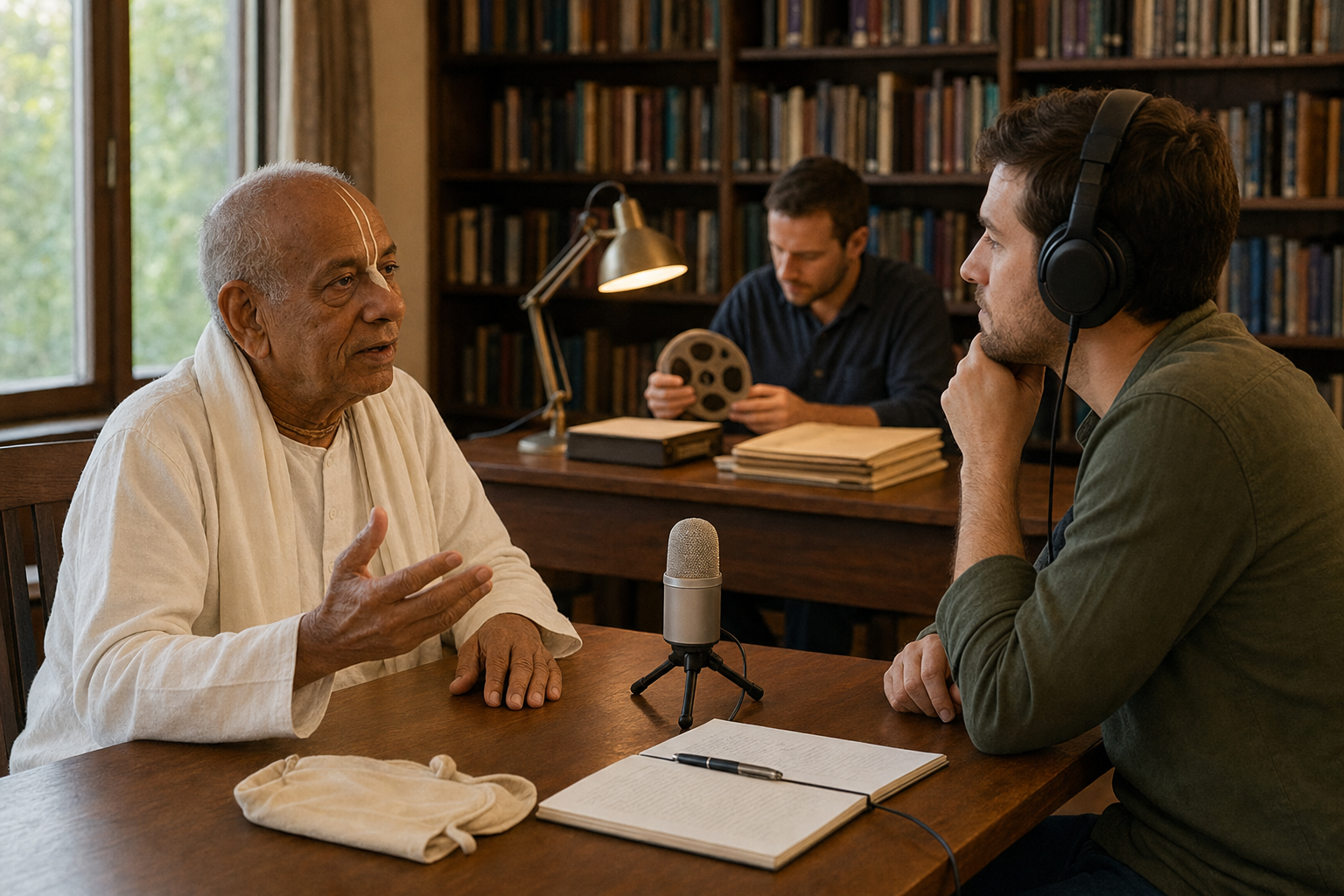
The DVD 109 article openly notes that oral memories are selective and shaped by devotion, time, and community identity. The DVD 108 article adds that video retains tone, pauses, facial expressions, and emotional register in ways that a written summary cannot. These observations are complementary: the medium makes testimony richer, but emotional immediacy does not remove the need for interpretation.
A careful reading begins by distinguishing the kinds of claims a memory can support. A recollection may describe a witnessed action, convey the atmosphere surrounding an encounter, explain the meaning later assigned to an instruction, or express gratitude and responsibility. Those are related forms of testimony, but they are not interchangeable. Where an exact chronology or wording matters, oral accounts are best compared with contemporaneous documents, published teachings, and other independent recollections. That is a general principle of oral-history research rather than a judgment against devotional testimony.
The same care applies to silence. Neither source article provides enough incident-level detail to determine where the seven named speakers converge or differ on particular events. What can be synthesized is the editorial framing shared by the posts: both regard remembered encounters as essential for understanding how Gaudiya Vaishnava teachings were embodied and transmitted across cultural boundaries.
Respectful analysis therefore avoids two extremes. Treating every recollection as a complete historical record asks more of memory than it can provide. Dismissing a testimony because it is devotional overlooks evidence about relationships, values, motivation, and community formation. The more productive approach is to identify what kind of knowledge each account offers and then place accounts in conversation with one another.
Key takeaways
- DVDs 108 and 109 broaden the record by preserving testimony from two different groups of disciples rather than presenting a single definitive viewpoint.
- The sources jointly portray discipleship as embodied learning in which scriptural principles become habits of worship, service, study, restraint, and responsibility.
- Video preserves emotional and nonverbal dimensions of testimony, while critical comparison remains necessary for exact historical claims.
- The archive is valuable both for ISKCON’s internal memory and for wider study of how religious traditions cross cultures without relying on texts and institutions alone.
From preserved recollection to future practice
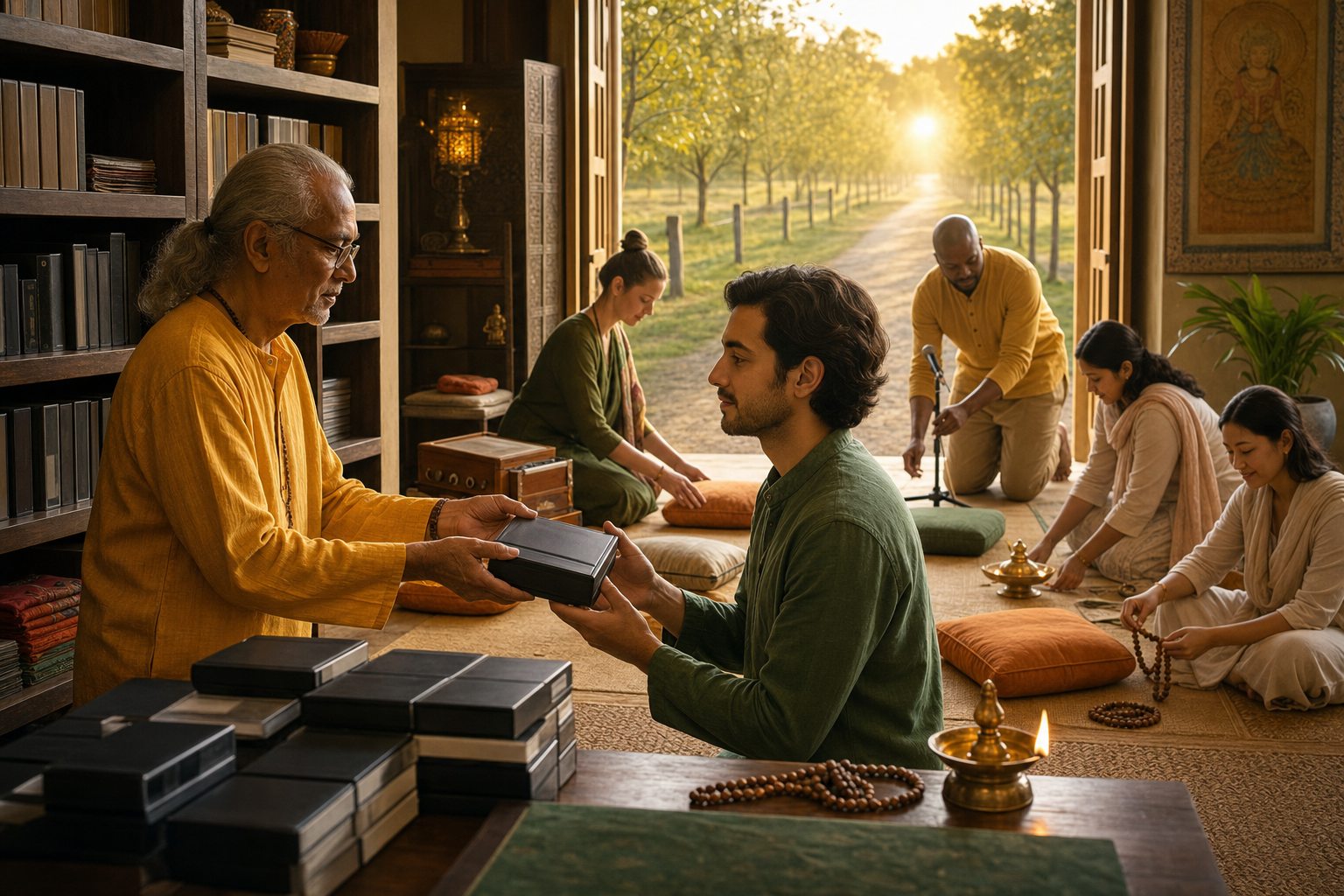
The broader dharmic relevance identified by both articles lies in a recurring question: how does a tradition remain lived when its founding or formative generation passes? Hindu, Buddhist, Jain, and Sikh traditions differ substantially in doctrine and practice, but the articles locate a shared concern in disciplined self-transformation, ethical responsibility, service, and the transmission of wisdom through relationships.
For future custodians of the Prabhupada memories, preservation should include the recordings, accurate speaker identification, searchable transcripts, dates and locations where available, and clear distinctions between testimony and later commentary. Such context would allow devotional communities, historians, and younger practitioners to ask better questions without stripping the memories of their spiritual purpose.
The archive will remain alive to the extent that recollection leads beyond nostalgia. Its next phase should connect carefully preserved testimony with study, ethical conduct, accountable service, and sustained practice, enabling later generations to encounter not only a remembered personality but the disciplines and responsibilities the memories are meant to carry forward.
References
- DharmaRenaissance Blog — Powerful Prabhupada Memories: Lessons in Bhakti, Service, and Living Faith
- DharmaRenaissance Blog — Powerful Lessons from Prabhupada Memories DVD 108 on Guru, Bhakti and Living Dharma