
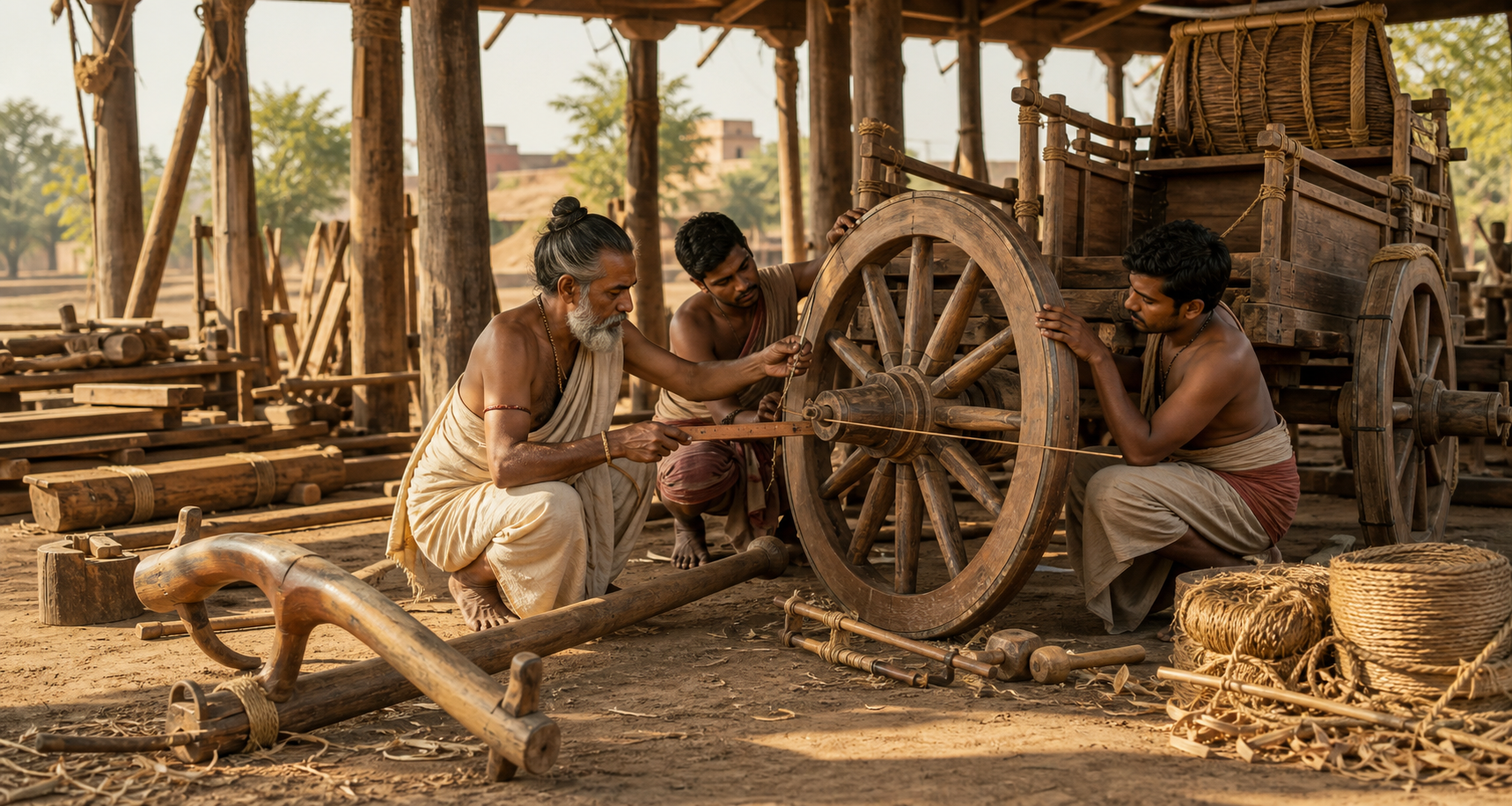
If you are trying to understand who built the chariots of ancient India, the word “carpenter” will lead you astray. A rathakara had to make several load-bearing parts behave as one moving system. That required measurement, material judgment, alignment, assembly, testing, repair knowledge, and responsibility for the finished vehicle.
This distinction matters whether you are reading a Sanskrit text, examining a museum reconstruction, or watching a temple ratha move through a town. It helps you avoid two common mistakes: treating the maker as a minor laborer, or treating every practical feature of the chariot as nothing more than religious symbolism.
The rathakara was responsible for the whole moving system
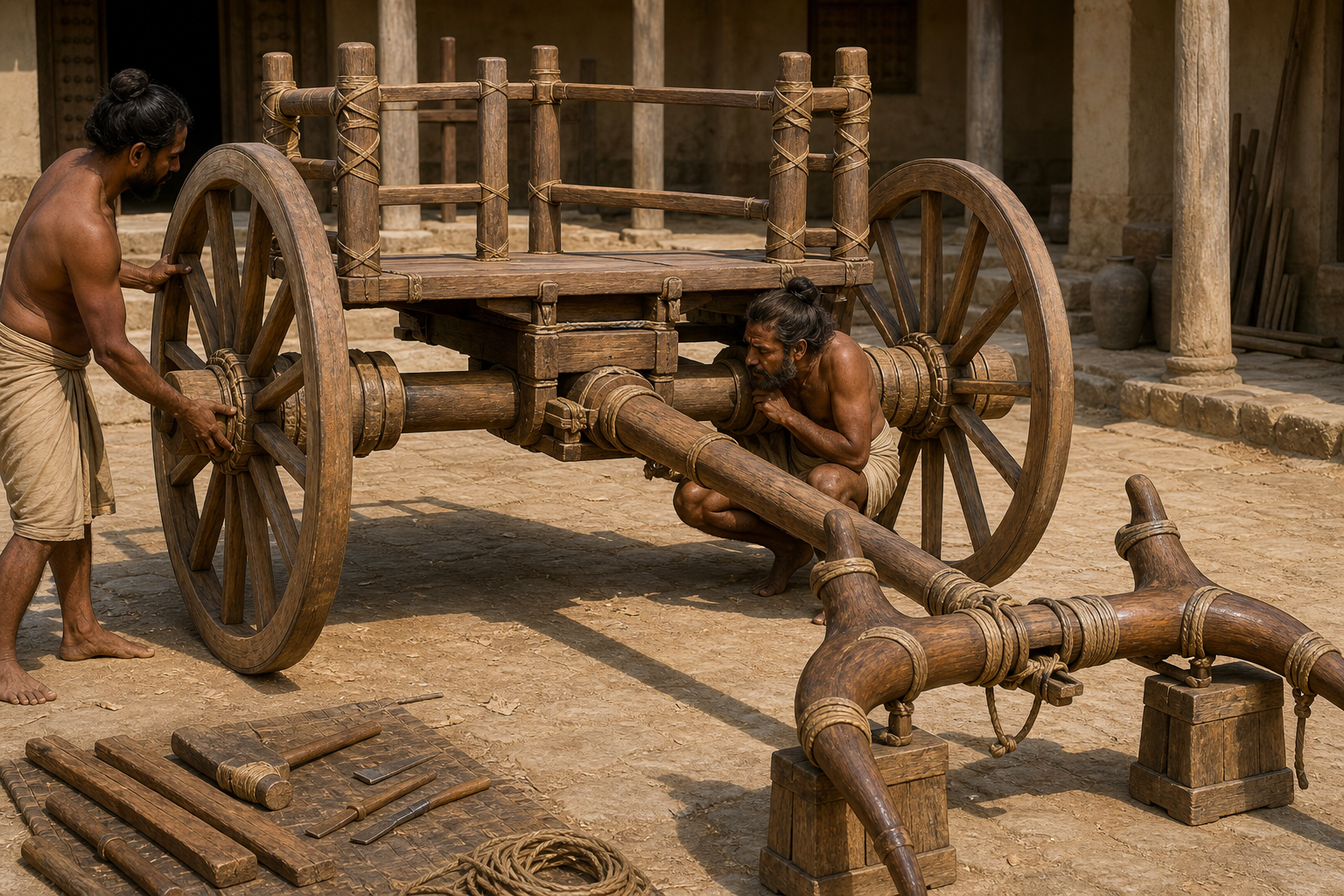
Rathakara literally means “chariot-maker,” but the work extended beyond shaping timber. The craftsperson was responsible for the relationship among the body, wheels, axle, and yoke. If one element was badly proportioned or fitted, the defect affected the performance of the entire vehicle.
| Part of the chariot | What the rathakara had to control | What a poor fit could affect |
|---|---|---|
| Body | Load placement and its relationship to the running structure | Balance, stability, and stress on other parts |
| Wheel assembly | Geometry, balance, and consistent movement | Smooth travel, vibration, and durability |
| Axle | Fit, load transfer, and alignment | Rolling resistance and structural strain |
| Yoke | Proportion and alignment with the vehicle | How pulling force entered the system |
| Joinery and fittings | Secure connections among materials and replaceable parts | Rigidity, repairability, and service life |
This is systems engineering in practical form. A perfectly shaped wheel cannot rescue a badly placed load. Strong joinery cannot correct a crooked running assembly. A sound axle is of limited value if the yoke introduces force unevenly. The rathakara therefore had to think in relationships rather than isolated components.
Measurements such as the angula and hasta gave artisans a disciplined vocabulary for dimensions. Their presence tells you that this was measured work, but a unit name alone does not reveal the proportions of a particular chariot. Whenever you encounter a claimed reconstruction, ask for the period, region, intended use, and dimensional basis before accepting it as a universal ancient Indian design.
A practical reconstruction of the building process
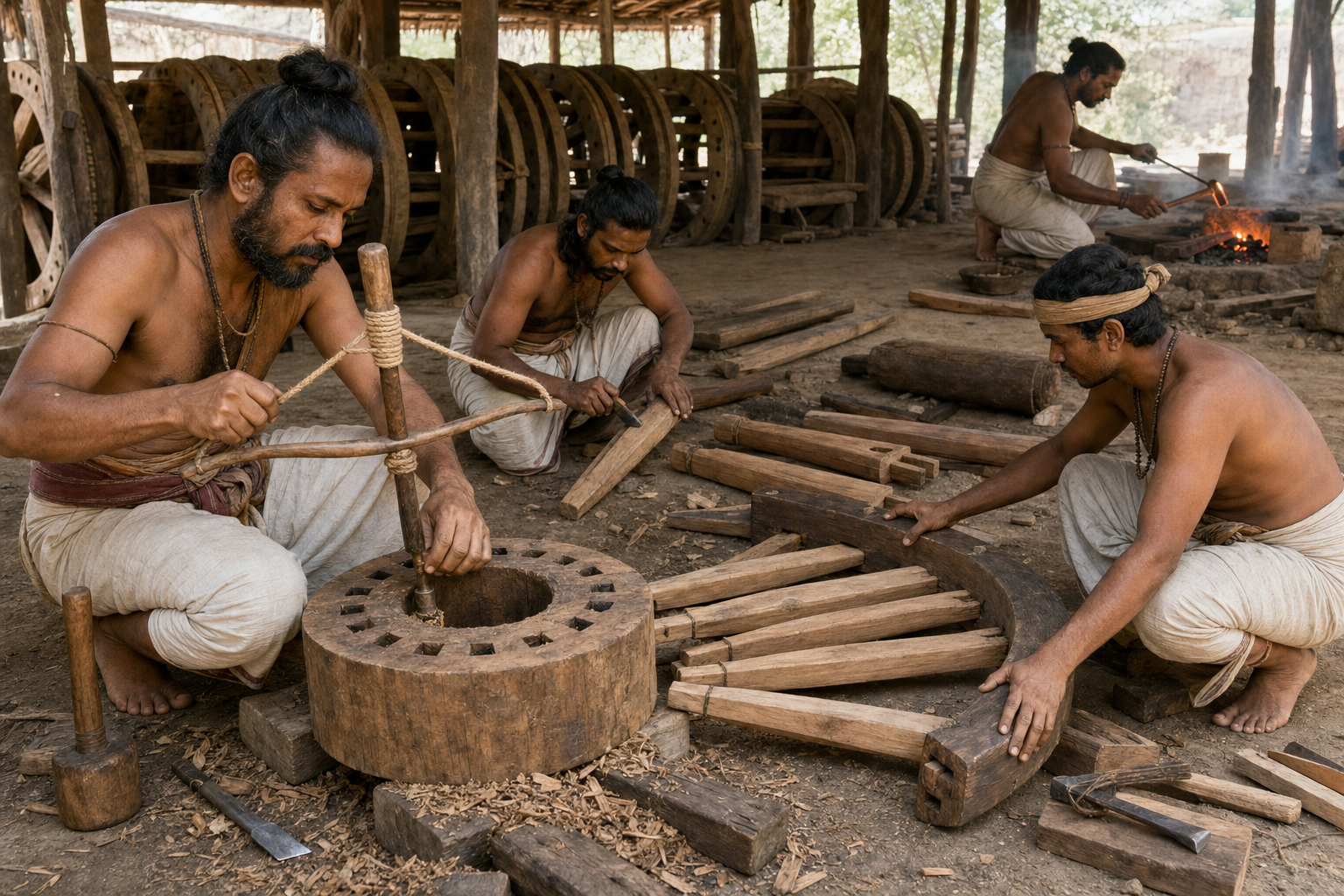
No single sequence should be imposed on every workshop in every region. The technical demands nevertheless reveal a clear working logic. You can use the following sequence to understand how the craft had to proceed and to evaluate modern descriptions of it.
- Define the chariot’s duty. A vehicle intended for warfare, a royal procession, civic use, or a temple festival did not answer exactly the same need. Purpose determined which demands the maker had to prioritize.
- Set the proportions of the complete assembly. The rathakara had to relate the body, wheel, axle, and yoke before treating any one of them as a finished object. Measurements in angula and hasta supported this dimensioned approach.
- Select and cure the timber. Wood selection was a structural decision, not merely a matter of appearance. Curing also mattered because timber that continued to change excessively after fitting could disturb joints and alignment.
- Shape the principal parts and prepare the joinery. The parts needed enough strength for their loads while still fitting the geometry of the complete vehicle. Joinery had to hold during movement rather than only while the chariot stood still.
- Integrate the other materials. Chariot production drew upon metal, leather, and fiber as well as timber. Fitting metal bands and incorporating the required non-wooden components made the rathakara dependent on a wider craft and supply network.
- Align the axle and yoke, then tune the assembly. This was where separately competent parts either became a coherent vehicle or failed to do so. Repeated fitting and adjustment were necessary to achieve smooth motion and stability.
- Inspect for performance and repairability. A working chariot had to endure use, not merely look complete at consecration or delivery. Replaceable and repairable parts reduced waste and allowed a valuable vehicle to remain in service.
Precision did not require modern factories. Standard units, repeated measurement, apprenticeship, and accumulated experience can produce highly controlled work. The craft addressed weight distribution, shock absorption, wheel balance, and axle-yoke alignment through empirical judgment. You should not invent a mechanism when the evidence does not supply one, but neither should you mistake the absence of modern technical vocabulary for the absence of technical reasoning.
The most useful test of any chariot reconstruction is therefore relational. Do not ask only whether its wheels, carvings, or body resemble an image. Ask whether the load sits coherently over the running structure, whether the wheels can move consistently, whether the pulling force meets the assembly correctly, and whether the joints can survive motion. A visually persuasive model can still be mechanically unconvincing.
Engineering, ritual, and workshop economics met in one craft
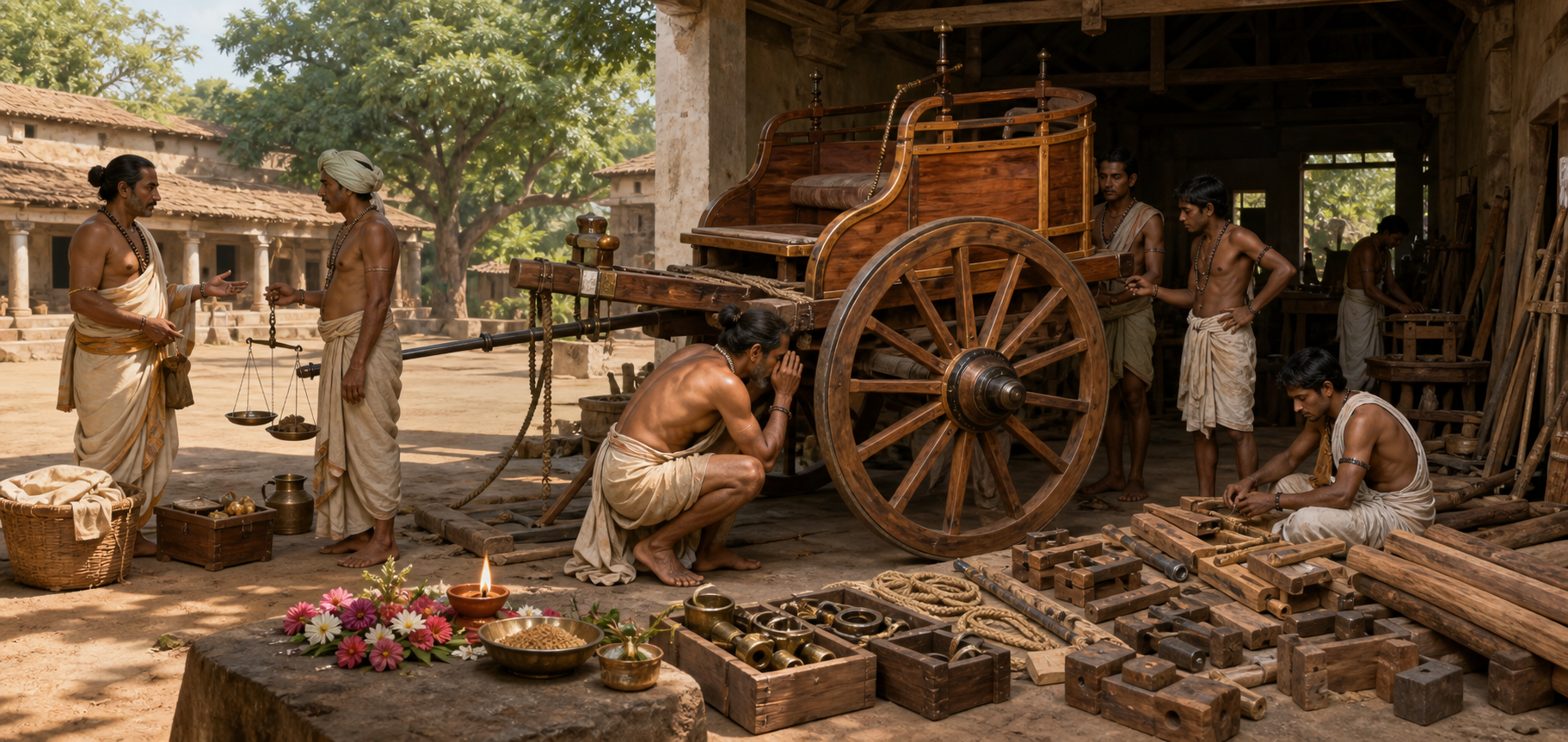
Ancient Indian chariot-making becomes distorted when engineering and ritual are placed in separate boxes. Chariots served warfare and royal display, but they also carried sacred images and communities in procession. For a ritual vehicle, calendrical timing, consecration, dimensions, materials, and iconographic details belonged to the requirements of the commission. They were not decorations casually added after the technical work ended.
This does not mean that every feature should be given a symbolic explanation. Wheel geometry still had to support movement. Axle alignment still had mechanical consequences. Joinery still had to bear changing loads. The better historical question is whether a feature answered a structural requirement, a ritual requirement, or both.
The supply chain was equally important. Organized guilds, or shrenis, helped coordinate timber, metals, leather, fiber, training, and standards of work. Royal patronage supported vehicles connected with defense and ceremony, while temple economies sustained processional traditions. Chariot-making was therefore not an isolated woodworker’s activity. It depended on material suppliers, related specialists, apprentices, patrons, and institutions able to maintain quality over time.
The statecraft setting associated with the Arthashastra helps explain why such artisans mattered beyond their workshops. Reliable chariots contributed to military readiness, transport, ceremonial authority, and public prestige. A ruler or temple establishment commissioning a ratha was acquiring a mobile platform, organizing specialized labor, and making a visible statement about institutional capacity.
When you examine a historical claim about a chariot, test it across four layers: intended function, mechanical coherence, material supply, and ritual protocol. An account that discusses only carved imagery omits the vehicle. An account that discusses only axles and loads omits why a community commissioned, consecrated, and moved it.
The rathakara’s social position cannot be reduced to one label
The rathakara appears across a long textual range, from Vedic material to later Dharmashastra discussions. Yet the social description varies among texts and regions. That variation should be preserved rather than forced into a single timeless rank.
A craft name can identify expertise while also appearing inside a text’s scheme of social classification. Those are related facts, but they are not interchangeable. A normative classification tells you how a particular textual setting organized social roles. It does not, by itself, tell you how every rathakara was trained, what a workshop produced, who commissioned its work, or how much authority a master artisan exercised over a complex build.
If you encounter a confident statement that “the rathakaras were” one fixed social group everywhere, ask four questions. Which text supplies the description? What period and region are under discussion? Is the term naming an occupation, a community, a ritual eligibility, or some combination of these? What evidence connects the classification to actual workshop practice?
This method does not dismiss Dharmashastra or ritual literature. It reads each kind of evidence for what it can establish. Textual categories reveal important ideas about social order; technical descriptions reveal the structure of the work; guild organization reveals economic relationships; and living traditions reveal transmitted practice. None should be made to speak for all the others.
Inside the workshop, competence had unavoidable consequences. Poor judgment could compromise the chariot, the animals drawing it, the people riding or handling it, and the ceremony or mission it served. Training therefore joined manual skill with responsibility. Apprenticeship and community transmission preserved knowledge about timber selection, curing, metal-band fitting, and assembly tuning. A social label alone cannot substitute for an account of that expertise.
How to recognize the rathakara’s living Dharmic legacy
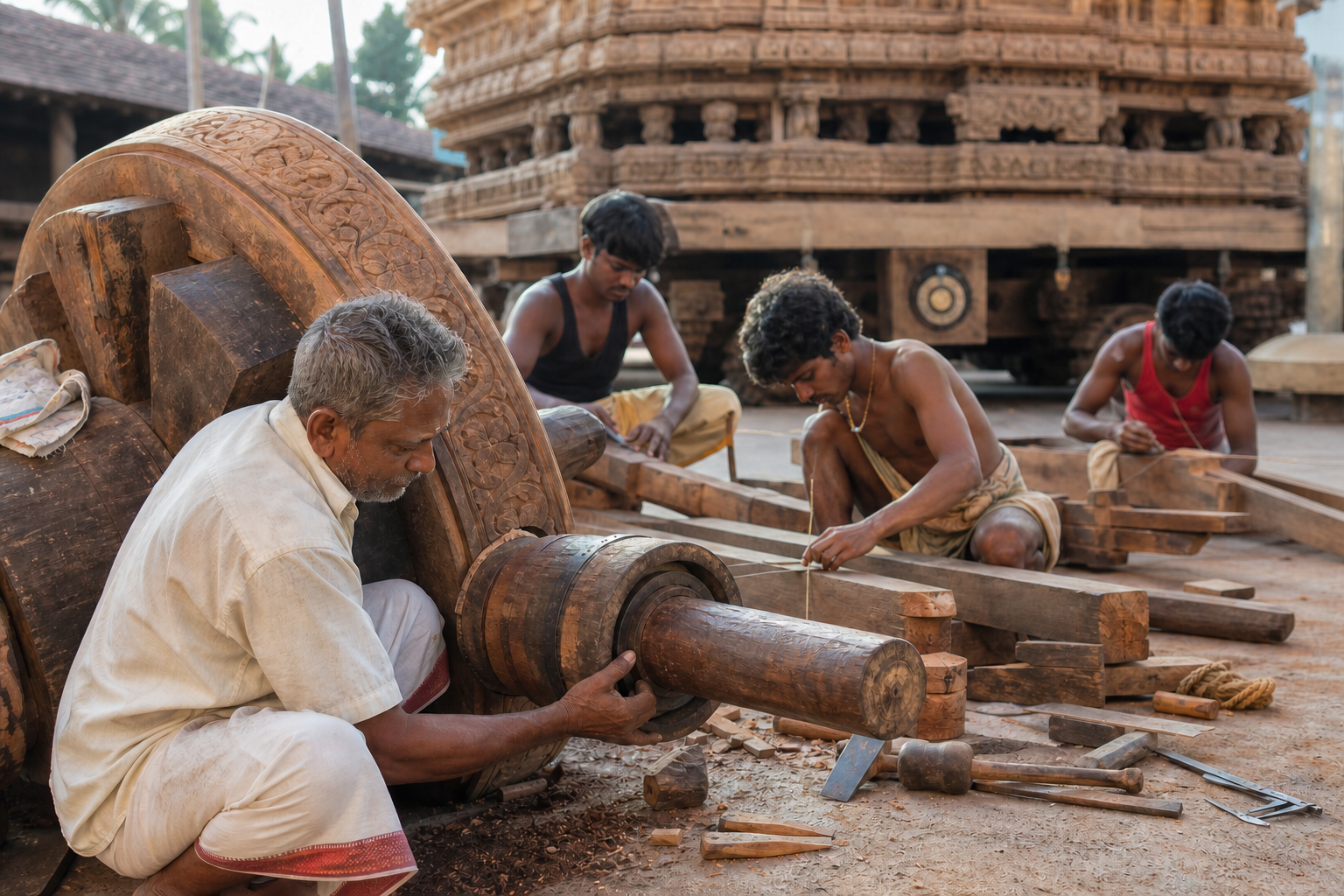
The chariot became more than a vehicle because its structure offered a language for disciplined life. The Katha Upanishad brings the self, intellect, mind, senses, and body into a coordinated chariot model. Buddhist thought uses a chariot simile to examine identity and composition. Jain ratha processions turn movement into an expression of spiritual journey. Later Sikh artisanal values resonate with the same respect for skilled work, ethical labor, and service.
These parallels do not make the Dharmic traditions identical, and they should not be used to erase doctrinal differences. They reveal a shared cultural capacity to think through assembled things. A chariot exists through the ordered relationship of its parts; discipline also depends on faculties working in proper relationship. The power of the image comes from real craft knowledge. A society familiar with the difficulty of controlling a moving vehicle could immediately grasp why an undisciplined mind or sense faculty endangered the whole.
Living temple traditions let you see part of this synthesis in operation. At Puri, hereditary artisans construct monumental chariots to exact specifications for the Jagannath Ratha Yatra. Temple-chariot traditions in Odisha, Tamil Nadu, and other regions also preserve combinations of measurement, joinery, ritual sequence, and communal labor.
Continuity does not mean that every living temple car is an unchanged copy of an ancient battlefield chariot. Function, scale, patronage, and ritual setting can change across time. Living practice is most valuable when you examine precisely what has continued: technical vocabulary, proportional rules, division of labor, material handling, ritual responsibility, maintenance, or hereditary transmission.
Key takeaways
- A rathakara was a systems craftsperson responsible for the interaction of body, wheels, axle, yoke, joinery, and fittings.
- Angula and hasta show dimensioned practice, but they do not justify one universal set of chariot proportions without regional and textual context.
- Timber selection, curing, assembly tuning, alignment, weight distribution, and repairability were central technical concerns.
- Ritual timing, consecration, materials, and iconography could form part of the vehicle’s specification rather than an ornamental layer added afterward.
- Claims about social status should identify their text, period, region, and meaning of rathakara instead of flattening varied evidence into one caste formula.
- Temple-ratha traditions preserve living knowledge, but continuity should be studied carefully rather than confused with complete identity across time.
The next time you encounter a ratha, begin with one relationship: wheel and axle, body and load, yoke and pulling force, or joint and repair. Ask who measured it, who fitted it, who maintained it, and which ritual rule governed it. That small act of attention turns a spectacle into craft history and restores the rathakara to the place the work itself demands.
References
