
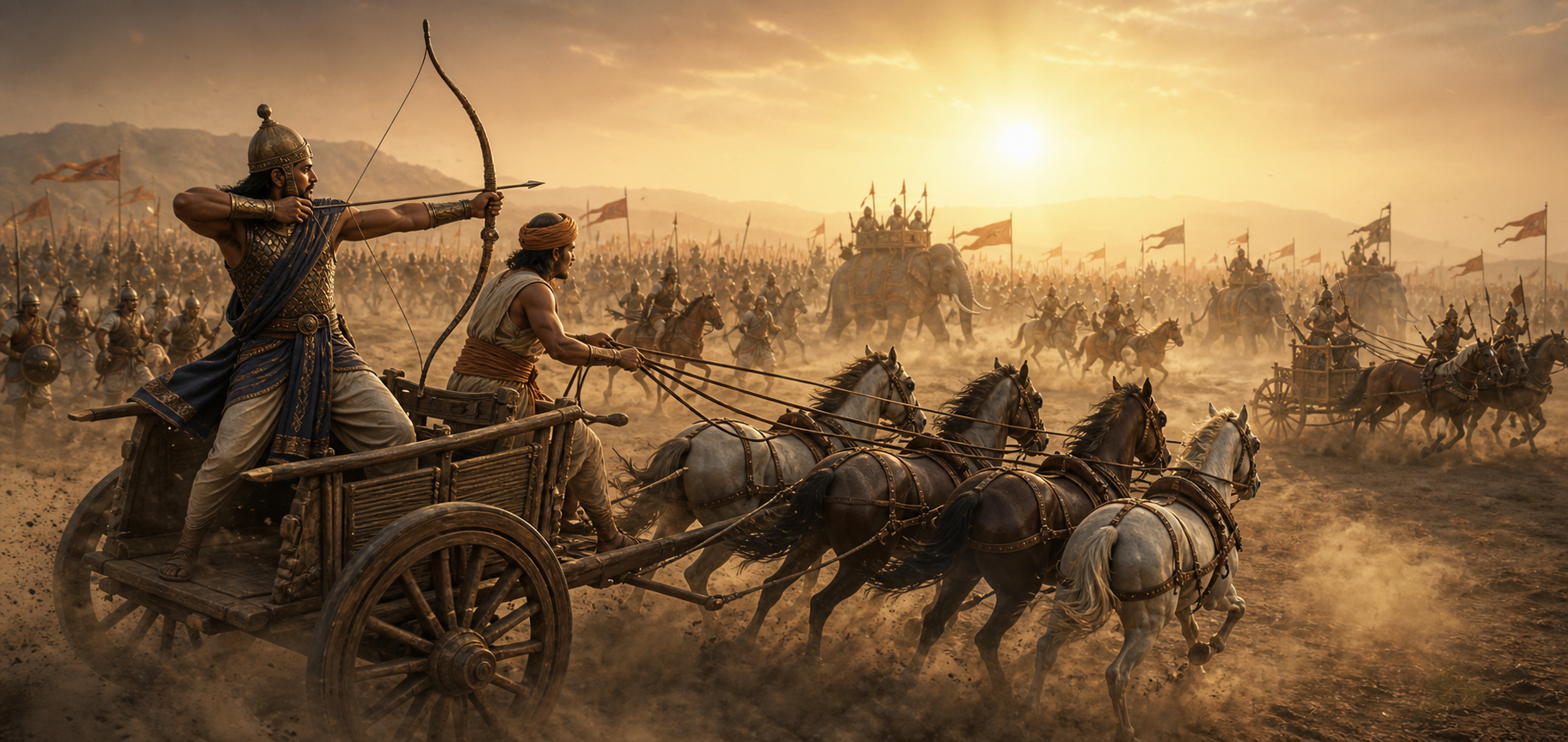
When you meet Ratha beside a warrior’s name, it is tempting to translate the word as chariot fighter and move on. That catches the battlefield image, but it can miss the judgment being made about the warrior.
Read Ratha as a compressed assessment of martial capacity. To understand it correctly, you must separate the chariot from the classification, prowess from social identity, and military excellence from moral excellence. Those distinctions prevent most of the inflated claims and false hierarchies that circulate around ancient Hindu warfare.
Ratha can identify a vehicle or evaluate a warrior
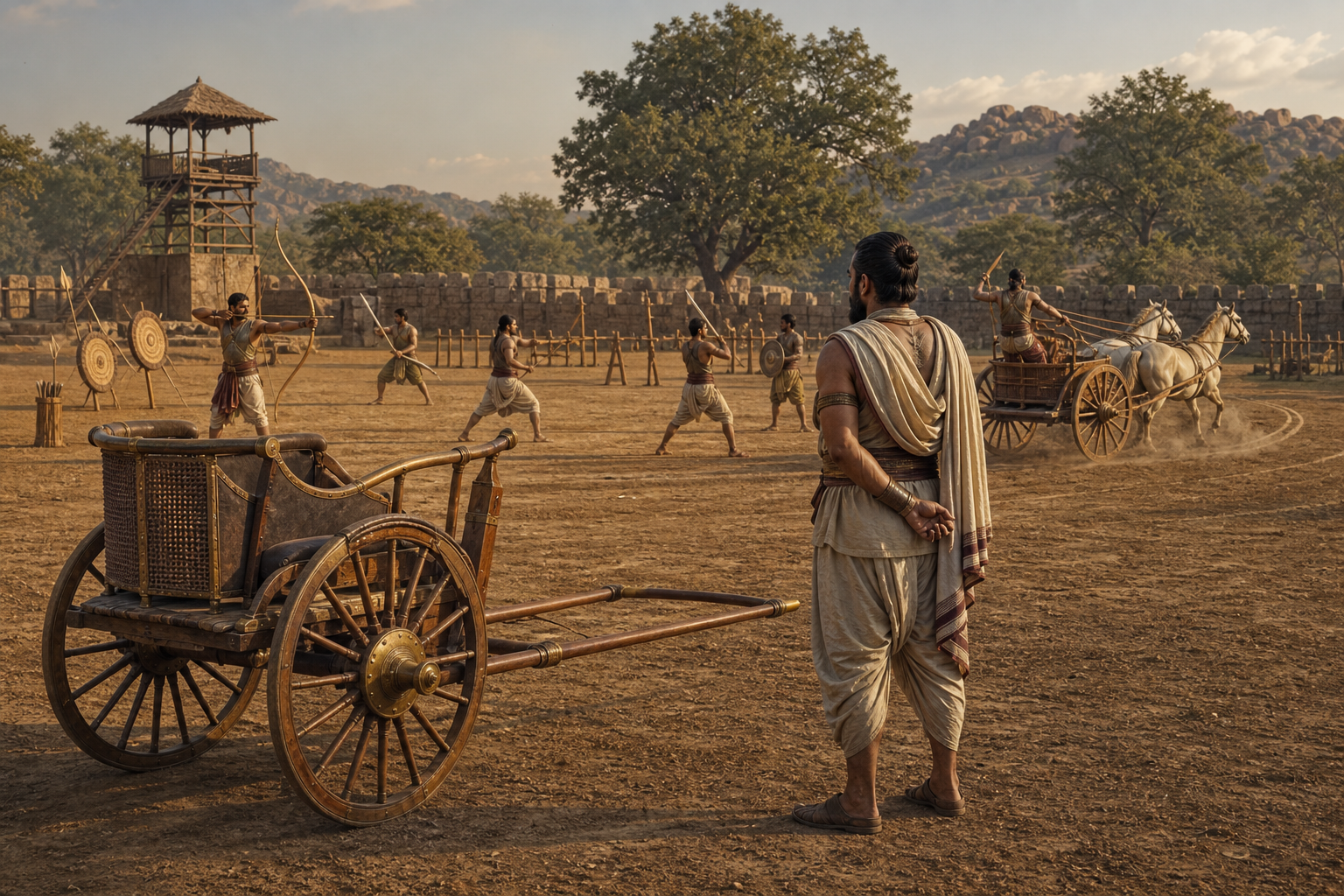
The first difficulty is linguistic. A ratha is a chariot, but Ratha can also denote a warrior class. Ancient Hindu military thought classified warriors by combat prowess, with Ratha representing a formidable class. The same word can therefore point either to equipment or to the assessed ability of the person using it.
In this article, lower-case ratha means the vehicle and capitalized Ratha means the classification. That capitalization is only an English reading aid. It should not be mistaken for a distinction built into the original script or assumed to appear in every translation.
| Use of the word | What it identifies | Clues in the passage |
|---|---|---|
| ratha | The chariot as a battlefield vehicle | Mounting, driving, movement, wheels, animals, damage, or loss of mobility |
| Warrior in a ratha | A fighter’s physical position or mode of deployment | The passage tells you where or how the person fights, but may not evaluate ability |
| Ratha | A prowess-based warrior classification | Naming, ranking, comparison, reputation, demonstrated skill, or an explicit judgment |
This yields a simple rule: occupying a chariot does not automatically prove that a warrior holds the Ratha classification. One statement describes deployment; the other evaluates capability. English translations can blur the difference by rendering both with similar language.
When the meaning is unclear, test it in four steps:
- Substitute the word chariot. If the sentence still describes movement, mounting, driving, or damage, the vehicle is probably meant.
- Substitute the phrase warrior grade. If the sentence is naming, comparing, or judging a fighter, the classification is more likely.
- Identify who makes the judgment. A narrator’s description, a commander’s assessment, and a rival’s boast do not carry the same evidentiary weight.
- Check the translation’s glossary and the surrounding passage. Do not let one isolated English word determine the entire hierarchy.
The classification expresses prowess, not a headcount formula
Ratha belongs to a system that distinguishes warriors by martial prowess. The safest interpretation is therefore qualitative: the label tells you that the warrior is regarded as seriously capable. It does not, by itself, provide an exact number of ordinary soldiers whom that person could defeat.
This matters because numerical conversions look precise even when the underlying passage has not supplied a number. A claim that one grade equals an exact quantity of fighters needs an explicit textual basis, together with the named text, passage, edition, and translation. Without those anchors, the arithmetic is an interpretation presented as a measurement.
A better method is to record what the narrative actually demonstrates. Look for evidence in four areas, while treating them as reading questions rather than a universal ancient checklist:
- Weapon control: Does the warrior remain accurate and effective while the chariot is moving or under pressure?
- Coordination: Does the fighter work effectively with the charioteer instead of acting as though the vehicle were a solitary platform?
- Composure: Does the warrior continue to make sound decisions when plans fail, mobility is threatened, or resistance stiffens?
- Battlefield effect: What changes because this warrior is present? Look for protection of allies, pressure on opponents, preservation of position, or another concrete tactical result.
Keep two columns in your notes: explicit and inferred. Place a directly stated classification, comparison, or feat in the first. Place your conclusion about what it implies in the second. This small discipline stops a reasonable inference from quietly becoming a supposed quotation or canonical rule.
Prowess-based classification also should not be confused with caste, family reputation, administrative office, or a modern military commission. Birth and lineage may matter elsewhere in a narrative, but the defining idea here is assessed combat ability. If a passage supplies additional criteria, retain them. If it does not, do not fill the gap with a rigid bureaucracy that the wording never establishes.
A Ratha fights through a battlefield system
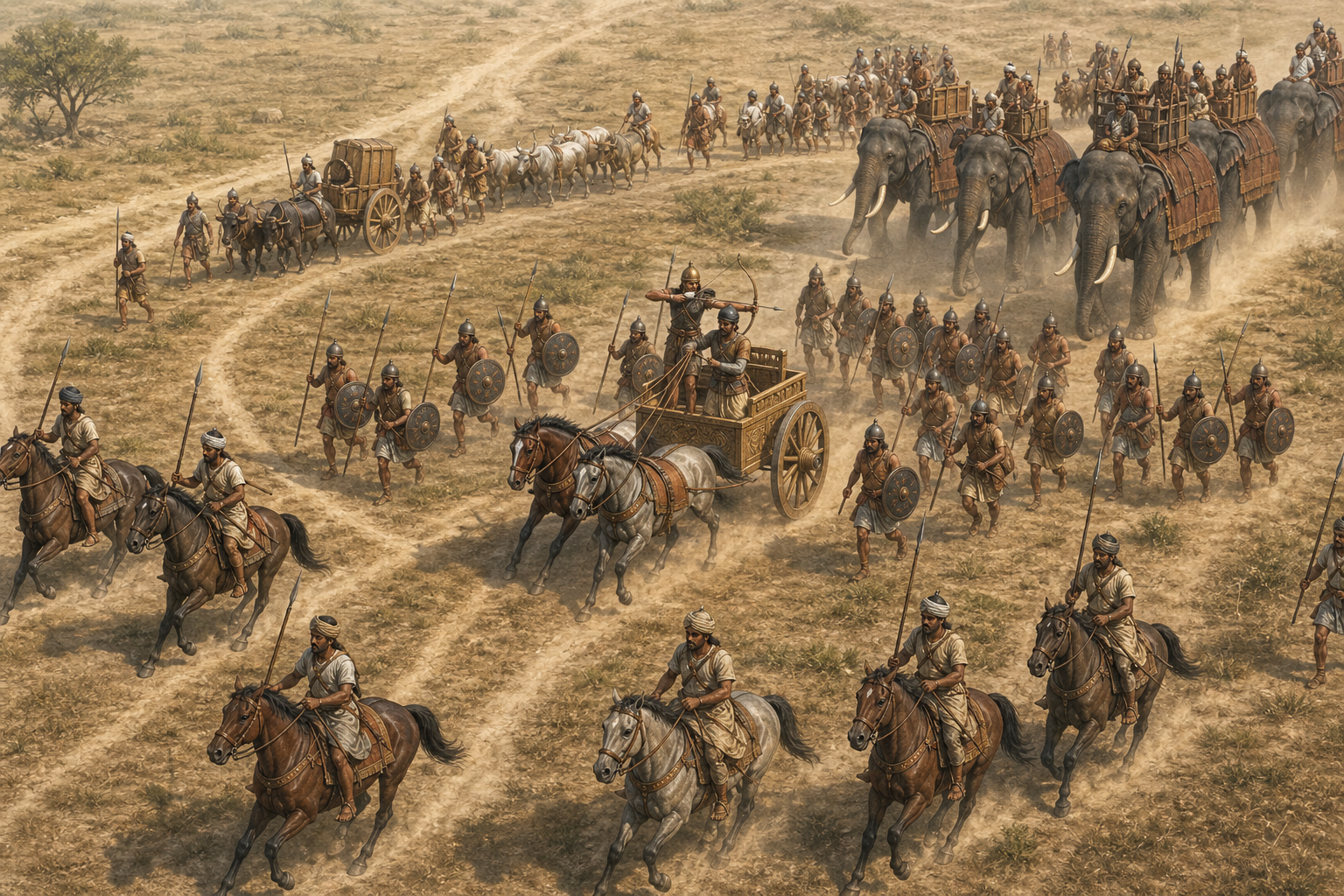
A chariot warrior is easy to imagine as a lone hero standing above the field. In practice, the fighting platform is a coordinated system. The combatant depends on a charioteer, a functioning vehicle, the animals that move it, enough space to manoeuvre, and conditions in which mobility can be maintained.
| Layer | What you should examine | Why it matters |
|---|---|---|
| Platform | Vehicle, motive animals, terrain, and room to move | These determine whether the chariot can deliver mobility at all |
| Crew | Warrior and charioteer | Movement, positioning, awareness, and attack must be coordinated |
| Combat evaluation | The warrior’s performance while using the system | This is the level at which a prowess classification becomes meaningful |
This distinction changes how you read a reversal. A broken wheel, disabled vehicle, lost driver, obstructed route, or exhausted team can remove the platform’s advantage without proving that the warrior lacked personal skill. Conversely, possessing an excellent chariot does not establish elite prowess. Equipment creates opportunity; performance supplies the evidence.
When a classified warrior is defeated, ask what failed. Was the combatant outmatched? Was mobility lost? Did coordination collapse? Did terrain neutralize the platform? Did several pressures converge? Ancient battle narratives become more intelligible when you stop reducing every outcome to a single scale of personal strength.
The same approach helps with comparisons between fighters using different modes of combat. Do not compare labels in a vacuum. Compare the task, weapons, mobility, support, terrain, and stage of the encounter. A classification expresses capacity, but capacity is always exercised under conditions.
Four common readings produce false hierarchies
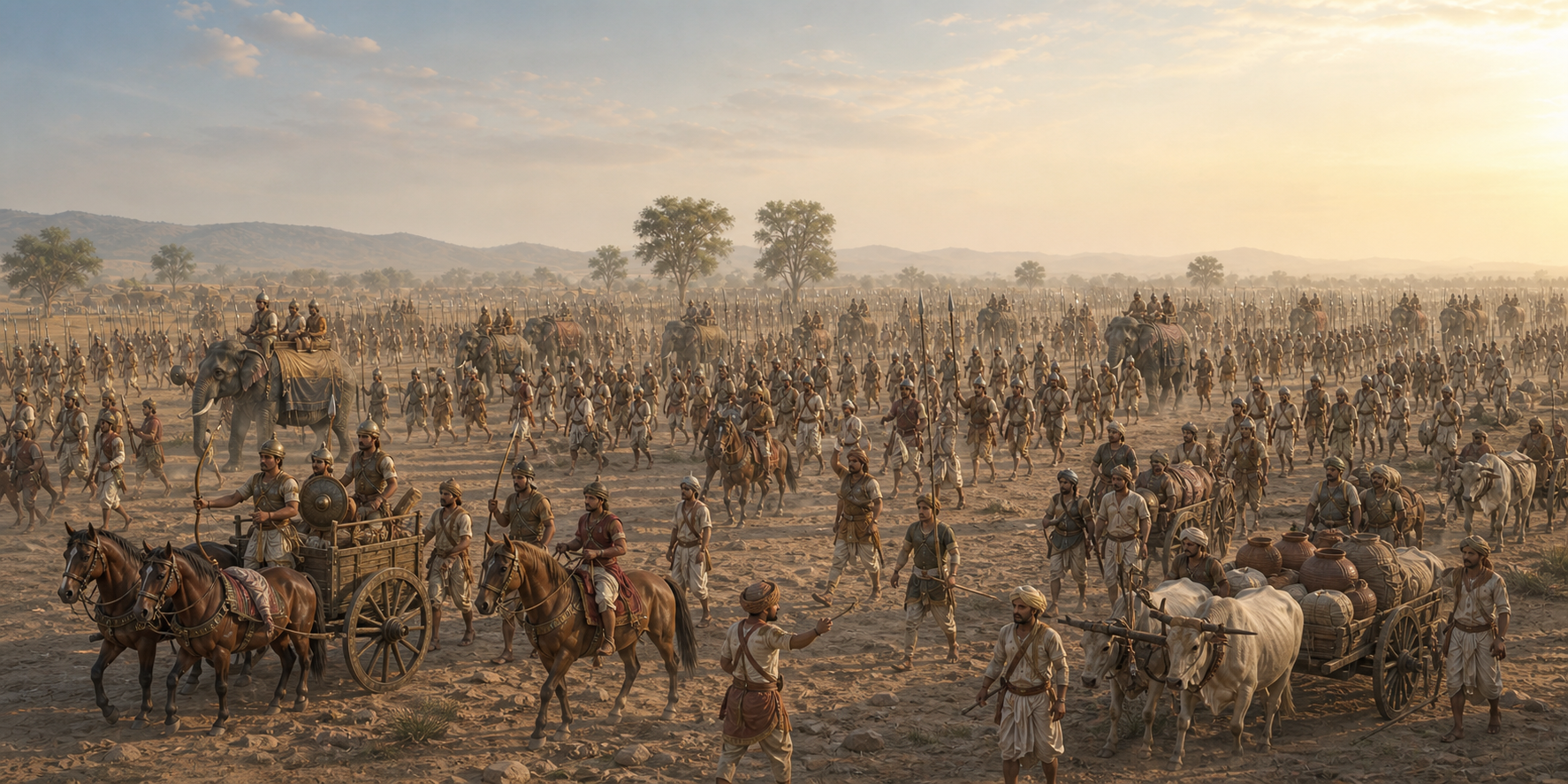
Every chariot fighter is treated as a classified Ratha
This mistake collapses equipment and evaluation into one category. A person can ride or fight from a ratha without the passage formally judging that person as a Ratha. Before assigning the classification, find the language of assessment rather than relying on the presence of the vehicle.
The label is converted into an exact numerical ratio
An exact ratio may look like the most useful definition, but precision must come from an identified passage, not from repetition. Ask where the number appears, which wording supports it, and whether it describes a universal rule or one context. If those questions cannot be answered, retain the qualitative meaning and omit the arithmetic.
A narrative judgment is treated as a permanent office
Modern ranks normally belong to an administrative structure with appointment, authority, and chain of command. A prowess label does not automatically establish any of those features. Use rank as convenient shorthand only if you make clear that the classification evaluates fighting ability. Do not infer command authority, pay, institutional seniority, or permanence from the word alone.
Martial excellence is mistaken for moral perfection
Ratha evaluates a warrior’s military capacity. It does not by itself certify righteous conduct, wise judgment, spiritual attainment, or loyalty to dharma. A highly capable fighter can still act from pride, anger, attachment, or an unrighteous cause.
This is an especially important Dharmic distinction. Kshatra is not merely the possession of force; it raises the question of how force is governed and for whose protection it is used. Read the martial classification and the ethical judgment on separate lines. Only then can you see whether prowess serves dharma or becomes dangerous because it has been detached from restraint.
Key takeaways
- A ratha is a chariot, while Ratha can function as a prowess-based warrior classification.
- Fighting from a chariot does not automatically prove that a person holds the classification.
- The label conveys formidable martial capacity, but it does not supply an exact enemy-count ratio unless a specific passage explicitly provides one.
- Judge a chariot encounter at three levels: the platform, the crew, and the combatant’s demonstrated performance.
- Do not turn Ratha into a statement about caste, permanent command authority, or moral perfection without separate evidence.
The next time you examine a battle passage, mark each occurrence of ratha as vehicle, classification, or uncertain. Record who makes any evaluation and what performance supports it. That brief annotation will give you a more defensible reading than an elaborate hierarchy assembled from labels alone.
References
