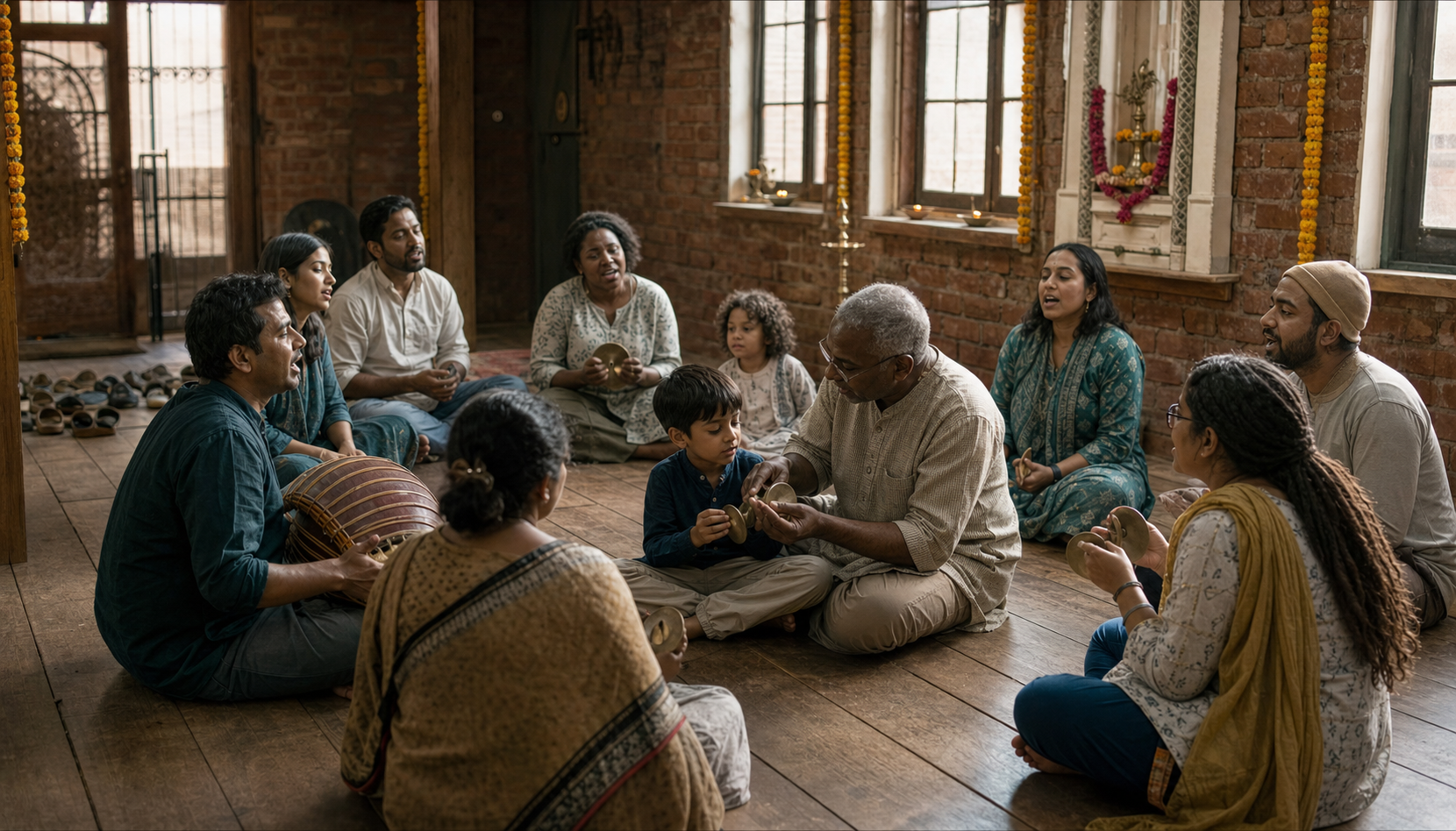
ISKCON’s sixtieth anniversary placed an administrative act from 1966 beside the devotional life that followed from it. The resulting picture is not simply a celebration of institutional longevity; it is an opportunity to ask how a founding mission becomes durable without losing its spiritual purpose.
The supplied account of Anniversary Week connects incorporation, scripture, congregational practice, publication, sacred places and community responsibility. Read together, these elements suggest that ISKCON’s future vision is best understood as a test of coherence: whether its institutions continue to serve the purposes for which they were created.
Two July dates illuminate one founding process
The source reports that Day 6 of ISKCON’s 60th Anniversary Week was held on Saturday, July 11, 2026, with HH Radhanath Swami and Yadunath Das participating in an evening centered on a play about the society’s incorporation. The date recalled July 11, 1966, when attorney Stephen Goldsmith reportedly gathered trustees’ signatures at the Lower East Side storefront where A.C. Bhaktivedanta Swami Prabhupada was teaching.
That signing date should be distinguished from July 13, 1966. According to the chronology presented in the source, the latter was when the certificate of incorporation and its objectives were registered with New York State. The two dates therefore mark different stages of the same development: people first committed themselves to a shared legal undertaking, and the state then formally recognized the organization.
This distinction gives the anniversary unusual depth. ISKCON’s theology and devotional practices did not originate in a corporate filing, but incorporation provided a continuing public vehicle for them. A legal society could hold property, maintain facilities, publish literature, assign responsibilities and continue beyond the circumstances of its earliest participants. The anniversary consequently joins spiritual inheritance to the practical demands of stewardship.
The source also notes an important evidentiary limit: the published program did not include a transcript. Specific teachings or arguments should therefore not be attributed to Radhanath Swami on the basis of the available material. What can be assessed is the documented design of the commemoration and the founding framework it brought into focus.
Key takeaways from the anniversary frame
- ISKCON’s founding was both devotional and institutional: an existing spiritual mission acquired a durable legal form.
- The reported July 11 signing and July 13 registration are complementary milestones, not rival founding dates.
- The seven purposes connect teaching and scripture with chanting, community, sacred places, daily conduct and publication.
- A sixtieth anniversary becomes forward-looking when the founding purposes are used to evaluate present institutional life.
The seven purposes form an interconnected mission
As summarized in the source from ISKCON’s constitutional materials, the society’s seven purposes cover systematic spiritual education; the presentation of Krishna consciousness through the Bhagavad-gita and Srimad-Bhagavatam; the formation of a community whose members draw closer to Krishna and one another; the teaching and encouragement of sankirtana; the establishment of places dedicated to Krishna; the promotion of a simpler and more natural pattern of life; and the publication and distribution of books and other writings.
The significance lies not only in the individual purposes but in their interdependence. Scripture gives the movement a body of knowledge, while education and publishing make that knowledge transmissible. Congregational chanting turns teaching into shared practice. Community gives relationships and continuity to that practice. Sacred places provide stable settings for worship, learning and memory. A disciplined pattern of living asks participants to carry religious commitments into ordinary conduct.
This architecture also exposes the limits of measuring success through visibility or expansion alone. Publishing without careful education can circulate texts without cultivating understanding. Public chanting without strong community relationships can remain episodic. Buildings can preserve heritage while becoming detached from accessible teaching. Conversely, inward-looking community life can lose the public and educational dimensions written into the founding purposes.
For that reason, the charter can function as more than a historical artifact. It supplies questions for institutional accountability: whether education changes understanding and conduct, whether communal worship deepens care, whether sacred spaces remain welcoming places of formation, whether publications retain intellectual seriousness, and whether governance supports rather than obscures the mission.
New York’s devotional geography made memory tangible
The anniversary program reportedly moved among three nearby Manhattan settings with different historical meanings. Matchless Gifts at 26 Second Avenue preserves the modest storefront associated with ISKCON’s emergence. Tompkins Square Park recalls the movement’s early public chanting. The Bhakti Center at 25 First Avenue represents a later urban institution shaped by the same devotional tradition.
The source clarifies that although the Day 6 recording appeared through the ISKCON 26 2nd Avenue @Matchless Gifts channel, the larger Saturday evening program was scheduled at the Bhakti Center. That relocation did not detach the event from the founding site. It placed the original storefront and a subsequent center in conversation, allowing participants to encounter institutional continuity within a small physical area.
Other reported features of the week included visits to Matchless Gifts, recollections from senior devotees, harinama connecting the storefront with Tompkins Square Park, classes, kirtan and prasadam. Drama contributed another mode of remembrance. A legal document records dates, names and objectives; a performance can help an audience consider the uncertainty and human choices behind formal incorporation without treating administration as separate from devotional history.
This combination of site, sound, teaching, performance and shared food mirrors the range of the seven purposes. The anniversary communicated history through participation rather than relying entirely on ceremonial speeches. Manhattan itself became part of the lesson: a founding room, a public park and a later community institution showed how a mission can move from fragile beginnings into sustained civic presence.
The next sixty years depend on fidelity with adaptation
Viewed through the material reported by the source, ISKCON’s anniversary vision is not a separate program imposed upon its history. It arises from applying the founding purposes to changing circumstances. Legal structures, buildings, publications and digital broadcasts are instruments; their value depends on whether they deepen scriptural understanding, devotional practice, ethical community and responsible public service.
The central challenge is therefore to preserve continuity without confusing preservation with immobility. New media, institutions and cultural settings may change the manner in which the mission is expressed, while the seven purposes provide criteria for judging those adaptations. The strongest continuation of the 1966 vision will be an institution capable of remembering why it was formed while repeatedly examining how well its present life embodies that reason.