

Four questions are often compressed into one human-origins debate: where Homo sapiens emerged, how populations dispersed, whether different human forms coexisted, and what any of this means for Vedic tradition or the Aryan migration controversy. The Dandavats essay supplied for this article moves among all four, but separating them reveals which conclusions follow from its evidence and which require additional argument.
Only one source article, ending partway through its discussion, was provided. Cross-publication corroboration is therefore not possible here. The useful synthesis is instead a critical comparison of the scientific models, historical claims and scriptural implications presented within that source, with its reported specifics clearly distinguished from general analytical framing.
Three models that answer different questions

The essay presents Out of Africa as the view that fully developed modern humans first appeared in Africa, later expanded through the Middle East and India, and largely replaced other human populations. It reports an African emergence between 200,000 and 500,000 years ago and an outward expansion between 80,000 and 125,000 years ago. These figures are claims reported by Dandavats, not independently verified dates in the supplied material.
Against this account, the essay invokes a multiregional theory and what it calls a simultaneous multi-species view. These are not interchangeable alternatives. A multiregional argument concerns where modern human characteristics developed. Simultaneous existence concerns whether more than one kind of human or humanlike being occupied the world during the same period. Coexistence alone does not identify the geographic origin of modern humans.
This distinction is crucial. Evidence that Homo erectus, Neanderthals and modern humans overlapped would challenge a simple story in which one form neatly followed another. It would not, by itself, demonstrate that modern humans originated independently in several regions. Nor would an old humanlike fossil outside Africa necessarily be evidence of an old modern human outside Africa. Its classification, dating context and relationship to later populations would all matter.
What the source’s fossil narrative does and does not show
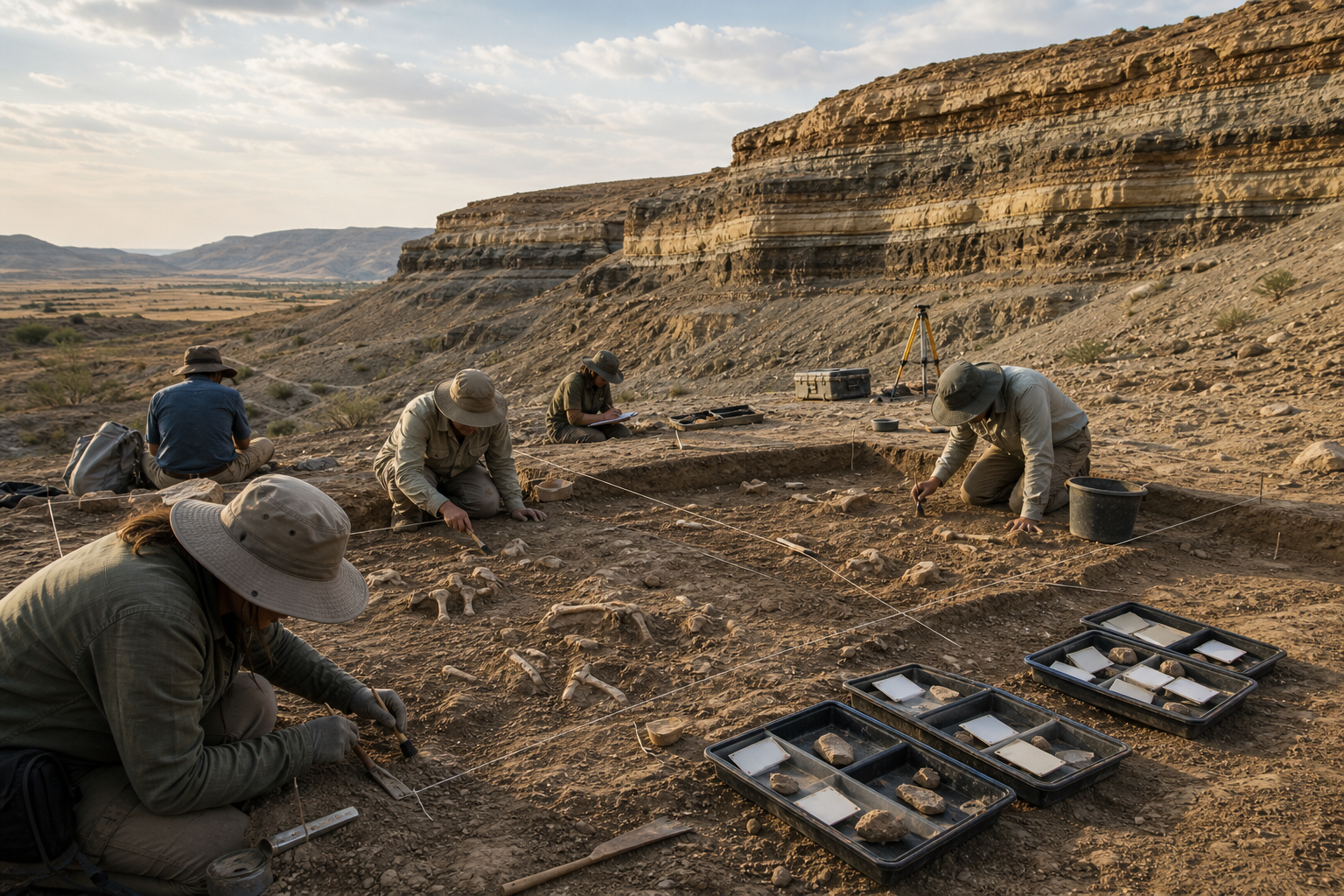
Dandavats describes skulls from Herto, Ethiopia, attributed to two adults and a child and dated in the essay to about 160,000 years ago. It reports that the discovery was discussed in Nature and relays the interpretation of Clark Howell of the University of California, Berkeley: the remains were regarded as non-Neanderthal and as evidence that modern humans had developed in Africa before European Neanderthals disappeared. Within the essay’s own presentation, this finding supports an African origin more directly than it supports a multiregional alternative.
The article also reports that discoveries of early Homo sapiens in deposits older than 150,000 years weakened the former placement of classic Western European Neanderthals as direct ancestors of modern humans. More broadly, it emphasizes that fossil classifications and evolutionary timelines have been revised as new remains have entered discussion. That is a reasonable methodological caution: a scientific model is assessed through accumulating evidence rather than protected from revision.
However, the essay proceeds to the much stronger assertion that modern human skeletons may extend into the Pliocene or Miocene, which it identifies as roughly 5 to 25 million years ago. It invokes a 1984 statement by anthropologist Frank Spencer about skeletal evidence prompting researchers to modify their views. The supplied excerpt does not present the particular specimens, dating arguments or independent publications needed to evaluate that extraordinary extension, and no second source was provided to corroborate it.
The source therefore uses evidence of unequal scope. Its Herto discussion concerns a particular discovery interpreted within an African-origin account. Its claim about modern humans existing millions of years ago is far broader and remains unsupported within the supplied material. Placing both under the general observation that scientific views change does not make them evidentially equivalent.
The Aryan and Vedic questions require separate arguments

The essay argues that Out of Africa can help contradict the Aryan Invasion Theory. In its account, modern humans moved from Africa through the Middle East to India and subsequently spread in multiple directions, including toward Europe. Yet a model of species-level origin cannot, on its own, decide a much later question about the movement of languages, cultural practices or historically identified populations.
Remote biological ancestry and civilizational history are different levels of explanation. A population could have distant African ancestry while a culture developed locally over a later period. Conversely, later population movement would not change the geographic account of the species’ much earlier emergence. The merits of Aryan migration, invasion or indigenous-development claims must therefore rest on evidence appropriate to those claims, rather than being inferred directly from a human-origins model.
The Vedic side of the comparison is even less developed in the supplied excerpt. Dandavats says that multiregional development and simultaneous human species appear closer to the Vedic version, but the provided text does not identify a Vedic passage, Sanskrit term, translation or interpretive tradition that establishes the proposed correspondence.
A rigorous comparison would need to specify what the relevant text means by a human being, whether its account is intended as material history, cosmology, theology or some combination, and how its categories are supposed to correspond to paleoanthropological classifications. Without that bridge, similarity remains an interpretive suggestion rather than a demonstrated agreement between scripture and fossil evidence.
The distinction need not force an artificial choice between science and Vedic thought. If a scriptural claim concerns metaphysical meaning, fossils may neither prove nor disprove it. If it is presented as a claim about material chronology or geographic origins, then its proposed correspondence can be examined using the same care applied to other historical claims. The important step is to identify the kind of claim before comparing evidence.
Key takeaways
- Keep the emergence of modern humans, their dispersal, the coexistence of human forms and later cultural migration as distinct questions.
- Do not treat evidence for several contemporaneous human forms as automatic evidence for multiregional origins.
- Read the Herto dates and other chronology in this article as claims reported by Dandavats, not as independently corroborated findings.
- Do not use a remote species-origin model by itself to settle the Aryan migration or indigenous-culture debate.
- Require identifiable Vedic texts and an explicit mapping of categories before describing a scientific model as the Vedic view.
A stronger future comparison would place primary fossil and genetic research beside clearly cited Vedic passages and competing interpretations. That would allow genuine points of agreement, difference and non-overlap to emerge without asking either scientific taxonomy or sacred literature to answer a question it was not framed to address.