
If you have been told either that ancient India had no history, or that devotion requires you to accept every traditional narrative as a modern chronicle, you are being handed a false choice. You need a way to respect Dharmic memory without lowering the standards of evidence.
There is a workable method: identify what kind of record you are reading, separate the claims it makes, and then look for convergence. You can take India’s civilizational memory seriously without forcing every text to perform a job it was never composed to do.
Replace the question of history versus myth
Historiography is more than a collection of facts. It is the way a civilization selects, preserves, orders, and interprets its past. A modern archive-driven history usually puts chronology, authorship, documentary provenance, and causal reconstruction near the centre. Dharmic traditions preserved those things selectively while also asking what the past reveals about Dharma, karma, liberation, right conduct, and legitimate rule.
That difference of emphasis produced a serious colonial misreading. When continuous linear chronicles were treated as the only evidence of historical consciousness, India appeared deficient. Yet the surviving landscape includes stone inscriptions, copper-plate charters, coins, manuscript colophons, genealogies, chronicles, temple records, and rigorously transmitted oral traditions. The problem was never a complete absence of memory or recordkeeping. It was the assumption that every civilization must organize memory in the same literary form.
The opposite reaction is no better. A narrative’s sacred authority, ethical depth, or long transmission does not automatically prove every date, genealogy, and event in the modern historical sense. Reverence and verification answer different questions. Neither needs to destroy the other.
When you encounter a claim about India’s past, separate three issues before deciding whether to accept or reject it:
- Historical claim: What person, place, date, institution, event, or sequence is being asserted?
- Mode of preservation: Was it carried by an inscription, coin, manuscript, recited lineage, genealogy, epic, chronicle, or later commentary?
- Dharmic meaning: What judgment about conduct, sovereignty, causality, community, or liberation does the memory convey?
This separation prevents two common mistakes. You will not dismiss an ethically shaped narrative merely because it is not an annal, and you will not use its ethical power as a substitute for evidence about a disputed date.
Identify the kind of memory before weighing its claims
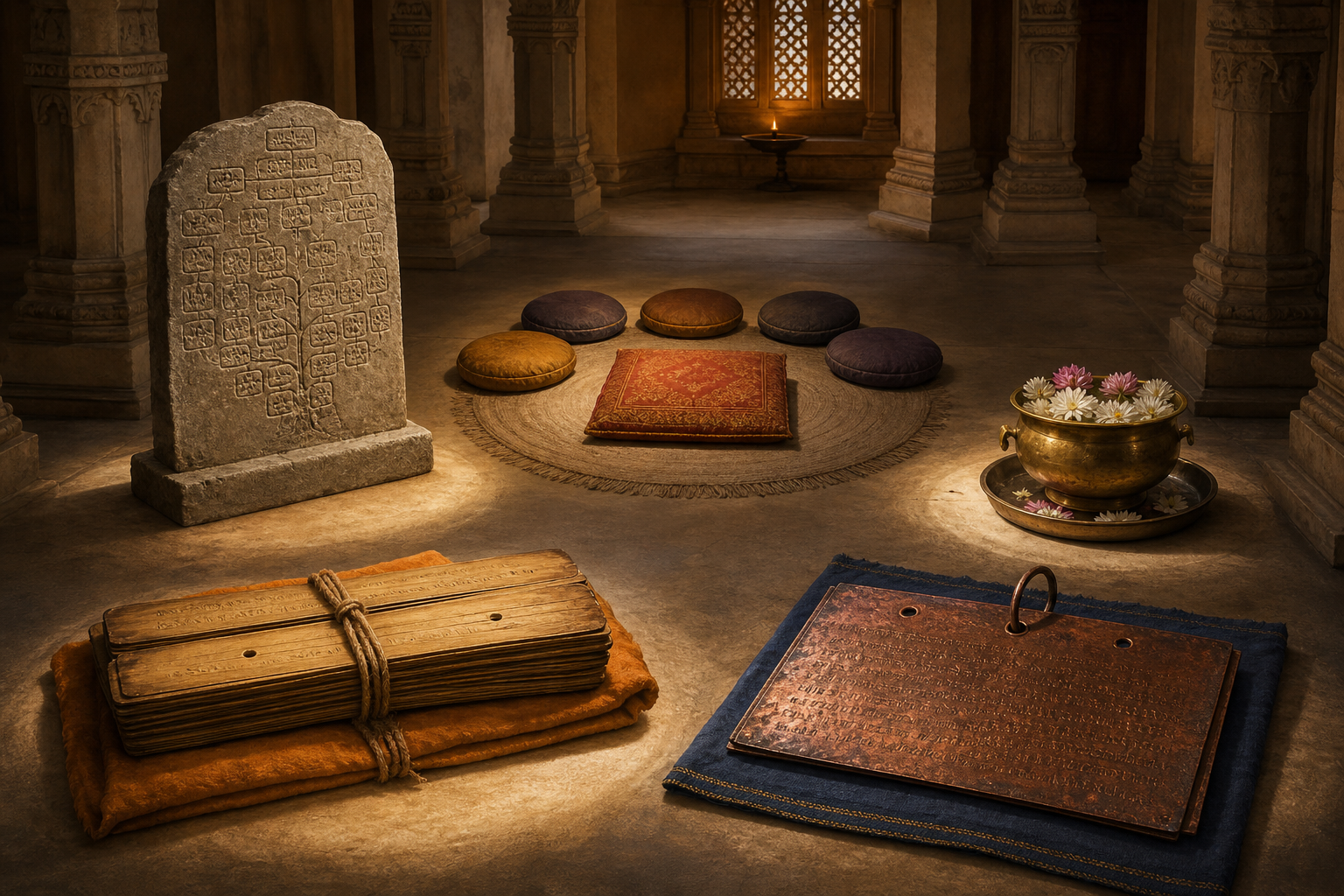
Genre is your first control against misreading. It tells you what a work was designed to preserve and what kind of precision you can reasonably demand. The distinctions below are starting presumptions, not rigid boxes; Indian works often combine several functions.
| Material or genre | Its characteristic work | The useful question to ask | The common misreading |
|---|---|---|---|
| Itihasa | Places remembered events and characters within questions of Dharma, karma, loyalty, justice, and consequence | Which moral conflict is being made thinkable, and which concrete memories can be checked separately? | Demanding a continuous annal, or treating moral authority as proof of every historical detail |
| Purana | Joins cosmology, genealogy, sacred geography, dynastic continuity, and moral exemplars | What lineage, place, relationship, or civilizational continuity may lie within the normative frame? | Assuming that every layer has uniform chronological precision |
| Shastra | Sets out principles, methods, norms, and disciplined bodies of knowledge | What rule or ideal is being prescribed, and what institutions would be needed to apply it? | Reading a prescription as a complete description of daily practice in every place and period |
| Inscription or copper-plate charter | Records titles, grants, boundaries, tax arrangements, endowments, obligations, and political claims | Who issued it, who benefited, what legal or sacred act did it establish, and what rhetoric supports that act? | Treating an official claim or royal praise as a neutral account of everything that happened |
| Coin | Preserves names, titles, symbols, authority, and evidence of economic networks | What narrow claim does the object support about issuer, symbolism, political reach, or exchange? | Building a detailed political narrative from an object that supports only a limited inference |
| Chronicle or vamshavali | Orders rulers, lineages, successions, and remembered events across time | What earlier records, oral accounts, or institutional interests shaped the sequence? | Assuming that chronological form eliminates selection, praise, blame, or moral judgment |
| Oral and commentarial lineage | Stabilizes recitation, teaching, interpretation, and community memory through disciplined transmission | What was preserved precisely: sound, wording, doctrine, ritual procedure, lineage, or event detail? | Confusing precision of recitation with precision of biography and dating |
The last distinction matters especially for Vedic material. Techniques such as pada-patha and krama-patha protected verbal and sonic fidelity through structured recitation. That achievement supports confidence in the transmission of what those methods preserved. It does not, by itself, supply an author’s biography or an exact date that the tradition did not set out to preserve.
The same discipline applies across the Dharmic family. Hindu memory often orders the past around Dharma and moksha; Buddhist lineage around Dhamma and nirvana; Jain narrative around karma, restraint, the Tirthankaras, and kevala; and Sikh remembrance around Gurmat, Shabad, truthful living, and seva. You should therefore ask not only what was remembered, but why a community needed to remember it.
Build historical confidence through converging evidence
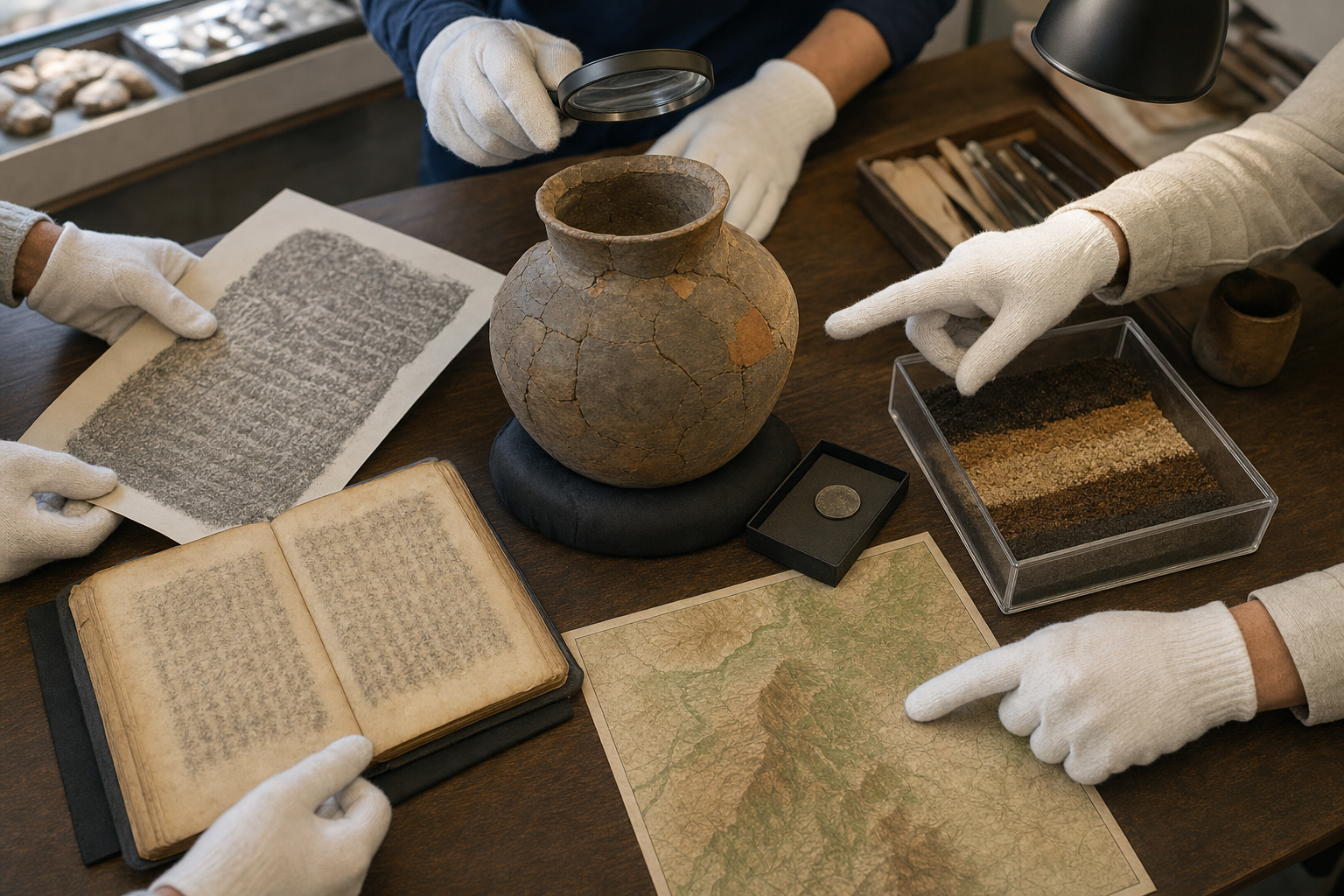
No single class of material should carry more weight than its purpose allows. A practical investigation moves from the smallest claim outward:
- Write the claim in one testable sentence. Replace a sweeping statement such as a ruler controlled all of a region with narrower propositions: a charter was issued there, a title was claimed there, a coin circulated there, or a lineage remembered the ruler there.
- Classify the claim. Decide whether it concerns a date, event, genealogy, geography, institution, textual layer, ethical teaching, or later cultural memory. Evidence strong for one category may be weak for another.
- Identify genre and purpose. A royal prashasti praises; a grant establishes rights; a Shastra prescribes; a Purana joins lineage to sacred order; an epic explores conduct through narrative. Purpose does not make a record useless, but it tells you where exaggeration, compression, or selectivity may enter.
- Extract concrete anchors. Note personal names, regnal titles, eras, tithis, nakshatras, places, boundaries, donors, lineages, languages, tax terms, and institutions. Keep these anchors separate from the interpretation placed around them.
- Look for convergence. Compare inscriptions with coins, manuscript colophons, archaeology, genealogies, and relevant Greek, Chinese, or Persian testimony. First check whether the records are genuinely distinct or merely repeat the same inherited account.
- Label the result honestly. Use categories such as well anchored, plausible historical core, primarily normative memory, or unresolved. Confidence can differ within one narrative: its geography may be durable while its absolute chronology remains uncertain.
Consider the Allahabad Pillar prashasti. Its ornate praise supplies valuable information about Samudragupta and his campaigns, but its eulogistic form is part of the evidence, not an inconvenience to be ignored. It strongly establishes how royal power wished to present itself. The precise scope of each political claim still has to be tested against other material.
Ashoka’s edicts require a different reading. Their use of Prakrit, with Greek and Aramaic in some regions, gives concrete evidence of public communication across a varied realm. Their emphasis on Dhamma, compassion, restraint, and ethical governance shows what Ashoka chose to make publicly memorable. They are therefore direct evidence of royal moral policy and self-presentation, but they are not a complete personal biography.
This method also keeps silence in proportion. If a record does not mention an event, that absence may matter, but it is not automatically disproof. Ask whether the event fell within that record’s purpose, place, period, and intended audience. Silence becomes stronger evidence only when the missing fact is something the record would reasonably have been expected to include.
Read moral purpose and chronological precision together
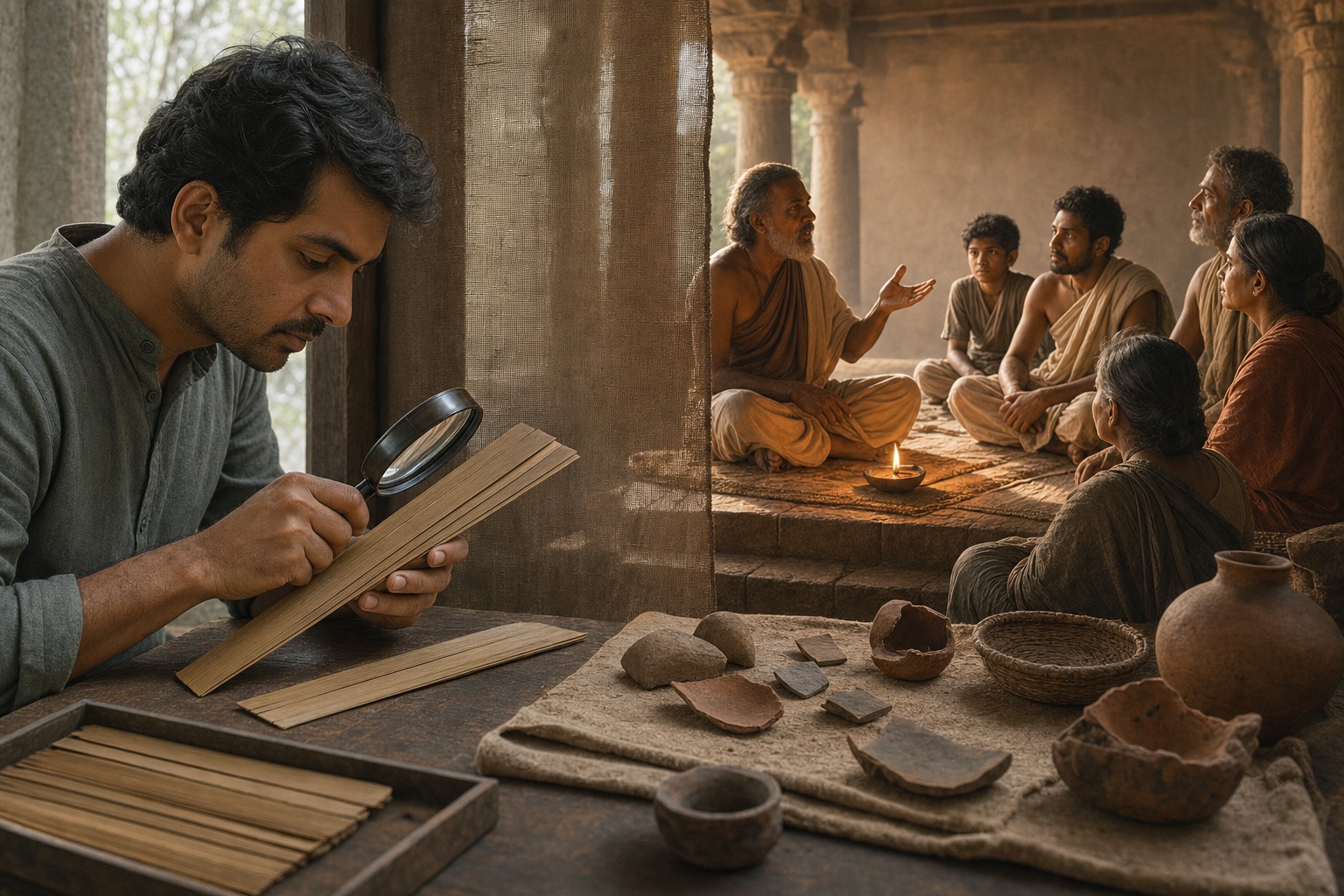
Moral framing can carry historical information
Dharmic historiography often makes the past answerable to a moral order. That does not turn every narrative into fiction. It means factual recollection and ethical interpretation may occupy the same work.
Kalhana’s Rajatarangini is a particularly useful example. Composed in Kashmir in the 12th century, it drew upon earlier chronicles, vamshavalis, inscriptions, and oral accounts while applying critical judgment to a long political sequence. Yet chronology did not displace moral evaluation. Rulers and events remained subject to judgment. The work demonstrates that sequence and significance could be pursued together.
Buddhist, Jain, and Sikh traditions likewise organized memory around the life of a teaching community. The Dipavamsa and Mahavamsa connect Buddhist lineage, monastic discipline, and kingship. Jain works including the Kalpasutra and Parishishtaparvan use lineage and karmic biography to preserve ideals of ahimsa, restraint, and liberation. Sikh janam-sakhis and community memory place remembered lives within Gurmat, while the Guru Granth Sahib keeps Shabad at the centre of religious authority.
When reading any ethically formed account, ask three questions. What concrete information survives inside the moral frame? Which conduct is being praised or condemned? Which community or institution benefited from preserving that lesson? These questions let you examine purpose without assuming that purpose cancels fact.
Exact timekeeping existed where exactness was needed
Cyclical ideas of time – yugas, manvantaras, and kalpas – existed alongside practical systems for ritual, agriculture, administration, and astronomy. Eras such as Vikrama Samvat and the Shaka era, together with tithis and nakshatras, allowed events and observances to be located precisely within calendrical systems. Aryabhata, Varahamihira, and Brahmagupta refined computation, calendars, and models of planetary motion. The selective dating of narratives therefore cannot be explained simply as an inability to calculate time.
The safer conclusion is narrower: chronological narration was not always the highest literary priority. Where land rights, ritual timing, taxation, or endowments depended on precision, Indian records could preserve dates, boundaries, revenue categories, obligations, places, and lineages. Where liberation, righteous conduct, or civilizational continuity was central, chronology could become subordinate to meaning.
You should carry this distinction into debates over the Ramayana, Mahabharata, and Puranic genealogies. Do not treat an absent exact date as proof that nothing historical was remembered. Do not treat a genealogy’s sacred setting as proof that every generation can be converted directly into an absolute chronology. Break the question apart: sequence, identity, geography, textual layer, and date each require their own support.
Living redaction adds another layer. Multiple recensions of the Ramayana and Mahabharata reflect transmission, adaptation, and interpretation across places and communities. Attribution to Vyasa can signify the role of arranger or synthesizer rather than the modern idea of one biographical author producing a fixed text at one moment. A critical edition helps with textual comparison and reconstruction; it does not replace archaeological or epigraphic evidence for an event.
Apply the same care to manuscript dates. A dated colophon can establish when and where a particular manuscript was copied and may name a scribe or lineage. Do not silently turn that copying date into the date of the work’s first composition. Record each date beside the precise thing it dates.
Key takeaways: a six-question test for any historical claim
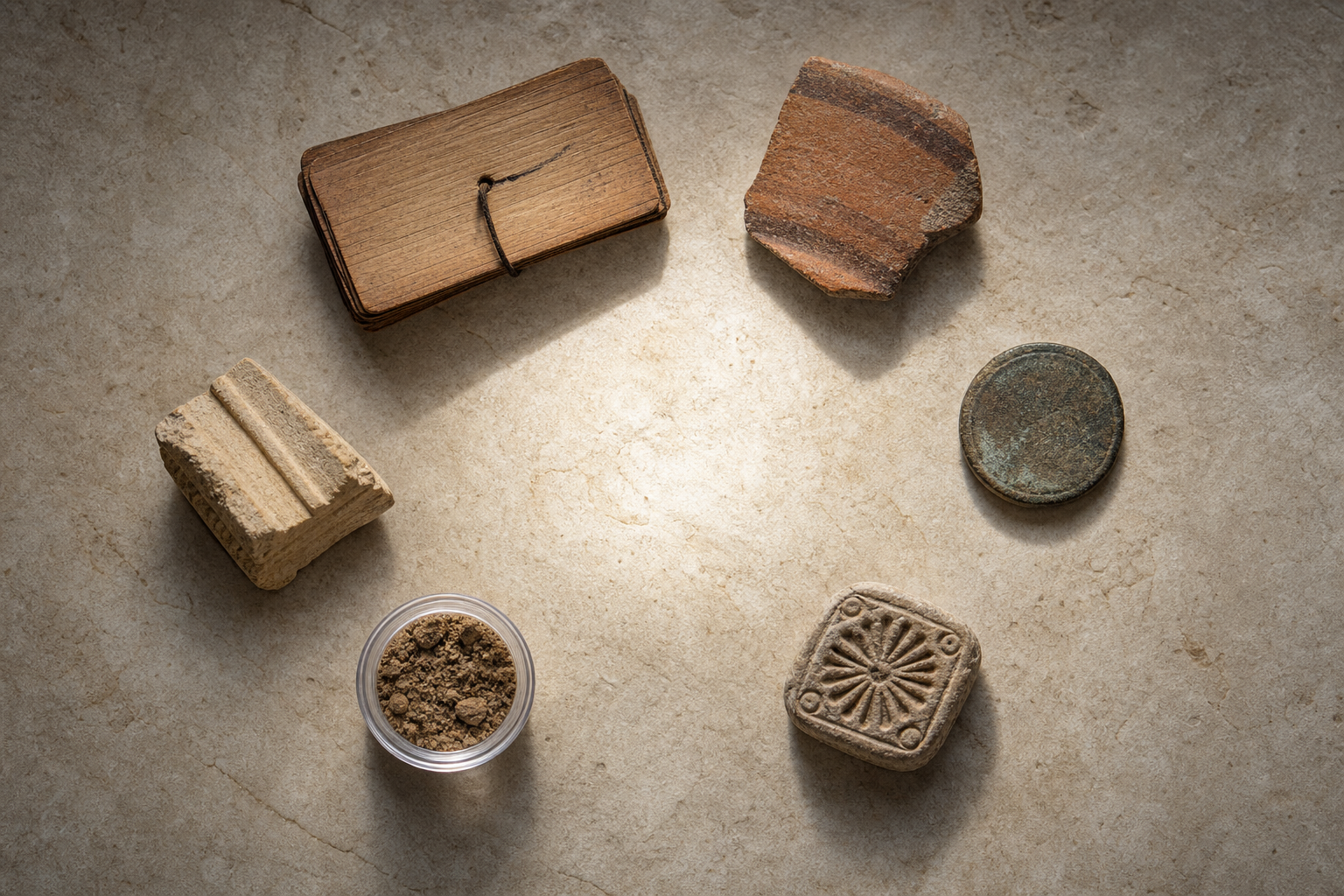
Before you share, defend, or reject a claim about Dharmic India, run it through this test:
- What exactly is being claimed? Separate event, date, person, lineage, geography, institution, textual history, and ethical meaning.
- What kind of record carries it? Identify whether you have Itihasa, Purana, Shastra, inscription, charter, coin, chronicle, genealogy, colophon, oral memory, or commentary.
- What was that record meant to do? Look for praise, prescription, legal confirmation, ritual continuity, community formation, moral instruction, or liberation-oriented teaching.
- Which details are directly anchored? List names, titles, dates, languages, places, boundaries, donors, recipients, and institutional acts without adding conclusions.
- What genuinely distinct evidence converges? Seek support across epigraphy, numismatics, manuscripts, archaeology, lineage records, and relevant testimony beyond India.
- How strong is the final conclusion? Say whether it is well anchored, a plausible core, principally normative memory, or unresolved. Do not make the conclusion broader than the evidence.
Use this test on one claim at a time, and keep your notes divided into evidence, interpretation, and confidence. When a claim survives, defend it precisely. When uncertainty remains, name it without embarrassment. That discipline is how you protect Dharmic memory from both casual dismissal and careless overstatement.
References
