

You may have arrived here after encountering two incompatible claims: ancient Bharat possessed every modern science, or Indian learning was mostly mystical until Europe supplied reason. Accept either frame and you lose the strongest case for the Dharmic knowledge traditions.
The sounder approach is to separate documented achievement from disputed chronology, and meaningful philosophical comparison from claims of scientific equivalence. That lets you defend India’s place-value decimal system, formal use of zero, algebraic methods, sine tables, and systematic astronomical computation without turning civilizational respect into an exemption from evidence.
Key takeaways
- Separate five questions that are often collapsed: what a text contains, when it was composed, whether its method was original, how it travelled, and whether it resembles a modern theory.
- Treat colonial or theological bias as evidence about the framing of a debate, not as proof that every disputed Indian chronology must be correct.
- Place each proposition in one of three boxes: well supported, genuinely contested, or a category error. Do not let pride or prejudice move it between boxes.
- Use Indian categories such as śāstra, darśana, and pramāṇa when they clarify how knowledge was organized and validated.
- Apply the same burden of proof to claims of Indian priority and European priority. Equal standards are more valuable than either automatic reverence or automatic suspicion.
Start with a claim narrow enough to test
The sentence "Vedic science was advanced" is too broad to evaluate. It might refer to a mathematical algorithm, a planetary table, a metaphysical account of consciousness, a ritual calendar, or the age assigned to a text. Those are different claims and require different evidence.
Before accepting or rejecting an impressive assertion, rewrite it so that you can answer five questions:
- What is the object? Name the text, table, rule, algorithm, commentary, inscription, or philosophical argument. "The Vedas" is not a substitute for identifying a passage, and "Indian tradition" is not a bibliographic reference.
- What does it actually do? Describe the operation before describing its importance. An arithmetic procedure, an eclipse calculation, and an account of ultimate reality do not make the same kind of claim.
- What date is being asserted? Distinguish the date represented inside a calculation from the composition of the work, its later revision, and the earliest securely attested form available to historians.
- What kind of priority is at issue? Independent invention, early attestation, refinement, preservation, and transmission are all significant, but they are not interchangeable.
- What conclusion follows? A successful astronomical calculation establishes technical competence. It does not, by itself, establish every traditional date attached to the work or validate an unrelated metaphysical doctrine.
Consider the statement that Indian astronomical tables prove an extremely early observational epoch. The tables can display real mathematical sophistication even if their dating remains disputed. John Playfair argued that their internal consistency and astronomical parameters implied long observation, while John Bentley maintained that later scholars could have calculated backward from more recent observations. The responsible claim therefore has two parts: the computational tradition was sophisticated, while the antiquity inferred from its tables was contested.
This separation protects a genuine achievement from an avoidable all-or-nothing argument. If a proposed date weakens, the mathematics does not disappear. If the mathematics is impressive, the date does not become certain by association.
The European encounter mixed evidence with inherited limits
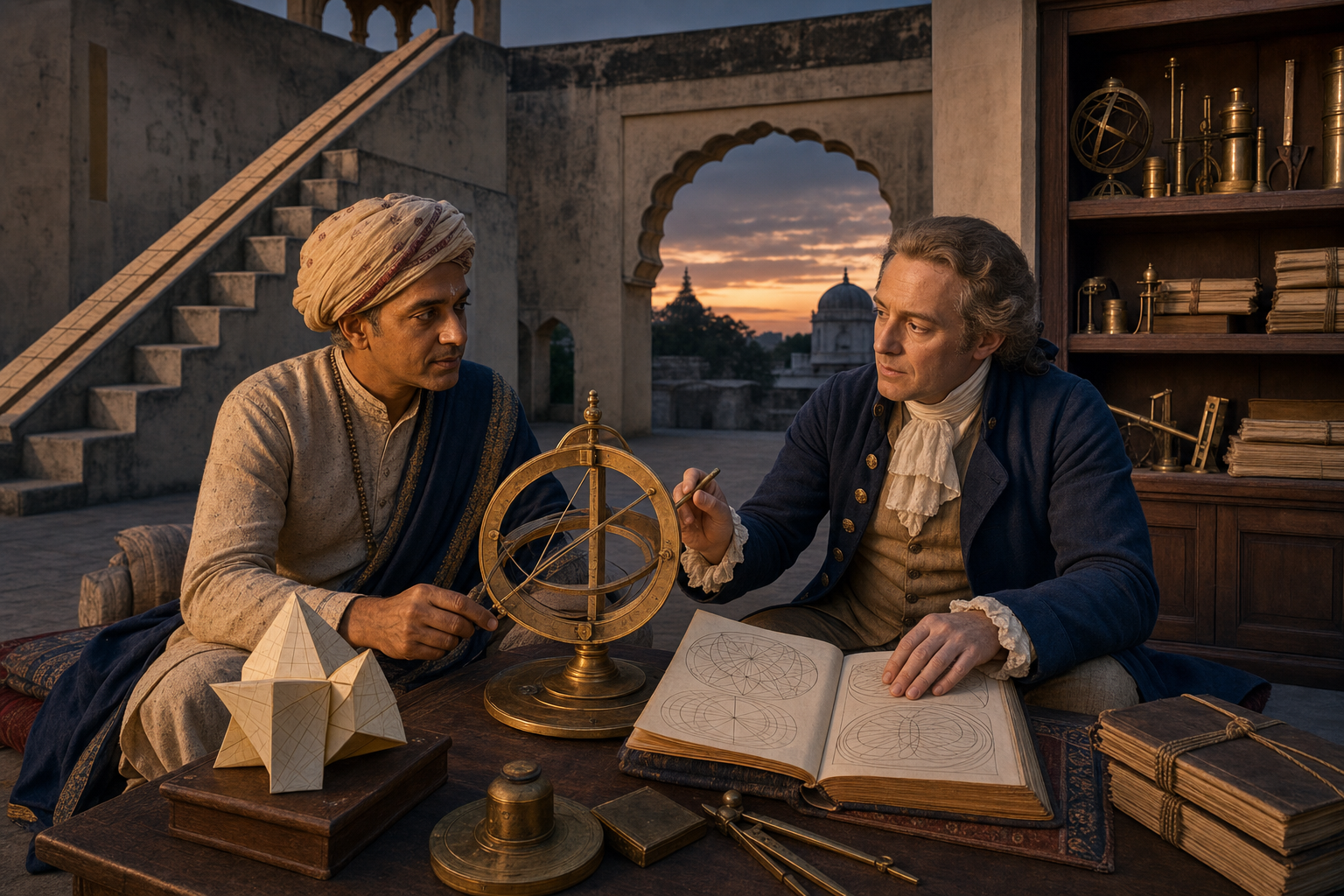
European engagement with Sanskrit learning did not begin in a neutral room. It took place among scholars whose intellectual world included biblical chronology, emerging historical disciplines, imperial administration, religious commitments, and genuine curiosity about Indian civilization. You need this context to recognize distorted assumptions, but context cannot replace analysis of the underlying evidence.
The founding of the Asiatick Society in Calcutta in 1784 gave the encounter an institutional form. William Jones, H. T. Colebrooke, and other scholars helped make Sanskrit grammar, literature, law, mathematics, astronomy, and philosophy objects of sustained European inquiry. Recognition of Sanskrit’s relationship to a wider Indo-European language family transformed comparative philology. Charles Wilkins’s 1785 English Bhagavad Gita and later translations of the Upanishads also carried Dharmic metaphysical vocabulary into European debates about consciousness, selfhood, and ultimate reality.
Admiration did not remove inherited limits. In 1825, Bentley objected to Playfair’s treatment of Hindu astronomical antiquity partly because accepting it seemed to threaten the Mosaic chronology. He complained that the biblical account would become "a fable, or a fiction". That admission matters because it reveals that the dispute was not only a disagreement over numerical parameters. A conclusion about India also appeared to carry a conclusion about European religious history.
Do not turn that evidence of bias into a shortcut. Bentley’s theological anxiety does not prove Playfair’s dating. Conversely, technical objections do not become sound merely because they preserve an inherited chronology. Motive can tell you why a question was framed in a particular way, which alternatives received attention, and where an unequal burden of proof may have operated. It cannot decide whether a calculation could have been made retrospectively.
Colonial power later affected which forms of learning received institutional support. Thomas Babington Macaulay’s 1835 Minute on Education privileged English-medium education and a Western canon over established Sanskrit and Persian systems. European institutions collected, classified, edited, and translated Indian materials even as official curricula narrowed the space available to indigenous learning. Preservation and displacement could therefore occur through the same colonial apparatus.
Provisional judgments could also harden into popular certainties. Max Mueller’s immense editorial and translational work brought Vedic texts to wider audiences, but conjectural dates acquired an authority outside the limited evidential conditions under which they had been proposed. Meanwhile, the linguistic label "Aryan" moved into racial and political classifications that comparative language relationships could not justify.
There is another correction to the simple Vedic-versus-Western story: knowledge did not move between two sealed civilizations. Indian numerical and mathematical methods travelled westward through the Arabic-speaking world long before colonial Indology. Transmission can include invention in one setting, development in another, and further application elsewhere. Giving each stage its due produces a stronger history than searching for one civilization to credit with the whole chain.
Put each proposition in the right evidence box
Most arguments become manageable once you classify the proposition before debating it. The following map is a practical starting point.
| Claim family | What you can responsibly affirm | What remains open or does not follow |
|---|---|---|
| Indian mathematics | The place-value decimal system and formal use of zero developed in Sanskritic and Prakrit intellectual settings. Aryabhata, Brahmagupta, and related traditions made foundational contributions to arithmetic, algebra, trigonometric calculation, and astronomy. | This does not establish that every later mathematical development originated in India, nor does it erase the refinements made along the transmission route. |
| Siddhāntic astronomy | Mean-motion parameters, sine tables, eclipse procedures, and calendrical calculations demonstrate an organized mathematical astronomy capable of technically demanding computation. | The precision of a table does not automatically date its observation. The competing possibilities of accumulated observation, revision, and retrospective calculation must be tested separately. |
| Sanskrit and Indo-European philology | Sanskrit’s recognized relationship with other Indo-European languages reshaped the study of language history and helped establish comparative philology. | A linguistic family is not a racial hierarchy, a simple population map, or proof of a single dramatic military event. |
| Aryan migration and Out of India | Language, archaeology, texts, environmental history, and archaeogenetics address different parts of a long and complex history of population and cultural formation. | Migration-versus-Out-of-India remains a live interdisciplinary dispute. Neither slogan can settle how linguistic, genetic, archaeological, and cultural patterns relate across millennia. |
| Dharmic philosophy and quantum theory | Classical Indian reflection on observation, causality, consciousness, and the limits of language can support serious comparative philosophy of science. | A philosophical resemblance does not prove that a modern physical theory, its mathematics, or its experimental predictions already appeared in a Vedic text. |
| Dharmic civilizational unity | Hindu, Buddhist, Jain, and Sikh communities participated in overlapping cultures of learning, ethical cultivation, commentary, dialogue, and debate. | Shared civilizational ground does not make their scriptures, metaphysics, or institutional histories identical. "Vedic" should not erase real distinctions among Dharmic traditions. |
The third column is not a list of hostile denials. It is the boundary that keeps the second column credible. When you say no more than the evidence can bear, critics must engage the documented contribution itself rather than an inflated version of it.
The same classification also exposes selective skepticism. Indian knowledge should not be required to produce an impossible chain of perfectly preserved manuscripts before receiving any credit, while European claims are accepted from later witnesses without examination. But correcting that asymmetry means comparing like evidence with like evidence. It does not mean removing evidential requirements altogether.
Use a disciplined protocol on any Vedic science claim
You can use the following procedure when reading a textbook, watching a lecture, assessing a viral claim, or preparing an argument of your own.
- Freeze the wording. Write the claim in one sentence before gathering arguments around it. Replace "the ancients knew" with a named work, a defined method, and the precise knowledge allegedly present.
- Classify the domain. Mark the claim as mathematical, astronomical, chronological, linguistic, archaeological, philosophical, or theological. If it spans several domains, divide it into separate propositions.
- Name the tradition accurately. Do not call every Sanskrit work a Vedic text. Do not treat a Buddhist, Jain, or Sikh teaching as interchangeable with a Hindu darśana. Civilizational relationship and textual identity are different facts.
- Reconstruct the content. For a scientific proposition, ask what operation could actually be performed: calculating an eclipse, generating a sine value, solving an equation, ordering a calendar, or predicting an observation. A modern label attached to an old metaphor is not a reconstruction.
- Separate the dates. List the date claimed by the tradition, the period in which the work is thought to have taken shape, the earliest secure attestation available, and the date of the scientific event described. Do not slide silently from one to another.
- Test the best rival explanation. If an astronomical value could result from either ancient observation or later back-calculation, ask what would distinguish those routes. If a similarity could result from transmission or independent development, identify evidence that bears on contact rather than assuming either conclusion.
- Assign a confidence label. Use plain terms such as well supported, probable, disputed, speculative, or symbolic. Record what new evidence would change the label. This prevents a favored conclusion from becoming immune to correction.
- Check for symmetry. Reverse the civilizations named in your argument. If you would reject the same inference when made for Europe, Greece, China, or the Arabic-speaking world, revise it before publishing or repeating it.
For mathematics and astronomy, demand an operation
A strong mathematical claim lets you point to a rule, notation, algorithm, table, or worked relationship. India’s contributions to zero and decimal place value pass this test because they concern identifiable mathematical tools with an intelligible history of development and transmission. The claim becomes weaker when "zero" is used only as a poetic bridge to every modern idea involving nothingness, vacuum, infinity, or binary computation.
Astronomy requires an additional distinction between computational skill and historical dating. Ask whether the disputed feature is the method, a numerical parameter, the epoch assigned to the table, or the age of the textual form that preserves it. You can then recognize sophisticated eclipse and planetary calculation without pretending that all four questions have one answer.
For origins debates, keep language, ancestry, and culture distinct
The Aryan question becomes unmanageable when a language relationship is treated as a complete account of people, identity, scripture, and political legitimacy. Comparative linguistics can address relationships among languages. Archaeology can examine material cultures and settlement patterns. Archaeogenetics can investigate ancestry and population movement. Textual interpretation can explore remembered geography, ritual worlds, and self-understanding. None of these disciplines automatically translates into all the others.
When someone presents either a dramatic invasion story or an absolute continuity story as settled, ask for the bridge between each evidential layer. What linguistic pattern is being connected to which archaeological horizon? What population movement is being equated with a language shift, and why? What evidence makes that connection more than a possibility? This is where transparent methods and openly examined datasets matter more than ideological confidence.
For modern physics comparisons, preserve both registers
Dharmic philosophies can illuminate questions that also trouble modern philosophy of science: the status of the observer, the relation between appearance and reality, causality, consciousness, and the limits of conceptual language. That is a serious intellectual encounter. It does not need the claim that an Upanishadic insight is identical to a quantum equation.
Use a three-part test. First, state the Indian concept in the vocabulary of its own tradition. Second, state the scientific concept with its mathematical and experimental meaning intact. Third, identify whether the relationship is identity, historical influence, structural analogy, or simply a shared question. In most responsible comparisons, analogy or shared inquiry will be more defensible than identity.
Read Dharmic knowledge through its own categories
European classifications are not the only possible map of rational inquiry. Śāstra identifies an organized field of disciplined knowledge; darśana names a systematic philosophical standpoint; pramāṇa concerns the means by which knowledge is warranted; and śāstrārtha places propositions into structured debate. These categories help you ask how a tradition itself distinguished testimony, inference, perception, argument, practice, and realization.
Internal categories must clarify rather than shield a claim. Calling a proposition śāstric tells you where it belongs and how its tradition understands authority; it does not make historical or scientific testing unnecessary when the proposition concerns an observable event. By the same token, a laboratory standard should not be used to dismiss a metaphysical question simply because that question is not an experimental prediction.
Precision also protects Dharmic plurality. Jain anekāntavāda offers a disciplined account of many-sided judgment. Buddhist Pāli traditions preserve their own analyses and methods of cultivation. Sikh teaching emphasizes equality, seva, devotion, and courageous responsibility. Hindu traditions contain multiple Vedic, devotional, philosophical, ritual, and scientific lineages. Their long interaction formed a shared but internally differentiated culture of truth-seeking. Unity is more convincing when it does not require sameness.
A pro-Dharmic history does not need immunity from scrutiny. It needs scrutiny applied without civilizational double standards. The next time you meet a sweeping assertion, narrow it to one testable sentence, name the relevant tradition, separate technical content from chronology, and mark the remaining uncertainty. Defend what survives that process without apology. Leave what does not survive open to correction.
References
