
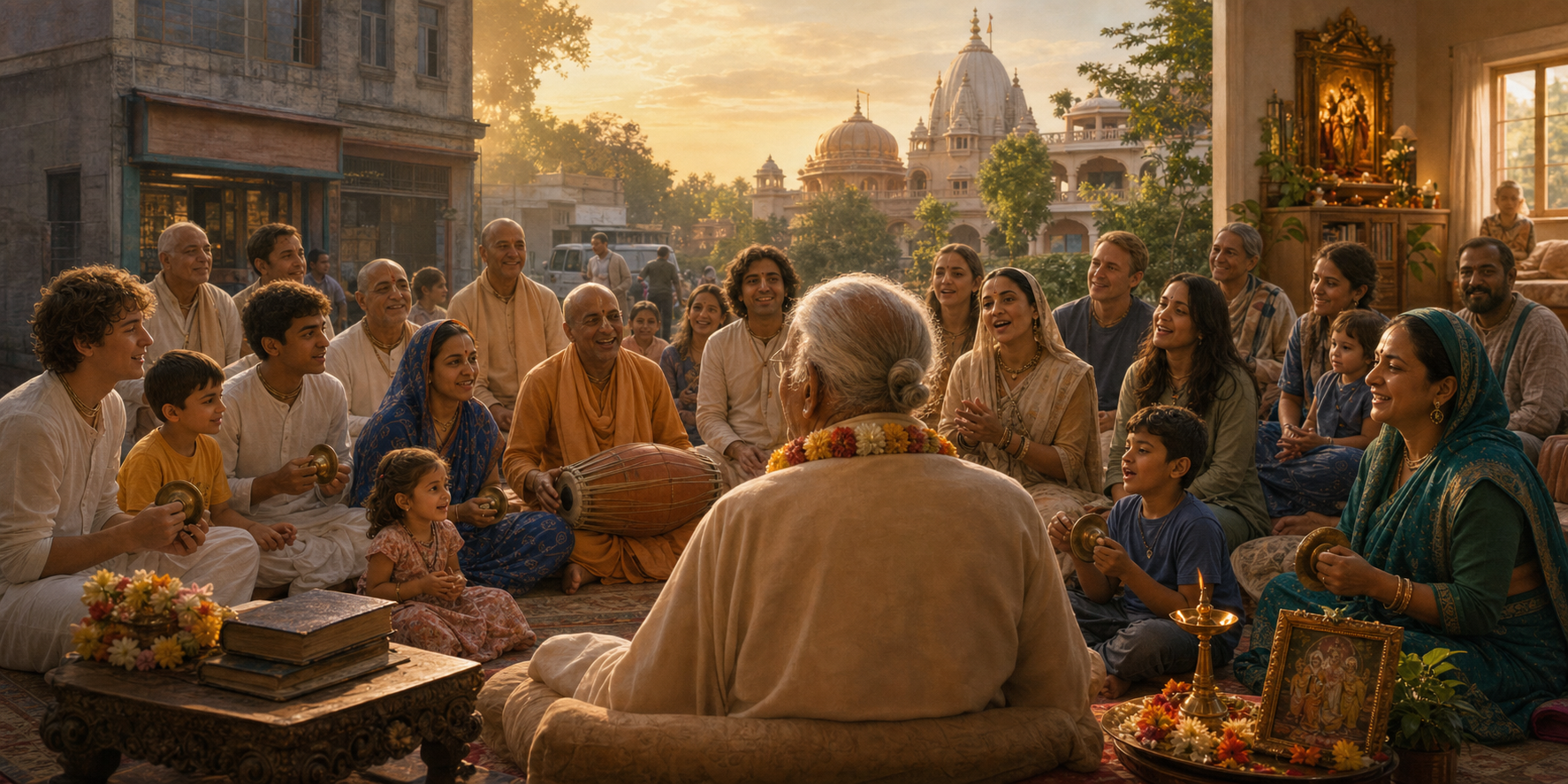
ISKCON’s sixtieth anniversary invites a larger question than how an organization grew from one New York storefront: what made Srila Prabhupada’s work capable of becoming a multigenerational spiritual inheritance? The supplied reports answer from three different settings – a historic site, an eyewitness presentation and a household celebration.
Together, they suggest that Prabhupada’s legacy lives through an interdependent system of scripture, sacred sound, disciplined service, trustworthy memory, worship and hospitality. Institutions provide continuity, but the tradition becomes durable only when people repeatedly embody its teachings in public, communal and domestic life.
Key takeaways
- Prabhupada’s legacy is transmitted through practices and relationships, not preserved merely as institutional history.
- Books give the movement doctrinal depth, while kirtan, worship and prasadam make participation accessible and embodied.
- Eyewitness testimony can convey character and atmosphere, but responsible historical memory requires comparison with contemporary records.
- The Seattle household celebration shows how a global movement remains alive through consistent local service between major anniversaries.
From a storefront to a portable devotional system
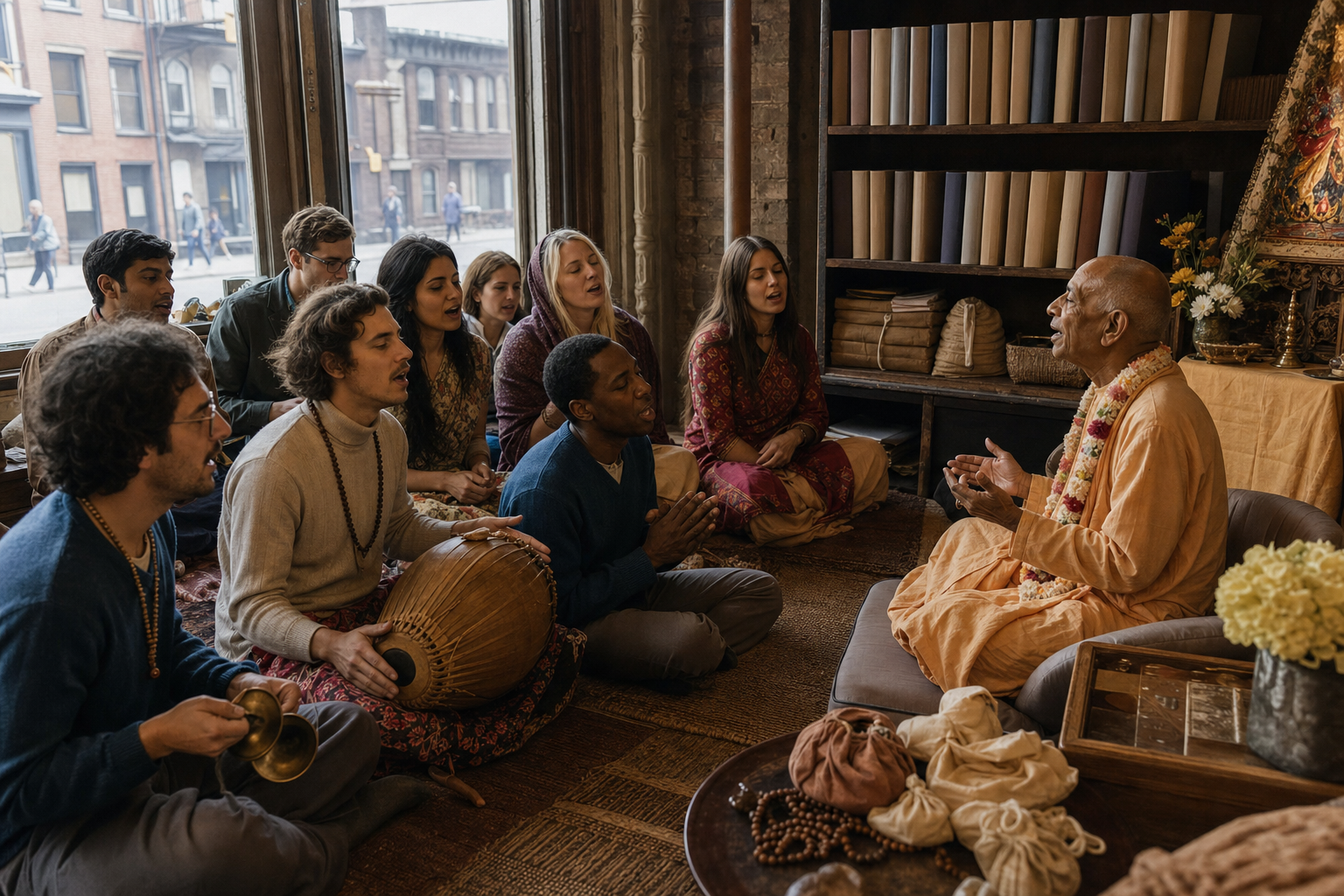
Both the account of ISKCON’s anniversary week and the living-witness presentation place the movement’s formal establishment in New York in July 1966. The anniversary report further states that Prabhupada had travelled from Kolkata aboard the Jaladuta in 1965, at the age of sixty-nine, and that 26 Second Avenue became the institutional starting point of ISKCON.
The historical contrast between that compact Lower East Side premises and ISKCON’s later international reach is striking, but physical expansion alone does not explain the legacy. What proved transferable was a coherent pattern of devotional life. The reports repeatedly connect philosophical teaching with congregational chanting, personal discipline, shared food, worship and service. These elements could be established in a rented room, carried into a park, organized in a temple or cultivated in a home.
The anniversary account describes daily movement between the Second Avenue storefront and Tompkins Square Park, where Prabhupada had led public chanting in 1966. In that setting, kirtan offered an unusually open threshold. A passer-by did not first need extensive theological education or knowledge of Sanskrit to listen, follow the repeated melody or join a call-and-response refrain. Participation could precede fuller understanding without making understanding unnecessary.
Prabhupada’s books supplied the corresponding intellectual foundation. The sources identify the Bhagavad-gita, Srimad-Bhagavatam and Sri Caitanya-caritamrita as central works in his literary legacy. The living-witness account highlights the structure of these editions: source passages, transliteration, word-by-word treatment, translation and commentary allow readers to see how an interpretation relates to its textual basis. The synthesis is important. Kirtan made entry into devotional practice immediate; sustained study situated that experience within a developed theology of the self, Krishna and bhakti.
ISKCON’s beginnings therefore should not be read as a story in which enthusiasm somehow became an institution. The reports instead depict a mutually reinforcing system: texts clarified the worldview, sacred sound enacted it, communities stabilized it and service trained people to transmit it. That combination helps explain how practices formed in one urban setting could cross linguistic and social boundaries.
Living witnesses connect history with spiritual formation
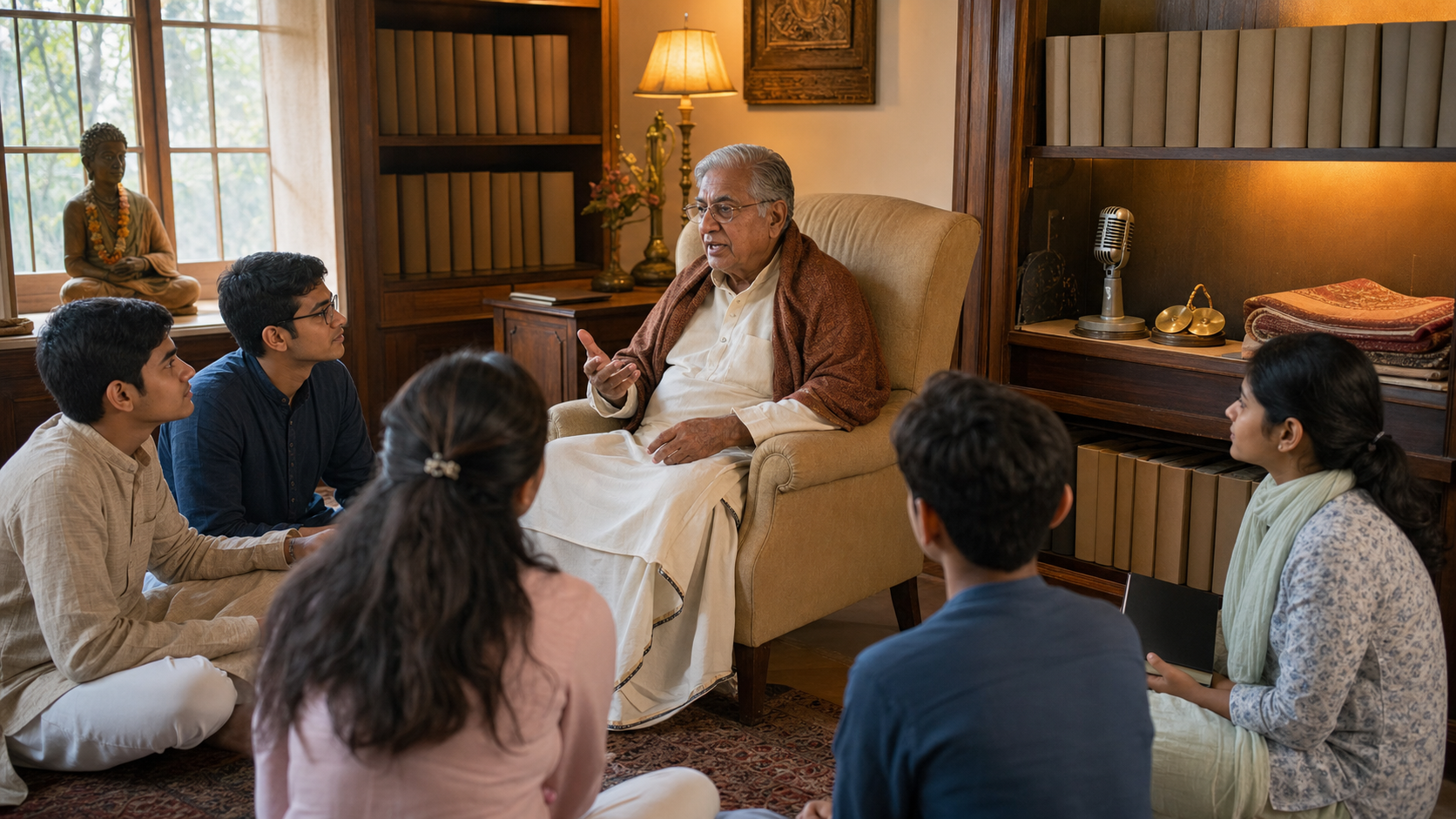
The anniversary programme reportedly placed senior practitioners’ recollections near the center of its opening evening at 26 Second Avenue. The separate presentation titled Srila Prabhupada As He Is, given by Srutakirti Das on July 10, 2026, approached the same inheritance through sustained personal proximity. Its accompanying account states that Srutakirti became Prabhupada’s personal servant in 1972 and continued in that role for more than two years.
Such testimony contributes details that an incorporation document, itinerary or publication record cannot supply. The presentation account recalls, for example, Srutakirti’s early instruction to answer whenever Prabhupada rang a bell and an occasion on which Prabhupada tested how promptly he responded. The episode is small compared with the founding of an international society, yet it makes visible the practical grammar of seva: attentiveness, accuracy, readiness and responsiveness to another person’s actual need.
That is also why memories of ordinary conduct matter within the idea of an acharya, a teacher whose example is integral to the teaching. Recollections of work, correction, humour, hospitality and daily discipline show how principles were expressed in relationships. They can prevent a spiritual founder from becoming either an abstract institutional emblem or a collection of detached inspirational sayings.
Both the anniversary report and the living-witness account nevertheless caution that memory is selective and shaped by later understanding. Devotional sincerity does not turn recollection into an infallible transcript. A responsible legacy culture compares oral accounts with letters, photographs, recordings, publications, legal records and reliable timelines. These sources perform different functions: documents help establish events, eyewitnesses communicate atmosphere and relationship, and philosophical texts explain the ideas by which participants interpreted their actions.
This distinction protects both history and devotion. Careful scrutiny need not diminish reverence; it can keep reverence attached to truth. Likewise, the source’s treatment of guru and seva emphasizes that spiritual authority does not cancel moral judgment or personal responsibility. Service matures through competence, humility and ethical self-examination, not through the pursuit of status or proximity to leadership.
A Seattle home shows how inheritance becomes local
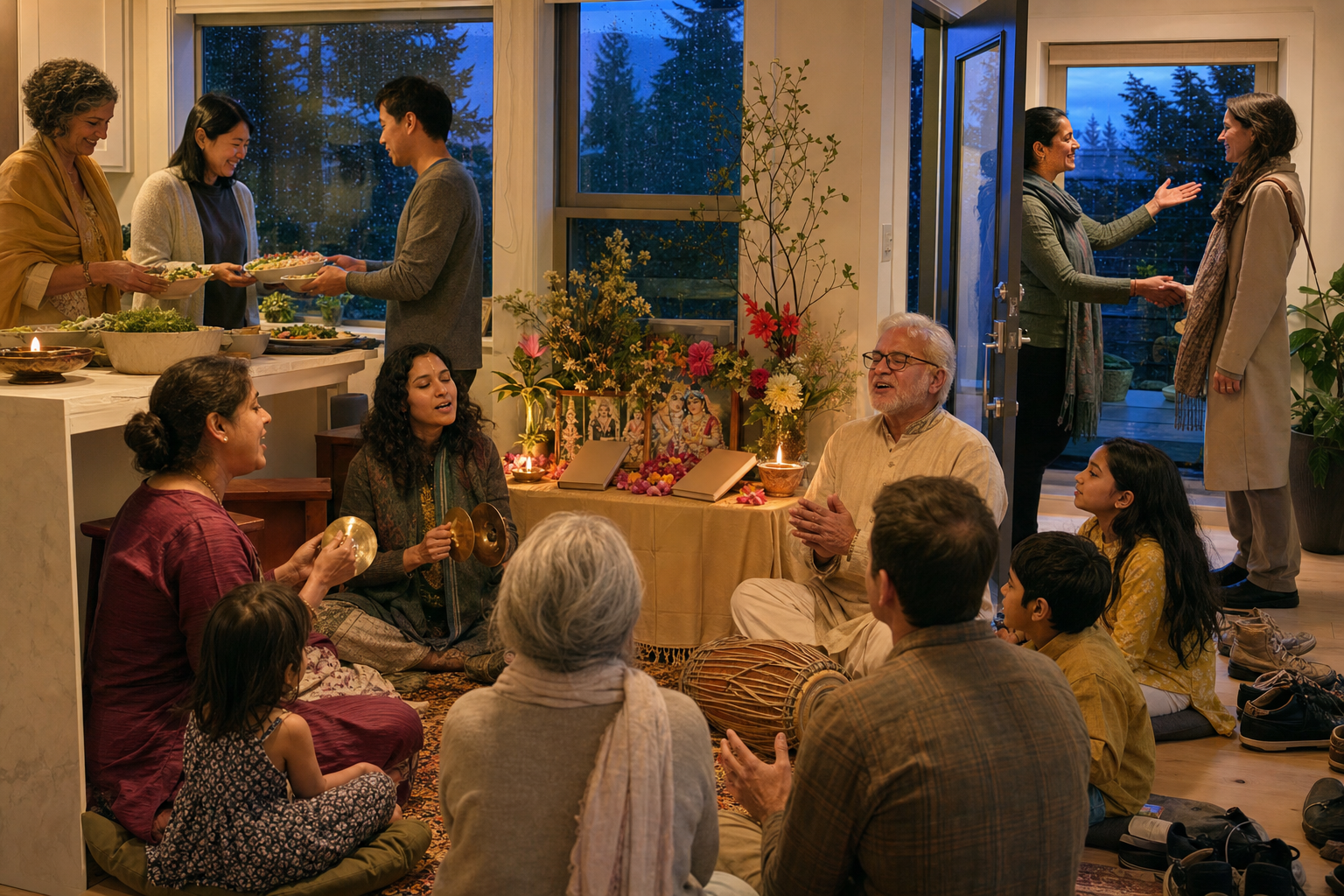
The report on Sri Sri Nitai Nimai Chandra’s seventh installation anniversary shifts attention from a founding location to the home of Vraja Raman and his family in Seattle. It describes talks by Hari Vilasa Prabhu and Ramai Swami, followed by bhajans, arati, kirtan and a feast. This is not direct evidence about life at 26 Second Avenue, but it reveals what the tradition inaugurated there can look like after it has entered the rhythms of another city and a household.
The Seattle account contrasts the original installation, reportedly attended by nearly three hundred people, with a smaller seventh-anniversary gathering. That difference supplies a useful measure of continuity. Founding ceremonies and milestone anniversaries attract attention, but a deity installation begins an ongoing responsibility. Daily offerings, remembrance, prayer and hospitality must continue amid work, family duties and changing circumstances. The quieter years between large events are where a living inheritance is tested.
A storefront and a household shrine are not interchangeable, and an installation anniversary is not an institutional commemoration. Their juxtaposition is valuable precisely because the settings are different. At 26 Second Avenue, repeated classes, chanting and shared food helped an unfamiliar public encounter Gaudiya Vaishnavism. In the Seattle home, repeated worship allowed an established community to renew the same broad disciplines through intimacy, regularity and care.
The sequence reported in Seattle also demonstrates how bhakti addresses more than one dimension of the person. Discourse interprets the practices; bhajan cultivates attentive listening; arati directs the senses toward worship; kirtan gives the assembly a shared voice; and prasadam extends devotion into nourishment and fellowship. Children, newcomers, experienced practitioners and visiting teachers can participate at different levels while remaining part of one gathering.
This domestic setting complicates any account that equates ISKCON’s legacy only with prominent temples, administrative reach or public festivals. Those forms matter, but continuity also depends on homes that welcome others, families that sustain worship and local devotees who prepare food, sing, teach and serve without the visibility of a historic anniversary. The global movement persists through such distributed centers of responsibility.
The real measure of a living legacy
Read together, the three reports offer several ways to assess Prabhupada’s continuing influence. Historical fidelity asks whether the founding story is documented honestly rather than polished into legend. Theological fidelity asks whether public practice remains connected to the scriptural framework Prabhupada translated and explained. Participatory vitality asks whether chanting, worship, food and fellowship remain genuinely accessible. Ethical maturity asks whether service and authority are joined to responsibility rather than prestige.
These measures also reveal why commemoration is spiritually demanding. Returning to 26 Second Avenue can recover a sense of scale and dependence. Listening to Srutakirti Das can restore the human texture of discipleship. Observing a seventh installation anniversary can show what long-term care requires. None of these activities is sufficient alone. Place without practice becomes a monument; memory without corroboration can harden into mythology; ritual without teaching can lose intelligibility; and institutional expansion without local responsibility can become hollow.
At sixty, the central question is therefore not whether ISKCON can reproduce the cultural surface of New York in 1966. It is whether successive generations can preserve the relationship among sound, scripture, service, community and accountable leadership while making that inheritance intelligible in new settings.
The next phase of Prabhupada’s legacy will be formed wherever practitioners turn inherited teachings into disciplined, hospitable and ethically responsible devotional life.
References
- DharmaRenaissance Blog – ISKCON at 60: Day One Returns to the Birthplace of a Global Bhakti Movement
- DharmaRenaissance Blog – Sacred Joy in Seattle: What Seven Years of Sri Sri Nitai Nimai Chandra Devotion Reveals
- ISKCON London Radha-Krishna Temple – Srila Prabhupada As He Is: Srutakirti Das Reveals the Power of Living Witness