
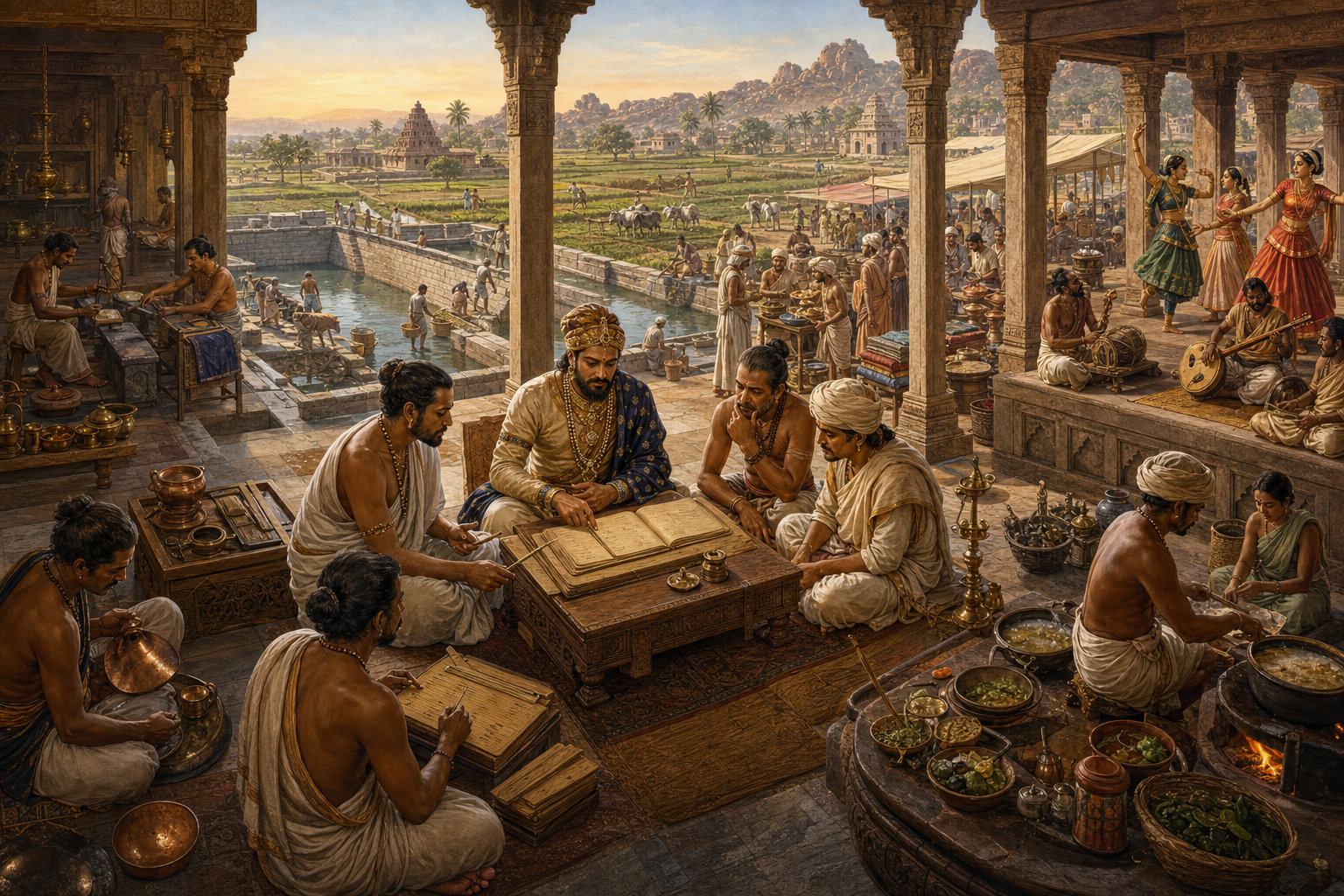
If your picture of medieval Bharat comes mainly from dynasties, battles, and surviving monuments, an important question remains unanswered: how did people connect ethical rule, public works, food production, skilled craft, commerce, and cultural life?
With Manasollasa, you can investigate that question at the level of working systems. The useful approach is not to hunt for isolated “firsts” or to turn every prescription into proof of universal practice. It is to follow the links between values, institutions, materials, expertise, and everyday routines. That is where medieval Indian civilizational knowledge becomes visible.
A map of civilization, not a cabinet of curiosities
Manasollasa, also known as Abhilashitartha Chintamani, is an encyclopedic Sanskrit composition attributed to King Someshvara III of the Western Chalukya dynasty, whose reign is dated to 1126-1138 CE. Its setting was the court at Kalyana, in the region of present-day Karnataka.
That location matters. The 12th-century Deccan was not merely a corridor between supposedly separate northern and southern worlds. Here, administrative thought, Sanskrit learning, regional practice, temple culture, agriculture, trade, and performance could meet within one intellectual environment. The familiar modern habit of placing politics, economics, religion, art, and domestic life in different departments would obscure this arrangement.
Within the same civilizational field appear rajadharma, dandaniti, ministerial conduct, revenue accounts, village records, water management, agriculture, markets, guilds, military organization, architecture, music, dance, sport, cookery, perfumery, ritual, and festivals. Their proximity is not accidental. It expresses a view in which competent rule depends on the condition of the whole social order.
You can make this breadth intelligible by sorting it into six connected layers:
- Ethical purpose: protection, justice, prosperity, restraint, learning, and public welfare.
- Institutions: rulers, ministers, judges, assessors, local officers, assemblies, market inspectors, guilds, temples, and workshops.
- Infrastructure: streets, markets, storage facilities, rest-houses, hospitals, wells, tanks, embankments, canals, forts, gardens, and civic halls.
- Production and exchange: cultivation, animal care, craft, transport, warehouses, weights and measures, lending, and revenue.
- Cultural transmission: teachers, performers, artisans, canons of proportion, musical systems, ritual calendars, and festivals.
- Daily practice: food preparation, vessels, fuel, cosmetics, fragrances, recreation, and seasonal routines.
This classification gives you a better starting point than a list of impressive topics. It lets you ask how a moral objective acquired an administrative procedure, what material infrastructure sustained it, and which kinds of trained knowledge made it work.
Four knowledge chains reveal how the system worked
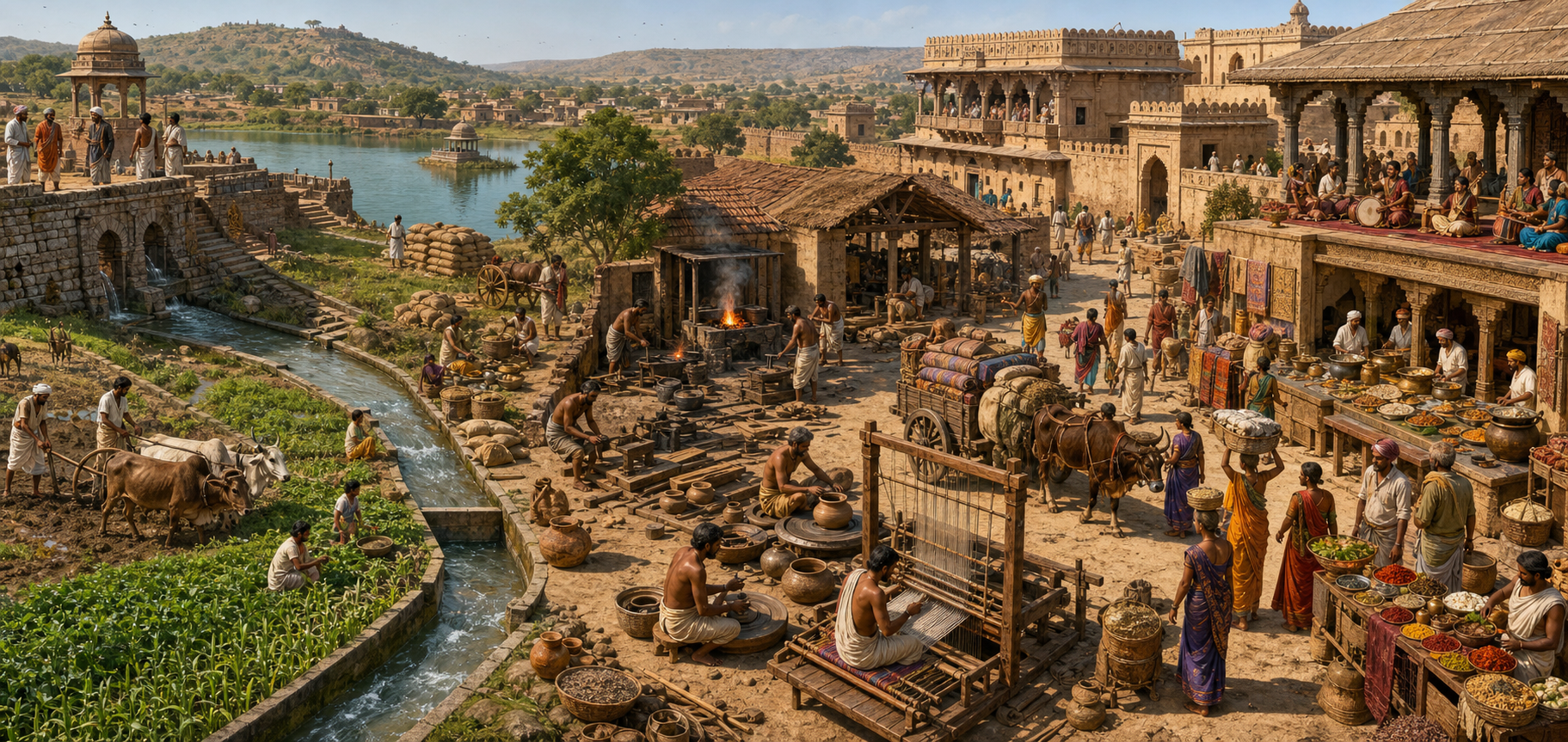
The most revealing units in Manasollasa are not individual entries. They are chains of dependence. Follow one chain far enough and a feature that initially looks ceremonial or technical becomes part of governance.
From rajadharma to ledgers and legal procedure
A ruler’s duty to protect life and property remains abstract unless authority is distributed competently. That is why character, expertise, consultation, accountability, and the assignment of responsibility belong beside royal ethics. The same logic reaches income and expenditure: intelligible accounts, predictable revenue collection, and moral supervision convert a general commitment to justice into repeatable administration.
Dandaniti completes the chain. Evidence, witness reliability, impartial adjudication, calibrated punishment, and safeguards against abuse show that justice was understood as a procedural discipline, not merely a virtuous intention. The practical lesson is simple: whenever you encounter a declaration of dharma, look for the office, record, rule, or review mechanism intended to carry it out. Without that second step, you have read the ideal but missed the statecraft.
From monsoon water to village prosperity
Water connects urban design, rural administration, agriculture, storage, and taxation. In towns, streets and markets sit beside wells, tanks, embankments, canals, storage, and civic amenities. In villages, land classification, irrigation management, water-sharing arrangements, crop planning, seed stewardship, and grain reserves support a more locally organized agrarian order.
This is more than a catalogue of hydraulic structures. A tank requires siting, construction, maintenance, rules of access, dispute settlement, and records. Its water affects crops; crops affect storage and trade; trade and harvests affect revenue; revenue supports public works and cultural institutions. Medieval ecological knowledge therefore appears as a combination of observation, engineering, administration, and collective obligation.
When you study a well, canal, orchard, or field, do not isolate the physical object. Sketch the flow around it: who maintained it, who recorded rights, how scarcity was managed, where produce went, and what happened when agreements failed. That exercise turns “traditional wisdom” from a vague compliment into an institutional question.
From weights and measures to commercial trust
Markets function only when strangers can rely on shared rules. Standard weights and measures reduce uncertainty. Inspectors make those standards enforceable. Guilds organize expertise and reputation. Warehouses protect goods between production and sale. Protocols for lending, borrowing, transport, and merchant caravans extend trust across distance.
The significant civilizational achievement here is not trade in the abstract. It is predictable exchange. A prosperous market depends on technical standards and ethical expectations at the same time. If either disappears, honest merchants bear the cost of fraud, storage becomes risky, prices become harder to trust, and revenue becomes less dependable.
This chain also corrects a common misreading of dharma. Moral economy did not mean the absence of calculation or commercial organization. Accountability, measurement, reputation, and oversight could themselves serve dharmic ends. When evaluating claims about medieval Indian commerce, look for the mechanisms that made confidence possible rather than treating prosperity as a free-floating cultural trait.
From aesthetic theory to trained practice
Painting, sculpture, jewelry, textiles, and architecture require more than inspiration. Proportion, suitable materials, workshop routines, site selection, orientation, and ornament translate aesthetic principles into objects and buildings. In performance, rasa and bhava stand beside ragas, talas, instruments, pedagogy, repertoire, and stagecraft. Ideas become durable only through trained bodies, tools, materials, and institutions of teaching.
The same pattern reaches festivals. Priestly roles, endowments, processions, performers, artisans, merchants, ascetics, and householders participate in a shared civic rhythm. Temple and festival culture therefore cannot be reduced to private belief. It also coordinates labor, patronage, movement, exchange, and public memory.
Even the kitchen belongs to this world of applied knowledge. Kitchen design, fuel economy, vessel properties, preparation sequences, tastes, and textures receive technical attention. Apupa, payasa, shrikhand, and iddarika appear among the foods discussed, with iddarika described as a steamed cake reminiscent of present-day idli. Perfumery and cosmetics likewise connect plant materials, extraction, infusion, season, sensory judgment, and trade.
These subjects are not decorative leftovers after “serious” statecraft. Food, fragrance, music, building, and craft show how knowledge entered ordinary materials and cultivated habits. The ruler’s world was expected to sustain competence as well as command.
Separate a courtly ideal from evidence of everyday life
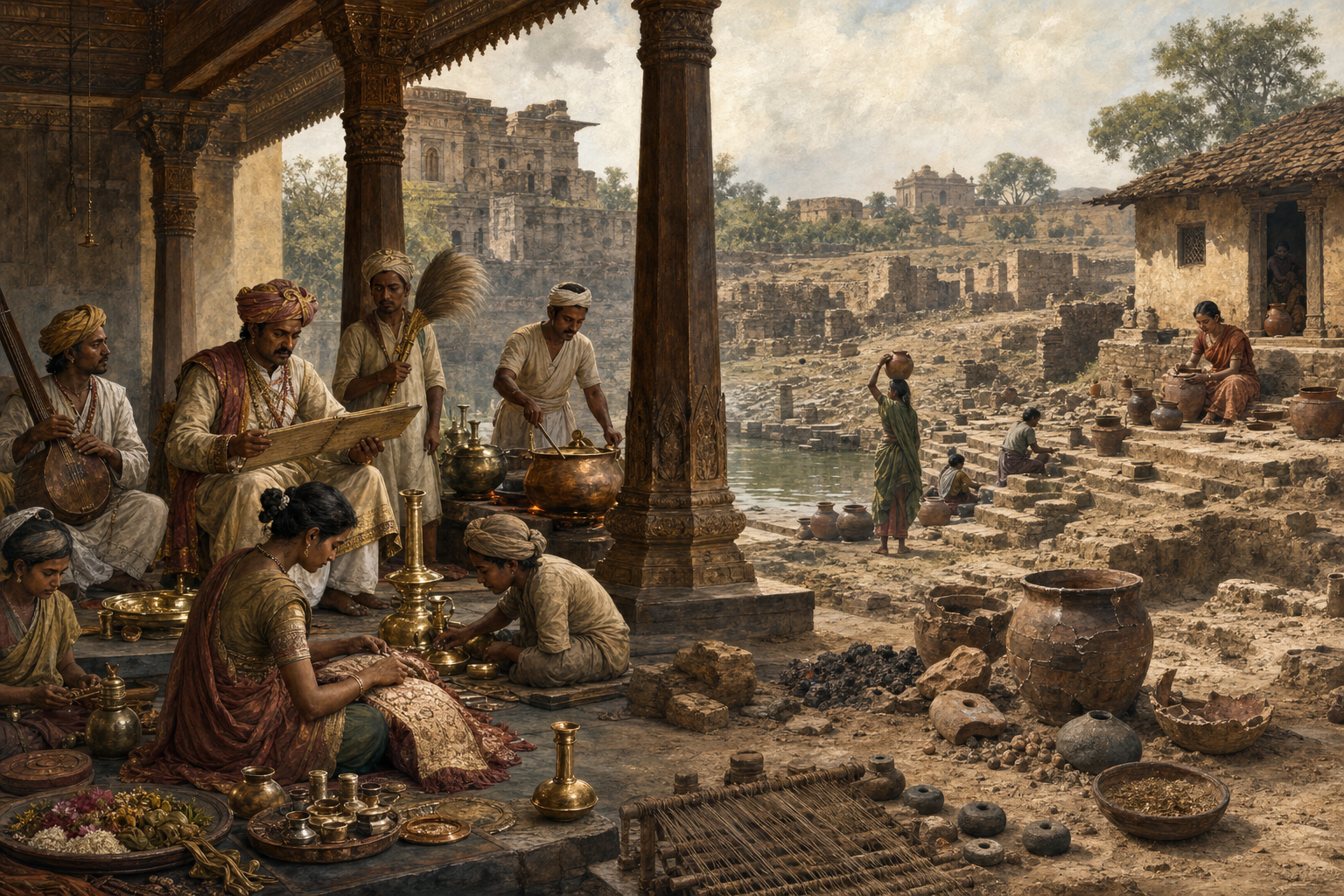
A confident reading also needs restraint. Manasollasa emerged in a courtly, normative setting and uses the idiom of shastra. A prescribed standard tells you that a practice, category, or problem was intellectually recognized. It does not automatically prove that every ruler followed the rule, every village used the same arrangement, or every household ate the foods described.
Use three labels in your notes: attested, inferred, and unproven. “Attested” covers what is explicitly named or described. “Inferred” covers a reasonable implication, such as the need for trained specialists behind a complex procedure. “Unproven” covers claims that require other evidence, including prevalence across regions, compliance in practice, and uninterrupted survival into the present.
| What you encounter | What it can establish | What it cannot establish by itself |
|---|---|---|
| An ideal ruler who is just, compassionate, and competent | Normative expectations attached to kingship | That an actual ruler consistently met those expectations |
| A detailed administrative or technical procedure | Recognition of a problem, specialized vocabulary, and an organized solution | Uniform implementation across the kingdom or subcontinent |
| A named food, game, instrument, or artistic form | Awareness of that form in the represented cultural setting | Universal popularity, identical modern form, or unbroken continuity |
| Rules for villages, markets, water, or taxation | A model of institutional order and the priorities behind it | Compliance by every local officer, assembly, merchant, or cultivator |
The iddarika example shows why this discipline matters. A resemblance to idli is worth noticing because it opens a question about culinary ancestry and steaming techniques. It is not enough to declare that the modern dish existed unchanged in every relevant detail. The careful phrase is stronger: a 12th-century Sanskrit culinary taxonomy includes a steamed cake with a recognizable resemblance.
The same caution applies to governance. Provisions for fair adjudication demonstrate a developed ideal of procedural justice. They do not certify that bias and abuse disappeared. Prescriptions often exist because a problem was real enough to require correction. Read the rule both as an aspiration and as evidence of the difficulty it was meant to control.
A six-step method for reading civilizational knowledge
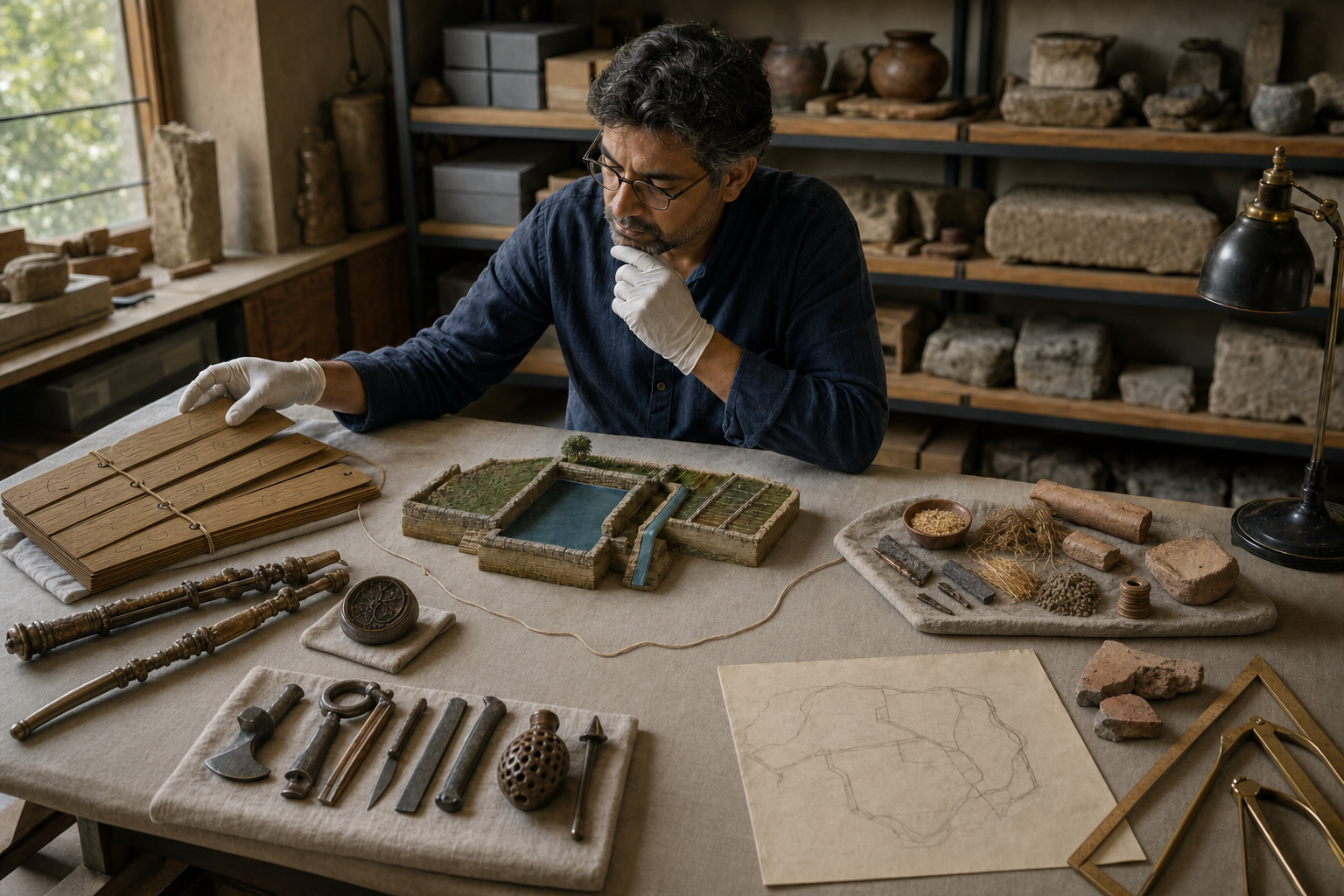
You do not need to master every domain before using Manasollasa well. Choose one subject – water, revenue, music, elephants, kitchens, architecture, or markets – and make six passes through it.
- Name the intended good. Is the practice meant to protect life, secure justice, increase prosperity, preserve order, cultivate excellence, or support public ritual?
- Identify the responsible actors. Look for rulers, ministers, judges, local assemblies, officers, merchants, artisans, teachers, performers, cultivators, animal handlers, or household workers.
- Find the operating procedure. Note records, consultation, inspection, training, evidence, seasonal timing, maintenance, classification, storage, or measurement.
- List the material requirements. A policy needs ledgers; irrigation needs earthworks and channels; music needs instruments and stages; cookery needs fuel and suitable vessels.
- Locate the ethical restraint. Ask how the arrangement addresses bias, abuse, excess force, dishonest measurement, ecological timing, or unfair access.
- Trace the next dependency. Follow irrigation into crops and markets, animal care into transport and military capacity, performance into pedagogy and patronage, or festivals into temples, crafts, and commerce.
Consider animal husbandry as a test case. Breeds, physical marks, training, stable hygiene, nutrition, and veterinary care appear because horses and elephants affected transport, warfare, ceremony, and prestige. The intended good includes readiness and reliable service. The actors include handlers, trainers, stable personnel, and commanders. The material conditions include feed, shelter, cleanliness, and equipment. What looks like zoological description becomes state capacity when you trace the full chain.
Music provides a different test. Raga and tala classifications alone would leave performance inert. Pedagogy, repertoire, instruments such as the veena, percussion ensembles, stagecraft, and occasions for performance turn classification into a living tradition. The result depends on disciplined transmission, not just a written canon.
This method also improves how you teach or discuss medieval Bharat. Instead of presenting a gallery of achievements, build a case around relationships:
- For a history lesson, pair kingship with accounts, courts, irrigation, storage, and local administration. Students can then see what rulership demanded beyond war.
- For a museum or cultural program, place an artifact within its chain of materials, training, patronage, ritual use, and exchange. An object becomes evidence of a knowledge system.
- For an essay on dharma, connect moral ends to procedures and institutions. This prevents dharma from shrinking into either private spirituality or an undefined slogan.
- For a continuity claim, distinguish resemblance, inheritance, adaptation, and unchanged survival. These are different claims and need different levels of evidence.
- For public debate, state exactly what is attested and what remains inferred. Civilizational confidence becomes more credible when it does not ask the evidence to carry more than it can.
The larger conclusion is not that medieval India had modern departments under Sanskrit names. That would flatten historical difference. The more defensible conclusion is that intellectual and administrative life already joined domains that modern narratives often separate: ethics and accounting, ecology and authority, commerce and trust, aesthetics and technical skill, ritual and civic organization, pleasure and disciplined training.
That integrated arrangement is the real civilizational lesson. Dharma supplied ends such as protection, justice, restraint, and welfare. Shastric organization classified and transmitted knowledge. Institutions assigned responsibility. Artisans, officers, cultivators, performers, cooks, and animal handlers converted principles into practice. Ecology and material limits kept that practice grounded.
Key takeaways
- Read Manasollasa as a network of connected systems, not as a collection of medieval curiosities.
- Follow every ethical ideal into its officers, procedures, records, materials, and safeguards.
- Treat waterworks, markets, kitchens, workshops, music, and festivals as locations of technical and institutional knowledge.
- Use normative passages as evidence of recognized ideals and problems, not automatic proof of universal compliance.
- Describe modern continuities carefully: resemblance or ancestry does not by itself establish an unchanged tradition.
- Build civilizational arguments from specific relationships rather than inflated claims of isolated invention.
Begin with one chain. Take water, markets, music, architecture, or food and map its purpose, people, procedure, materials, restraints, and dependencies. Once you do that, medieval Bharat no longer appears as a row of disconnected achievements. You can see knowledge moving through institutions and becoming a way of life.