
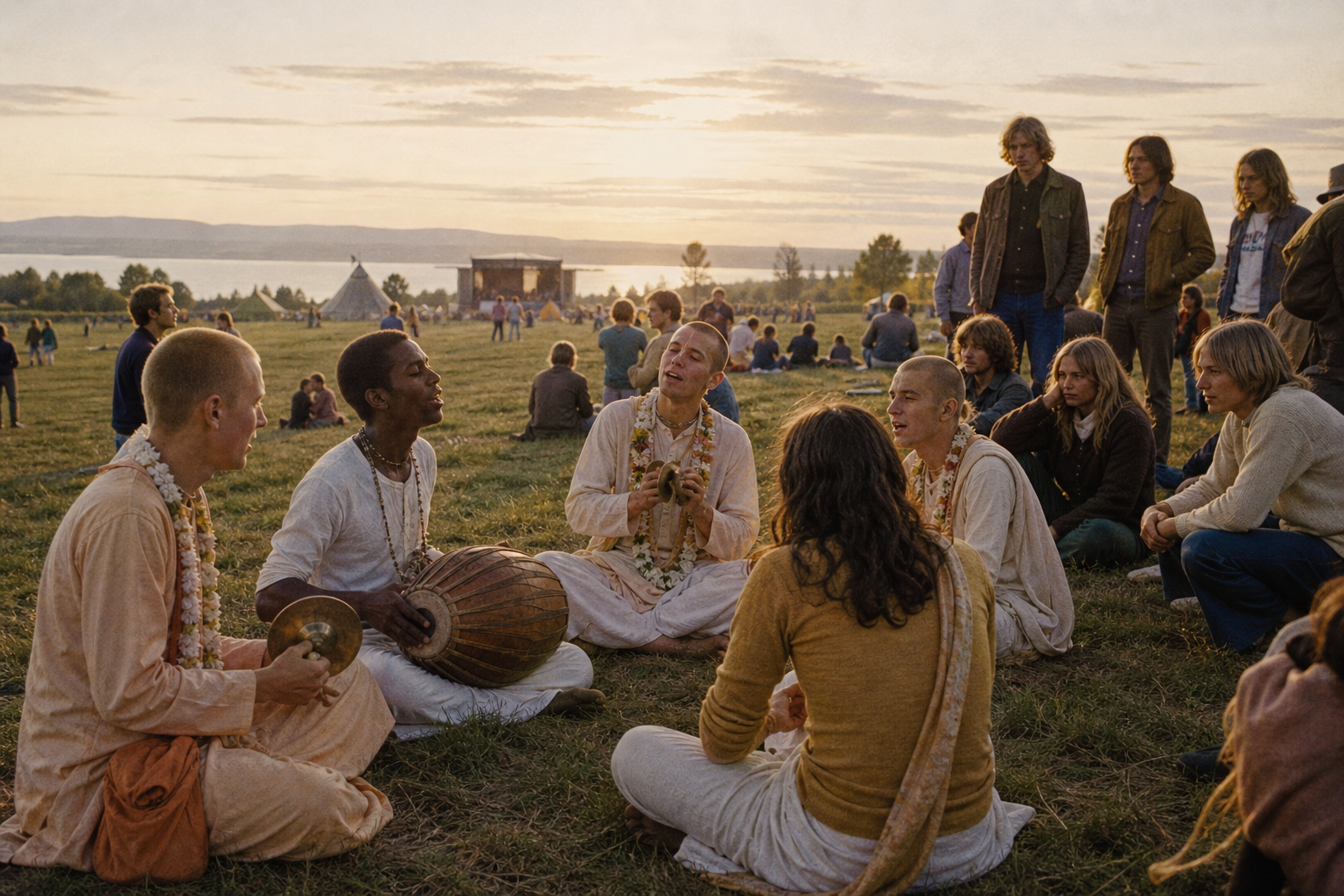
If you have just encountered the archival scenes from Sweden, the immediate question is not whether they are evocative. It is what they actually establish about ISKCON’s early presence in Scandinavia.
The firm historical core is concise: in 1970, Dhanajaya Prabhu led a group of devotees from London to the Festival of the Midnight Sun outside Jönköping. That makes the visit a documented instance of early Hare Krishna outreach in Sweden. It does not, by itself, establish the movement’s first appearance in the country, the creation of a permanent Swedish centre, or the size of any local following.
What the 1970 visit firmly establishes
Good history begins by keeping the claim narrow enough to remain true. Five details can be stated without stretching the evidence:
- The visit occurred in 1970.
- Dhanajaya Prabhu led the travelling group.
- The devotees came from London.
- The destination was Sweden.
- The public setting was the Festival of the Midnight Sun outside Jönköping.
Each detail changes how you should describe the episode. It was not simply a Swedish group appearing at a Swedish event; it was a cross-border journey from an existing London base. Nor should a festival appearance be silently converted into a temple opening or an established congregation. A visiting group can create a genuine spiritual encounter without proving that a lasting institution already existed.
If you are cataloguing, teaching, or sharing the material, a reliable caption would be: “In 1970, Dhanajaya Prabhu led a group of ISKCON devotees from London to the Festival of the Midnight Sun outside Jönköping, Sweden.” Add stronger claims only when you have additional records to support them.
Why the festival setting changes the meaning
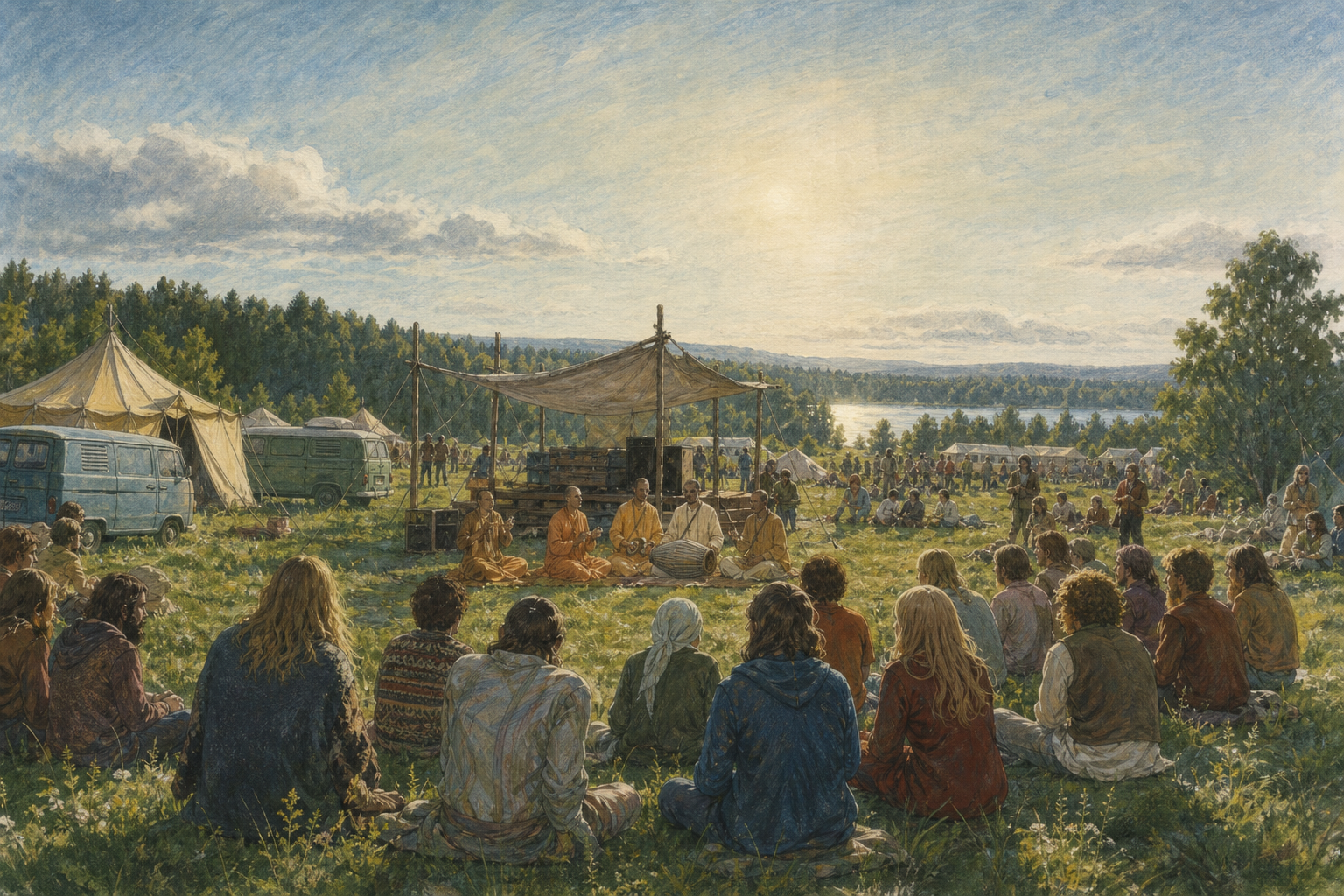
The devotees did not make their first contact with this audience by asking people to enter a dedicated religious venue. They entered a gathering that people had already chosen to attend. That distinction is central to public outreach: the spiritual practice crosses the social threshold before the visitor has to cross a physical one.
At the same time, public contact is not the same as religious affiliation. A festival visitor may observe, listen, participate briefly, ask questions, or simply pass by. None of those responses should automatically be recorded as conversion, membership, or even agreement. The Swedish episode documents devotional practice and public engagement within a wider European festival culture; it does not supply attendance figures, participant testimonies, or a measured account of the audience’s response.
What gives the encounter lasting significance is the meeting of a recognisable devotional ethos with an unfamiliar cultural setting. The devotees travelled, but the devotional character of their activity remained visible. For present-day organisers, the principle is practical: make participation understandable without making the tradition anonymous. Tell visitors what is happening, explain how they may join, permit them to observe without pressure, and avoid presenting temporary curiosity as settled commitment.
This is also a useful model for relations among dharmic communities. Hinduism, Buddhism, Jainism and Sikhism should not be flattened into interchangeable paths. Yet devotion, compassion, disciplined practice and service can provide ground for encounter. Unity becomes credible when distinct traditions meet honestly, not when their differences are concealed.
How to read the archival record without overclaiming

You are encountering film clips and photographs from 1970 through a presentation by Mukunda dasa. Historical images and the later context supplied around them are both useful, but they are not the same kind of evidence. Use this five-step method when you study or republish them:
- Record what is directly visible. Describe only the people, actions, objects and surroundings that can actually be seen. Do not assign motives or identities from appearance alone.
- Record the supplied context separately. Place the year, location, event name, group leader, London origin and presenter’s name in a caption or catalogue field. This keeps visual observation distinct from historical identification.
- Label interpretation as interpretation. The London-to-Sweden journey reasonably indicates a mobile devotional network capable of crossing national boundaries. It does not prove how every later Swedish activity was organised.
- State the missing evidence. These materials alone do not establish that this was the first Swedish visit, how many people attended, how local residents understood the devotees, or whether the appearance immediately produced an enduring institution.
- Preserve provenance. Save the URL, title, names, date, place and event alongside any copy you are authorised to keep. Retain the original caption separately from your commentary so later researchers can see what was inherited and what was added.
This discipline prevents two opposite mistakes. One is dismissing a small travelling programme as an anecdote without historical value. The other is enlarging a brief appearance into an unsupported founding story. The episode matters precisely as an early, documented act of outreach; it does not need embellishment.
Key takeaways
- Verified core: In 1970, Dhanajaya Prabhu led devotees from London to a festival outside Jönköping, Sweden.
- Historical significance: The visit shows ISKCON carrying public devotional practice across a European national boundary at an early stage of its Scandinavian presence.
- Necessary limit: A festival appearance does not by itself prove a first visit, mass acceptance, a permanent centre, or an established local membership.
- Best description: Call it “early documented ISKCON outreach in Sweden” unless further evidence justifies a more specific claim.
What dharmic communities can do with this history

The useful lesson is not to reproduce the appearance or atmosphere of 1970. It is to recover the underlying method: travel to an existing public gathering, remain recognisably devotional, offer a clear point of contact, and preserve an accurate record of what occurred.
If you are planning outreach at a cultural festival, decide in advance what may be adapted and what should remain intact. Language, signage, the length of an explanation and the way newcomers are welcomed can respond to the setting. The identity of the practice should not become so vague that visitors cannot tell what tradition they have encountered.
Separate invitation, participation and affiliation in your own reporting. Someone who stops to watch is a visitor. Someone who joins an activity is a participant. Neither should be called a member unless that person has actually entered the community in a meaningful and identifiable way. This simple vocabulary keeps enthusiasm from turning into inaccurate history.
Assign one person to document every programme. Record the exact date, place, public event, organising group, travelling route and names of people who consent to identification. Keep original files, edited selections and captions as separate items. If you publish images, preserve the context with them; an uncatalogued image may survive while its historical meaning disappears.
The London-to-Sweden route also tells you how to search for further evidence. Do not look only in records associated with Jönköping or Sweden. Search the archives, recollections and catalogues connected with the London community and with the people who travelled. Early movement history often belongs to the point of departure as much as to the destination.
When you next share these scenes, begin with the precise caption, mark the boundary between observation and inference, and ask how your own community will preserve today’s outreach for the next generation. That turns a rare memory into usable cultural heritage without forcing it to prove more than it can.
References
