

If you hear a conflict explained as “ancient hatred,” pause before accepting the phrase. It can hide the political work that turned a social distinction into a permanent identity, attached rewards and punishments to it, and taught ordinary people to see neighbours as hereditary enemies.
You need a better way to read identity politics, especially when colonial history, missionary influence and present-day grievance are tangled together. Rwanda offers a precise warning: a division can be older than colonial rule and still be radically hardened by colonial rule. That distinction matters when you think about Bharat, caste and any movement that converts a complex past into collective guilt.
The first warning sign is a flexible identity becoming permanent
Hutu and Tutsi were not names invented by Europeans. Before European rule, however, Rwandans shared Kinyarwanda, inhabited the same broad cultural world and practised many of the same customs. Differences involving cattle ownership, lineage, political office and status did not fit neatly into the biological races imagined by nineteenth-century Europeans. Social movement was possible; a prosperous Hutu could previously become recognised as Tutsi.
This is where careless accounts go wrong. Saying that colonialism changed an identity does not require pretending that no earlier distinction or inequality existed. Identity engineering usually works with material already present. It selects one interpretation, suppresses ambiguity and gives an official boundary more power than it previously possessed.
European racial anthropology supplied that interpretation in Rwanda. The so-called Hamitic hypothesis cast Tutsi as racially separate, more “Caucasian,” more intelligent and naturally fitted to govern. Germany colonised Rwanda near the end of the nineteenth century; Belgium assumed control during the First World War and later governed under a League of Nations mandate. Belgian officials then translated racial speculation into administration by favouring Tutsi elites and introducing ethnic identity cards in the 1930s.
The card was not a neutral description. It made a category portable, enforceable and difficult to escape. A local relationship that might once have contained status, wealth, patronage and mobility became a hereditary administrative fact. Officials no longer had to understand a person’s life; they could read the label.
When you encounter a sweeping identity claim, therefore, do not ask only whether the name existed before colonialism. Ask four sharper questions: What did the name mean? Could people move across its boundary? Who gained by fixing it? What changed once a government recorded it? A precolonial name does not prove a timeless race, just as colonial intervention does not prove that every earlier grievance was imaginary.
Labels become dangerous when institutions assign life chances
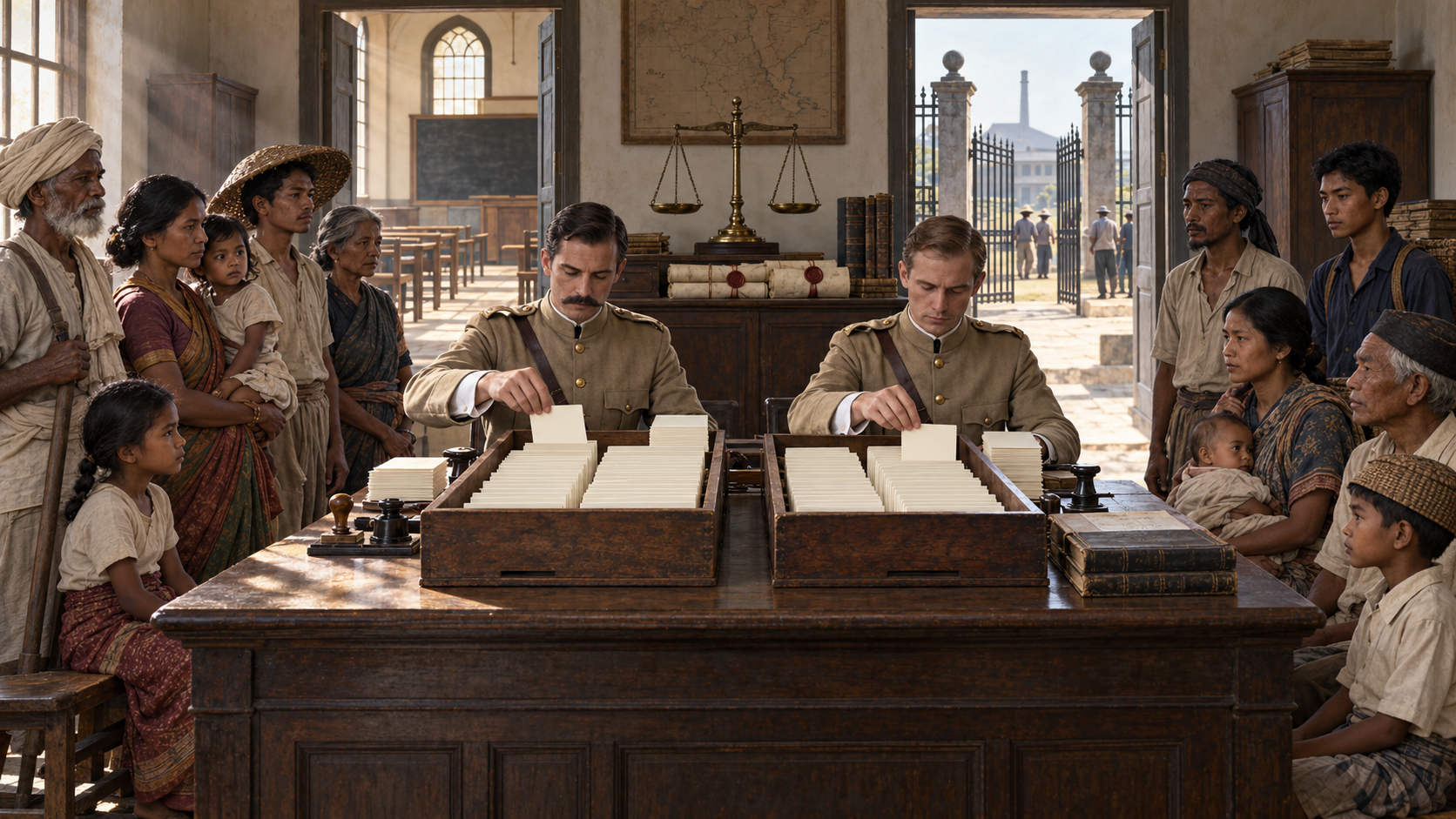
Classification becomes politically explosive when schools, offices and religious institutions make it consequential. Belgian administrators recruited favoured Tutsi elites into the colonial system. Catholic education often strengthened the same hierarchy: many Tutsi children received French instruction suited to administrative work, while many Hutu children were directed towards manual labour. Conversion to Christianity increasingly appeared to offer a route to education and social advancement.
After the Second World War, influential missionary currents changed alignment. Churches, schools and hospitals received support in Hutu regions, while parts of the Catholic establishment recast themselves as protectors of an oppressed majority. That change could be described as concern for disadvantage, but it also shifted political sponsorship without dismantling the racial framework through which the population had been organised.
In 1957, Hutu intellectuals issued the Bahutu Manifesto. The colonial myth was not discarded; its moral direction was reversed. Tutsi were now presented not as superior rulers but as foreign invaders and hereditary oppressors. Violence in 1959 killed or displaced thousands of Tutsi. Belgium and influential Catholic actors moved away from their former allies and supported Hutu political ascendancy. When Rwanda became independent in 1962, the hierarchy had been inverted while its rigid categories survived.
That is the distinction to carry into present debates: reversing a hierarchy is not the same as escaping it. If one group was once declared naturally entitled to rule, declaring another group naturally innocent and the first naturally guilty preserves the underlying machinery. The beneficiaries change; hereditary political identity remains.
When evaluating a movement that speaks in the language of liberation, examine its proposed remedy. Does it remove inherited barriers for actual people? Or does it assign virtue, blame, authority and punishment by ancestry? A programme can name a genuine injustice and still deepen the identity system that produced the conflict.
Mass killing requires more than private prejudice
After independence, Tutsi persecution and exile continued. Many lived as refugees in neighbouring countries. Juvénal Habyarimana seized power in 1973, promised stability and maintained institutional discrimination. The Church remained influential and entangled with the regime; the Archbishop of Kigali had served on the ruling party’s central committee before resigning.
War then gave extremists a mechanism for turning classification into collective liability. The largely Tutsi-led Rwandan Patriotic Front invaded from Uganda in October 1990. As civil war continued, propaganda increasingly portrayed all Tutsi civilians as accomplices of the RPF. That move was decisive: people no longer had to do anything hostile to be treated as enemies. Their assigned identity was made to stand in for evidence.
On 6 April 1994, the aircraft carrying Rwandan President Juvénal Habyarimana and Burundian President Cyprien Ntaryamira was shot down near Kigali. Organised killing began within hours. Over roughly one hundred days, political extremists, soldiers, militias and participating civilians exterminated Tutsi and murdered Hutu who resisted the campaign. The International Criminal Tribunal for Rwanda calculated that between 800,000 and one million people were killed.
The killings inside churches expose how far the moral order had collapsed. At Nyange parish, more than 1,500 Tutsi refugees gathered in and around a church. Father Athanase Seromba approved its destruction, encouraged the bulldozer driver and advised him about weaker parts of the building. The structure was brought down on the people inside. Seromba was later convicted of genocide and extermination as a crime against humanity and sentenced to life imprisonment.
This does not justify a blanket accusation against Christians or clergy. Some protected Tutsi, and some risked or lost their lives doing so. Others were silent, collaborated or participated. The useful question is not whether an institution was wholly good or wholly evil. It is whether its authority, schools, local knowledge and moral vocabulary were used to protect persons or reinforce the engineered division.
Rwanda reveals five components you should watch together:
- Administrative legibility: the state can identify every person by a hardened category.
- Unequal institutional treatment: education, employment or political access makes the label materially consequential.
- A hereditary grievance story: historical injury becomes proof that every member of another group is personally culpable.
- Collective liability: civilians are treated as agents of an armed or political organisation merely because they share an identity.
- An activating crisis: war, assassination or economic instability is used to turn an established enemy image into permission for violence.
No single component proves that genocide will follow. Their convergence is the warning. By the time explicit killing orders appear, the intellectual and administrative preparation may already have been operating for decades.
Use Rwanda carefully when thinking about Bharat

Rwanda is not Bharat, and Hutu-Tutsi history is not a template that can simply be laid over jati, varna, sect, language or region. A comparison is useful only when it clarifies a mechanism. It becomes propaganda when it erases differences between societies in order to produce a predetermined verdict.
Three shortcuts should be rejected. The first says that because a community name existed before Europeans arrived, colonial rule could not have transformed it. The second says that because colonial administrators hardened a category, every older distinction or injustice must have been invented. The third says that a documented injustice makes collective guilt across generations legitimate. None survives careful scrutiny.
For readers concerned about colonial accounts of Hindu society, the right response is not denial. It is reconstruction with precision. Separate indigenous concepts from European racial theories. Distinguish textual ideals, local practices, political arrangements and later administrative classifications. Ask how much movement existed in a particular time and place instead of assuming either perfect fluidity or total immobility. Most importantly, do not allow a claim about a system to become a licence to hate persons living now.
A Dharmic response must hold satya and ahimsa together. Truth requires facing actual exclusion and inherited injury where the evidence establishes them. Non-harm requires refusing the conversion of that injury into hereditary guilt, dehumanisation or punishment of civilians. Compassion without historical accuracy becomes evasion; historical argument without restraint can become a weapon.
Use this audit whenever a politician, activist, missionary, academic or media campaign presents an identity as ancient, uniform and morally decisive:
- Recover the earlier meaning. What did the category denote before a census, identity document or colonial law fixed it?
- Test the boundary. Could status, occupation, marriage, patronage, locality or political power change how a person was classified?
- Trace the administrative intervention. Which government form, school rule, hiring practice or political quota made the category govern daily life?
- Follow the incentives. Which elites or institutions gained authority, funding, converts, offices or clients by presenting the boundary as permanent?
- Separate grievance from genealogy. Is a specific wrong being proved against responsible actors, or is guilt being assigned to descendants and unrelated civilians?
- Look for enemy fusion. Are ordinary members of a community being equated with militants, invaders or a political organisation?
- Check the proposed remedy. Does it protect equal dignity and correct a demonstrable barrier, or does it reverse the hierarchy while preserving collective blame?
This method will not tell you that every identity conflict is colonial in origin. It will tell you where to look for the engineering: the moment description becomes destiny, bureaucracy turns destiny into unequal treatment, and political rhetoric converts unequal treatment into a struggle between hereditary enemies.
Key takeaways: act before the divide becomes a command
- Do not confuse the age of a group name with the age of its present political meaning.
- Treat identity documents, censuses, school systems and hiring structures as active forces, not passive records.
- Reject both historical denial and hereditary guilt; neither can support a truthful remedy.
- Pay close attention when civilians are described as automatic accomplices of an armed or political faction.
- Judge religious, educational and civic institutions by whether they protect individual persons when group pressure intensifies.
The practical moment for intervention is before a slogan becomes a file, a file becomes an entitlement or disability, and a political crisis turns the classified neighbour into an enemy. When you meet a new claim about an allegedly eternal social divide, trace the category, the institution and the proposed punishment in that order. That habit is slower than choosing a camp, but it is far more likely to expose the machinery before the machinery begins to move.
References

Leave a Reply
You must be logged in to post a comment.