
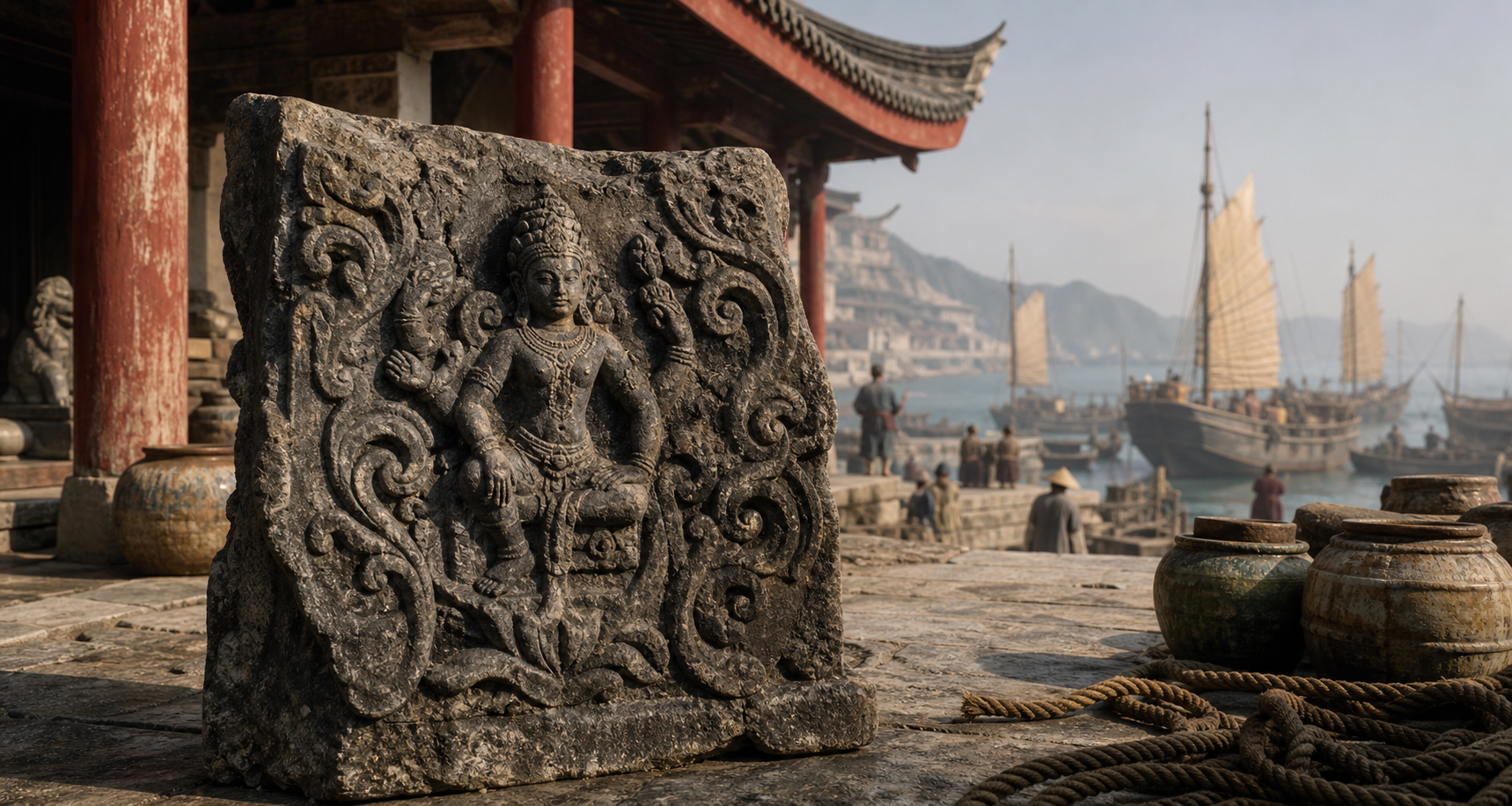
You may have encountered a photograph of Hindu-style carvings in a Chinese Buddhist temple and wondered whether its caption is revealing a forgotten history or overselling an ambiguous image. The answer is more substantial than either extreme.
Not every lotus proves that a Hindu temple once stood nearby. Yet reused columns, coherent deity imagery, maritime trade chronology, foreign merchant communities, and surviving worship are not random coincidences. If you learn to separate these kinds of evidence, you can recognize the Hindu heritage of maritime China without inflating it into a claim the surviving record cannot bear.
Make the claim no larger than the evidence
The first discipline is to ask exactly what you are trying to establish. The presence of an Indic motif, the existence of a Hindu congregation, the former location of a shrine, and the survival of Hindu worship are four different claims. Each requires different evidence.
| Claim being tested | Evidence that matters | What you can safely conclude |
|---|---|---|
| Hindu merchants lived in a Chinese port | Records of foreign settlements, the port’s trade connections, material remains, and a matching historical period | A resident or regularly visiting Hindu community is credible, even when its size is unknown |
| A Hindu shrine once stood there | Architectural components, a coherent iconographic program, archaeological context, and evidence of later reuse | A former sanctuary may be strongly supported without claiming that its full plan or precise location has been recovered |
| A Chinese religious figure has an Indic lineage | Name, attributes, ritual function, textual transmission, and development within Buddhist traditions | Religious adaptation occurred; this does not by itself prove that a separate Hindu congregation worshipped at that site |
| Hindu worship survives locally | Ritual practice, community testimony, oral history, a ritual calendar, and care of a sacred image | A living tradition survives, although present practice alone cannot date the origin of the image or shrine |
The strongest historical formulation is therefore specific: Hindu worship, sacred imagery, and temple architecture had a place within the plural port societies of southeast China during the Song dynasty (960-1279) and Yuan dynasty (1271-1368), and portions of that heritage endured through architectural reuse, Buddhist adaptation, museum collections, and local devotion.
This is not evidence that China as a whole became Hindu. It is evidence that Hindu communities belonged to the maritime life of particular Chinese ports. That narrower conclusion is also the more meaningful one: it identifies the people, routes, institutions, and places through which Bharat’s civilizational influence actually moved.
Why a trading port would need a Hindu shrine
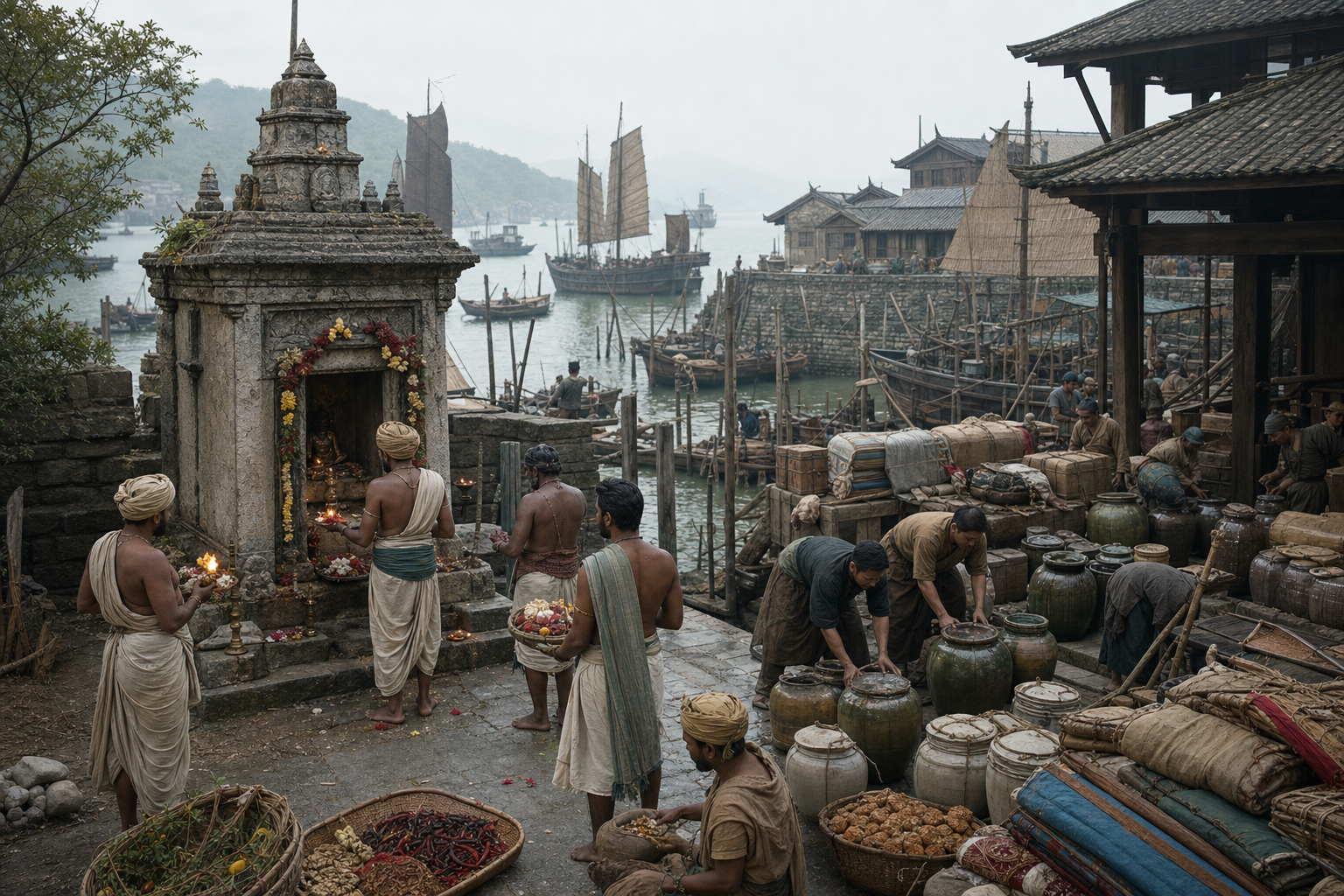
Begin with the port rather than the deity. Quanzhou, also known historically as Zayton, and Guangzhou, or Canton, connected China with South Asia and Southeast Asia. Their ships and markets handled pepper, textiles, aromatics, precious woods, ceramics, silks, and metallurgical knowledge. Religious life traveled through the same harbours because the merchants, craftspeople, sailors, and families involved in commerce did not arrive as culturally empty economic units.
A diaspora temple answered several practical needs at once. It provided a place for puja, preserved ancestral customs, created a meeting point for a merchant association, and gave newcomers a recognizable institution in a foreign city. Local collaborators, patrons, and artisans could also enter that social world. The resulting sanctuary was a cultural hearth, not necessarily the headquarters of a campaign to convert the surrounding population.
This distinction prevents a common historical mistake. Maritime influence does not require territorial conquest. A commercially important community can leave temples, inscriptions, loanwords, artistic techniques, and ritual memories without ruling the land in which those things survive.
South Indian networks provide the connective tissue. The maritime reach of the Chola period, broadly spanning the ninth through thirteenth centuries, overlapped with guild networks such as the Ainnurruvar and Manigramam. Their activities are epigraphically attested across South and Southeast Asia. In coastal China, however, direct inscriptions naming these guilds are rare. That absence sets a necessary boundary around the claim.
- The existence and wide reach of South Indian merchant networks are part of the established historical setting.
- The date, style, and location of Quanzhou’s Hindu remains are consistent with activity flowing through those networks.
- The identity of a particular donor, guild, sculptor, or congregation should remain uncertain unless an inscription or comparable direct evidence names it.
Use the Chola and Tamil connection to explain how people, resources, and artistic forms could have reached China. Do not turn it into an ownership stamp on every Indic-looking carving. The network is strong context; it is not a substitute for an object’s provenance.
How to read the Hindu stones preserved at Quanzhou
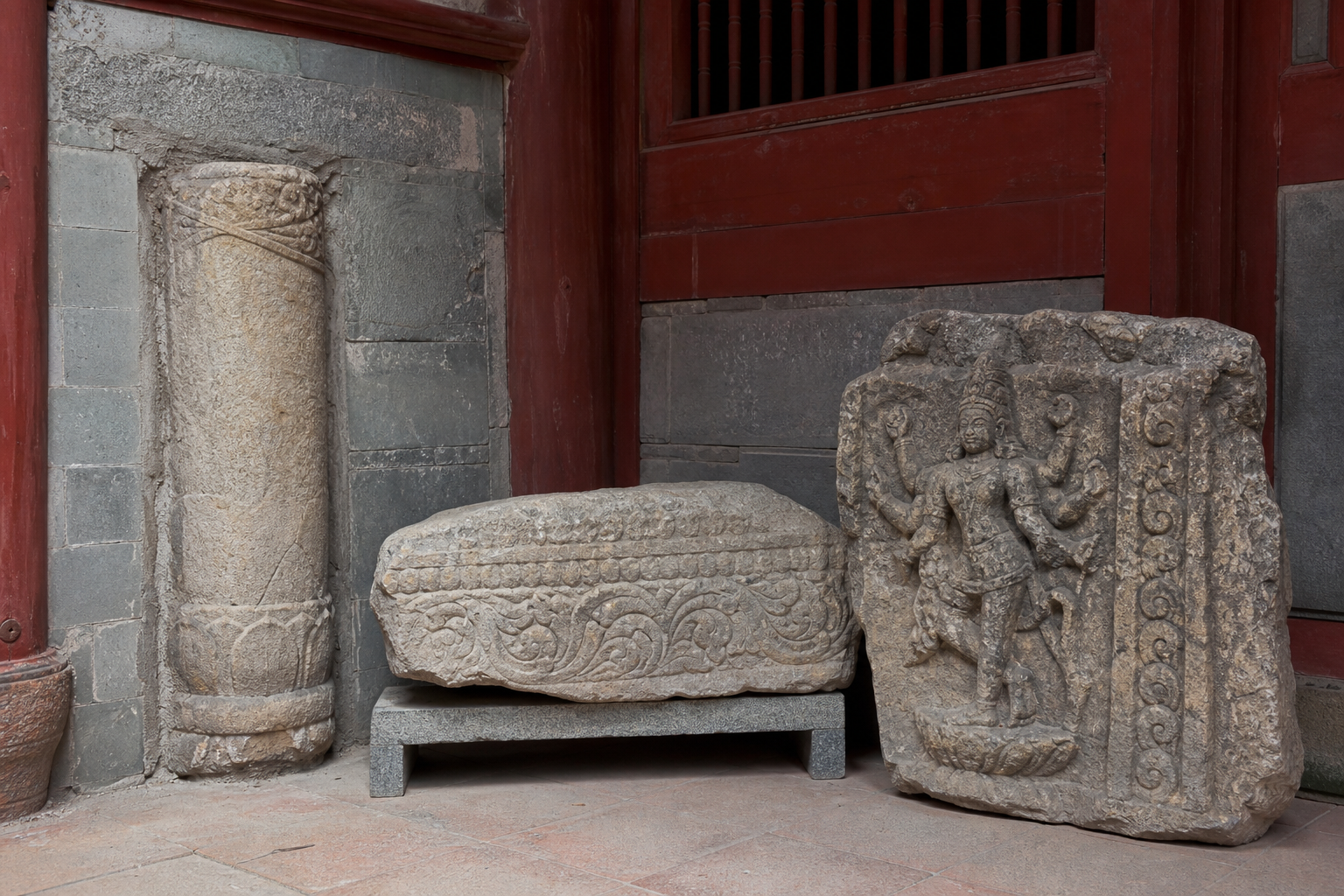
Quanzhou’s most instructive remains are not standing inside an intact Hindu temple. They survive in displacement. The major Buddhist complex known as Kaiyuan Temple preserves two granite columns and additional stonework associated stylistically with South Indian Hindu temple architecture of the twelfth through fourteenth centuries.
The presence of those stones in a Buddhist complex is not a contradiction. Architectural reuse can preserve material after the institution that commissioned it has disappeared. The correct question is therefore not simply, What building contains this column now? You must also ask, For what building was it originally carved?
The Quanzhou material includes lotus bands, yali-like creatures, dancers, elephants, and panels interpreted through Shaiva, Vaishnava, Ganesha, and broader South Indian iconographic conventions. A lotus alone would be weak evidence because Hindu and Buddhist art both use it. A cluster of compositional features, creatures, deities, postures, attributes, and carving conventions is much more informative.
When you encounter a museum label, photograph, travel account, or online claim about a Hindu carving in China, work through this sequence:
- Establish provenance. Ask where the object was found, whether it remains in its original position, and whether its earlier setting is known. If the provenance is missing, treat the identification as a lead rather than a settled conclusion.
- Look for a program, not one attractive motif. Repeated bands, attendant figures, animals, deity panels, and architectural relationships carry more weight together than any single flower or decorative curve.
- Identify attributes before assigning a name. Posture, objects held in the hands, attendants, vehicle, crown, and placement can distinguish a deity from a generic divine or protective figure.
- Check for reuse. A stone can be genuinely Hindu in origin while standing today in a Buddhist structure. Name both histories instead of forcing the object into only its present setting.
- Ask how the date was obtained. An inscription may provide a donor and date. Without one, stylistic comparison and archaeological context usually offer a range rather than an exact year.
- Seek corroboration beyond the object. Related sculptures, port records, settlement history, and the chronology of maritime traffic can strengthen an interpretation, although they cannot identify an unnamed donor by themselves.
Several disciplines contribute different pieces. Art historians compare deity attributes and regional carving styles. Archaeologists examine context, quarry marks, tool signatures, and stone types. Epigraphists look for names, guild titles, and dates. Maritime historians compare port records with shipwreck cargoes and ceramic sequences. No one method carries the whole argument.
Quanzhou’s maritime collections also preserve sculptures attributed to Hindu deities, so the columns do not stand as an isolated visual puzzle. Even so, the careful description remains the best one: Kaiyuan Temple preserves reused stonework that supports the former presence of Hindu sacred architecture in the port. It does not follow that the entire Buddhist complex was once a Hindu temple.
When a Hindu deity crosses into a Chinese tradition
Stones are only one route of survival. A deity can also cross a cultural boundary by receiving a new name, ritual setting, visual form, or protective function. Maritime China must therefore be read through translation as well as archaeology.
- Skanda, or Kartikeya, appears in Chinese Buddhist temples as Weituo, a guardian figure.
- Shaiva-linked Mahakala enters tantric Buddhist settings as Daheitian.
- Vinayaka, or Ganesha, appears within East Asian esoteric lineages.
Those statements describe routes of transmission, not perfect equivalence. A deity adapted within Chinese Buddhism may acquire functions and iconography that differ from worship in a Hindu temple. Calling the later form entirely unchanged would erase the Chinese development. Denying its Indic lineage would erase the route by which the figure entered that religious world.
The same care applies to philosophical language. Sanskrit dhyana developed into Chinese Chan, with related names such as Zen and Seon elsewhere in East Asia. Karma and samsara acquired Chinese renderings and places within Buddhist teaching. These words demonstrate deep intellectual transmission, but they do not establish that every community using them maintained a separate Hindu institution.
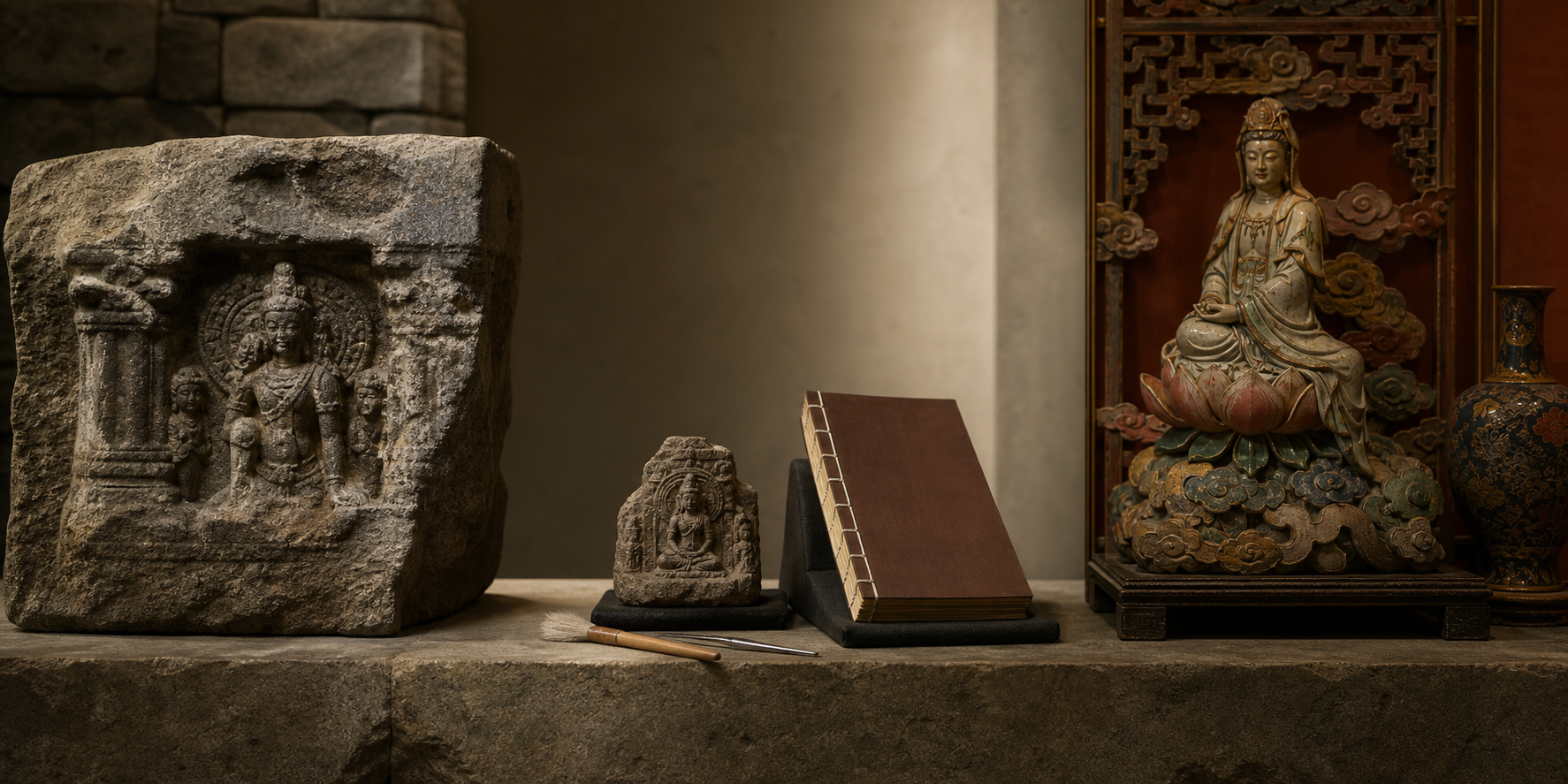
You can avoid confusion by naming three layers whenever possible: the Indic origin or relationship, the Chinese Buddhist form, and the local ritual function. This lets you acknowledge a shared dharmic genealogy without collapsing Hinduism and Buddhism into one undifferentiated religion. Cultural exchange becomes visible precisely because difference remains visible.
Chedian shows why living memory must be protected with the stone
At Chedian in Fujian, the historical question is not confined to an excavated fragment. A village community continues to honour a deity understood locally as Hindu through offerings, incense, and seasonal observances. That practice gives the site a different evidentiary character from an object held in a museum.
This is possibly the only temple in China where we are still praying to a Hindu God.
Li San Long, Chedian resident
The word possibly matters. It expresses the rarity and perceived importance of the shrine without pretending that every religious site in China has been exhaustively surveyed. The statement is powerful testimony to living practice, not a statistical census of Chinese temples.
Living worship and archaeological dating also answer different questions. Ritual continuity tells you how a community understands and cares for a sacred presence. It cannot, by itself, establish the century in which a stone was carved. Conversely, laboratory or stylistic analysis may help date an object but cannot explain everything the object means to its present custodians. Both records must be kept.
If you are documenting such a site as a visitor, educator, community organization, or heritage worker, use a three-layer record:
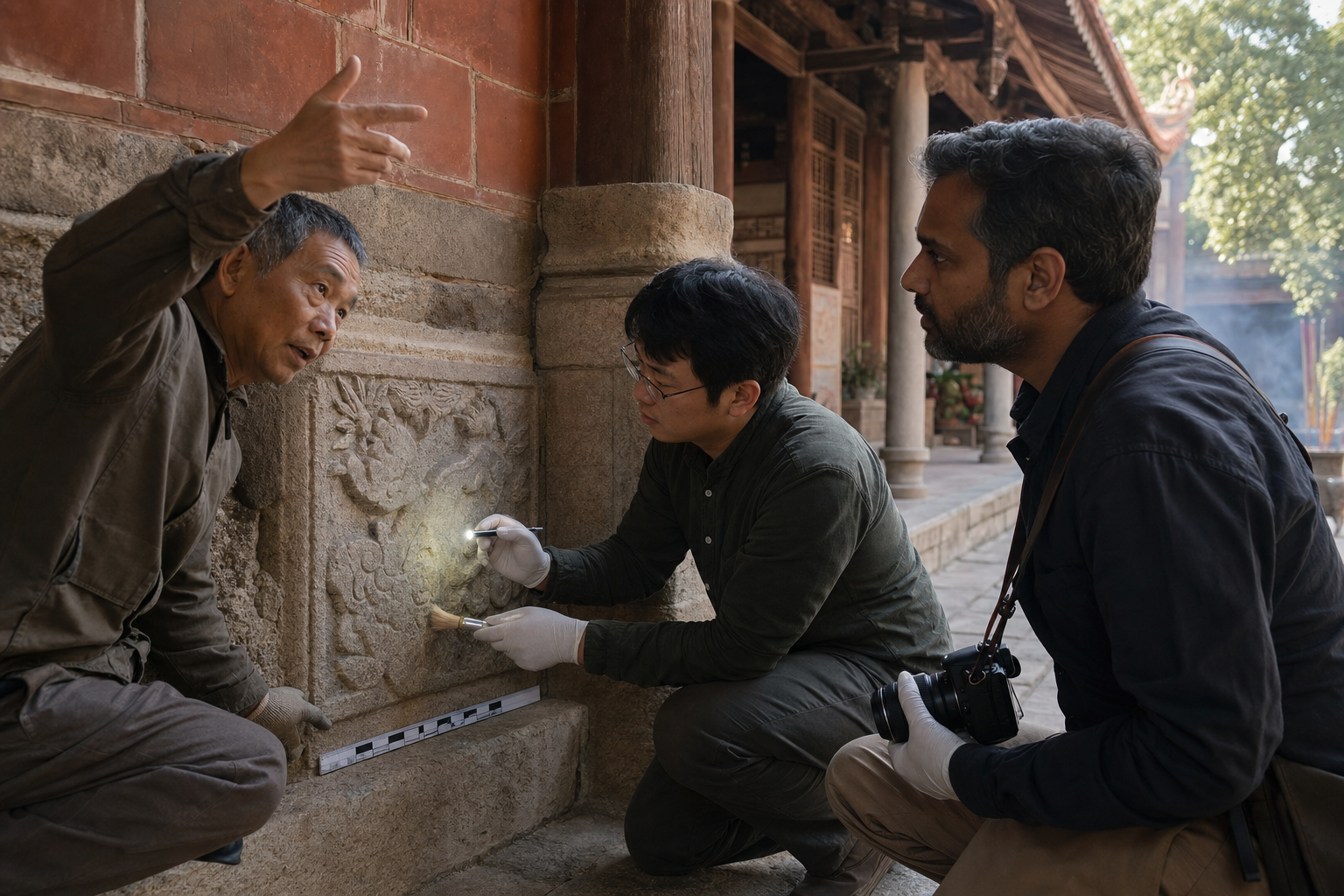
- Record the object. Document the whole image or architectural element, its material, visible attributes, condition, and physical setting. Do not clean, move, or reconstruct it. Those actions can destroy tool traces or separate the object from evidence of its context; treatment belongs with qualified conservators and local custodians.
- Record the practice. With the community’s permission, note the local name of the deity, offerings, festival or seasonal calendar, caretaking customs, and who performs the rites. Preserve the local terminology rather than silently replacing it with a name that appears more familiar in India.
- Record the interpretation. Keep community memory, iconographic identification, archaeological dating, and hypotheses about merchant patronage distinct. They may support one another, but they are not interchangeable.
Conservation should then make those layers legible. Bilingual interpretation can explain both the South Asian origin of an image and its Chinese afterlife. Digital archives can connect dispersed sculptures, columns, oral histories, and ritual calendars. Partnerships with local schools can give younger residents the context behind inherited customs. Traveling exhibitions and joint conservation workshops can bring Chinese and Indian specialists into the same practical work.
Quanzhou’s recognition as a UNESCO World Heritage site provides a broader setting for this approach. Its Song-Yuan prosperity supported a religious ecology that included Buddhist, Islamic, Manichaean, Christian, and Hindu traces. The Hindu material should be clearly named within that plural history, neither hidden under a generic label of foreign influence nor detached from the Chinese city that preserved it.
This is shared custodianship in a concrete sense. South Asian history helps explain the imagery, religious lineages, and maritime routes. Chinese communities and institutions hold the physical settings, local memories, and later lives of the objects. Protecting one side by erasing the other would make the heritage less intelligible.
Key takeaways
- Hindu heritage in maritime China is strongest when port history, merchant presence, iconography, chronology, and local practice converge.
- Quanzhou provides material evidence through carved stones and sculptures; Chedian adds the distinct evidence of living worship.
- South Indian and Tamil merchant networks explain a credible route of transmission, but rare direct inscriptions in China limit claims about specific guilds or donors.
- A Hindu-derived deity in Chinese Buddhism demonstrates adaptation and exchange, not automatically the existence of a separate Hindu temple at that location.
- Good conservation protects the sacred object, its archaeological context, the community’s ritual practice, and uncertainty about what has not yet been proved.
The next time you see a claim about a Hindu image in China, ask for the chain: object, context, date range, maritime route, present setting, and local name. If you can influence a museum label, classroom lesson, archive, or heritage project, insist that each link be shown. That precision does not diminish Bharat’s civilizational reach. It makes the history harder to dismiss and easier for the next generation to protect.
References
