

You may have found an early ISKCON remembrance because you want something a biography cannot quite provide: the texture of being near A.C. Bhaktivedanta Swami Prabhupada as his mission took root in New York. Yet a moving memory can be mishandled. It can become nostalgia, an isolated proof-text, or a story repeated so often that nobody remembers who actually told it.
You can hear these accounts devotionally and still handle them carefully. The most fruitful method is to listen twice: first for the relationship being remembered, then for the precise testimony being preserved. That discipline lets the memory deepen your practice without asking it to prove more than it can.
Key takeaways
- Listen once without interruption so that you receive the remembrance as a whole, not as a collection of quotable fragments.
- On a second hearing, separate the remembered event, remembered wording, the speaker’s interpretation, and your own application.
- Keep the speaker’s name, honorific, program title, channel, stated date, link, and relevant timestamp attached to every note you share.
- Give each devotee a separate hearing before comparing accounts. Different emphases do not automatically amount to contradiction.
- End with one practice that follows clearly from the remembrance, while refusing to turn a personal interaction into a universal rule.
A memory is testimony, not a transcript
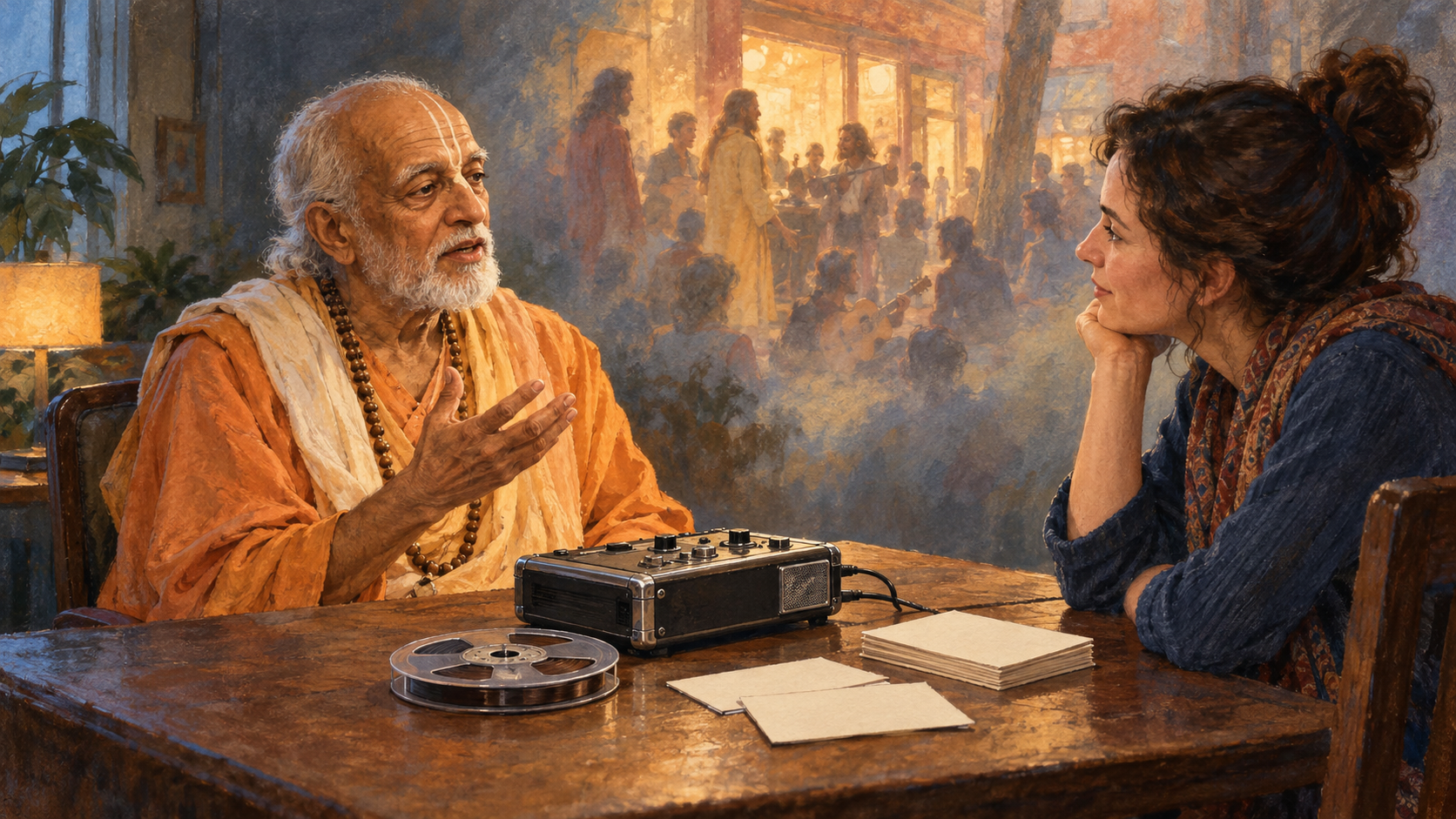
A devotee’s remembrance can carry several kinds of knowledge at once. It may preserve an event, remembered words, a tone of voice, the devotee’s understanding of the encounter, and the spiritual meaning that became clearer over time. All of those layers matter, but they are not interchangeable.
Suppose a speaker remembers that Srila Prabhupada smiled and then explains, “We understood that he approved.” The smile belongs to the narrated event. Approval is the speaker’s interpretation of it. You do not honor the testimony by blurring that distinction. You honor it by retaining both layers and labeling them honestly.
Use four simple labels as you listen:
- Event: What does the speaker say happened? Record the action without adding a motive.
- Wording: Does the speaker present particular words as a direct recollection, or merely convey their sense? Use quotation marks only for wording presented as exact.
- Interpretation: What did the speaker understand the incident to mean, either then or later?
- Application: What conclusion are you drawing for your own sadhana, service, or understanding of guru-seva?
This distinction prevents two common mistakes. The skeptical mistake dismisses a recollection because memory is not a mechanical recording. The sentimental mistake treats every remembered detail as if it were an independently verified transcript. Neither approach hears the devotee on the devotee’s own terms.
When a name, date, location, or sequence is essential to your conclusion, mark whether the speaker states it explicitly. If it is only inferred, label it as an inference. A spiritually significant remembrance does not become less meaningful because one chronological detail remains uncertain.
Keep each New York voice distinct

Begin with the person, not with a composite legend. HG Daivi Shakti Mataji is presented in a Srila Prabhupada Lilamrita session dated 18 October 2026 through ISKCON Vrindavan. Dayananda Prabhu and Rupa Vilas Prabhu are presented together in an NYC program through Hare Krishna Gita NYC. These are three named voices. Do not dissolve them into the vague phrase “the early devotees said.”
Create a separate page of notes for each speaker, even when two devotees appear in the same program. That small choice matters because one person may supply the remembered event while another adds context, interpretation, or a related incident. A combined summary can accidentally assign one devotee’s recollection to the other.
Before comparing accounts, answer four questions for each speaker:
- What relationship or setting does the speaker personally describe? Do not infer a role that is not stated.
- Is the devotee recalling direct participation, something personally observed, or something heard from another person?
- Which place and period are explicitly identified, and which are assumptions supplied by the listener?
- What aspect of Srila Prabhupada comes into view through this particular memory: instruction, correction, affection, standards, practical service, or another feature named by the speaker?
Only then should you place the accounts beside one another. Look first for complementarity. One devotee may remember a practical detail while another remembers the inner effect of the same kind of association. Difference in emphasis is not evidence that one memory must displace the other.
If two details appear to conflict, preserve both attributions rather than silently harmonizing them. Write, “Daivi Shakti Mataji remembers…” or “Dayananda Prabhu recalls…” until the point can be clarified. Attribution is not a sign of doubt; it is how you prevent a living voice from being replaced by an anonymous community legend.
Use two passes and a fixed note sheet

On the first pass, do not pause every few seconds. Hear the account from beginning to end. Your task is to notice its center: What encounter is being remembered? Why did it remain important to the devotee? What quality of discipleship becomes visible through the telling?
Write only one sentence after that first hearing. If you cannot express the central remembrance without stacking several unrelated incidents together, listen again before extracting lessons. This keeps the most dramatic detail from crowding out the actual point.
On the second pass, pause and take documentary notes. Use the same fields every time:
- Speaker’s published name and honorific
- Program title and hosting channel
- Original link
- Date stated in the title or on the hosting page
- Timestamp for the relevant passage
- Event claim
- Remembered wording or clearly marked paraphrase
- Speaker’s interpretation
- Your proposed application
- Any name, term, or sequence that requires checking
Carry forward the date 18 October 2026 for the Daivi Shakti Mataji session because that date is supplied in its title. For the Dayananda Prabhu and Rupa Vilas Prabhu program, record whatever date the host actually displays when you access it. If no date is shown, write “date not stated.” Never transfer the date from a neighboring upload or assume that an upload date is the date of the remembered event.
Timestamps are equally important. A quotation detached from its question, preceding explanation, or change of speaker can acquire a meaning it did not have in context. When you share a passage, provide the timestamp and enough surrounding context for another listener to hear the exchange fairly.
Preserve devotional names and honorifics accurately. If the audio is unclear, mark the word as uncertain rather than quietly substituting the name you expect to hear. The note “[uncertain]” is more responsible than confident misidentification.
Turn reverent hearing into practice and preservation
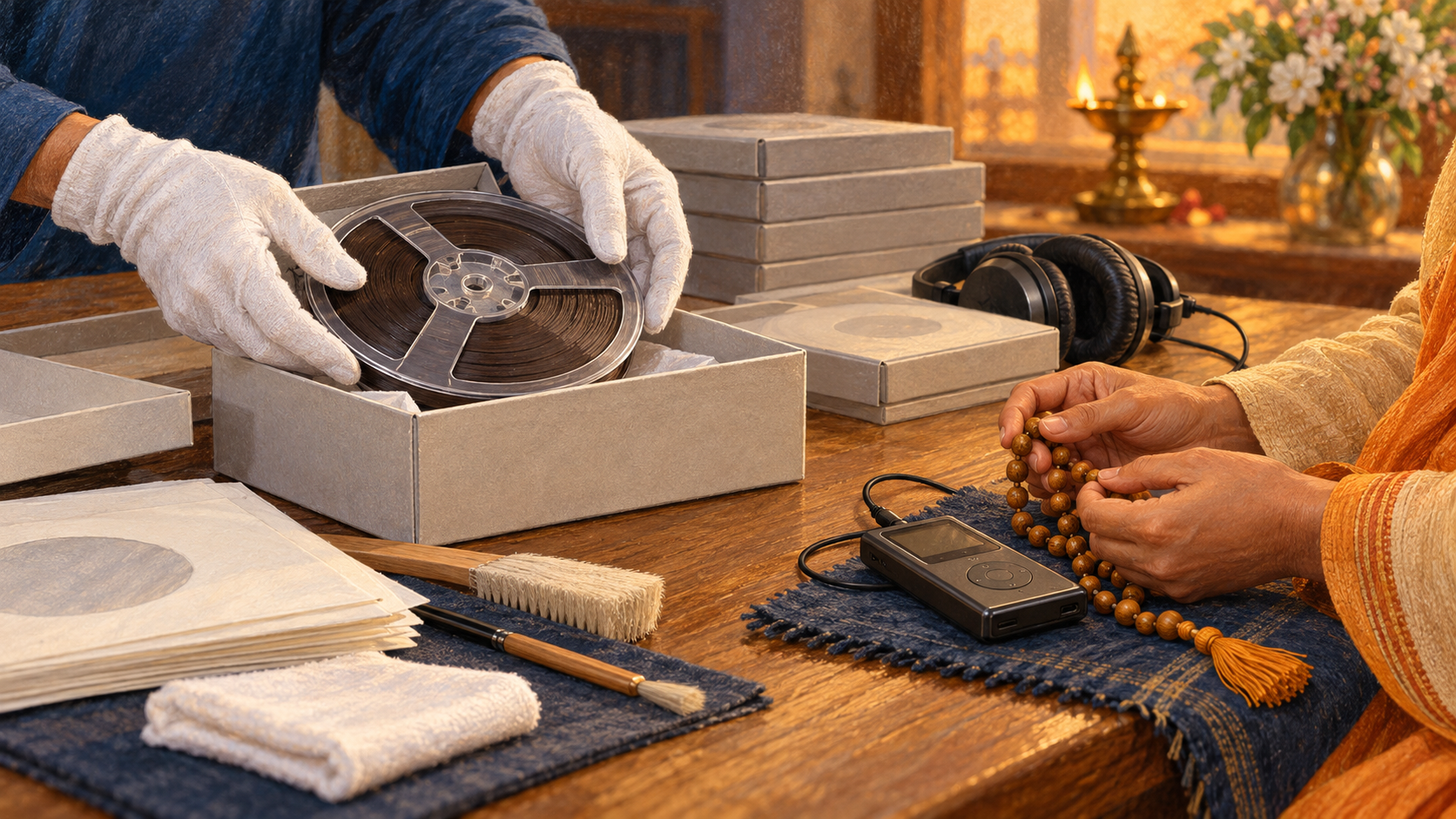
Remembrance of Srila Prabhupada is not meant to end as interesting information. Yet application requires restraint. A personal instruction given to one devotee in one circumstance is not automatically a command for every devotee in every circumstance. Look for the underlying principle before copying the visible action.
After listening, work through this sequence:
- Describe the remembered incident in one sentence without interpretation.
- Name the principle that follows with the least speculation.
- Choose one small practice you can complete within the next day.
- State the boundary: what does this memory not establish?
If the remembrance emphasizes attentive hearing, your application might be one uninterrupted period of reading or japa with the phone placed out of reach. If it emphasizes prompt service, finish one neglected responsibility before seeking another inspiring story. If it emphasizes care between devotees, contact one person whose service you ordinarily overlook. These are applications, not claims about what any particular speaker said.
Keep personal remembrance in conversation with established teaching. An anecdote may show what an instruction looked like in a particular room, relationship, or moment. It should illuminate siddhanta and service, not be used to overturn clear teaching or manufacture a factional slogan.
Preservation is also a form of service. Keep a local index containing the speaker, title, channel, stated date, link, and your timestamps. A bare bookmark is fragile because its meaning disappears when the title changes or the link stops working. Your index should tell a future reader what was there without pretending to replace the original recording.
If you prepare a transcript, retain the speaker’s sequence and distinguish transcription from editorial clarification. Mark inaudible words, put supplied explanations in brackets, and keep your theological commentary outside the transcript itself. Do not silently polish conversational speech into words the devotee may never have used.
When sharing a memory publicly, lead people back to the named devotee and the complete context. Include the link and timestamp. Avoid turning private details, incidental remarks, or uncertainty about another person into gossip. The purpose is to transmit Prabhupada-katha with fidelity, not to win an argument by borrowing a senior devotee’s authority.
Choose one of these remembrances and hear it all the way through. Then return with your note sheet and preserve one event, one principle, one boundary, and one action. That modest discipline allows early New York memories to remain living Vaishnava inheritance rather than fading into unattributed atmosphere.
References
- Dandavats — HG Daivi Shakti Mataji || Srila Prabhupada Lilamrita || 18-10-2026
- Dandavats — Dayananda Prabhu and Rupa Vilas Prabhu — NYC

Leave a Reply
You must be logged in to post a comment.