
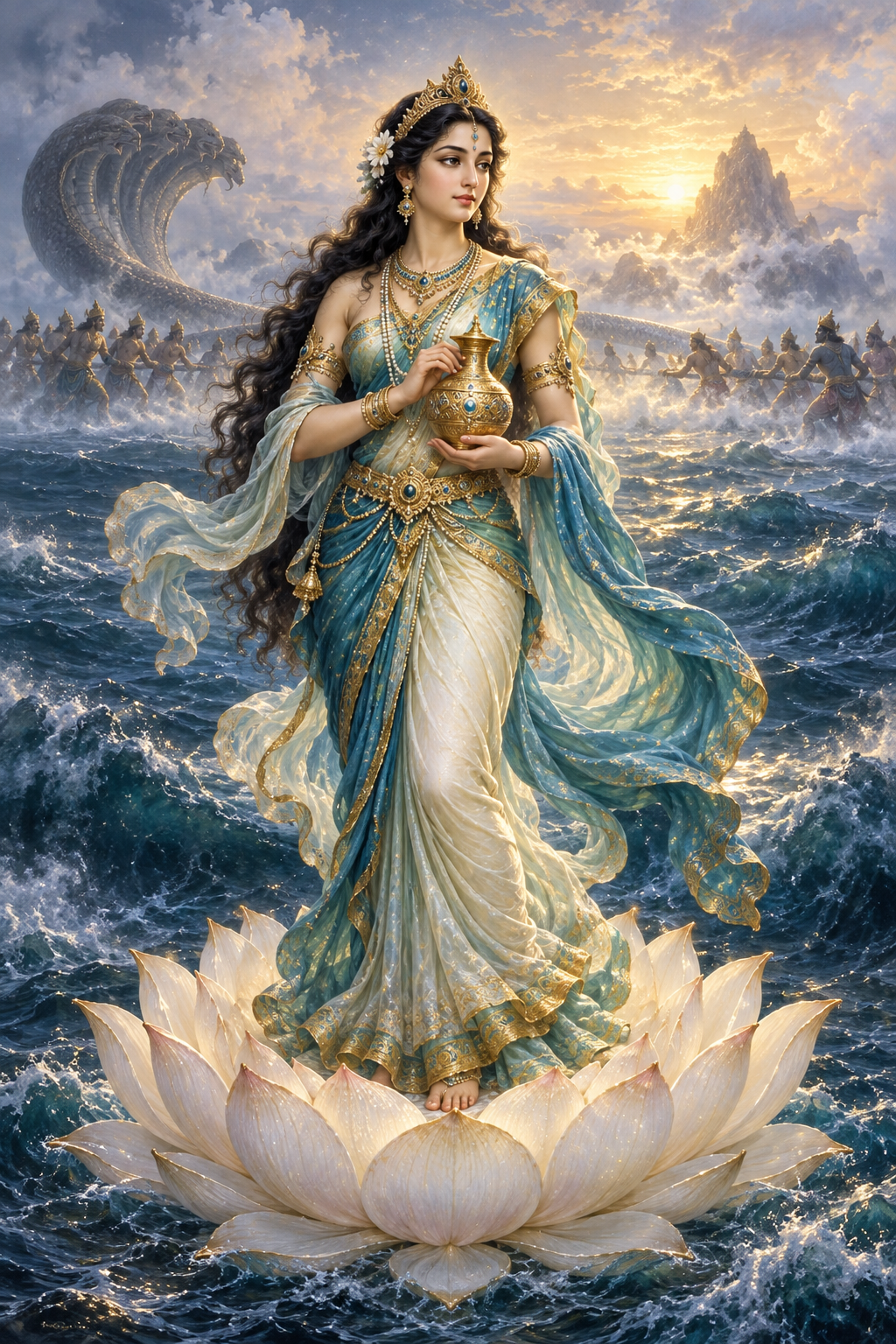
You may have found a murti or painting labelled Varuni Devi, only to encounter explanations that leap from water to pleasure, abundance, intoxication, or spiritual bliss. The real difficulty is not a lack of symbolism. It is knowing which meanings belong to the image, which belong to a particular tradition, and which have simply been added by an enthusiastic interpreter.
A reliable reading begins with three anchors: Varuni’s identity, the mythic event surrounding her appearance, and the details actually visible in the image. Keep those anchors separate, and her Tantric significance becomes clearer without being reduced to a collection of speculative claims.
Identify Varuni before interpreting her attributes
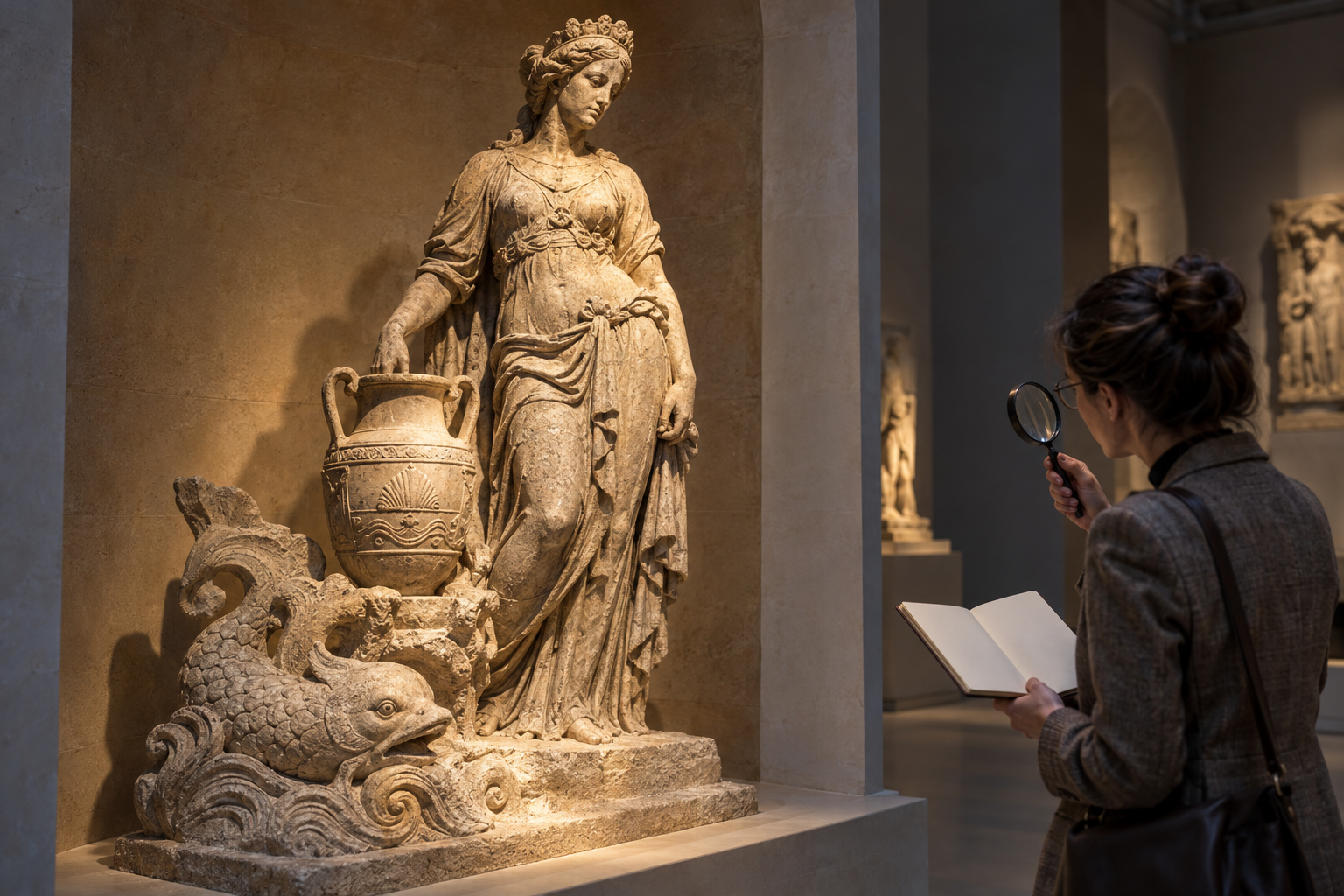
The first question is not “What does the water symbolize?” It is “Which Varuni is represented here?” A commonly given account identifies her as the daughter of Varuna, the deity of water, and his consort Jyeshtha. It places her emergence within the churning of the cosmic ocean by the Devas and Asuras, alongside amrita and other divine manifestations.
Those relationships matter. Varuni is not merely Varuna redrawn as a woman, and she should not automatically be treated as a generic river goddess. Her name connects her to Varuna and the waters, while the Samudra Manthan gives her an event-based identity: she is a power that becomes manifest when the hidden contents of the cosmic ocean are brought forth.
Before assigning a symbolic meaning, record the evidence available to you:
- Read the inscription, museum label, temple notice, or accompanying caption, if one exists.
- Notice whether water is shown as her seat, her surroundings, or merely a decorative border.
- Look for a larger Samudra Manthan scene rather than interpreting the figure in isolation.
- Record the number and position of the hands before trying to identify what they hold.
- Note accompanying figures, animals, vegetation, architectural details, and ritual objects.
- Ask whether the image belongs to a temple tradition, a manuscript, a Tantric diagram, or a modern devotional print.
No single visual feature should carry the entire identification. Water can accompany many deities. A vessel can hold many substances. A lotus can function as a seat, an attribute, or part of the surrounding design. The whole composition is stronger evidence than one attractive detail.
Samudra Manthan supplies the image’s central movement
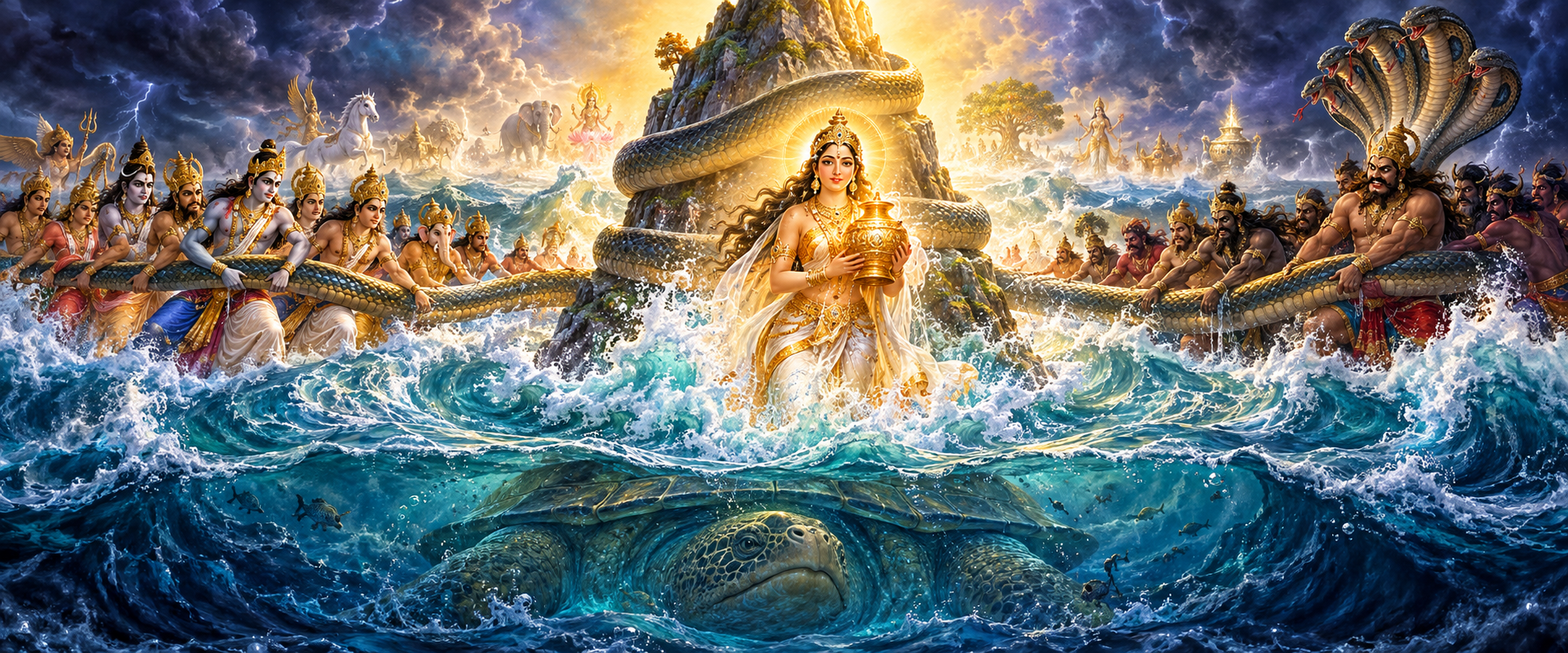
Varuni’s oceanic setting is not just scenic decoration. Her mythic context has a definite sequence: the cosmic ocean is present, the Devas and Asuras churn it, and distinct powers emerge from what had been concealed within it. Varuni appears during that process rather than before it.
This sequence gives you a disciplined symbolic framework. The ocean can be read as a field of unmanifest potential. Churning introduces sustained movement, tension, cooperation, opposition, and separation. Emergence makes a previously hidden potency perceptible. This is an interpretation of the mythic structure, not a claim that every wave or ornament has one fixed secret meaning.
Three distinctions prevent common misreadings:
- Origin is not identity. Varuni emerges from the oceanic process, but that does not make her identical to the entire ocean.
- Association is not equivalence. Her appearance alongside amrita does not, by itself, establish that she is amrita personified.
- Transformation is not instant gratification. The myth places manifestation after churning, so the symbolic emphasis falls on a process that reveals and differentiates latent powers.
If an image shows Varuni seated upon or surrounded by water, begin with this mythic relationship. Only then ask whether the local tradition adds further meanings such as receptivity, fertility, nourishment, pleasure, abundance, purification, or spiritual transformation. Those meanings may be plausible in a particular context, but the image alone does not make all of them equally certain.
A Tantric reading joins cosmology, ritual, and attention
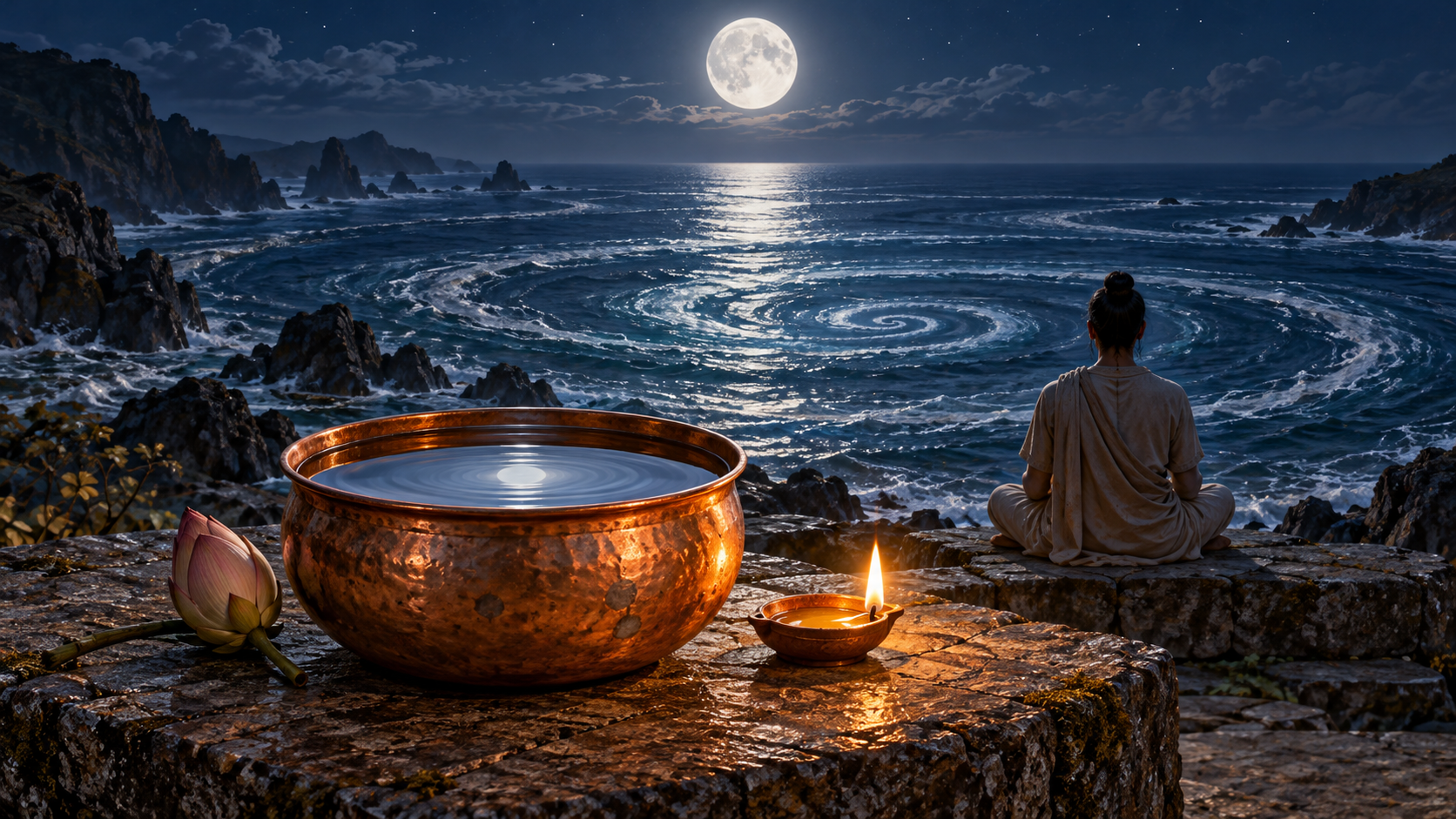
Tantric iconography is not best approached as a rebus in which every object has a universal one-word solution. A deity’s form establishes relationships among cosmic forces, the practitioner’s attention, ritual action, and the presence being worshipped. Meaning lies not only in an attribute but also in what the complete form asks the practitioner to notice and integrate.
Varuni’s imagery can therefore be considered at three levels, provided you keep interpretation distinct from established lineage teaching.
The cosmological level
At this level, focus on manifestation. Varuni’s emergence during the churning presents divine power as something disclosed from within a deeper field. Ask what changes between the undifferentiated ocean and the appearance of an identifiable Devi. The important movement is from hidden potency to present form.
The ritual level
At this level, visual objects must be identified carefully. If the image includes a vessel, for example, first establish its shape, position, and traditional name. A vessel may suggest containment, reception, offering, or a specific ritual substance, but those possibilities are not interchangeable. Do not call it a skull cup, an amrita vessel, or a container of another substance unless the image’s provenance or tradition supports that identification.
The same caution applies to hand gestures, seats, colours, and accompanying beings. A Tantric meaning becomes more reliable when the visible form, the ritual context, and an identifiable teaching agree. An isolated internet caption is not enough to establish a mantra, offering, initiation rule, or secret ritual use.
The contemplative level
At this level, the churning can serve as a structure for reflection. Attention is applied repeatedly rather than casually. Conflicting forces are not denied; they become part of the movement through which something concealed is revealed. Varuni’s arrival can then invite contemplation of how an unrecognized capacity becomes conscious, named, and related to the rest of life.
This does not reduce the Devi to a psychological metaphor. A symbolic reading can illuminate your own mind while still respecting Varuni as a divine presence. Dharmic iconography loses much of its depth when a deity is treated either as nothing but an external object or as nothing but a projection of human psychology.
There is also a practical boundary. Studying symbolism does not authorize you to invent a Tantric practice. If a ritual involves a mantra, initiation, consecrated substance, or lineage-specific procedure, learn it from a qualified teacher within that tradition. What you can responsibly do on your own is observe the image, understand its mythic relations, and distinguish evidence from contemplation.
Use a four-pass method when examining an image
You can apply the following method to a temple sculpture, manuscript illustration, museum object, or devotional print. It takes only a few minutes and prevents a compelling interpretation from being mistaken for an established fact.
- Transcribe what you see. Record posture, seat, hands, objects, water, companions, ornaments, colours, and inscriptions. Use neutral descriptions when an object is uncertain. Write “rounded vessel” rather than supplying a ritual name you cannot verify.
- Establish the identity. Use labels, provenance, placement, surrounding figures, and the wider scene. If only the name Varuni is supplied, treat the identification as a starting point rather than a complete interpretation.
- Connect the mythic relationships. Ask how Varuna, water, Samudra Manthan, and Varuni’s emergence clarify the composition. Do not import unrelated stories merely because they contain similar objects.
- State the interpretation with its level of certainty. Separate what is visible, what is traditionally identified, and what you infer from their relationship.
A useful annotation can be as simple as three lines:
- Seen: a female deity seated above stylized water.
- Known: a commonly given account links Varuni to Varuna and places her emergence during Samudra Manthan.
- Interpreted: the combination of water, churning, and emergence can support contemplation of a latent power becoming manifest.
The wording matters. “Can support” identifies a reasoned interpretation. “Always means” makes a universal doctrinal claim that would require much stronger evidence. This small grammatical distinction keeps your reading open to correction by a temple tradition, textual description, or initiated lineage.
The method also exposes weak claims quickly. If someone says that a vessel proves intoxication, ask how the object was identified, what the image’s provenance is, and which tradition supplies that meaning. If those links are missing, retain the visible fact and suspend the conclusion.
Key takeaways
- Identify Varuni through the complete composition, not through one object or an aquatic background alone.
- Begin with her relationship to Varuna and her emergence during Samudra Manthan.
- Read the ocean, churning, and emergence as a sequence; the sequence is more informative than an isolated symbol.
- Do not confuse appearing alongside amrita with being identical to amrita.
- Treat Tantric meanings as contextual: cosmological, ritual, and contemplative readings can overlap, but they are not automatically interchangeable.
- Keep three categories in your notes: what is seen, what is traditionally known, and what is being interpreted.
The next time you encounter Varuni Devi, pause before searching for a list of symbolic definitions. Write those three categories first. You will have a reading that is both more spiritually attentive and more honest about its evidence.
If a temple explanation, textual identification, or lineage teaching later adds detail, update the “known” line and reconsider the interpretation. That willingness to refine your understanding is not hesitation. It is the discipline that allows sacred iconography to remain richer than our first impression of it.
References

Leave a Reply
You must be logged in to post a comment.