
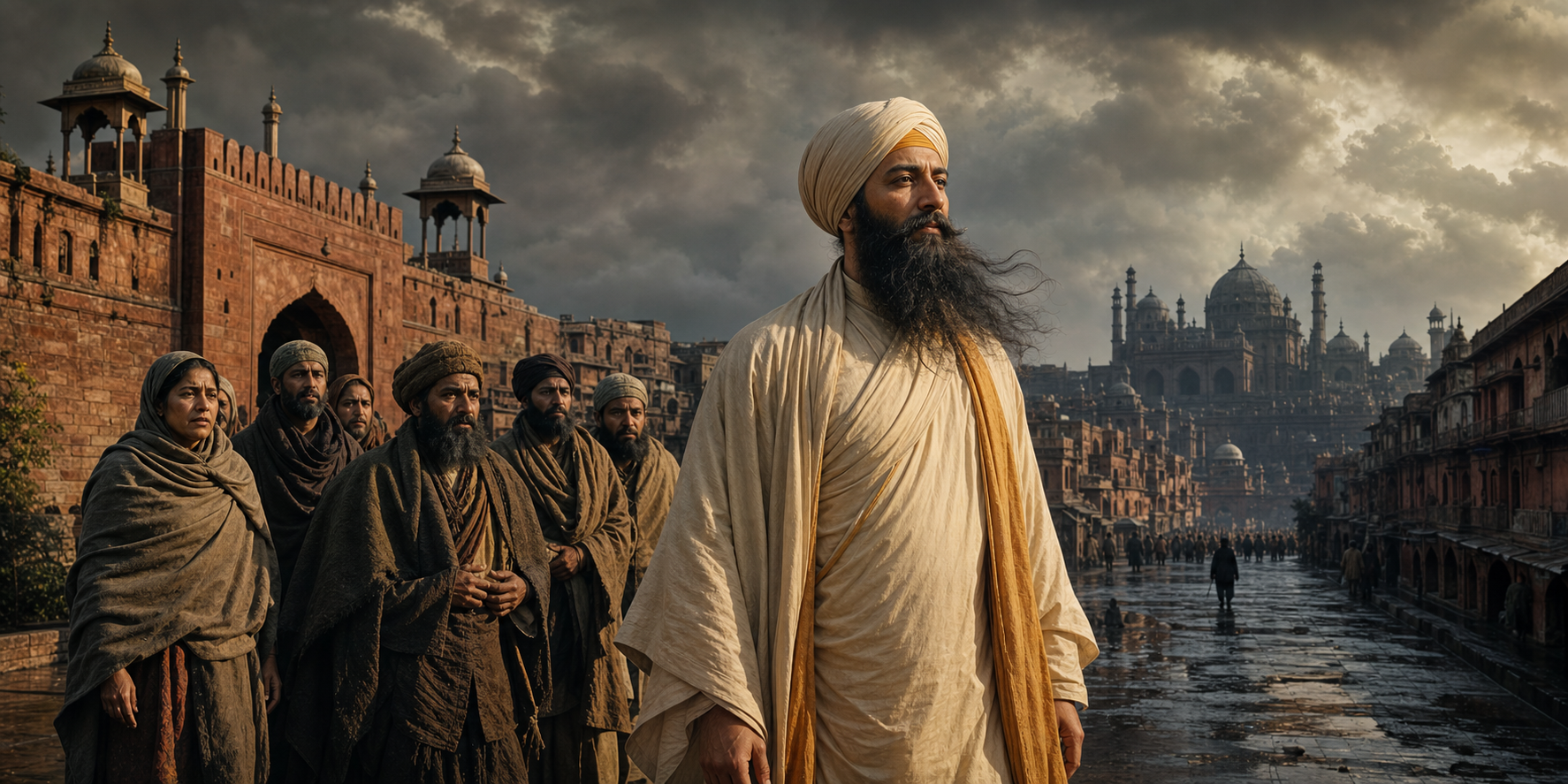
If you honour Guru Tegh Bahadur Ji, the difficult question is not whether you admire his courage. It is whether you would defend another person’s freedom to worship when you do not share that person’s beliefs.
That is the living test within his martyrdom. Freedom of conscience becomes meaningful when a vulnerable person’s faith is under pressure, neutrality is convenient, and intervention carries a cost. His example helps you distinguish genuine religious liberty from mere tolerance, and principled solidarity from slogans.
The stand in Delhi was for a faith other than his own
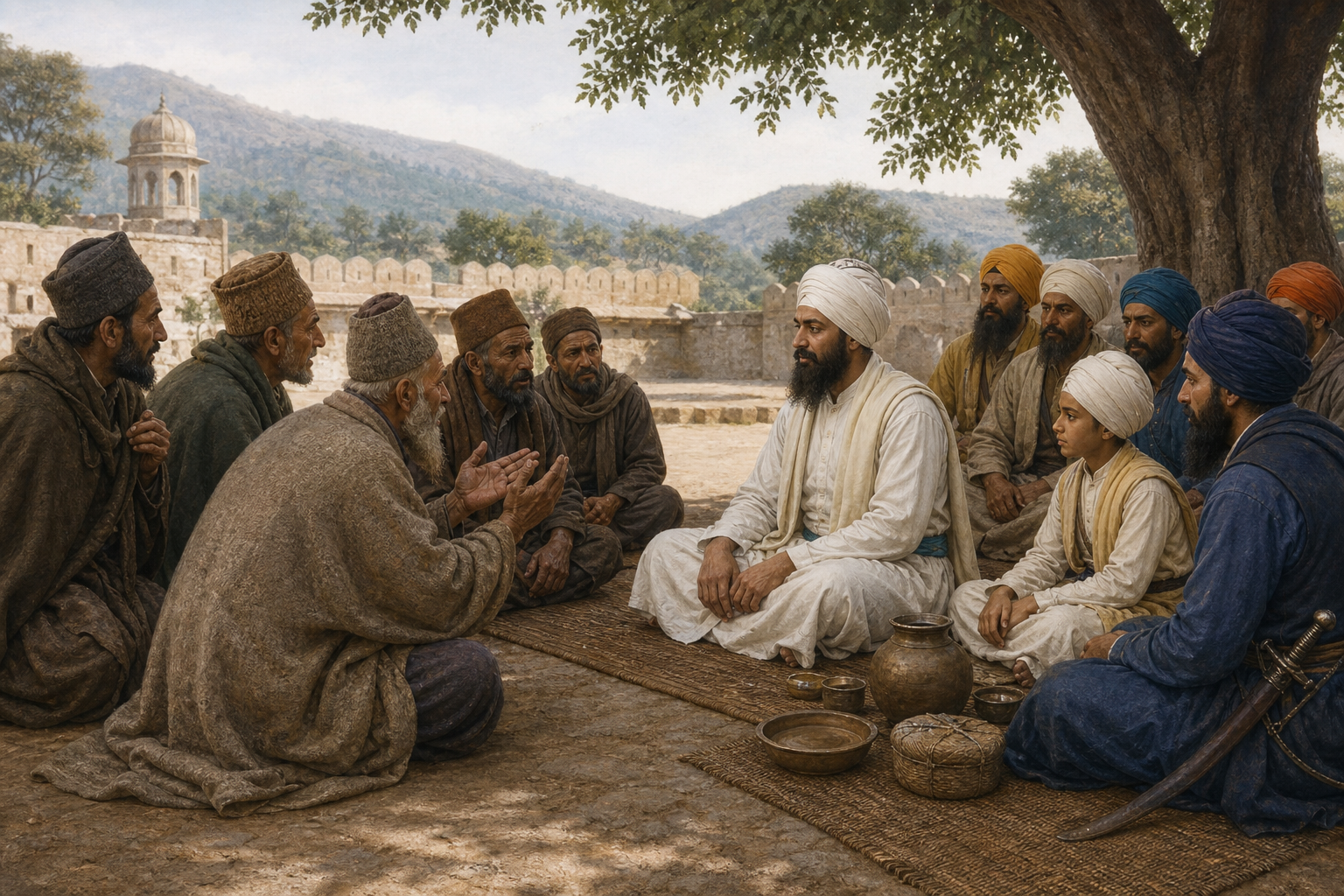
During Aurangzeb’s reign in the seventeenth century, Kashmiri Pandits facing coercive conversion pressures sought help from Guru Tegh Bahadur Ji. They were led by Pandit Kirpa Ram. The ninth Sikh Guru’s answer turned their appeal into a civilizational principle: political power must not control the human search for spiritual truth.
This distinction matters. The Guru was not protecting only the Sikh Panth, securing an advantage for his own community, or asking Hindus to become Sikhs. He was defending the right of Hindus to remain Hindu. His solidarity therefore did not depend on theological agreement. It rested on the dignity of the person choosing how to approach the Divine.
After being arrested and taken to Delhi, the Guru was offered a choice between conversion, the performance of miracles, and death. He refused to make conscience answerable either to imperial command or to demands for spectacle. His companions Bhai Mati Das, Bhai Sati Das, and Bhai Dayala were killed with exceptional cruelty. Guru Tegh Bahadur Ji was beheaded at Chandni Chowk in 1675.
The sequence reveals why this was more than private steadfastness. A person can preserve personal integrity by refusing to convert. Guru Tegh Bahadur Ji went further: he accepted the consequences of confronting coercion directed at somebody else. That is what converts endurance into protective dharma.
Two gurdwaras keep the geography of that decision visible. Gurdwara Sis Ganj Sahib commemorates the place of his martyrdom, while Gurdwara Rakab Ganj Sahib marks the cremation of his remains. These are not merely sites associated with a tragic death. They mark the places where state force encountered a conscience it could kill but could not command.
Freedom of conscience is more demanding than tolerance

Tolerance can mean, “You may remain here because I permit it.” Freedom of conscience begins from a stronger premise: no ruler, majority, institution, or community owns another person’s inner conviction. Permission can be withdrawn. A right cannot depend on the goodwill of the powerful.
You can apply three boundaries when deciding whether a dispute concerns freedom of conscience:
- It protects the person, not every proposition. Defending someone’s right to profess a belief does not require you to declare that belief true.
- It prevents compulsion, not disagreement. Debate, criticism, and persuasion leave room for an answer. Coercion attaches punishment, violence, deprivation, or an imposed penalty to refusal.
- It must work in both directions. A liberty claimed only for your own community is a privilege. Freedom of conscience must also protect the person whose worship, doctrine, or identity you reject.
The practical question is therefore not simply, “Was somebody offended?” Ask what happens if the person says no. Can they retain their faith without being threatened, dispossessed, attacked, or forced to prove its worth? That question separates the ordinary friction of a plural society from an attempt to overpower conscience.
The demand that Guru Tegh Bahadur Ji perform a miracle is instructive here. It placed his liberty behind a test designed by his captors: demonstrate supernatural power or submit. Freedom of conscience rejects that bargain. A human being does not have to win a contest, satisfy a ruler, or furnish miraculous evidence before receiving protection from forced conversion.
This also explains why religious freedom cannot be reduced to private belief hidden inside the mind. Conscience ordinarily takes visible form through worship, community, teaching, dress, remembrance, and inherited practice. A society has not protected conscience if it nominally permits belief while coercively suppressing every peaceful way that belief is lived.
A shared Dharmic inheritance without erasing differences
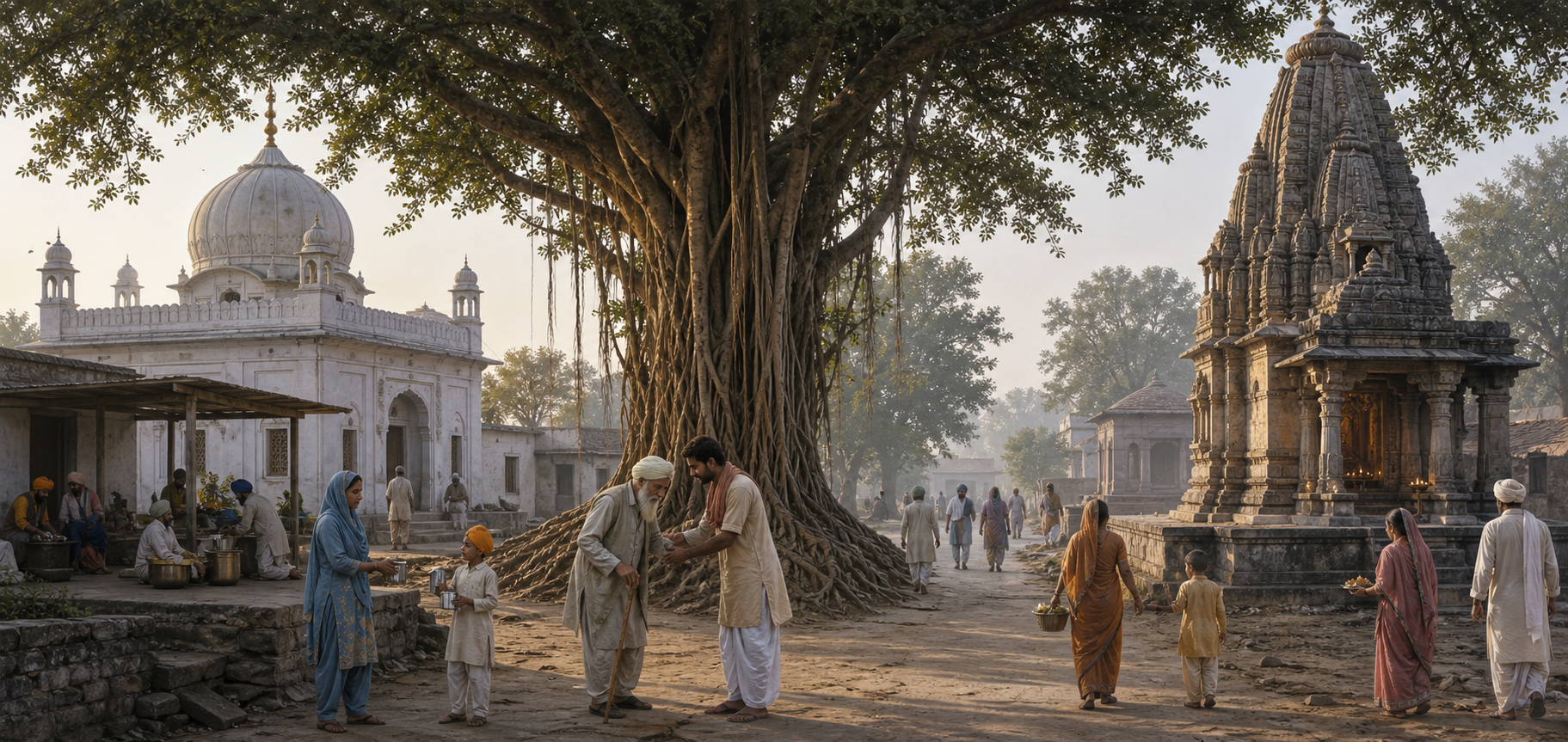
Guru Tegh Bahadur Ji is remembered as “Hind di Chadar,” a shield of the land’s spiritual life. The honour is significant because his protection crossed a communal boundary. His action can be understood through several Dharmic moral languages, but those traditions should not be collapsed into one undifferentiated teaching.
For a Hindu, the event illuminates protective dharma. Righteousness is not confined to maintaining one’s own practice. When power is used to destroy another community’s legitimate spiritual life, dharma can require resistance on behalf of those placed at risk.
For a Buddhist, karuna offers a lens of active compassion. It is not enough to feel sorrow for persecuted people while leaving the machinery of suffering undisturbed. Compassion becomes socially meaningful when it moves a person to stand beside those exposed to harm.
For a Jain, ahimsa directs attention to both overt violence and the domination behind it. Coercing a person to betray deeply held conviction is an injury even before physical force is applied. Steadfastness in truth must therefore be joined to restraint: resist injustice without adopting cruelty as a virtue.
For a Sikh, the martyrdom embodies chardi kala and the obligation to defend justice beyond the boundaries of one’s own group. Spiritual resilience is not passive optimism. It is the capacity to remain morally unbroken while confronting oppression and protecting another person’s dignity.
These lenses are related, but they are not interchangeable. Dharma asks whether the action is rightful. Karuna asks whether it responds to suffering. Ahimsa asks whether it resists domination without multiplying needless harm. Chardi kala asks whether courage survives fear and adversity. When you evaluate a public response to religious coercion, use all four questions. A response that is loud but cruel, compassionate but passive, or courageous but self-serving remains incomplete.
Key takeaways
- Guru Tegh Bahadur Ji defended Hindus without requiring them to adopt Sikh belief, making his stand a model of solidarity across religious boundaries.
- Freedom of conscience protects a person’s uncoerced spiritual choice; it does not require agreement with every belief that receives protection.
- The clearest test for coercion is what happens when a person refuses to comply.
- A right is universal only when you will defend it for communities other than your own.
- Commemoration becomes faithful to the Guru’s example when it produces accurate memory, moral courage, and practical protection for people under pressure.
How to carry the legacy into an actual decision

The safest way to turn this history into action is to use a conscience test before reacting to a religious controversy. It keeps you from ignoring real coercion, but it also prevents every disagreement from being mislabelled as persecution.
- Name the exact act. Identify the demand being imposed and the consequence for refusal. Do not rely on labels such as intolerance, offence, or oppression without describing what happened.
- Separate persuasion from compulsion. A person who can disagree and walk away remains an agent. Threats, violence, punitive exclusion, or forced abandonment of worship change the moral character of the situation.
- Reverse the identities. Ask whether you would defend the same freedom if your own community held power and the vulnerable person followed a tradition you considered mistaken.
- Listen to the person at risk. Do not turn another community’s vulnerability into a stage for your own anger. Find out what protection is wanted: a witness, safe accompaniment, institutional accountability, public clarification, or lawful support.
- Choose an action proportionate to the danger. Correct a false claim with accurate information. Document a threat rather than amplifying rumour. Support peaceful worship where access is obstructed. When violence is threatened or occurring, prioritize immediate safety and competent lawful assistance.
Families and educators can teach this legacy through decisions rather than memorized praise. After recounting the appeal of the Kashmiri Pandits, ask a young person: Why would a Sikh Guru accept death for the freedom of Hindus? Would the principle still apply to someone whose beliefs we dislike? What is the difference between trying to persuade a person and punishing that person for refusing? Those questions reveal the ethical structure of the event without reducing martyrdom to graphic suffering.
Community commemorations can be equally precise. On Shaheedi Diwas on November 24, connect the Guru’s name to the people he protected, the companions who died beside him, the choice placed before him, and the two Delhi gurdwaras that preserve the memory. Then add one present commitment: defend peaceful worship, learn the facts before speaking, or build a relationship with a neighbouring faith community before a crisis arrives.
Accuracy also matters in public remembrance. Aurangzeb’s policy of coercion should not be softened until the Guru’s sacrifice becomes unintelligible. Nor should the history be converted into collective blame against people who did not commit those acts. The morally serious path is to name the persecuting power clearly, honour those who resisted it, and refuse to imitate its logic by denying conscience to another community.
The next time religious liberty is threatened, begin with the question Guru Tegh Bahadur Ji’s life places before you: will you protect only the conscience that resembles your own? Choose one concrete act that makes your answer visible. That is how remembrance becomes responsibility.
References
