
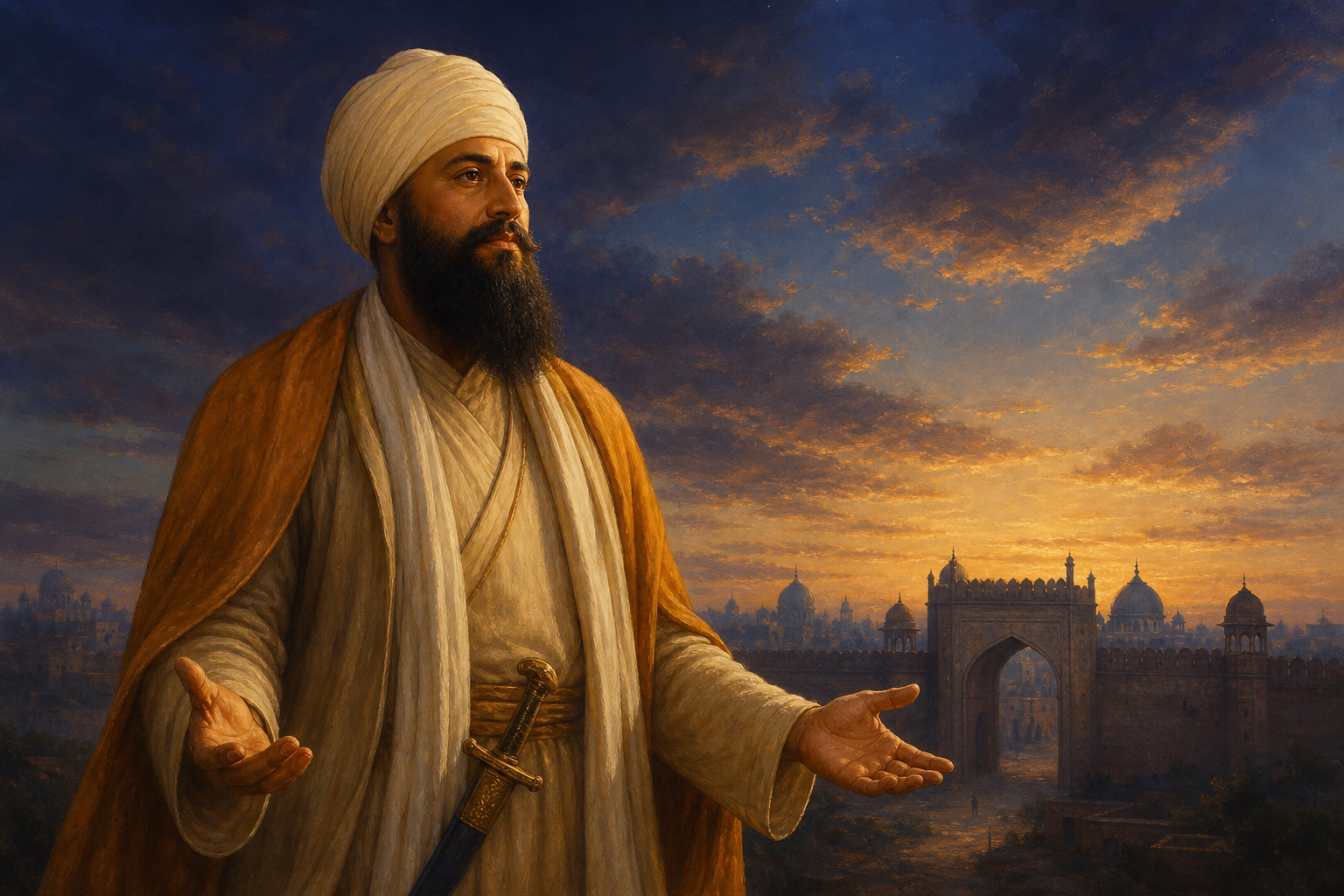
If you came looking for why Guru Tegh Bahadur’s martyrdom matters beyond Sikh history, begin with the difficult principle at its heart: he accepted death while defending the freedom of other people to follow their own religious path. His sacrifice therefore tests more than our knowledge of the past. It tests whether we will defend conscience only for our own community, or also for people whose beliefs differ from ours.
The death in Delhi can be misunderstood when it is detached from the life that preceded it. The courage of 1675 grew through spiritual discipline, seva, extensive travel, institution-building and concern for the welfare of all. Follow that sequence and the title Hind Di Chadar, the Shield of India, stops being ceremonial praise. It becomes a standard by which you can examine your own conduct.
The courage of Delhi was trained long before 1675
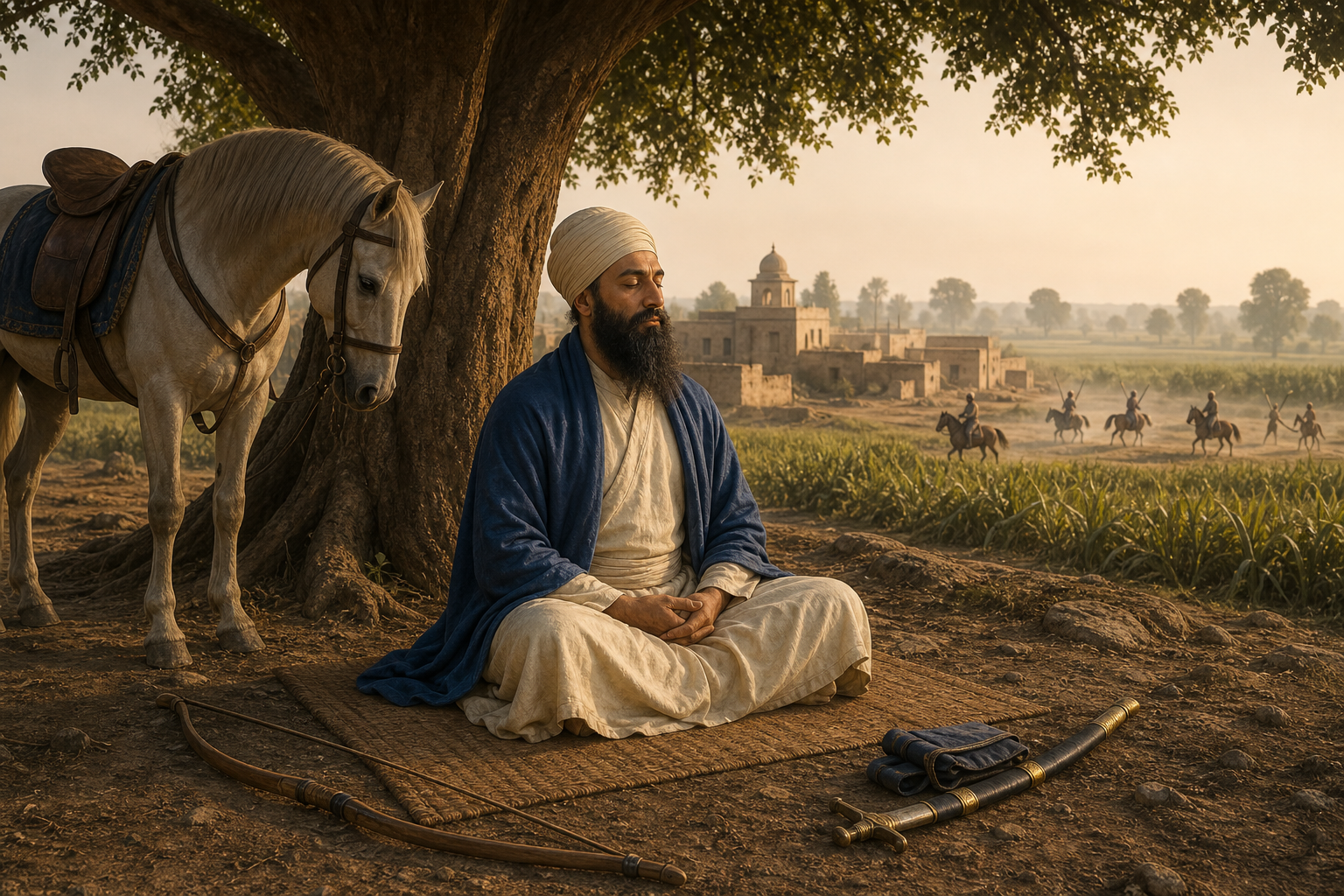
Born in 1621 to Guru Hargobind and earlier known as Tyag Mal, Guru Tegh Bahadur was formed within the Sikh union of piri and miri: spiritual depth joined to moral courage in public life. His name came to reflect distinguished bravery in his youth, but physical fearlessness was only one part of his formation.
His contemplative life centred on Naam, remembrance of the Divine, together with humility and seva. These qualities are sometimes treated as private virtues, while resistance to injustice is treated as a separate, political matter. Guru Tegh Bahadur’s life corrects that division. Remembrance disciplines the ego. Humility prevents courage from becoming a search for glory. Seva trains a person to place another’s welfare before personal comfort. By the time a grave public choice arrives, the underlying choice has already been practised in ordinary life.
He was recognized as the ninth Sikh Guru at Baba Bakala in 1664. He then established a spiritual seat at Chak Nanaki, later known as Anandpur Sahib. It became a centre of worship, learning and community welfare. This matters because he did not wait for a crisis before building an ethical community. Institutions capable of sustaining people in hard times are created through years of teaching, service and shared discipline.
When you remember his martyrdom, therefore, do not begin and end at the execution. Notice the training behind the decision. Ask what daily discipline made such courage possible, whom that discipline served, and what institutions carried its benefits beyond one individual. That is a more demanding way to honour him than admiration alone.
His travels made devotion answerable to society
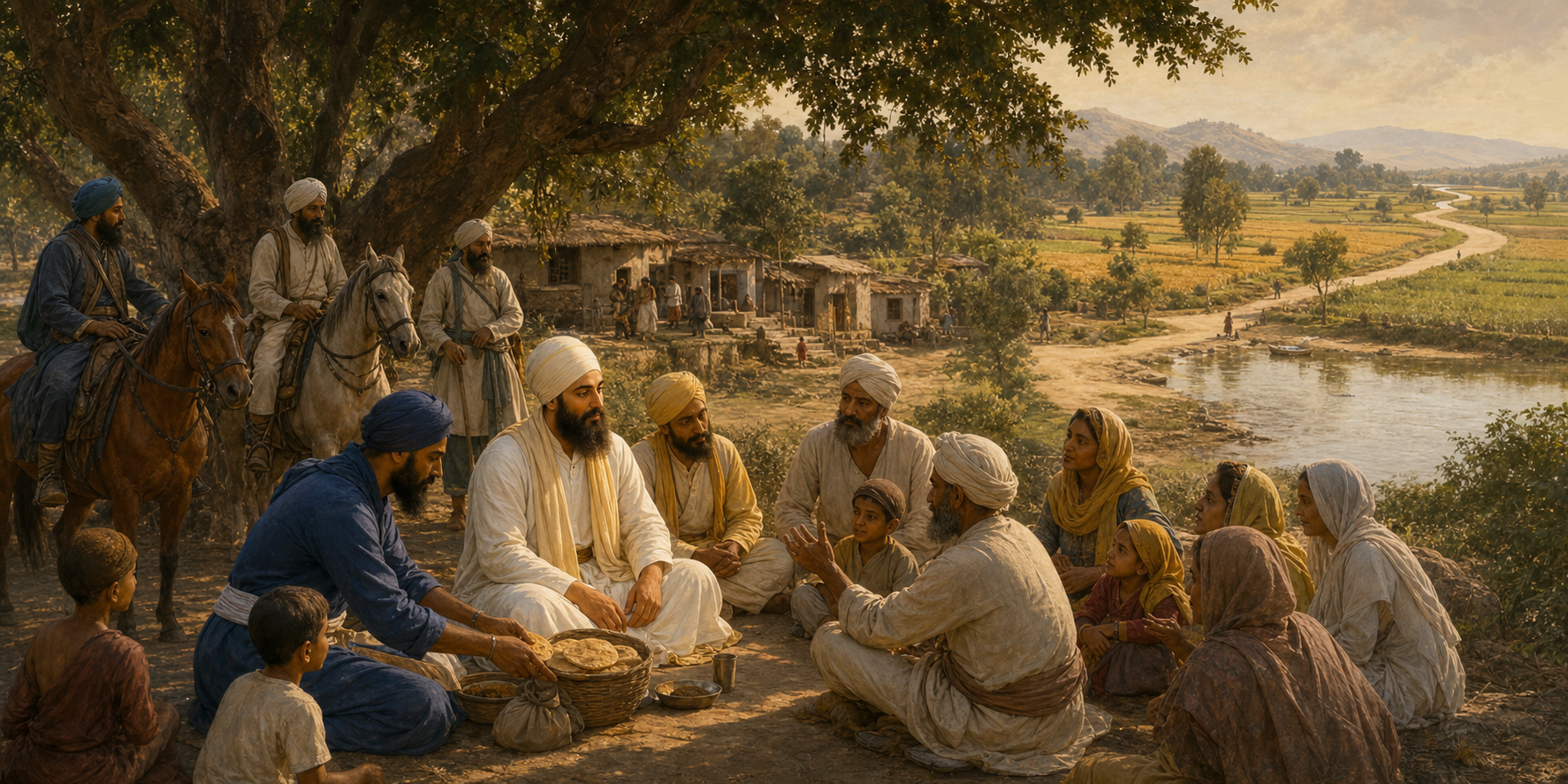
Guru Tegh Bahadur’s travels extended through Punjab, Delhi and the Doab, and eastward into areas of present-day Uttar Pradesh, Bihar, Bengal and Assam. Community memory preserves his association with Patna, which later became the birthplace of Guru Gobind Singh, and with Dhubri in Assam. The breadth of this route is not a decorative detail. It shows a Guru carrying spiritual responsibility across regional and community boundaries.
Along these routes, he established dharamsals and taught ethical living. Kirat karni called people to earn through honest work. Vand chhakna called them to share what they had. These teachings put spirituality into the marketplace, household and community meal. They ask whether livelihood is honest, whether resources circulate beyond the self, and whether devotion produces a neighbour others can trust.
His journeys also encouraged harmony among communities. That is important when reading the martyrdom that followed. His defence of conscience did not suddenly appear as an isolated reaction in 1675. It was consistent with a public ministry that had already crossed geographic and social boundaries. The person willing to protect strangers in a crisis had spent years meeting communities where they lived.
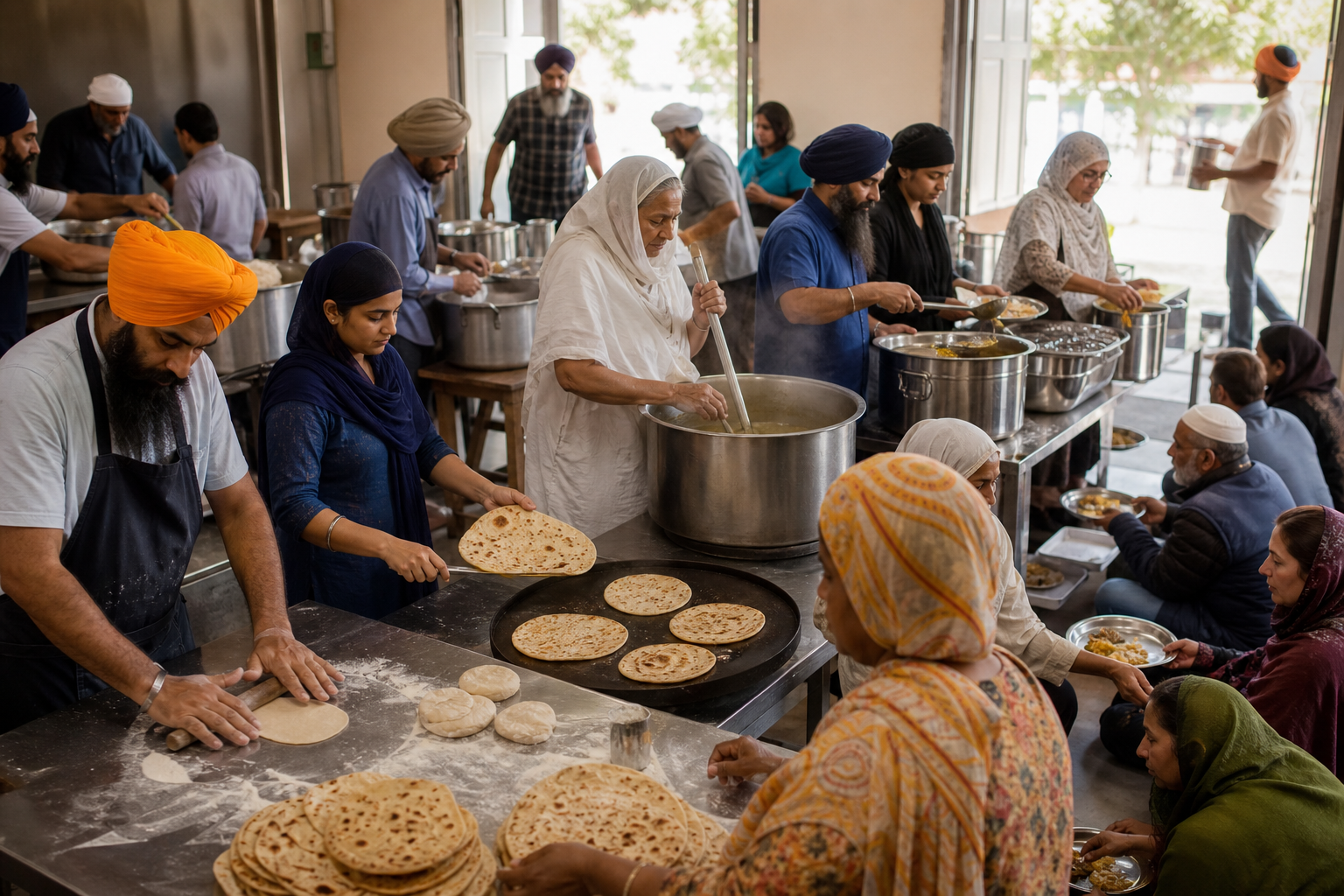
You can apply the same pattern without pretending to reproduce his sacrifice. Move beyond occasional declarations of solidarity. Build a regular practice that reaches people outside your immediate circle: support education, contribute to health-related seva, serve through a community kitchen, or help maintain a place where people can learn and gather. The practical lesson of the travels is that goodwill needs routes, habits and institutions if it is to endure.
What the martyrdom protected, and how to remember it accurately
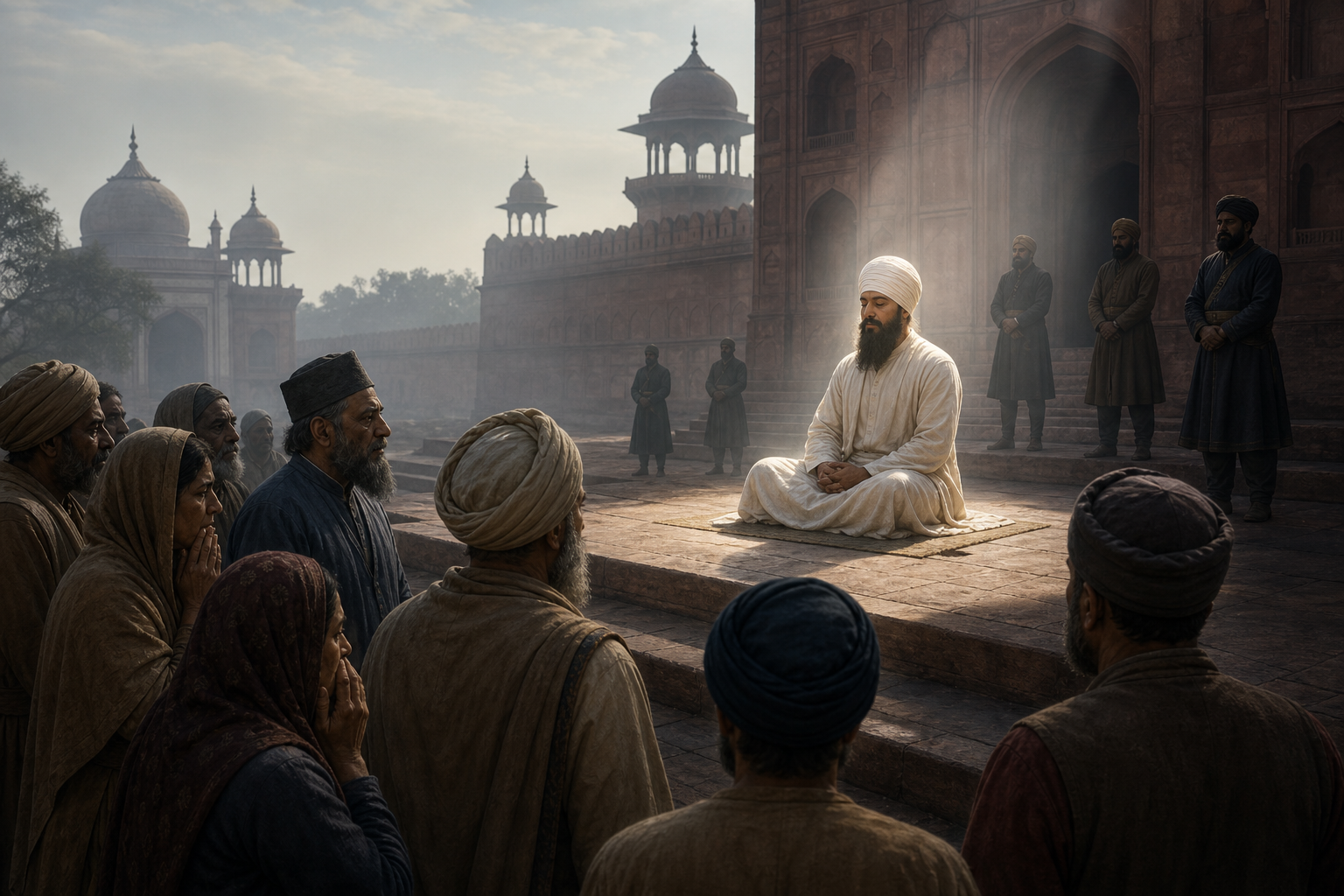
In 1675, appeals from Kashmir reached Guru Tegh Bahadur amid mounting pressure for religious uniformity. He chose self-offering over personal safety and accepted martyrdom in Delhi on 24 November 1675. The principle was unusually exacting: the conscience of another person is worth defending even when that person follows a different path from your own.
This is stronger than mere tolerance. Tolerance can mean that a powerful party temporarily permits difference. Freedom of conscience places a moral limit on power itself. It holds that faith loses its ethical meaning when conformity is imposed and that human dignity includes the freedom to seek truth without coercion.
Guru Tegh Bahadur did not stand alone in this final ordeal. Bhai Mati Das, Bhai Sati Das and Bhai Dayal Das also embraced martyrdom. Remembering their names prevents the history from collapsing into a lone-hero tale. It reveals a community of conviction in which disciples as well as Guru accepted the cost of refusing coercion.
Gurdwara Sis Ganj Sahib and Gurdwara Rakab Ganj Sahib in Delhi preserve the memory of the sacrifice. If you visit them, or teach someone about them from afar, carry four elements together: the pressure for uniformity, the appeal from Kashmir, the Guru’s defence of conscience, and the steadfastness of his companions. Omitting any one of these makes the account easier to repeat but less useful to live by.
There is another discipline required in remembrance. Do not convert resistance to coercion into generalized hostility toward an entire religious population. That would abandon the very principle being honoured. The moral target is compulsion, not the existence of neighbours who worship differently. Refusing sectarian hatred does not soften the history; it preserves the ethical clarity of the Guru’s choice.
The martyrdom also changed the course of Sikh history. Its example helped inspire the formation of the Khalsa under Guru Gobind Singh in 1699. Contemplative discipline, organized service and the defence of dignity were carried forward within a community prepared to bear public responsibility.
Why Hind Di Chadar speaks to the whole dharmic family
Hind Di Chadar means Shield of India. The title recognizes that Guru Tegh Bahadur’s stand had a civilizational consequence beyond the Sikh community. It should not be used to blur his identity as the ninth Sikh Guru, nor should his Sikh identity be invoked to confine the meaning of his sacrifice. The accurate approach does both things at once: honour the distinctly Sikh life that produced the act and recognize the protection it offered to a plural society.
The dharmic traditions do not become identical merely because they share ethical ground. Hindu understandings of dharma and ahimsa, Buddhist teachings on karuna and maitri, Jain commitments to aparigraha and anekantavada, and the Sikh prayer for sarbat da bhala arise within distinct traditions. Yet they can converge in practice around compassion, restraint, dignity, service and respect for more than one path to truth.
Guru Tegh Bahadur gives that convergence a hard edge. Unity in diversity means little if it survives only while there is no cost. A plural civilization proves its integrity when one community protects another, when strength restrains rather than coerces, and when disagreement does not cancel the dignity of the person with whom you disagree.
This also gives pro-dharmic remembrance a clear boundary. Do not appropriate the Guru as a generic symbol while neglecting Naam, seva, kirat karni, vand chhakna and sarbat da bhala. When you speak about his legacy, name the Sikh disciplines that shaped him. Then explain why those disciplines produced a defence whose moral beneficiaries extended far beyond Sikhs. That is solidarity without erasure.
Key takeaways: turn remembrance into a practice
- Keep the historical sequence clear: his birth in 1621, recognition as the ninth Guru in 1664, the travels and community-building that shaped his public ministry, his martyrdom in 1675, and the formation of the Khalsa under Guru Gobind Singh in 1699.
- Defend freedom of conscience consistently. The real test is whether you protect it for a person whose theology, ritual or community identity differs from yours.
- Join inner discipline to public courage. Naam, humility and seva are not retreats from responsibility; they train the ego so that action can serve a principle rather than personal anger or prestige.
- Make commemoration materially useful. Choose one recurring commitment in education, health, community kitchens or another form of seva instead of limiting remembrance to an annual message.
- Build interfaith trust before a crisis. Learn how neighbouring communities worship, support their freedom to do so, and create relationships through shared service while disagreement remains peaceful.
- Remember Bhai Mati Das, Bhai Sati Das and Bhai Dayal Das alongside the Guru. Their presence shows how a moral teaching becomes a community capable of standing by it.
At your next commemoration, write down one religious liberty you expect for your own community. Then ask whether you would defend that same liberty for someone whose beliefs you reject. Choose one concrete response: challenge coercive rhetoric, join an intercommunity service effort, or make a recurring seva commitment.
That is how Hind Di Chadar remains a living responsibility. You do not honour the Shield of India only by remembering whom he protected. You honour him by becoming dependable when another person’s conscience needs protection.
References
