
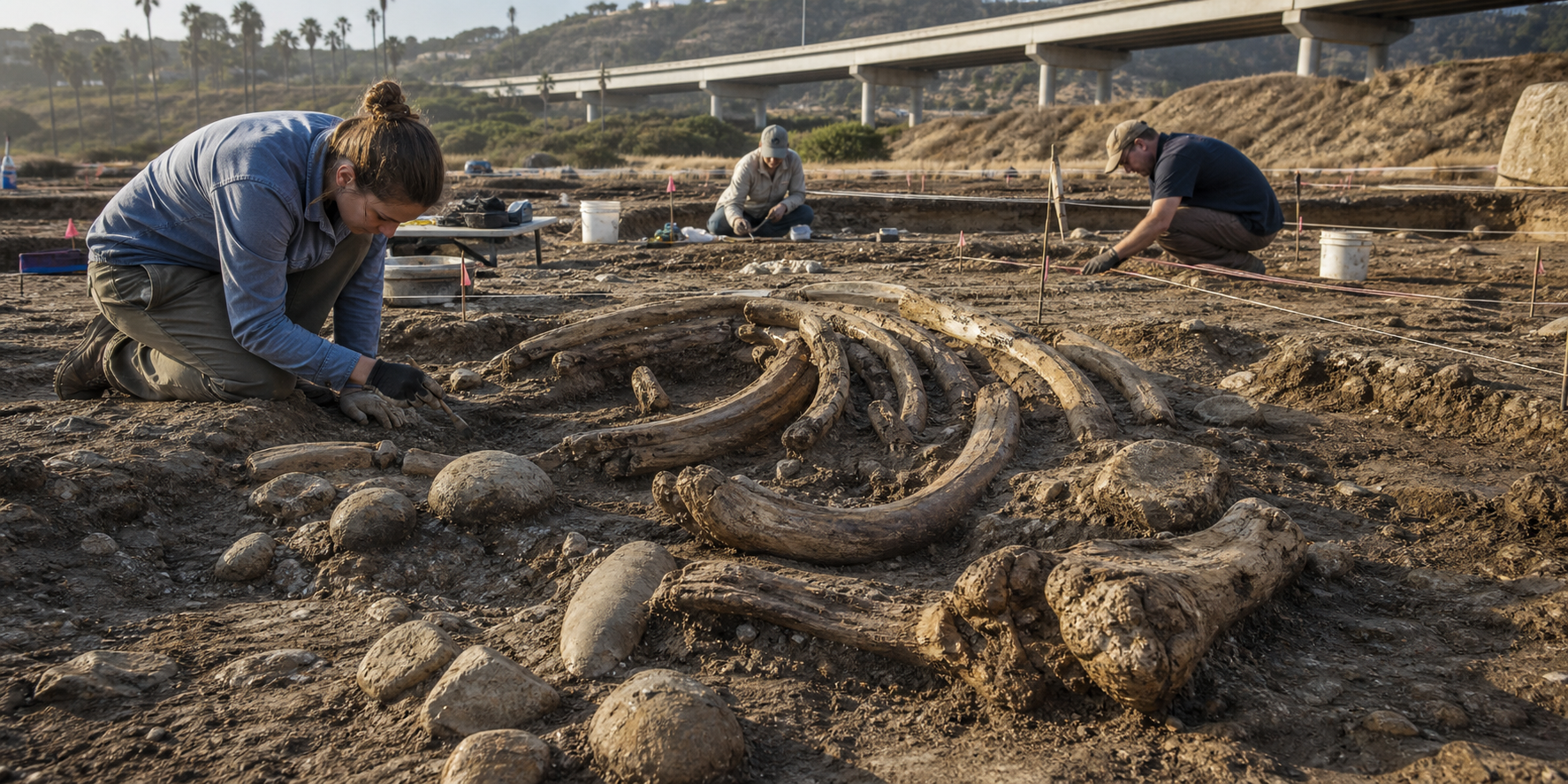
If you encountered the claim that humans reached North America about 130,000 years ago, you may be wondering whether the accepted migration timeline has already been overturned. It has not. The Cerutti Mastodon site presents a serious but contested possibility, not a settled rewriting of human history.
The clearest way to judge the case is to separate what was found from what has been inferred. The mastodon remains, fractured bones, cobbles, and proposed age are evidence. Deliberate human activity is an interpretation that must survive several competing explanations.
What was actually found beside Highway 54
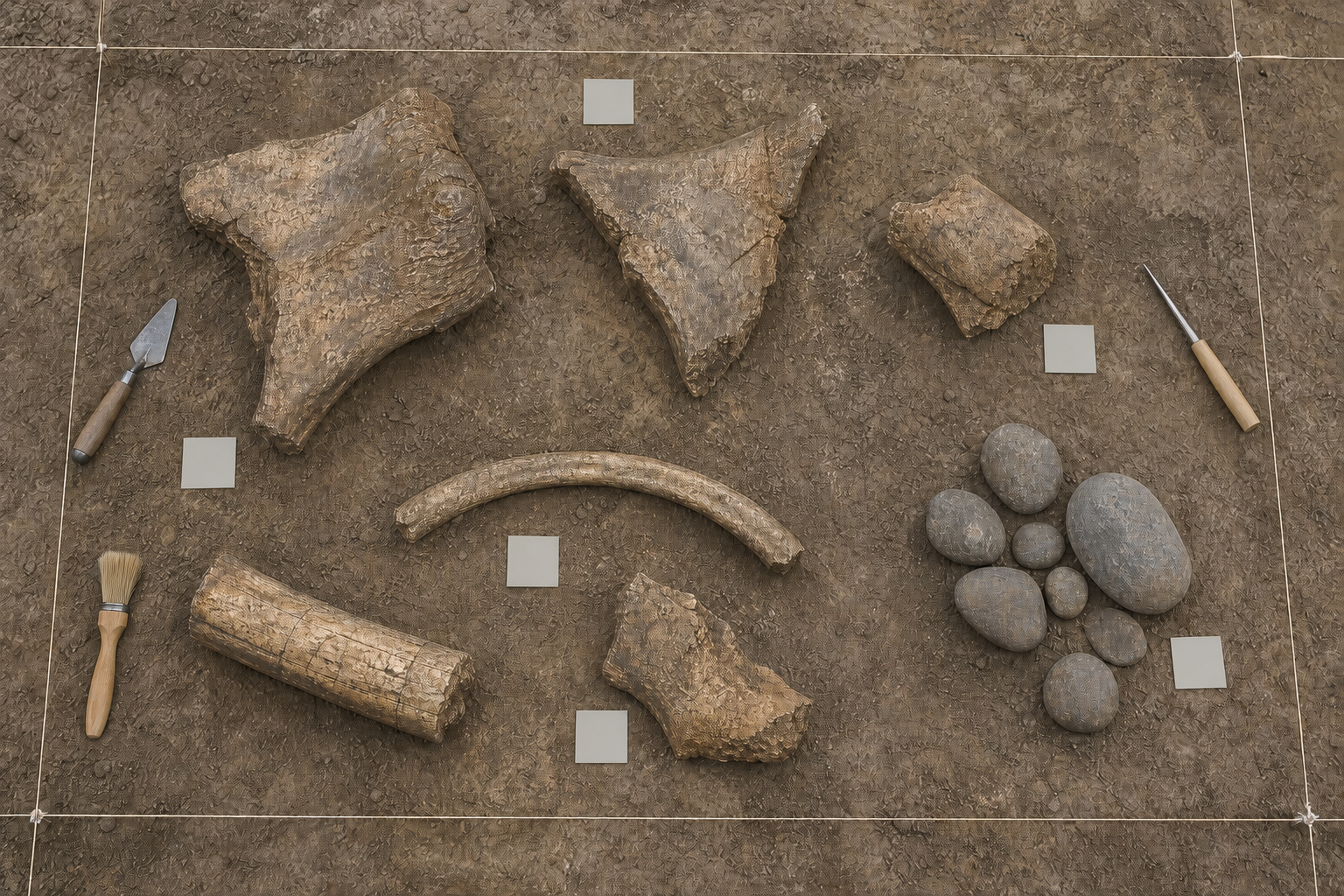
During construction along State Highway 54 in San Diego County, paleontologists monitored the work in 1992 and 1993 and documented mastodon remains. The assemblage included broken mastodon bones and nearby cobbles that some investigators later interpreted as stones used for hammering and supporting the bones.
The argument for early human activity combines three distinct propositions:
- The mastodon material and its archaeological context are approximately 130,000 years old.
- The fractures were produced through force rather than ordinary decay alone.
- The cobbles and broken bones form a deliberate hammer-and-anvil arrangement better explained by human action than by natural processes or construction damage.
Those propositions must all hold for the larger conclusion to hold. An ancient mastodon is not automatically evidence of ancient humans. Broken bone is not automatically butchered bone. A stone capable of serving as a tool is not automatically a tool.
The proposed age of roughly 130,000 years places the assemblage deep in the late Pleistocene. If the date, association, and human origin of the damage were independently confirmed, the site would place human activity in North America far earlier than prevailing archaeological models allow. Even then, it would establish presence, not identity. It would not tell us who those humans were, where they came from, how long they remained, or whether they contributed to later populations.
The human-activity claim succeeds or fails as a chain
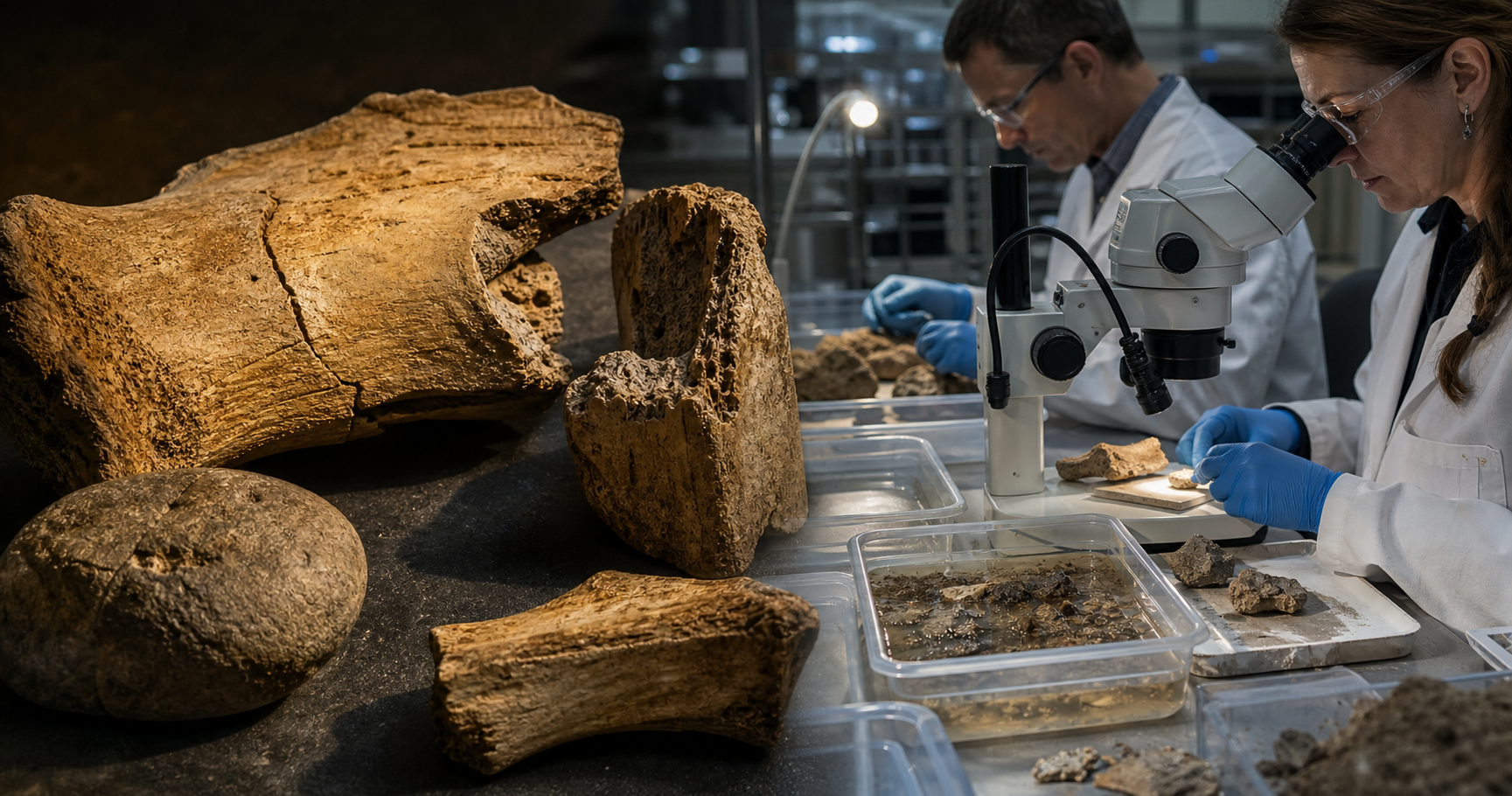
You do not have to choose immediately between belief and dismissal. Test the claim as a chain of four questions. Its strength is limited by its weakest link.
- Is the chronology reliable? A reproducible age near 130,000 years would establish the antiquity of the dated material. Dating alone cannot identify the cause of a fracture or the maker of a mark.
- Do the objects belong to the same undisturbed context? The bones, fragments, cobbles, and dated material must be shown to share the relevant depositional history. Their proximity matters only if later movement or disturbance can be ruled out.
- Does human action explain the damage better than rival causes? The central alternatives include natural breakage, pressure from overlying sediment, and damage from heavy construction machinery. Each acts differently and should leave testable patterns.
- Can independent investigators reproduce or corroborate the interpretation? Comparable results from another team, another undisturbed site, or both would carry more weight than repeated arguments over the same ambiguous objects.
The alternatives do not all challenge the same part of the chain. Machinery could have broken genuinely ancient bone during modern roadwork, leaving the age correct but the human interpretation wrong. Sediment loading could have produced ancient fractures without any human involvement, leaving both the age and antiquity of the breakage intact while defeating the claim of agency. A good analysis must therefore identify not merely whether the bone broke, but when, how, and under what physical conditions.
Road construction does not automatically invalidate a discovery made during construction. It does raise the importance of field records. The exact position of each object, the relationship between fragments, signs of disturbance, and the sequence in which material was exposed become crucial. Once that context is lost, later laboratory sophistication cannot fully reconstruct it.
How to evaluate new evidence without choosing a camp
When you read a new claim about the Cerutti site, begin by asking what has actually become better established. A refined date, a new fracture analysis, and a comparable second site would answer different questions. Treating them as interchangeable is how a suggestive result becomes an exaggerated headline.
- Ask what was dated. The age of a specimen or deposit is not automatically the age of every event proposed for that context.
- Look for a discriminating test. A useful test should distinguish deliberate impact from sediment pressure, natural movement, and machinery damage rather than merely showing that force occurred.
- Check for refitting work. Reassembling fragments can reveal whether the proposed breakage sequence is physically coherent. Experimental refitting and impact work should be described well enough for others to repeat.
- Examine microwear cautiously. Microscopic traces may strengthen the tool interpretation if they match the proposed use and can be distinguished from transport, abrasion, excavation, and handling.
- Look for taphonomic analysis. Taphonomy examines what happened to remains after death. Here it must account for burial, pressure, movement, exposure, breakage, and modern disturbance as parts of one history.
- Demand converging evidence. Reproducible dating, fracture mechanics, microwear, refitting, field context, and comparable discoveries are more persuasive together because they address different possible errors.
Also notice whether an argument merely points out that no alternative has been proven. Failure to identify a natural mechanism is not, by itself, positive evidence of human agency. The stronger case shows that the human explanation predicts the observed pattern more successfully than its competitors do.
Future techniques may expand the inquiry. Sedimentary DNA, more advanced microwear analysis, improved radiometric methods, and wider regional surveys could add important context. None is a magic answer. Each must be tied to a specific question about age, association, biological presence, or the production of the fractures.
What confirmation would change, and what it would not
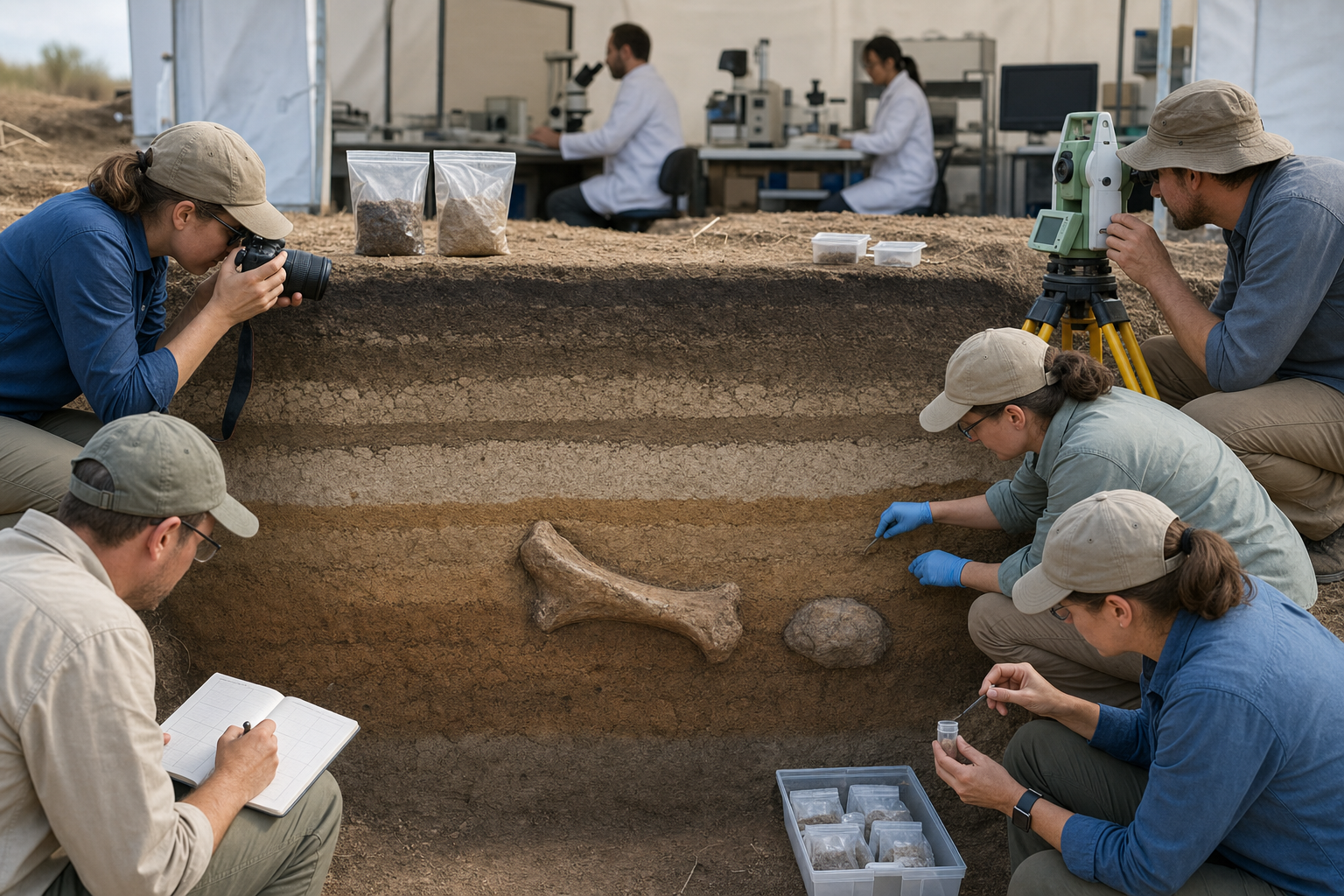
The Cerutti interpretation would become substantially stronger if independent teams obtained compatible dates, demonstrated a securely associated bone-and-stone context, reproduced the proposed impact pattern, and identified wear or fracture features that rival mechanisms could not readily produce. A separate site of comparable age with similarly documented evidence would matter even more because it would reduce dependence on one disputed assemblage.
The case would weaken if construction machinery reproduced the relevant damage, if sediment pressure explained the fracture pattern, or if the cobbles proved indistinguishable from naturally positioned stones. Such results would not make the mastodon younger. They would show why chronology and human agency must not be collapsed into a single claim.
If human activity near 130,000 years ago were corroborated, models of movement into the Americas would have to accommodate a much earlier episode of dispersal. Archaeology, geochronology, and paleoecology would then face new questions about possible routes, environments, survival, and disappearance. One confirmed episode would not necessarily demonstrate continuous occupation between that remote event and later populations.
For a reader interested in Bharat and the Dharmic world, an additional boundary matters: this assemblage does not identify a connection to Bharat, a Vedic culture, or any named religious tradition. Deep antiquity can invite civilizational speculation, but speculation should not be presented as an archaeological result. Respect for heritage is strongest when the boundary between evidence and aspiration remains visible.
A Dharmic outlook need not demand either reflexive acceptance or reflexive rejection. Humility permits an unexpected possibility to remain open. Discipline prevents that possibility from being converted into certainty before the evidence converges. Reverence for the past should make us more careful with it, not less.
Key takeaways
- The proposed age of roughly 130,000 years concerns the ancient assemblage; it does not independently prove that humans broke the bones.
- The decisive question is whether deliberate hammer-and-anvil activity explains the fractures and cobble positions better than sediment, natural breakage, or road machinery.
- Field context matters because objects found near one another are meaningful only when disturbance and later movement have been addressed.
- Microwear, refitting experiments, taphonomy, reproducible dating, and independent comparable sites test different links in the argument.
- Confirmation would transform models of early dispersal into the Americas, but it would not identify a people, migration route, cultural tradition, or connection to Bharat.
When the next Cerutti claim appears, reduce it to one sentence and mark which part is observation, which part is inference, and which competing explanation has actually been tested. Until chronology, context, agency, and independent corroboration converge, the most accurate description is simple: the Cerutti Mastodon site is an important unresolved case with potentially far-reaching consequences.
References
