
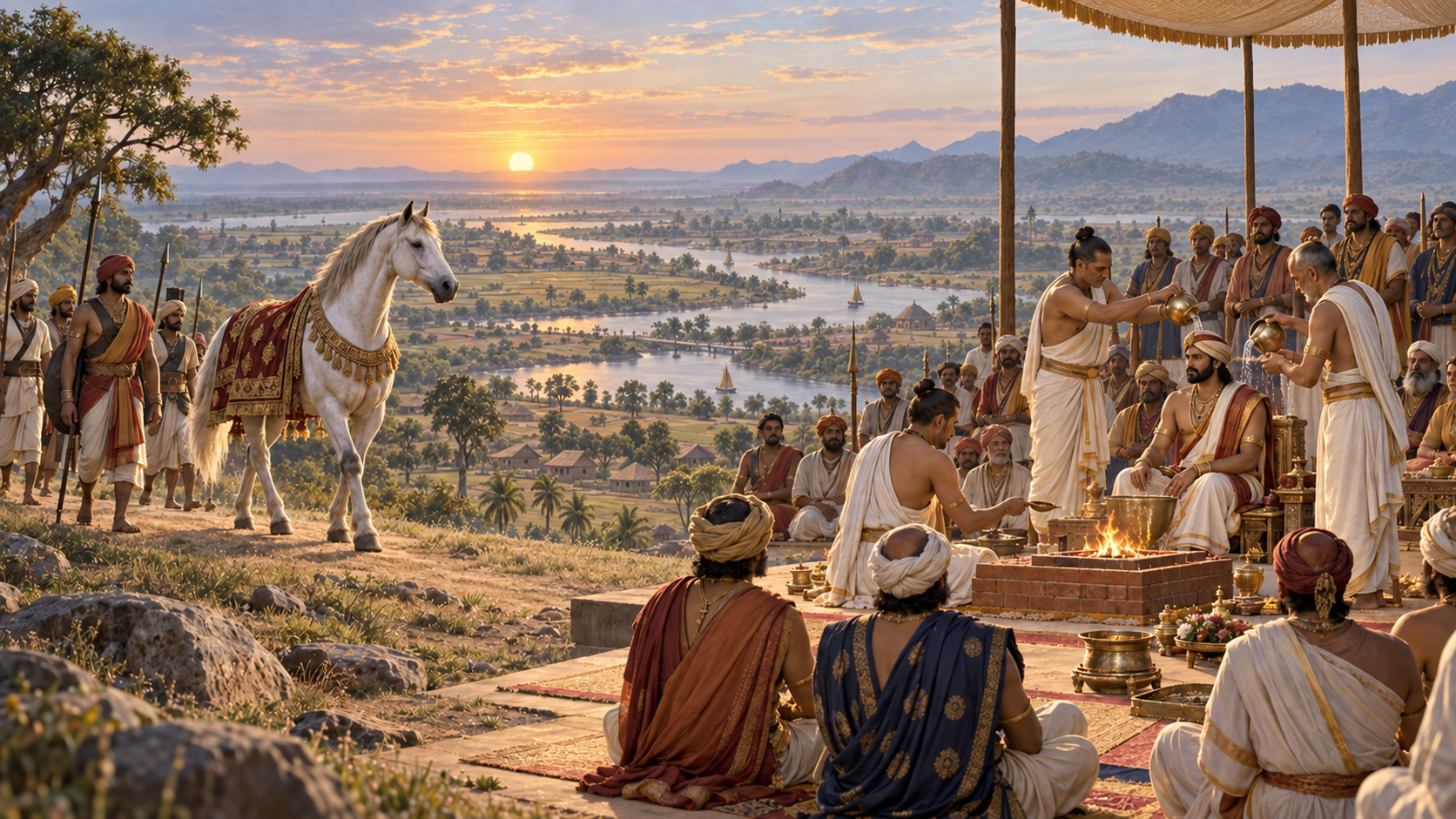
If you have encountered Ashvamedha and Rajasuya in an epic narrative, a discussion of ancient Bharat, or a debate about Vedic ritual, you may be asking a simple question: were they two names for the same royal ceremony? They were not. Nor should they be treated as two interchangeable measures of how powerful a king had become.
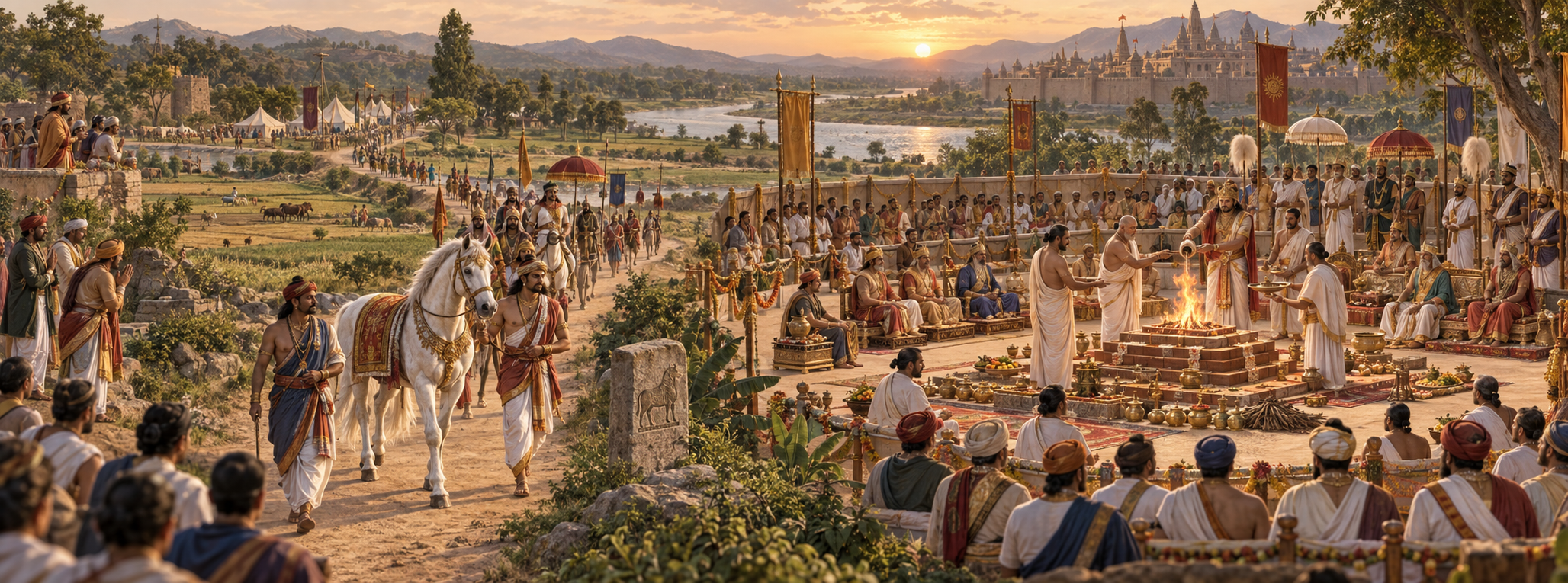
The most useful distinction is this: Ashvamedha concerned the reach and recognition of sovereignty, while Rajasuya concerned the consecration and ordered legitimacy of kingship. Ashvamedha directed royal authority outward. Rajasuya established the ruler at the sacred and political centre. That difference gives you a reliable way to interpret either yajna without reducing it to spectacle.
Begin with the question each royal yajna answered
A yajna is not adequately understood as a public celebration, a display of wealth, or an isolated act of sacrifice. It is a disciplined offering performed within a prescribed sacred order. Vedic yajnas could be directed toward personal welfare, the welfare of a kingdom, or the declaration of royal sovereignty. The royal yajnas belonged to that larger ritual world, but they addressed questions that individual worship could not answer.
Ashvamedha asked, in effect: how far does this ruler’s sovereignty extend, and who accepts or contests it? The horse’s movement carried the royal claim beyond the political centre. Its passage made sovereignty visible because neighbouring powers had to respond to the claim rather than merely hear about it. The yajna therefore joined sacred action to a public demonstration of the king’s capacity to assert and maintain authority.
Rajasuya asked a different question: how is a ruler established in royal dignity within a sacred, social, and political order? Its emphasis was consecration. The king did not merely announce that he possessed power; his kingship was ritually constituted and recognised through an ordered yajna. The centre of gravity was the royal office and the network of duties and relationships gathered around it.
When you meet either name, ask what kind of claim is being made. If the passage stresses the reach of sovereignty and the response of other rulers, think first of Ashvamedha. If it stresses consecration, royal status, precedence, and ordered recognition around the king, think first of Rajasuya.
The difference becomes clear across five dimensions
| Dimension | Ashvamedha | Rajasuya |
|---|---|---|
| Central question | What extent of sovereignty can the ruler assert and sustain? | How is the ruler consecrated and recognised as king? |
| Primary direction | Outward from the royal centre | Inward toward the royal centre |
| Political meaning | Supremacy made visible through the responses of other powers | Legitimacy and precedence established within an ordered royal community |
| Ritual emphasis | The horse carries a claim whose passage has political consequences | Consecration gives sacred form to the ruler’s office and obligations |
| Common misreading | Reducing it to conquest or to the killing of an animal | Reducing it to a coronation, banquet, or prestige ceremony |
This is a distinction of primary function, not a claim that politics disappeared from Rajasuya or sacred consecration disappeared from Ashvamedha. Every royal yajna operated across religious and political life. The table tells you where to place the interpretive emphasis.
It also prevents a second error: treating the two rites as rungs on a single ladder. Ancient kingship was not a game in which one ceremony automatically unlocked the next. A rite must be interpreted by the claim it enacted. Asking which yajna was simply “bigger” is less illuminating than asking what form of royal authority was being established.
Royal yajna placed power inside a larger order
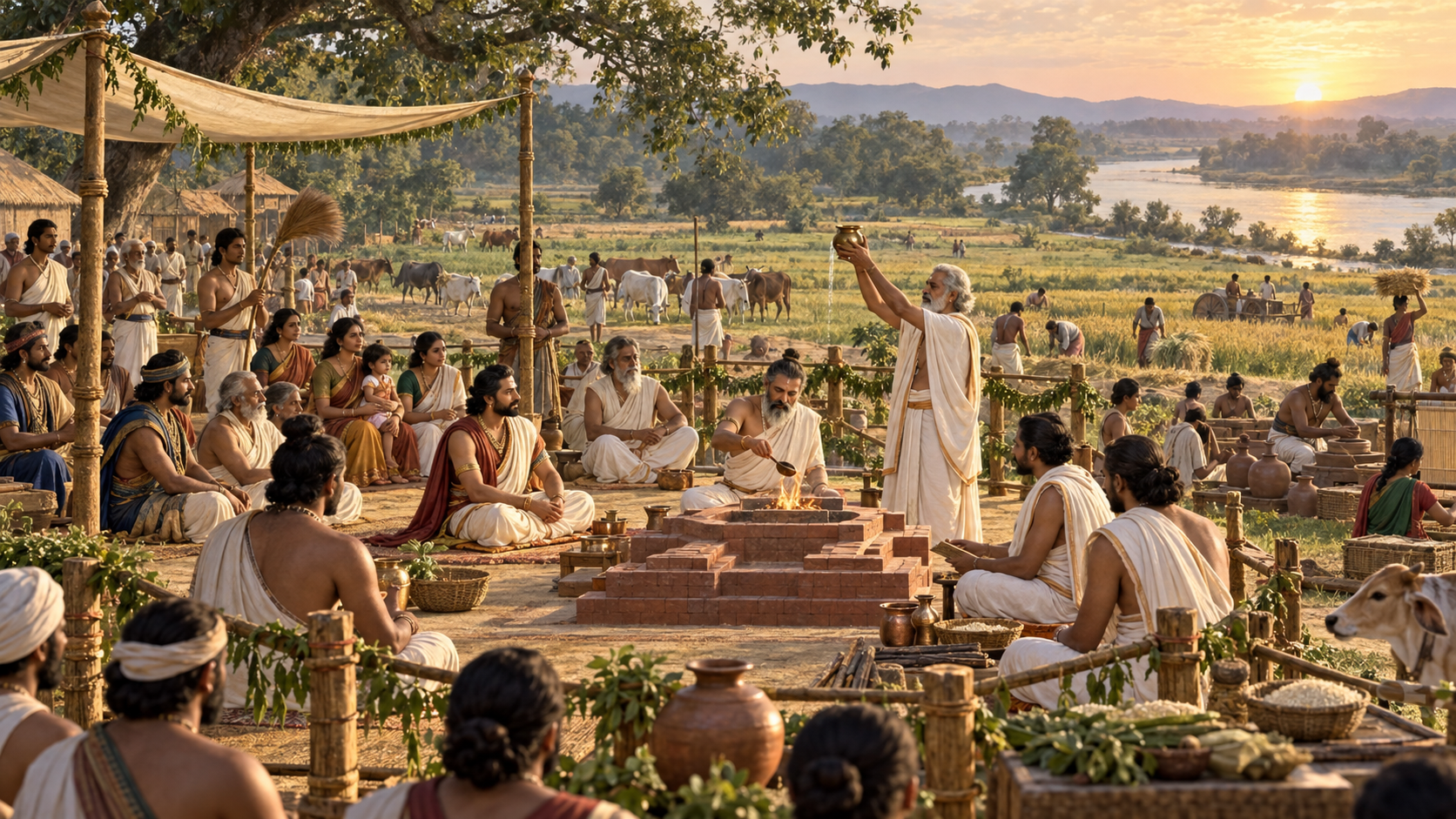
Modern political language encourages us to imagine sovereignty as control: the ruler commands, and others obey. Royal yajna presents a more demanding picture. The ruler may stand at the centre, but he does not invent the sacred order that validates his office. He must enter a prescribed discipline, make offerings, accept ritual obligations, and depend upon other participants to complete the act.
That dependence matters. A king could possess force without possessing uncontested recognition. He could occupy a throne without showing that his kingship belonged within dharma. Ashvamedha and Rajasuya addressed these gaps in different ways: the former enacted the reach of sovereignty, while the latter enacted the consecrated standing of the sovereign.
You should therefore resist reading either yajna as a licence for unlimited royal action. Ritual success does not make every later decision righteous. The deeper political principle is that power requires form, recognition, responsibility, and a relationship to an order greater than the ruler’s preference.
This also explains why several familiar English labels are useful but incomplete. “Horse sacrifice” identifies a conspicuous element of Ashvamedha but can hide its territorial and political logic. “Imperial conquest” catches its geopolitical edge but misses its ritual character. “Coronation” helps a modern reader approach Rajasuya but can shrink a royal yajna into a transfer of office. Keep the labels as entry points, not as complete definitions.
Key takeaways
- Ashvamedha and Rajasuya were distinct royal yajnas, not alternate names for one ceremony.
- Ashvamedha primarily enacted sovereignty outward: the ruler’s claim entered a wider political field and elicited acceptance or resistance.
- Rajasuya primarily established kingship inward: the ruler was consecrated and placed within an ordered field of sacred and political recognition.
- Neither rite can be understood through a purely religious or purely political category; each joined ritual discipline to royal authority.
- Do not rank the yajnas before identifying their purposes. Reach of sovereignty and consecration of kingship are different questions.
- A ritualised royal claim is not the same as unrestricted power. Dharmic kingship places the ruler within obligations he does not create for himself.
How to read the next royal-yajna passage
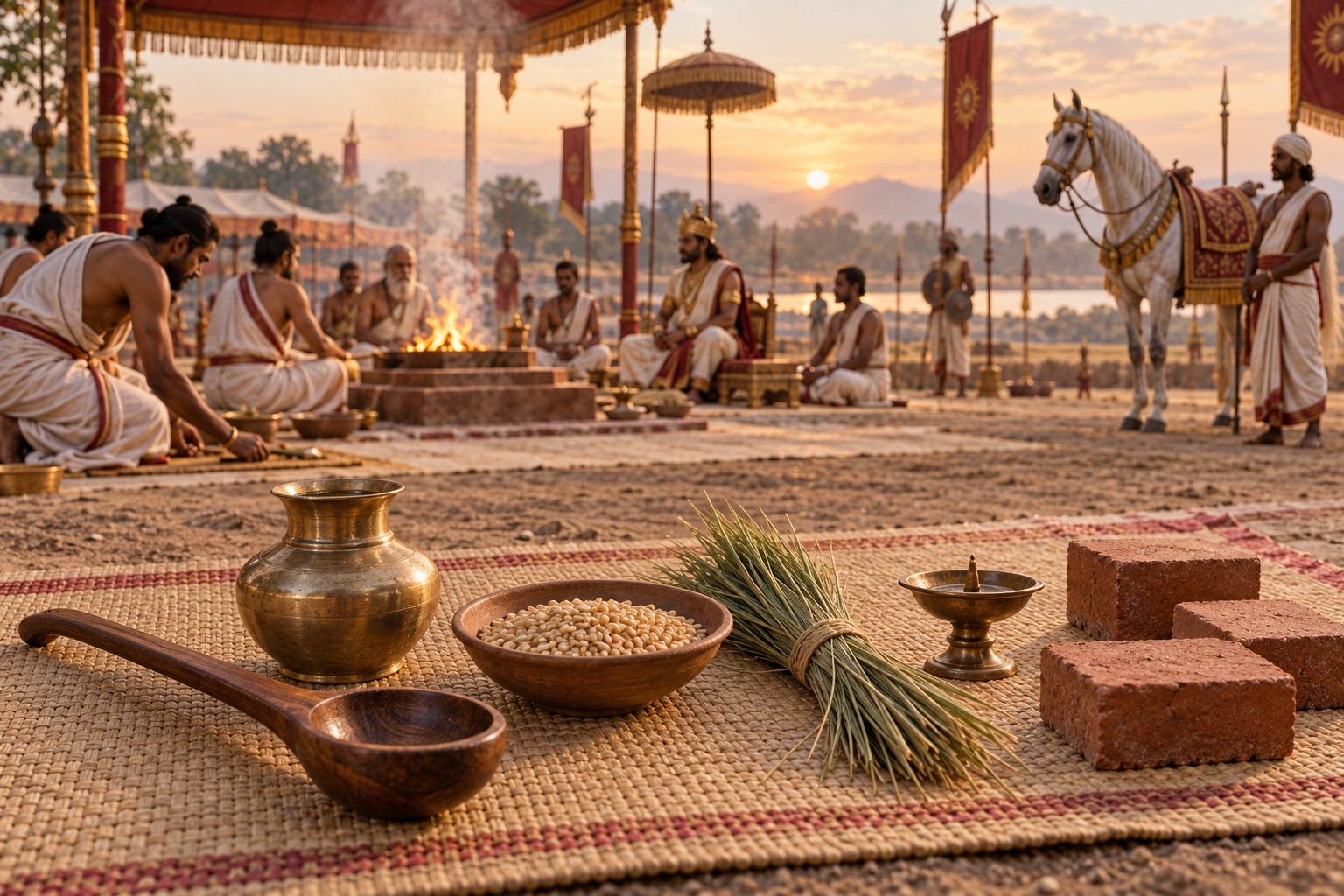
When a royal yajna appears in a narrative or historical discussion, use the following sequence before drawing conclusions:
- Name the rite precisely. Do not allow “royal sacrifice” to erase the difference between Ashvamedha and Rajasuya.
- Identify the claim being enacted. Is the ruler asserting the extent of sovereignty, receiving consecrated royal status, or doing something else?
- Watch the direction of recognition. Ashvamedha directs attention toward the territories and rulers confronted by a sovereign claim. Rajasuya directs attention toward the ordered relationships assembled around the consecrated king.
- Separate ritual action from political consequence. Ask what the rite does within sacred discipline, then ask what its performance communicates to allies, rivals, subjects, and the court.
- Distinguish description from approval. A narrative can record a ruler’s success, question his fitness, expose the cost of ambition, or use the yajna to test what kingship means. Do not assume that every narrated act is an unqualified moral endorsement.
- Keep literary and historical claims distinct. A ritual description can preserve sacred memory, political ideals, narrative symbolism, or historical information. Establish which kind of claim you are reading before using it as evidence for another.
This method gives you something more valuable than a memorised definition. It helps you see what a royal yajna is doing in its setting. The next time Ashvamedha or Rajasuya appears, ask whether the passage is mapping the reach of rule or establishing the meaning of kingship. From there, the political and Dharmic argument becomes much easier to recognise.
References

Leave a Reply
You must be logged in to post a comment.