
If you encountered the news of Ahilya Kamadhenu hoping to find Ahilyabai Holkar’s rules for governing well, pause before repeating the most attractive claims. The discovery may become an important doorway into Holkar statecraft, but a newly surfaced title is not yet a verified handbook of policies in the Maharani’s own words.
You can still understand why the find matters, what evidence should come next, and how to separate a serious historical conclusion from an appealing quote card. That distinction protects both Ahilyabai’s legacy and the credibility of Dharmic history.
What is presently known about Ahilya Kamadhenu
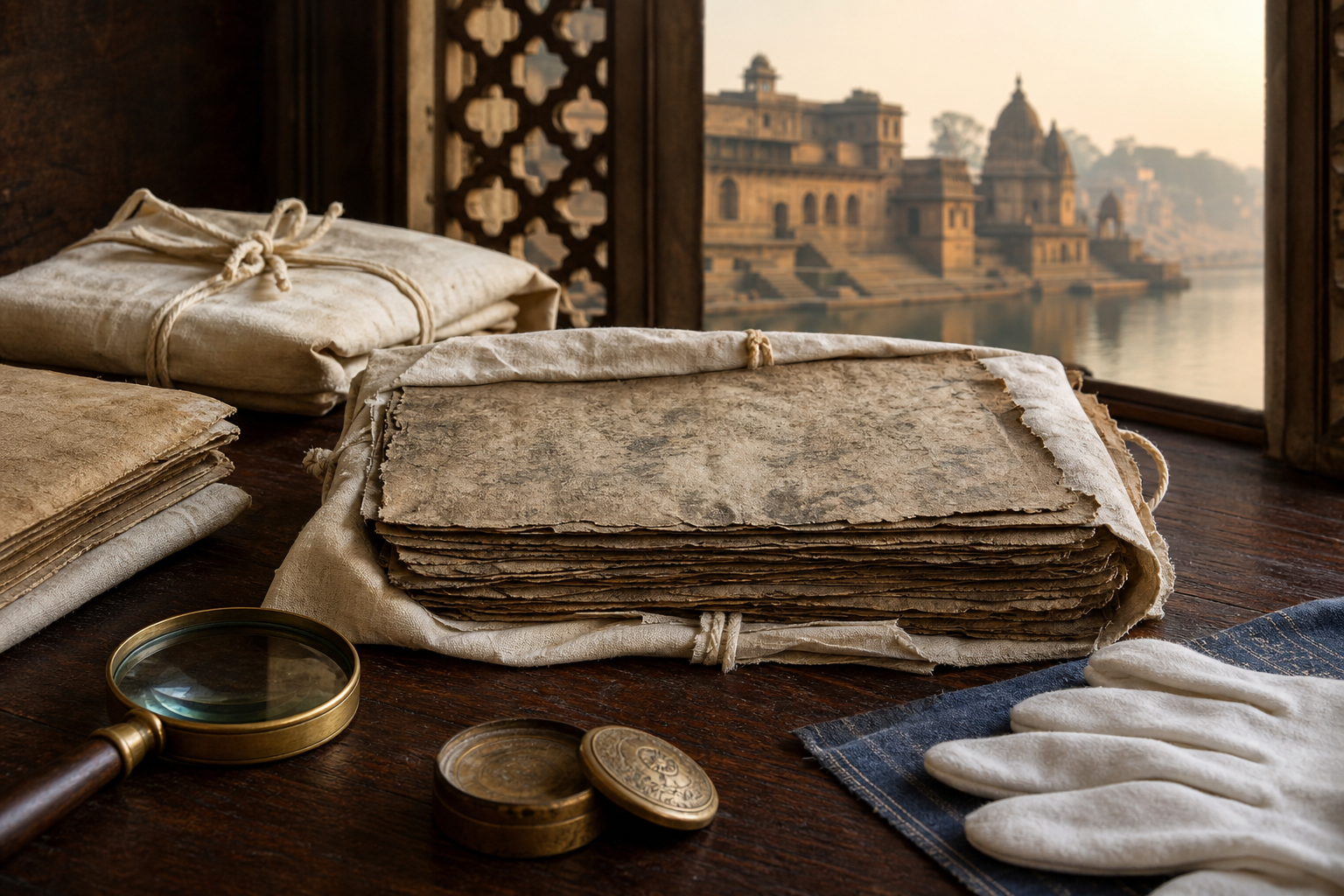
In Indore, a Marathi work titled Ahilya Kamadhenu has emerged from private custody. It has been described as an approximately 1,500-page manuscript concerned with Maharani Ahilyabai Holkar’s statecraft.
The surviving material was reportedly kept for about 14 generations by descendants of the Holkar state’s traditional Rajpurohit family. It came to wider notice during a survey under the Gyan Bharatam Mission, a nationwide initiative intended to locate, preserve and digitise India’s manuscript heritage.
The work has also been characterised as nearly three centuries old. Treat that age as a reported description until specialists publish the evidence used to date the physical object and its textual layers. Paper, ink, handwriting, binding, colophons, ownership notes and internal references can support a date, but a title or family tradition cannot settle it alone.
One distinction is especially important: a work about Ahilyabai is not automatically a work written by Ahilyabai. Her name in the title does not establish that she authored, dictated, commissioned or personally approved its contents. Until authorship and composition are documented, call it a manuscript associated with her statecraft, not her personal governance manual.
Keep discovery, authorship and interpretation separate
Historical claims become unreliable when three different questions are compressed into one. You should test them separately:
- Has a physical manuscript surfaced? The reported custody history and survey identification support the existence of substantial material, but a complete catalogue is still needed to show exactly what the collection contains.
- Who created the text, and when? The age of the physical pages, the date of the underlying composition and the dates of later copying or additions may not be identical. Authorship also remains distinct from subject matter.
- What does it reveal about governance? That answer depends on reading the Marathi text in context. A celebration of a ruler, a compilation of maxims, an administrative record and a later commemorative narrative would provide different kinds of evidence.
This separation changes how you speak about the find. It is reasonable to say that potentially important material connected with Ahilyabai Holkar’s statecraft has come to light. It is premature to attribute a particular maxim, policy or theory of rajadharma to her unless the relevant passage, its location and its editorial history are available.
The phrase good governance also needs care. It is a modern evaluative label, not a substitute for the manuscript’s own vocabulary. Before applying present-day terms such as accountability, welfare or decentralisation, a reader needs to know which Marathi or Sanskritic expression appears in the text and what that expression meant in its setting.
The path from a family collection to usable history
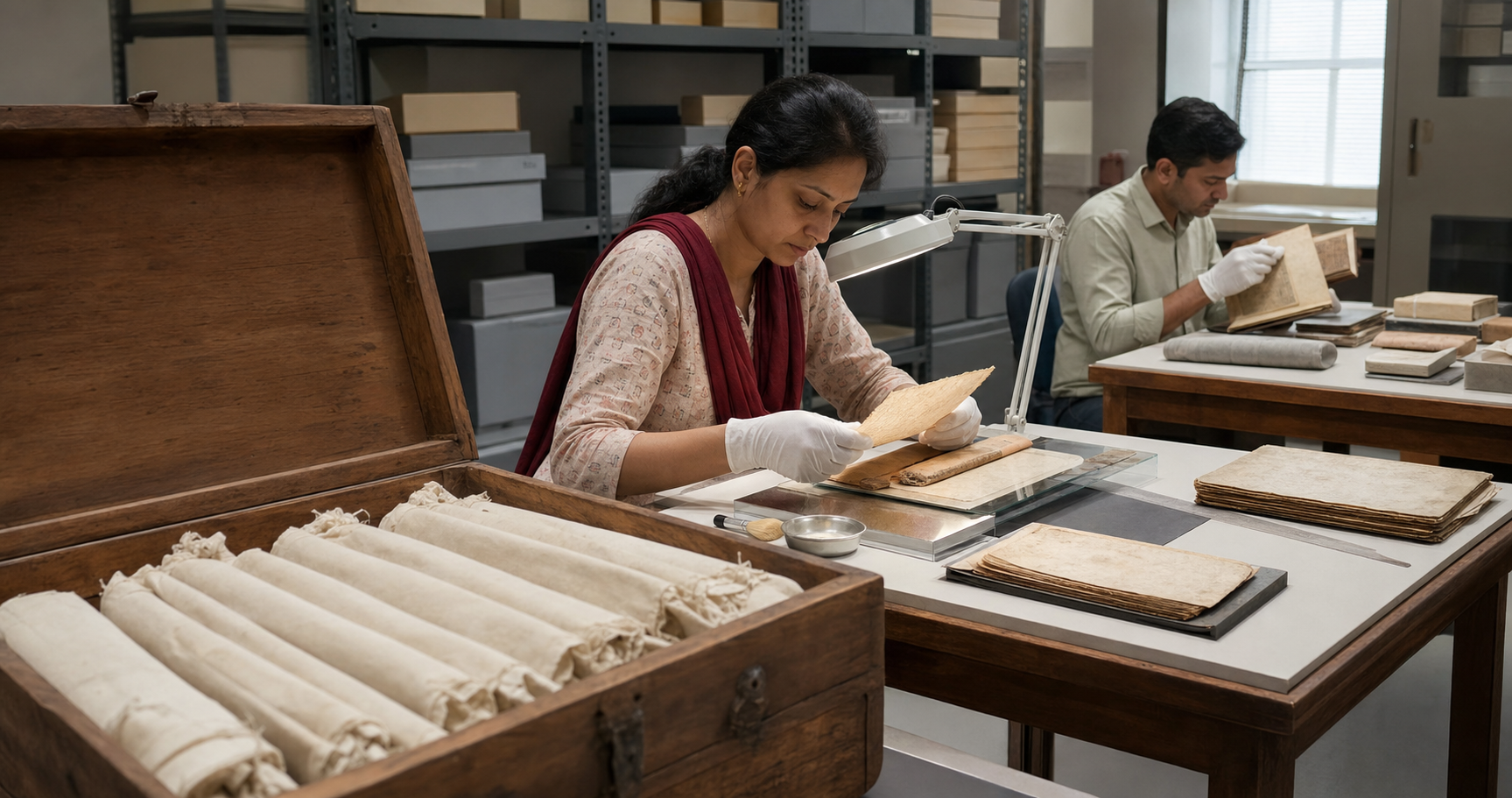
Digitisation is essential, but photographs alone do not produce a trustworthy edition. A responsible publication process should make the following stages visible:
- Assign a stable identity to every physical unit. Record volumes, bundles, loose leaves and covers before changing their order. Clarify whether the reported page total counts written pages, blank pages, folios or modern scans.
- Document condition before intervention. Note tears, stains, fading, insect damage, missing leaves, later repairs and disturbed bindings. Conservation work should preserve evidence rather than silently make the object look complete.
- Record provenance precisely. The reported 14-generation custody is significant, but researchers need names, dates, ownership notes, seals and any family records that can connect one custodian to the next. Honest gaps should be marked as gaps.
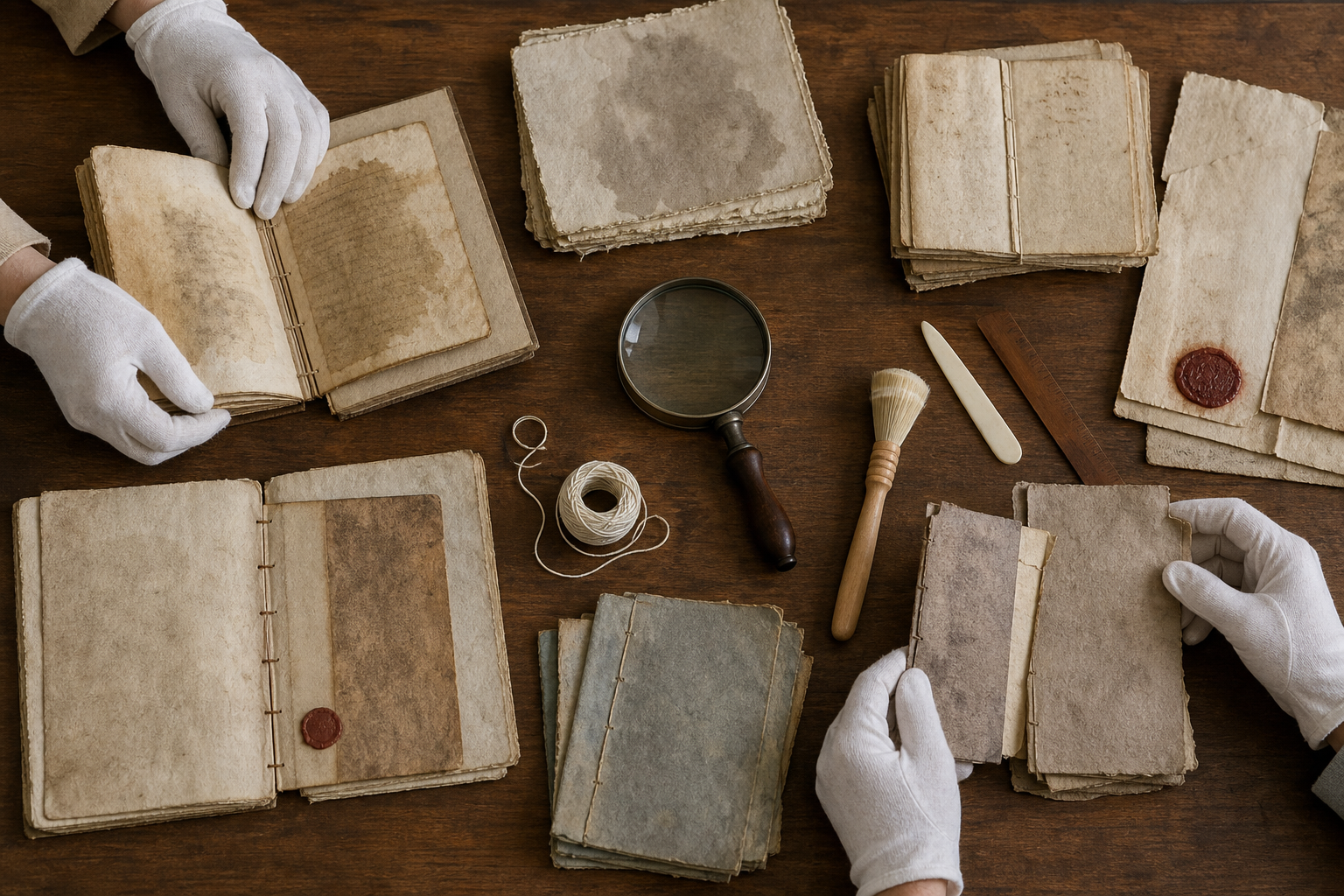
- Prepare a descriptive catalogue. Each unit should have its opening and closing lines, language, script, dimensions, apparent scribal hands, colophons, dates, marginal notes and associated names recorded. This reveals whether Ahilya Kamadhenu is one continuous composition or a collection with distinct parts.
- Create preservation-quality images. Images should retain page order, identifiers and colour references. Public access copies may be smaller, but scholars must be able to trace every image back to the physical leaf.
- Transcribe without hiding uncertainty. Damaged letters, illegible words, deletions, insertions and changes of hand should be marked. A smooth modernised text can be useful later, but it must not replace the evidence-bearing transcription.
- Publish translation beside the original. Readers should be able to compare the Marathi wording with the English or Hindi rendering. Terms carrying administrative or Dharmic meaning may require transliteration and a note rather than one deceptively simple English equivalent.
- Explain editorial decisions. If leaves are reordered, spellings normalised or passages assigned to different periods, the editor should state why. That apparatus is what lets another scholar test the conclusion instead of merely trusting it.
For you as a reader, the practical test is traceability. A credible claim should lead back to an identified volume and page or folio. If a striking sentence circulates without the original wording, location and surrounding passage, keep it in the category of an unverified attribution.
How to evaluate future claims about Ahilyabai’s governance
Once portions become accessible, begin with genre rather than ideology. Ask what kind of speech you are reading and who is speaking. Praise written about an exemplary ruler does not prove that every praised action occurred. A rule addressed to an official does not prove universal enforcement. An account of an administrative act may describe a particular dispute rather than a general policy.
Use these questions when a translation, lecture, video or social-media claim invokes Ahilya Kamadhenu:
- Where is the passage? Look for a volume and page or folio reference, not merely the manuscript’s title.
- What are the original words? Ask for the Marathi text and an explanation of key administrative or Dharmic terms.
- Who is the voice? Distinguish Ahilyabai, an official, a narrator, a compiler and a later commentator.
- Is the statement prescriptive or descriptive? A command, an ideal and a record of something done answer different historical questions.
- What is its scope? Determine whether the passage concerns one person, locality, office, dispute or institution before treating it as a rule for the whole Holkar state.
- Can other evidence corroborate it? Orders, accounts, correspondence, inscriptions and related records can help show whether a stated principle entered administrative practice.
A Dharmic reading should be equally disciplined. Dharma must not become a decorative synonym for every policy we admire. Look instead for the duties assigned to rulers, officials and subjects; the limits placed on power; the handling of justice and wealth; and the relationship between moral obligation and administrative procedure. Let the text define its categories before fitting it into a modern political slogan.
This discipline is not scepticism toward Ahilyabai. It is respect for her. Weak attribution makes a historical figure easier to dismiss, while a passage supported by provenance, transcription, context and corroboration can withstand scrutiny outside sympathetic circles.
Key takeaways
- Ahilya Kamadhenu is reported to be a substantial Marathi manuscript connected with Ahilyabai Holkar’s statecraft.
- Its reported age and long custody history make preservation and cataloguing urgent, but neither fact alone establishes authorship.
- Do not describe it as Ahilyabai’s own manual unless evidence of authorship, dictation or commission is published.
- A dependable governance claim needs the original wording, a precise location, a transparent translation and enough context to identify genre, speaker and scope.
- Digitisation protects access; transcription, critical editing and corroboration turn images into usable historical evidence.
For now, share the discovery with one careful sentence: a roughly 1,500-page Marathi work associated with Ahilyabai Holkar’s statecraft has reportedly been identified in Indore after long custody within a Rajpurohit family, while its dating, authorship and teachings await documented scholarly publication. Then watch for a catalogue and sample folios. Those will tell you far more than another confident summary.
References
