

If you saw the Preah Vihear demolition video and wondered whether it proves an anti-Hindu attack, a Thai state action, or something else, the honest answer is narrower: the destruction deserves a firm response, but the circulating images do not settle every question about responsibility, motive, or territorial authority.
You do not have to choose between defending a Vishnu murti and demanding accurate information. In a tense Cambodia-Thailand border zone, disciplined truthfulness is part of protecting both sacred heritage and human life.
Key takeaways
- The Lord Vishnu statue was installed in 2014 in the An Ses region, within a disputed border area near Preah Vihear.
- Visuals appeared to show the structure being demolished as Cambodia-Thailand tensions were rising.
- India condemned the demolition and urged dialogue, de-escalation, and protection of the region’s shared cultural heritage.
- The installation date does not make the murti religiously insignificant, but it also does not establish its archaeological age or legal status.
- A credible response should combine independent verification with a halt to further site alterations, joint documentation, neutral monitoring, and a clear cross-border code for cultural property.
Separate the incident from the claims surrounding it

The essential facts are serious enough without embellishment. A Vishnu statue installed in 2014 in An Ses became a flashpoint after images appeared to show its demolition in a contested area near Preah Vihear. India condemned what happened while calling on Cambodia and Thailand to resolve their differences through dialogue.
Several different claims are often compressed into one inflammatory caption. You should separate them before deciding what to repeat:
- The physical event: What exactly do the images show, and can the date and location be authenticated?
- The responsible actor: Who controlled the equipment, who was present, and who issued the instruction?
- The motive: Was the structure targeted because it represented Vishnu, altered because of a military or border decision, or removed for another stated reason?
- The territorial claim: Which government controlled the immediate location at that moment, and how does each side describe the site?
- The heritage status: Was the statue formally documented, protected, consecrated, or covered by any existing agreement?
A video can help establish that a physical act occurred. It cannot, by itself, prove who gave an order, why the order was given, or which territorial claim is lawful. Calling the event iconoclasm requires evidence of hostile religious intent; calling it harmless border administration ignores the sacred character of the object and the foreseeable injury caused by its destruction.
The responsible wording is therefore precise: visuals appear to show the demolition of a Vishnu statue in a disputed border area. Attribution, command responsibility, motive, and the site’s exact legal status require independent verification or a credible joint account. If you share the footage, preserve those distinctions in your caption.
A 2014 installation can still be sacred heritage
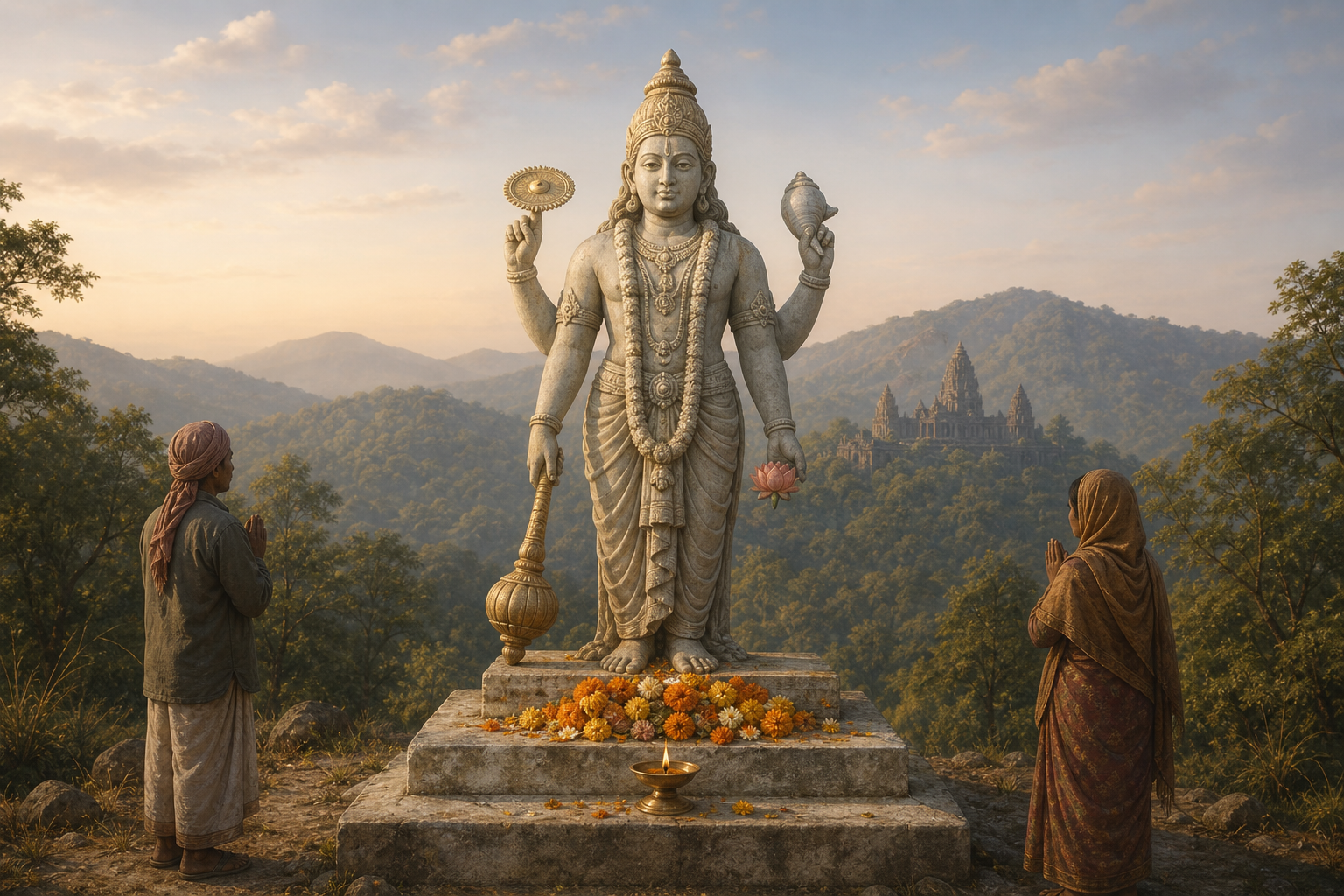
Some responses dismiss the loss because the statue was installed in 2014 rather than inherited in place from antiquity. That confuses age with meaning. A recently installed murti can become a focus of reverence, pilgrimage, communal memory, and cultural belonging. Its modern installation does not turn it into disposable scenery.
The opposite caution matters too. The 2014 date does not tell you when the object was made, whether consecration occurred, or whether it possessed a formal archaeological designation. Sacred significance, archaeological classification, and territorial ownership are three different questions. Defenders of the murti weaken their case when they claim evidence that is not yet available.
For a Hindu, Vishnu is not an interchangeable emblem of vague Asian spirituality. A murti may be approached as a sacred presence within a particular tradition of worship. Buddhists, Jains, and Sikhs do not relate to Vishnu through identical theology, and Dharmic solidarity does not require pretending otherwise. The common ground is a refusal to treat another community’s sacred forms as expendable tools of political rivalry.
Preah Vihear’s wider landscape carries intertwined Cambodian, Thai, Hindu, and Buddhist histories. That makes heritage protection more necessary, not less. A border may divide administrative authority, but it cannot neatly divide every layer of memory, architecture, devotion, and artistic inheritance found around it.
A Dharmic response must protect truth, people, and place
Outrage at desecration is understandable. What matters is how that outrage is disciplined. A Dharmic response can be tested against three duties.
- Truthfulness: State what is known, label what remains alleged, and correct captions that outrun the evidence. False certainty does not serve Vishnu.
- Ahimsa: Do not turn anger over a damaged sacred object into hatred against Thai or Cambodian people. Collective blame can feed the same border escalation that endangers temples, communities, and soldiers.
- Stewardship: Demand preservation of the location, records, fragments, photographs, and witness accounts. Heritage advocacy should seek conservation and accountability, not retaliatory destruction.
This framework also explains why diplomacy is not a timid response. India paired condemnation with a call for dialogue and protection of Hindu and Buddhist heritage across South and Southeast Asia. That combination rejects both indifference and uncontrolled escalation.
India does not need to decide the Cambodia-Thailand boundary in order to insist on a basic principle: disputed territory is not culturally empty territory. Interim arrangements should protect human life and sacred places while the underlying political disagreement is negotiated.
What a serious cross-border heritage protocol should require
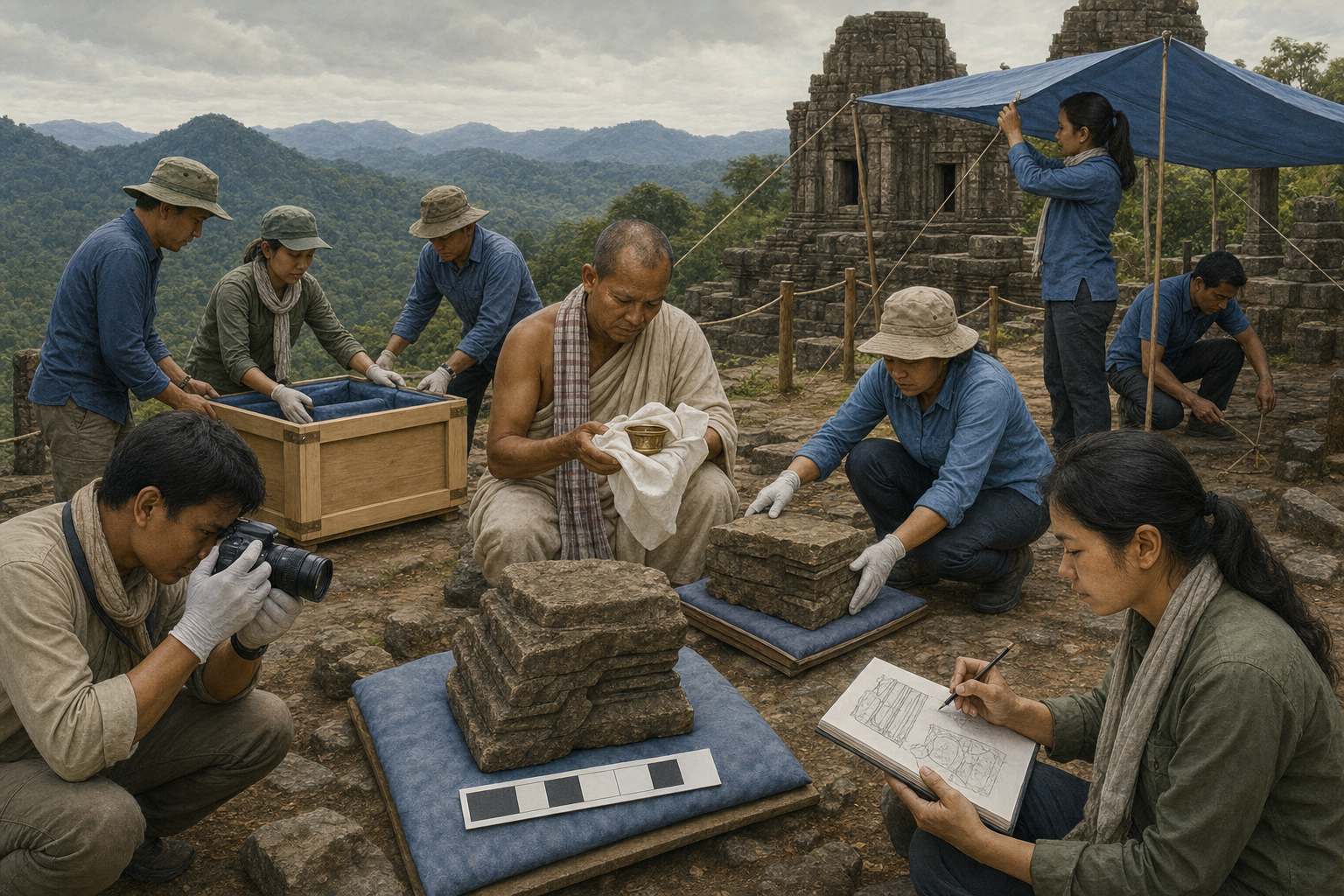
General appeals for respect will not prevent another demolition. Cambodia and Thailand need procedures that apply before the next crisis, when commanders, local officials, and equipment operators are under pressure. A workable interim protocol should include the following measures:
- A temporary no-alteration rule: Pause demolition, construction, earthmoving, relocation, and military reuse at identified cultural or sacred locations in contested areas, except where an immediate threat to life requires action.
- A shared site inventory: Record coordinates, photographs, known religious associations, physical condition, and the authority responsible for each location. Both sides should retain identical copies so that a later dispute cannot depend on one government’s archive.
- Professional assessment: Archaeologists and conservators should examine the site before debris is cleared or fragments are moved. Unsupervised removal can destroy physical evidence and make restoration harder.
- Community representation: Local religious and community representatives should be consulted alongside border and heritage officials. A government inventory may record dimensions while missing how a place is actually revered.
- Neutral monitoring: Where bilateral trust is insufficient, a mutually accepted observer should document site conditions and compliance with the temporary protections.
- A cultural-property code of conduct: Border personnel need explicit instructions covering sacred structures, statues, archaeological material, archives, and recovered fragments. The rules should identify who can authorize an intervention and how an emergency action must be documented.
- A remedial process: Once the facts are established, qualified professionals should determine what can be conserved or restored. Any rebuilding or reinstallation should involve the relevant communities rather than becoming another unilateral political gesture.
These measures do more than protect stone and sculpture. Joint documentation creates a common factual record. A moratorium reduces the chance that one alteration will provoke another. Community participation makes it harder for sacred meaning to disappear behind bureaucratic language. Neutral monitoring gives both governments a way to step back without appearing to surrender their territorial positions.
None of this requires postponing heritage protection until a final border settlement. In fact, waiting for a comprehensive settlement is the dangerous choice. Cultural assets can be damaged in minutes, while boundary negotiations may remain unresolved for far longer. Protection must operate during the dispute, not only after it.
How you can advocate without worsening the dispute
Your most useful contribution is not the angriest caption. It is a request that officials can answer and institutions can act upon.
- Use calibrated language: Say that visuals appear to show the demolition. Do not present an unverified chain of command or religious motive as settled fact.
- Keep the location and date attached: Identify An Ses, the Preah Vihear border context, and the statue’s 2014 installation. Detached clips are easier to mislabel and harder to verify.
- Ask for specific outcomes: Request independent verification, a joint public account, a halt to further alterations, professional documentation, and a bilateral cultural-property protocol.
- Address institutions rather than alleged individuals: Contact foreign ministries, diplomatic missions, heritage authorities, and credible cultural organizations. Do not dox, threaten, or encourage harassment of people identified from an unauthenticated clip.
- Support preservation: Favor efforts that document the site, protect any remaining material, and involve local communities. Retaliatory rhetoric may generate attention, but it does not conserve a single fragment.
A concise message can ask both governments to preserve the location, permit professional assessment, publish the factual basis for the demolition, and adopt a temporary ban on alterations to sacred or cultural sites in contested zones. That is harder to dismiss than a message built around collective blame.
The next useful step is immediate and modest: correct one overclaimed caption, send one evidence-based request to an appropriate institution, or support one credible preservation effort. Defending Vishnu’s image with truth, restraint, and determined stewardship is not a diluted response. It is the response most likely to protect the next sacred place before machinery reaches it.
References
