
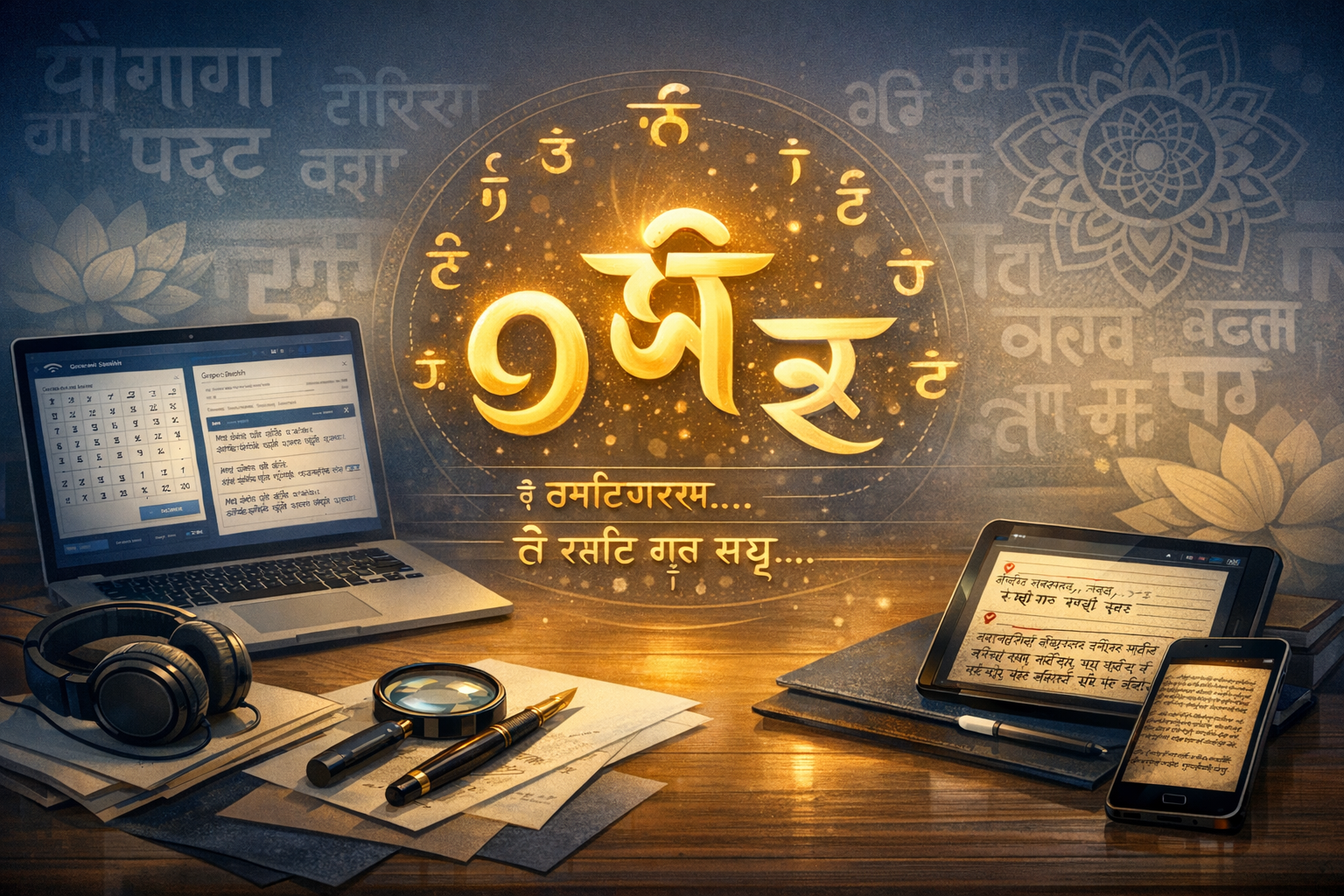
Gurmukhī Classes at atTheBunga present a rigorous, research-informed pathway to script mastery, Gurbani fluency, and digital literacy, designed for learners across the dharmic spectrumHinduism, Buddhism, Jainism, and Sikhismwho wish to engage Punjabi and Sikh heritage texts with accuracy and respect. The program emphasizes linguistic precision, historical context, and technological competence so that participants can read, understand, and preserve sacred and literary traditions while fostering unity in diversity.
Gurmukhī, standardized in the 16th century and associated in scholarly consensus with Guru Angad, descends from mercantile Laṇḍā lineages. It is the principal script of Punjabi in East Punjab and the canonical script of the Sikh tradition, used to transmit the Guru Granth Sahib, Dasam Granth traditions, and a broad corpus of Punjabi literature. Its development intersects with shared cultural space in North India, where scripts and languages moved across communities of Hindus, Buddhists, Jains, and Sikhs, making Gurmukhī study an inclusive act of cultural continuity rather than a sectarian boundary.
The curriculum at atTheBunga is outcome-driven: learners acquire accurate letter–sound mapping, confident decoding of continuous Gurbani (“larivaar”) and segmented text (“padh-ched”), correct handling of nasalization and gemination, a working awareness of Punjabi tone in reading, and command of Unicode-based input, search, and corpus tools. Graduates are prepared to read Japji Sahib, Anand Sahib, Sukhmani Sahib, Rehras Sahib, and other texts without transliteration crutches, while understanding script conventions that support clarity, humility, and reverent practice.
Foundations begin with the paintī akhar (35 basic letters) and the three vowel carriersੳ (ura), ਅ (aira), ੲ (iri)which host dependent vowel signs in syllable-initial positions. Dependent vowels (mātrās) such as ा (kannā), ਿ (sihari), ੀ (bihari), ੁ (onkar), ੂ (dulainkar), ੇ (laav), ੈ (dulaav), ੋ (hora), and ੌ (kanora) are introduced with minimal pairs and graded readers to embed letter–sound automaticity. Early work stresses accurate stroke order, spacing, and eye-voice span so that subvocalization patterns support fluent, respectful recitation.
Orthographic essentials include nasalization and length. The tippi (ੰ) and bindī (ਂ) mark nasalization patterns in complementary distribution contexts; addak (ੱ) signals gemination and must be read without over-lengthening the following vowel. Learners also meet the nukta (਼) extensionsਖ਼, ਗ਼, ਜ਼, ਫ਼, and ਲ਼used for Perso-Arabic borrowings and regionally marked phonemes. Consonant clustering relies on limited subjoined (pairī) formscommonly for ਹ, ਰ, ਵ, and ਯrather than the extensive conjunct ligatures found in scripts such as Devanagari, keeping the writing system transparent and beginner-friendly.
Punjabi is lexical-tonal, and while tone is not overtly marked in everyday Gurmukhī, historical processes (including the loss of voiced aspirates and orthographic use of ਹ) condition predictable tonal patterns. Instruction employs audio exemplars, minimal pairs, and recitation drills to cultivate tonal sensitivity that respects traditional paṭh and kīrtan aesthetics. This attention to sound supports accurate Gurbani reading that honors the phonology of Punjabi while preserving the semantic and devotional integrity of the shabad.
Learners study historical and contemporary layout standards: larivaar (continuous script) nurtures concentration and holistic phrase parsing, while padh-ched (word-separated) eases entry for new readers and supports teaching. Both formats are approached with humility and care, emphasizing textual fidelity and the interpretive prudence expected in sacred study.
Numerals (੦–੯) and contemporary punctuation practices are covered, including legacy danda usage in older prints and modern adoption of global punctuation conventions. Attention is given to typography, line breaks, hyphenation, and diacritic placement to avoid misreadings in both liturgical and secular texts.
A dedicated digital track builds robust script technology skills. The Unicode Gurmukhi block (U+0A00–U+0A7F), normalization, and font selection (for example, Raavi, Saab, Noto Sans Gurmukhi) are taught alongside keyboarding options (INSCRIPT, phonetic layouts, and mobile IMEs). The course details safe migration from legacy, non-Unicode fonts (such as older Anmol/Chanakya encodings) to standards-compliant text, preventing data loss, search failures, and broken archives.
Applied digital humanities methods enable learners to query Gurbani corpora responsibly, annotate morphology, and run concordances. OCR tools (for example, Tesseract Gurmukhi models) and proofreading workflows are introduced for digitizing older gutkās, sāhitya, and community newsletters. Students are guided to maintain metadata integrity, use version control for transcriptions, and respect intellectual property and community norms.
Pedagogy is anchored in cognitive science: spaced repetition for akhar–sound links; interleaving matra families for durable discrimination; retrieval practice via dictation; and contrastive analysis with near-neighbor glyphs to reduce visual confusion. Reading fluency grows through graduated texts, from phonics readers to pauris and shabads selected for clear scaffolding, culminating in independent reading with light commentary.
Assessment is transparent and constructive. Baseline diagnostics identify letter–sound gaps and matra stability; mid-course checks track words-per-minute, error profiles (nasalization, addak, matra slips), and tonal alignment in recitation; final assessments combine timed reading, dictation with diacritics, and a short exegesis task that demonstrates comprehension and reverence for context. Rubrics privilege accuracy, steadiness, and humility over speed.
A prototypical 12-week core sequence includes: Weeks 1–4: paintī akhar, vowel carriers, and high-frequency mātrās with minimal pairs; Weeks 5–8: nasalization, addak, pairī forms, and graded passages; Weeks 9–12: larivaar and padh-ched navigation, tonal awareness in recitation, and an applied digital assignment (input methods, search, and citations). Extensions add paleography, calligraphy, and corpus annotation for those pursuing advanced competence.
Cross-script literacy modules place Gurmukhī in conversation with Devanagari, Śāradā/Takrī heritages, and Shahmukhī (Perso-Arabic script for Punjabi) to promote mutual intelligibility across communities. Comparative exercises help learners map cognates and script conventions without privileging a single pathway, reinforcing the dharmic ideal that many authentic paths coexist in harmony.
Gurbani grammar (vyākaraṇa) and register are introduced at an appropriate depth: learners meet frequent function words, compounds, and the Sant Bhāṣā continuum spanning Sanskritic and Prakritic lexicons. Reference works, such as Mahan Kosh (Bhai Kahn Singh Nabha) and standard Gurbani grammar primers, are used to cultivate disciplined reading and etymological curiosity.
Participants consistently report a profound shift when they first read Japji Sahib unaided: comprehension widens, pronunciation settles, and memory anchors lines more naturally. In reflective sessions, adult heritage learners describe feeling more connected to elders, while younger learners express pride in being able to decode inscriptions in gurdwaras and community librariesexperiences that bind families and communities across the broader dharmic fabric.
Accessibility is built in: print-friendly handouts use dyslexia-aware spacing and generous line height; mobile-first readers allow commuting practice; and bilingual explanations reduce cognitive load during early lessons. Diaspora cohorts benefit from time-zone sensitive scheduling and optional pronunciation clinics that accommodate a range of backgrounds from first exposure to partial familiarity.
Ethical study practices are emphasized throughout: textual fidelity, respectful handling of sacred names, and an ethos of service to language and community. The classes cultivate appreciation for Sikh tradition while welcoming learners from all dharmic lineages, positioning script study as a shared endeavor in cultural preservation rather than as a vehicle for religious competition.
Recommended preparatory materials include letter charts with stroke-order cues, curated audio recitations for tonal modeling, and frequency lists drawn from commonly read paths to accelerate early wins. As fluency grows, learners transition from transliteration to script-first reading, using transliteration only as a temporary scaffold.
By uniting careful orthographic training, tonal and grammatical sensitivity, and robust digital skills, atTheBunga equips learners to approach Gurmukhī texts with clarity, devotion, and scholarly responsibility. The result is practical literacy that strengthens community memory, preserves a living script tradition, and deepens bonds among Hindus, Buddhists, Jains, and Sikhs who share the cultural landscapes of the subcontinent.
Inspired by this post on SikhNet – News.
