
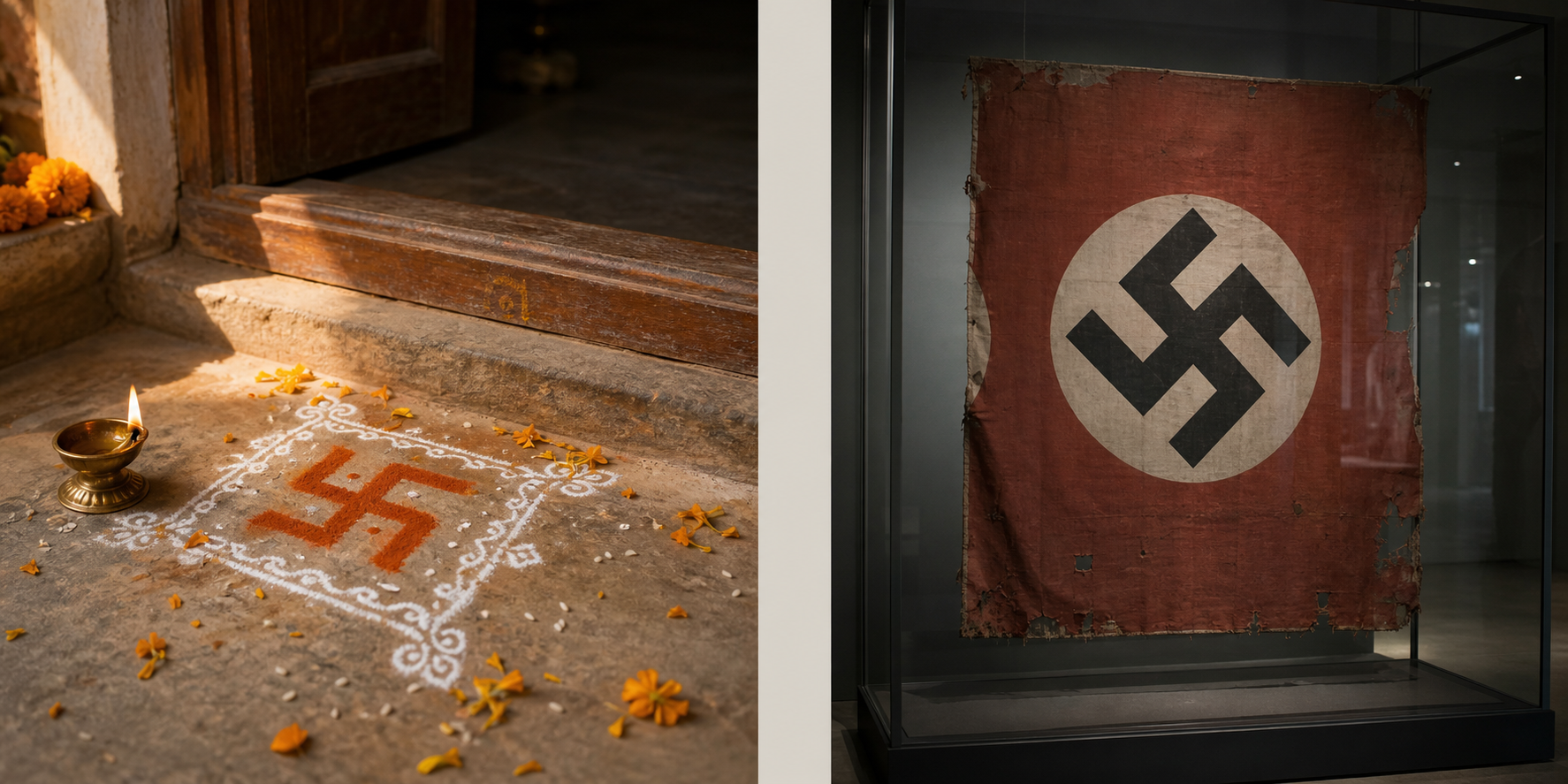
You see a hooked-cross form in a news report, a classroom, a workplace complaint, or a family ritual, and you need to choose a word. The wrong choice can either obscure Nazi hatred or brand a sacred Dharmic practice as hateful.
Use this working rule: call the ancient auspicious symbol the Swastika, and call the Nazi emblem the Hakenkreuz or Nazi Hakenkreuz. Then verify the context before deciding which one you are looking at. You can oppose antisemitism clearly without making Hindu, Buddhist, and Jain traditions collateral damage.
The two terms identify different cultural meanings

Swastika and Hakenkreuz should not be treated as interchangeable names for one cultural object. A visual resemblance exists, but resemblance alone does not erase origin, purpose, use, or meaning.
The Swastika has carried meanings of auspiciousness, well-being, and good fortune for millennia. It remains part of living Hindu, Buddhist, and Jain practice. It can appear on temple thresholds, ritual altars, wedding mandaps, household doorways, and festive rangoli. In these settings, it is not a reference to twentieth-century European politics. It is a sacred and cultural sign used to invoke what is good.
Hakenkreuz means hooked cross and was the German name used by Hitler and the Nazi Party for their emblem. Western reporting during the 1920s also used Hakenkreuz when referring to the Nazi symbol. When the intended referent is Nazism, the term Nazi Hakenkreuz names that history directly and leaves no doubt about what is being condemned.
| What you are identifying | Term to use | Reason |
|---|---|---|
| An auspicious emblem in Hindu, Buddhist, or Jain life | Swastika | Names the symbol within its ancient and continuing sacred context |
| Hitler’s or the Nazi Party’s emblem | Nazi Hakenkreuz on first mention; Hakenkreuz thereafter | Names the Nazi referent without transferring its guilt to Dharmic traditions |
| An image whose setting and purpose are unknown | Hooked-cross form, pending verification | Avoids both a premature accusation and premature exoneration |
You may still encounter the familiar phrase Nazi swastika. Familiarity does not make it the clearest wording. If your subject is Nazi ideology, say Nazi Hakenkreuz. If your subject is a sacred Dharmic symbol, say Swastika. Capitalization can reinforce that editorial distinction, but it cannot replace contextual judgment.
Read the setting before you label the symbol

Do not reduce identification to an angle, rotation, or other single graphic feature. A symbol communicates through its setting, the person using it, the surrounding words, and the audience toward whom it is directed. The caption and circumstances often tell you more than the geometry alone.
- Look at the physical setting. A temple entrance, prayer altar, mandap, rangoli, festival decoration, or family doorway strongly indicates a sacred Swastika context.
- Read the surrounding message. Nazi slogans, praise for Hitler, antisemitic abuse, Nazi merchandise, or racial intimidation indicate the Hakenkreuz and its associated ideology.
- Identify the person or institution using it. A Hindu family marking an auspicious occasion, a Buddhist community displaying traditional imagery, and a Nazi sympathizer making a threat are not performing the same act.
- Check provenance. A ritual object or established Dharmic practice cannot responsibly be interpreted only through the later history of Nazi appropriation.
- Describe uncertainty honestly. If an isolated image gives you no reliable context, do not assign motive. Record where it appeared, what accompanied it, and how the person displaying it explained its use before choosing a culturally loaded label.
Context is not an excuse for hostility. If someone deploys the form with antisemitic language or to menace a Jewish person, the conduct and message establish a hateful use regardless of any evasive claim about ancient symbolism. The converse also matters: a sacred household or temple display does not become an act of hate merely because an observer knows only the Nazi association.
Accuracy protects Jewish safety and Dharmic dignity together

This is not a choice between condemning antisemitism and defending Dharmic heritage. Call the Nazi Hakenkreuz what it is, condemn the ideology attached to it, and protect Jewish people from intimidation. At the same time, refuse to redefine an ancient sacred Swastika as if Nazism had acquired permanent ownership of it.
Calling every Swastika a hate emblem has practical consequences. It can turn a wedding mandap, rangoli, temple threshold, or prayer space into presumed evidence of extremism. Families can be pressured to hide ordinary religious expression, while children may be taught that something sacred in their home is inherently shameful. That is not responsible anti-hate education; it is cultural misidentification.
The reverse error is just as avoidable. When imagery is used to promote Hitler, Nazism, or antisemitic hostility, do not invoke the Swastika’s antiquity to blur the offender’s message. Name the Nazi Hakenkreuz and the hatred surrounding it directly. Precision should sharpen moral judgment, not weaken it.
The sacred-use claim is specific to traditions in which the Swastika has that living role, especially Hinduism, Buddhism, and Jainism. Sikhs can stand within the wider Dharmic commitment to protect sacred symbols and religious dignity without requiring us to pretend that every Dharmic community uses every symbol identically. Solidarity becomes stronger when it respects differences rather than flattening them.
The distinction has also entered public policy. Virginia’s statutory language and California’s AB 2282 formally acknowledge the need to distinguish the sacred symbol from Nazi use. Parliamentary action involving Canada’s Bill C-9 has addressed the same concern. Design-historical discussion has likewise explained why context changes the identification of the form.
These examples are precedents for careful language, not a universal legal test. If you are drafting a policy, responding to a formal complaint, or assessing possible legal consequences, read the controlling text in your own jurisdiction and obtain qualified legal advice where needed. Using the right term improves the analysis, but terminology alone does not decide liability.
How to request a correction that fixes the real error
A useful correction does more than object to an offensive word. It identifies the referent, supplies the accurate replacement, and explains why the change matters. That gives an editor, teacher, employer, or platform moderator a clear action to take.
- Preserve the exact wording. Save the headline, caption, policy clause, or statement and note where it appeared. Do not rely on a paraphrase when one word is the dispute.
- Identify the depicted context. State whether the material concerns the Nazi Party and antisemitism or a Hindu, Buddhist, or Jain religious setting.
- Ask for one precise replacement. If the referent is Nazi, request Nazi Hakenkreuz. If it is sacred, request Swastika and an accurate description of its tradition.
- Explain the consequence briefly. Say that conflation stigmatizes living Dharmic practice while obscuring the Nazi emblem’s own historical name.
- Supply a focused reference. A concise terminology explanation or educational resource on the Swastika is more useful than a large bundle of unrelated links.
- Match the correction to the original reach. When the error appeared publicly, ask for a visible public correction. A silent change may fix future reading but does not address the false wording already circulated.
For a news report about Nazi imagery, you can write: The emblem in this passage should be identified as the Nazi Hakenkreuz, not as the sacred Swastika. Please correct the term and add a brief distinction so readers do not mistake Hindu, Buddhist, or Jain religious use for Nazi symbolism.
For a school or museum label in a Dharmic setting, use: Swastika, an ancient auspicious symbol used in Hindu, Buddhist, and Jain traditions. For an object explicitly associated with Hitler or the Nazi Party, use: Nazi Hakenkreuz, the hooked-cross emblem of the Nazi movement.
For a workplace or platform rule, focus on conduct and context. Distinguish Nazi advocacy, antisemitic intimidation, and other hateful deployment from bona fide religious or cultural display. A blanket ban on an undifferentiated shape invites moderators to punish the very communities whose traditions predate the Nazi movement.
Key takeaways
- Use Swastika for the ancient auspicious symbol in Hindu, Buddhist, and Jain traditions.
- Use Nazi Hakenkreuz for Hitler’s and the Nazi Party’s emblem, then shorten it to Hakenkreuz after the first mention.
- Determine meaning from setting, message, user, audience, and provenance rather than from one visual feature.
- Condemn Nazi and antisemitic use plainly without transferring that condemnation to sacred Dharmic practice.
- When correcting a public error, quote the wording, request an exact replacement, give one concise reason, and ask for a correction with comparable visibility.
The next time this symbol appears in front of you, pause before repeating the first label you have heard. Establish the context, name the referent accurately, and make the correction specific enough that someone can act on it. That small discipline protects historical truth, Jewish safety, Dharmic religious freedom, and the possibility of honest interfaith respect.
References
- CoHNA – CoHNA Demands Correction: Ye’s WSJ Apology Mislabels Swastika as Hakenkreuz
- CoHNA – Hakenkreuz, Not Swastika
- CoHNA – Swastika educational resources
- Virginia Law – Code Section 18.2-423.1
- LegiScan – California AB 2282 bill text
- CoHNA – Bill C-9 amendment
- PRINT Magazine – When Is a Swastika Not a Hate Symbol?
